
Most American "Mexican kitchen" inspiration stops at saltillo floors and a single row of talavera behind the cooktop. The vocabulary is bigger than that. A masonry counter built into the wall. A nicho carved between the studs for the espresso machine. A copper sink left unlacquered so it actually ages into something. These eleven ideas pull from kitchens in San Miguel de Allende, Mérida, Pátzcuaro, and the rural cocinas of Michoacán, with the products, prices, and construction details most pinboards skip.
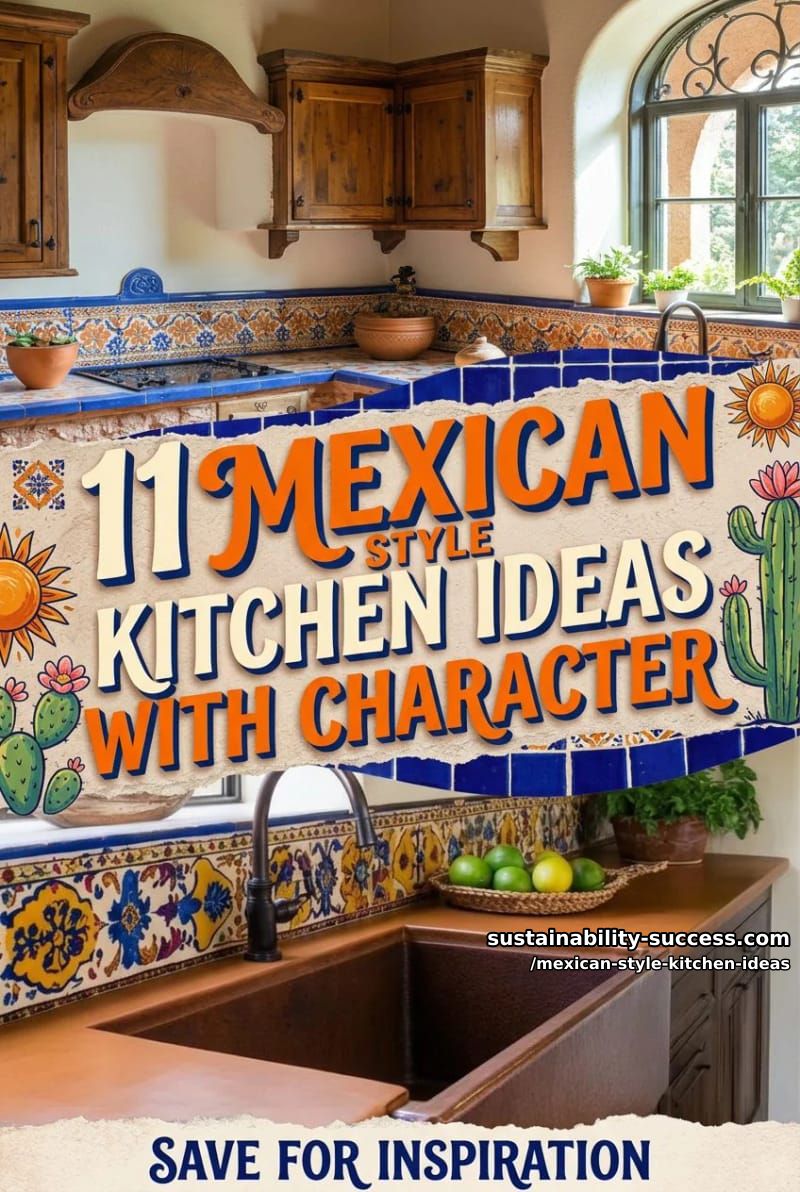
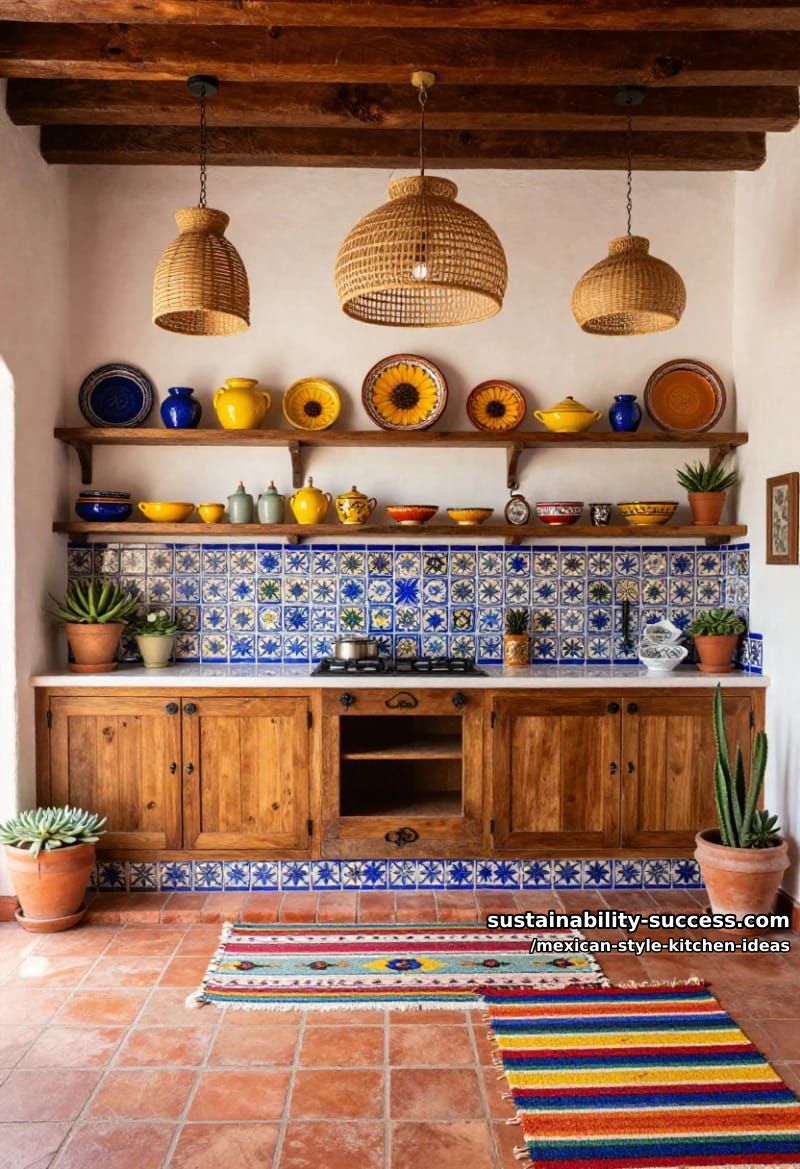
1. A real talavera backsplash, not the printed lookalike

Real certified Talavera comes from Puebla (and nearby communities in the states of Puebla and Tlaxcala). Dolores Hidalgo, in the state of Guanajuato, produces similar handmade ceramic tile that is legally classified as Majolica , Mexico’s Talavera Denomination of Origin, established in 1997, covers only Puebla and Tlaxcala; Guanajuato’s petition to share the designation was specifically denied. It does not look like the printed porcelain "talavera-style" tile from the big box stores, and once you've seen the difference you can't unsee it. Each tile is hand-cut from local red clay, screened, glazed, and fired. You'll see brushstrokes. The tiles won't be the same size. Plan for that: grout joints from 1/8 inch to 1/4 inch absorb the variation, and accept ± 1/4 inch of deviation on joint alignment and leveling.
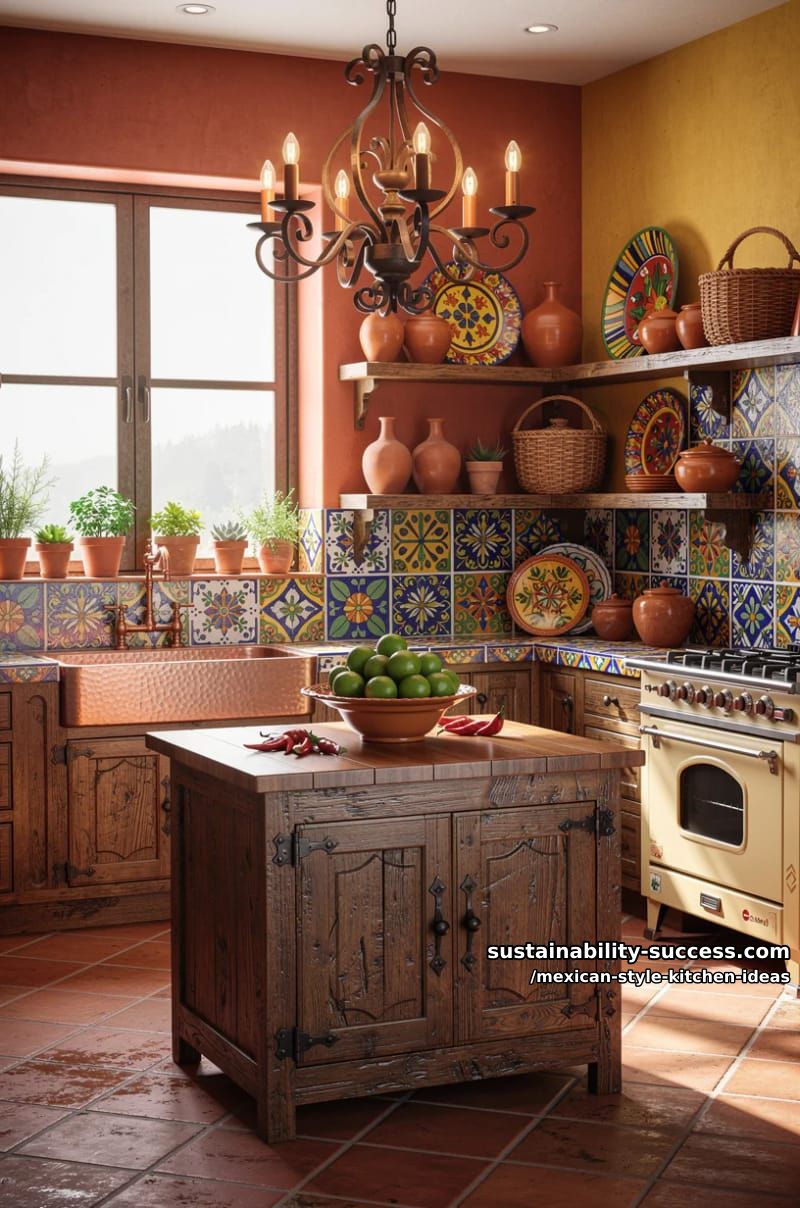
For a standard 30-square-foot backsplash, order roughly 100 tiles plus 15% overage. Mix one bold patterned design with two coordinating solids in cobalt and cream, set in a calm 3-tile-to-1-pattern ratio so the wall reads composed instead of busy. The printed PVC peel-and-stick versions sold as "talavera" wrinkle around outlets within a year. Skip them.

A 100-piece pack of genuine hand-painted Puebla tiles is what you actually need to cover a full backsplash run, with enough design variety to mix your own pattern.

2. A carved nicho as a built-in coffee bar

A nicho is the small recessed wall niche you see all over colonial Mexican architecture, traditionally holding a santo or a bowl of fruit. Put one in a kitchen and it earns its place as a coffee station , espresso machine, two cups, a tin of beans, nothing else cluttering the counter. The standard depth is 14 inches, which fits between standard 2×4 wall studs without re-framing if you keep the opening inside two stud bays (roughly 30 inches wide).

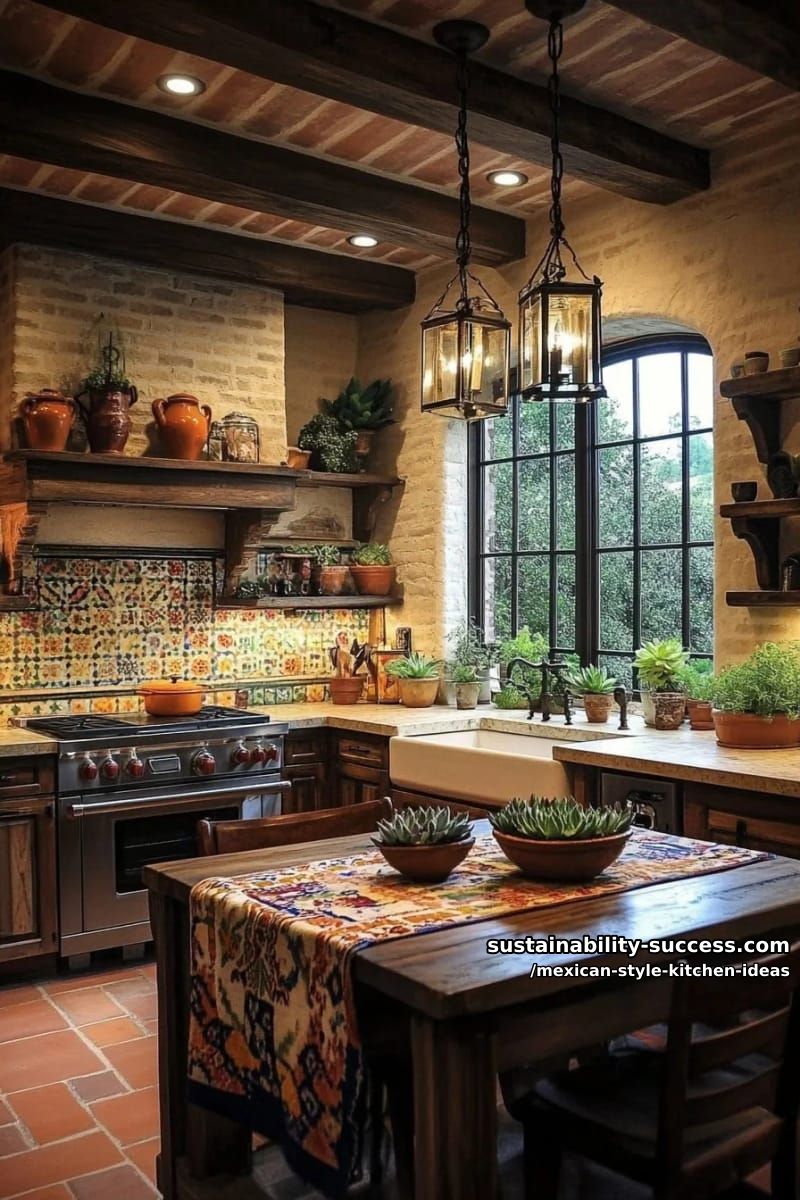
The shape is the whole thing. A rounded-shoulder arch carved freehand into the plaster reads like a real nicho. A perfectly geometric rectangle reads like a Restoration Hardware shelf cubby. If your drywall installer wants to cut it with a router and call it a day, don't let him , get a plasterer to round the inside corners, break the edge slightly, and finish the interior in the same lime wash as the surrounding wall. Budget $400 to $900 for custom carving and plastering if you're hiring it out.

A nicho lit by a small LED puck on the inside top edge looks beautiful at night. A nicho with the back finished in glossy paint over fresh joint compound looks like an HVAC return. Use lime plaster, Roman clay, or limewash on the interior , never satin latex.
3. A hammered copper sink, with the patina left alone

The copper sink is the most-stolen Mexican kitchen idea in North America, and three quarters of the ones sold on Amazon are too thin. 16-gauge solid copper, hand-hammered, lifetime warranty , that's the spec that holds up, because the gauge is heavy enough to resist denting and the finish won't go green with normal indoor use. Anything thinner dents when you drop a cast-iron skillet, and a dent in copper is permanent. I used to recommend the Premier Copper Products budget line. Two years of client feedback later, I stopped.

The other mistake is buying a lacquered copper sink. The lacquer eventually wears through in patches and the sink looks blotchy. Buy unlacquered, wipe it dry after each use for the first month, let the patina darken on its own. Sinkology's Courbet is the cleanest 30-inch apron front I've installed , the apron makes the sink a focal point, and the rough opening is a standard 33-inch base cabinet, which means you don't have to redesign the run around it.

Solid 16-gauge copper, the right size for a standard 33-inch sink base, and the antique finish darkens beautifully if you skip the wax for a few months.

4. Cobalt lower cabinets, lime-washed cream uppers

The two-tone cobalt-and-cream kitchen is everywhere on Pinterest right now, which is exactly why most of them look the same. Specificity in three places fixes it. Pick a real cobalt with green undertones , Benjamin Moore Champion Cobalt 2061-20 or Farrow & Ball Drawing Room Blue 253. Use an actual lime wash on the uppers instead of trying to fake plaster texture with regular paint. Keep the cabinet style inset shaker with a slightly chunky 1-inch rail. Slab cobalt reads as IKEA every time.

Do this
- Real mineral lime wash on the upper walls , Romabio Classico or Bauwerk, two coats, the second coat broken up with a damp brush so the cloudiness reads as plaster instead of paint.
- Brass hardware. Unlacquered if you can find it, aged if you can’t. Polished chrome fights the palette.
- Paint the cabinet interiors the same cobalt. Bare oak insides break the volume.
Avoid
- Sage green sold as the “softer” Mexican option. It reads English country. If you want softer, go marigold or pale terracotta.
- Cobalt on the uppers too , the eye needs the cream plaster to breathe.
- The 10-pack “talavera-inspired” knobs from Wayfair. Plain forged iron or aged brass, and let the backsplash do the color.
5. A cocina integral: the masonry counter wall
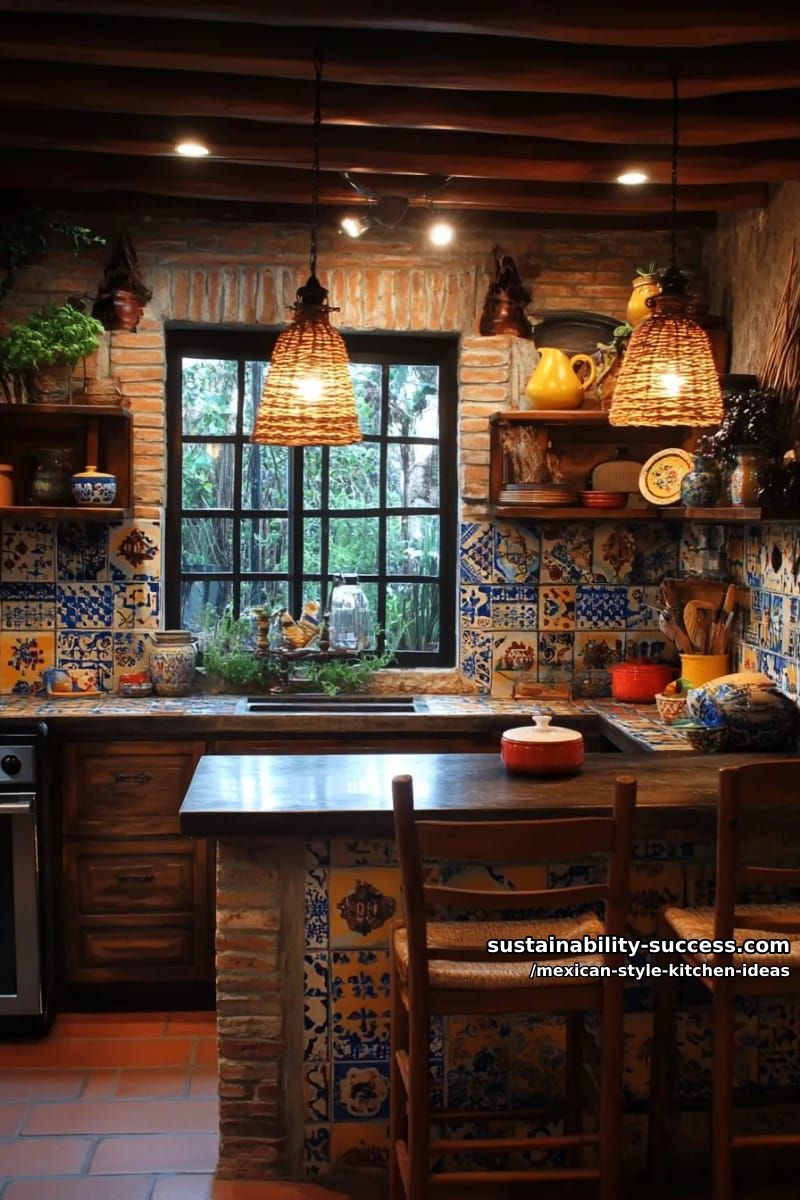
This is the idea I keep coming back to, and the one almost no American adaptation will commit to, because it requires giving up upper cabinets entirely. A cocina integral is a single masonry counter built against the wall, parged with cement, finished with tile across both the top and the apron, with the cooktop, sink, and storage integrated into the masonry mass itself. You see it in older homes throughout Michoacán and Oaxaca, and in restored haciendas where the original kitchen has been preserved instead of ripped out.
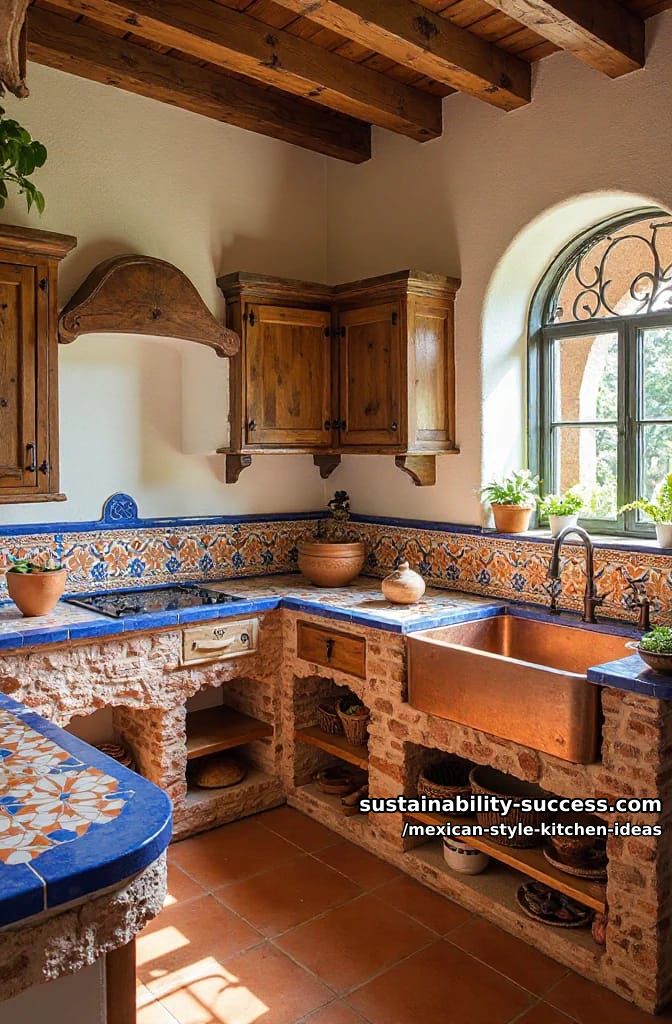
What makes it work in a contemporary American build is the proportion and the weight. A 36-inch finished counter height with a 30-inch counter depth gives you generous workspace. The apron , the vertical face you see from the room , gets the same tile treatment as the top, which means a continuous wash of pattern from the floor up. Above sits open shelving, never upper cabinets. The whole thing reads heavy, low, grounded. It looks like furniture that was poured rather than installed, which is essentially what it is.
The catch: it’s permanent. You don’t move a cocina integral the way you move a base cabinet. The plumbing and the gas have to be right the first time, and the tile selection has to be one you’re going to love in a decade. That’s the trade.

Core: standard concrete masonry units (CMU) or solid brick, dry-stacked to 35 inches finished height. The mass is the point , this is not a cabinet.
Parge coat: 1/2-inch type S mortar over the masonry, wood-floated smooth, with bullnose returns at the apron edges.
Top substrate: 3/4-inch cement backerboard mortared to the parge coat, then a layer of 1/4-inch backerboard for the tile bed.
Tile field: 4×4 talavera on the top and apron with a hand-cut bullnose at every edge. Unsanded grout for joints under 1/4 inch, sanded for wider.
Cooktop cutout: rough opening 1 inch larger than the stovetop spec on every side, with a continuous bead of high-temp silicone between the tile and the cooktop flange.
6. Saltillo floors with a petatillo brick threshold
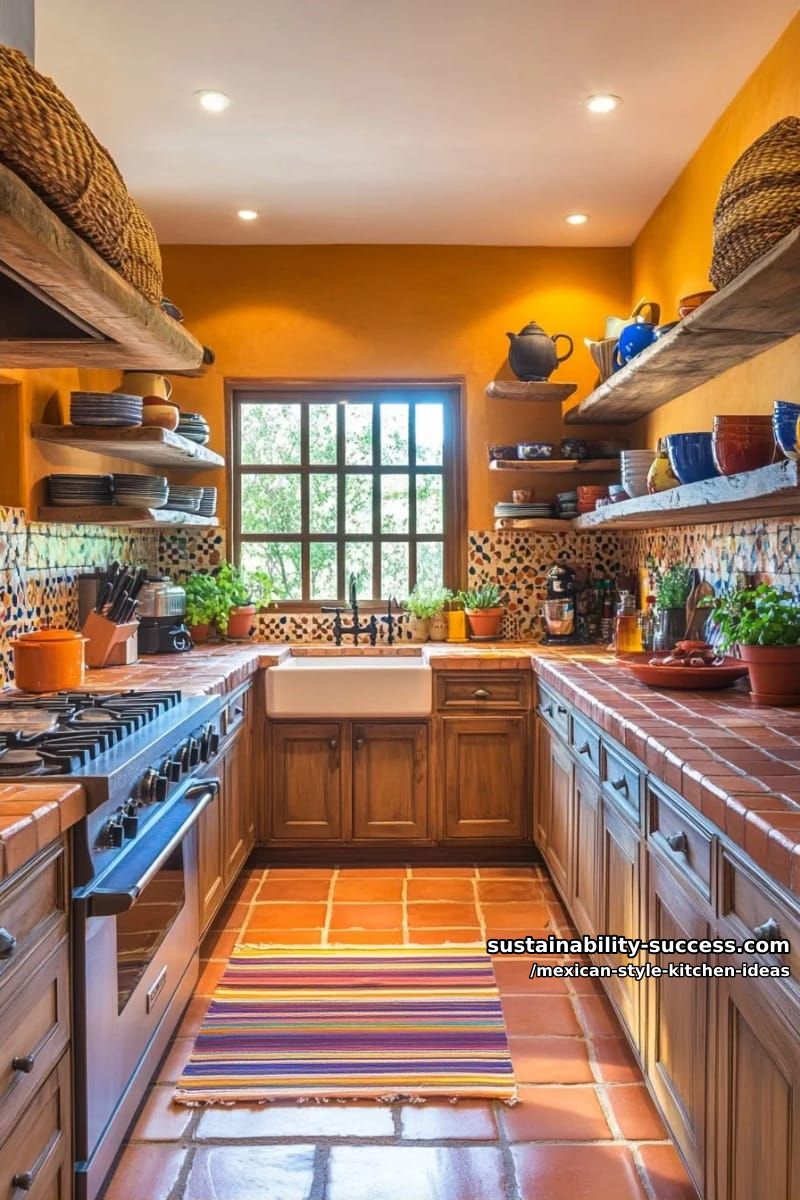
Saltillo squares wall to wall can read flat. The Mexican move is to break up the field with a petatillo border , small handmade bricks laid in a tight herringbone, usually running across a threshold or framing a cooktop alcove. Saltillo runs about $3 to $10 per square foot for the tile itself, and you should expect to order 15 to 20 percent overage on jobs using 12-inch and smaller pieces. Avoid the pre-sealed factory tiles. The pre-seal looks plasticky, and the corners chip within two years anywhere the stools get dragged.
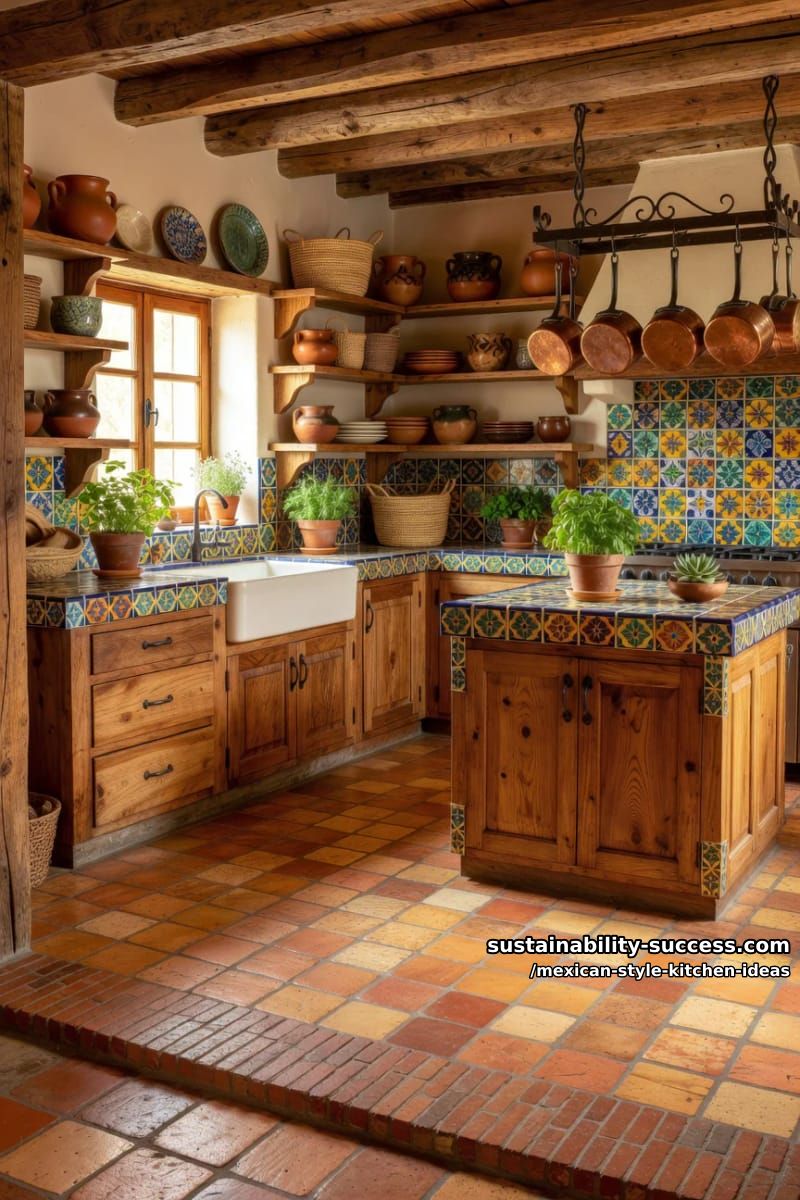
What nobody tells you on the front end: large saltillo tiles, especially the classic squares, take very wide grout joints , 3/4 inch, sometimes a full inch , and keeping widely-spaced tiles in alignment is much harder than aligning tiles with thin joints. Hire someone who has installed saltillo before, not just "tile."
| Floor option | Look | Price (material) | Sealing |
|---|---|---|---|
| Classic 12×12 saltillo | Warm orange, slightly irregular, the default | $3 to $6 / sf | 2 coats penetrating, then 1 topical |
| San Felipe arabesque saltillo | Curvy Moorish pattern, dressier | $6 to $10 / sf | Same; harder to lay flat |
| Petatillo herringbone brick | Small bricks, tight pattern, used as a border or whole floor | $4 to $8 / sf | Penetrating only; avoid topical gloss |
| Pasta (encaustic) cement tile | Bold geometric color, factory-flat | $8 to $15 / sf | Must be sealed before grouting |
7. A curved lime-plaster range hood
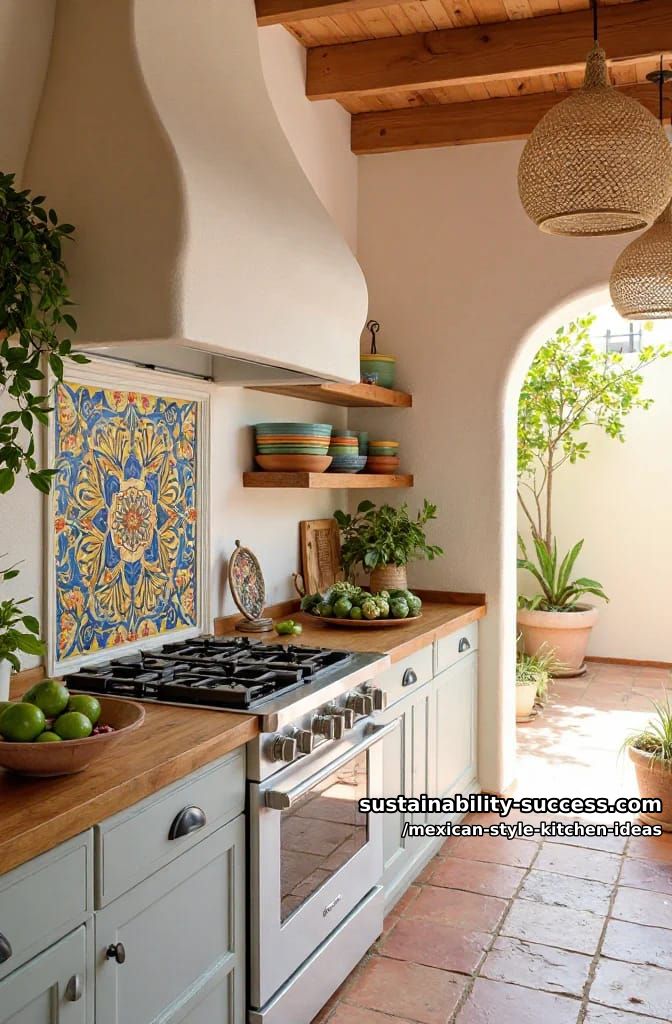
The plaster hood , smooth, curved, rounded at the shoulders instead of squared off , is the single piece of a Mexican kitchen that most contractors get wrong. They build a drywall box, skim it with joint compound, paint it eggshell, and call it Spanish. It looks like a hotel-lobby chimney. The fix is real lime plaster (American Clay or Romabio Stucco Veneziano) trowel-applied over cement backerboard, with the corners shaped by hand to a soft 4-inch radius. Budget $1,500 to $3,500 for the build and plaster depending on size and access.
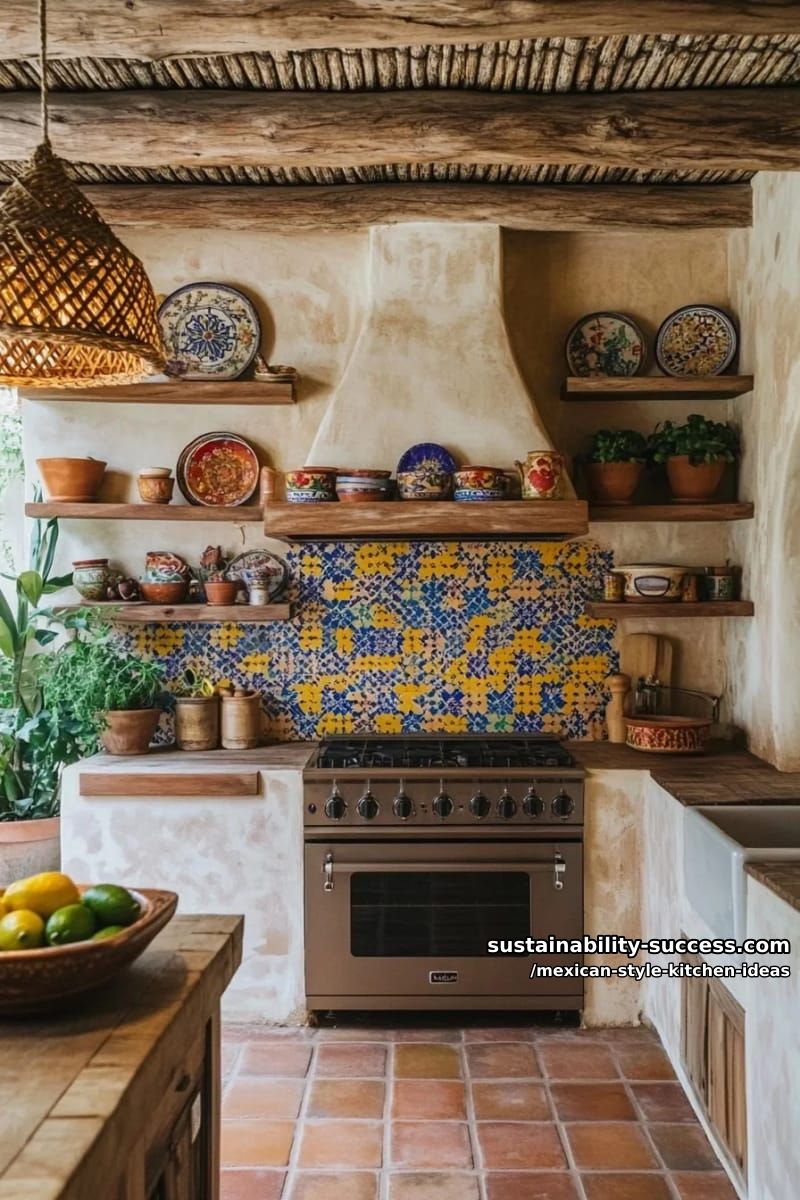
For a 36-inch range, the hood face should be 42 to 48 inches wide and rise 30 inches above the cooktop, with a depth that overhangs the front of the range by 3 inches. Anything skinnier reads as a vent box. Anything shorter looks chopped off. Carry the curve all the way to the ceiling , never stop the hood face at 60 inches and put a soffit above it.
8. Cantera stone island with equipal stools
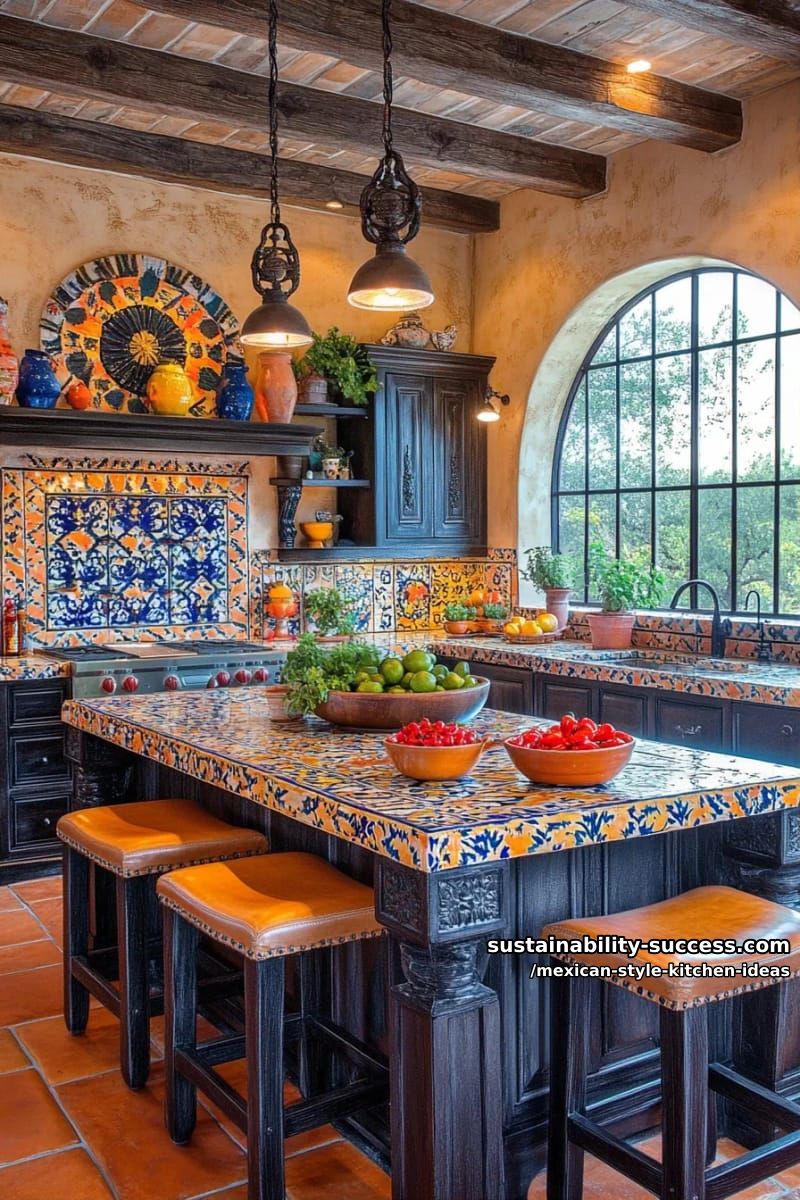
Cantera is the volcanic stone quarried in Querétaro and Guanajuato, and it's the right material for a Mexican island if you can source it. It comes in rosa, amarilla, and gris , pink, honey, gray. Expect $30 to $55 per square foot for the stone, plus fabrication on top. Cantera is softer than granite, so it scratches. That's a feature in a kitchen meant to look lived-in.
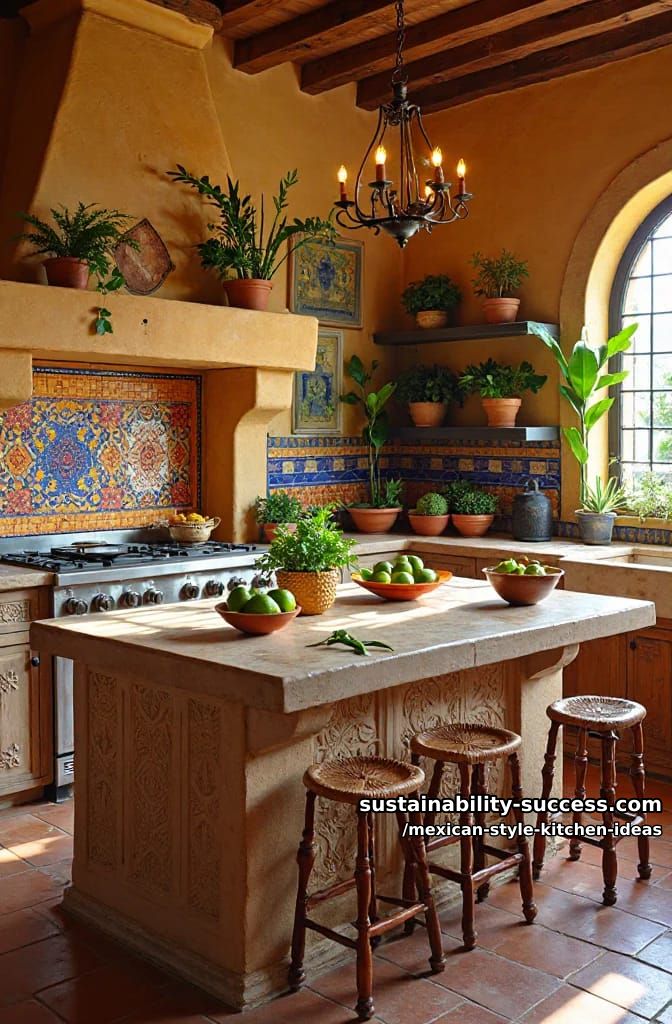
The stools matter as much as the stone. The default mistake is the wrought-iron-with-saddle-leather barstool sold at every Western-lodge knockoff retailer. What you want is equipal , the round Jalisco stool with a woven cedar-strip frame and a pigskin seat. They're rustic, and a little weird-looking, which is correct.
Traditional Equipal
Cedar-strip woven base, pigskin seat and back, $180 to $320 each from importers like Mexgrocer or Casa Bonita. They smell like leather for the first month.
Carved Mesquite Barstool
Solid mesquite frame with woven leather seat, more refined than equipal, $300 to $600 from Oaxacan workshops. Holds up to commercial use better.
9. Vigas and latillas, not a coffered ceiling
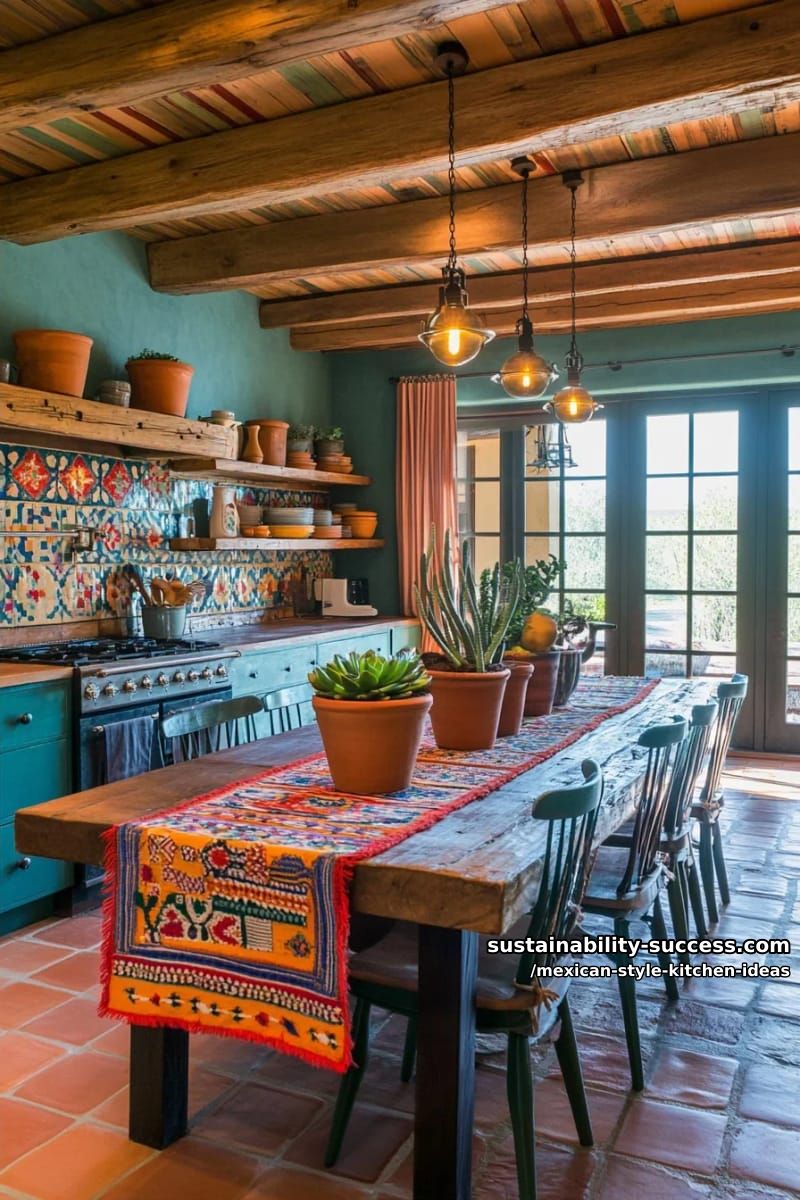
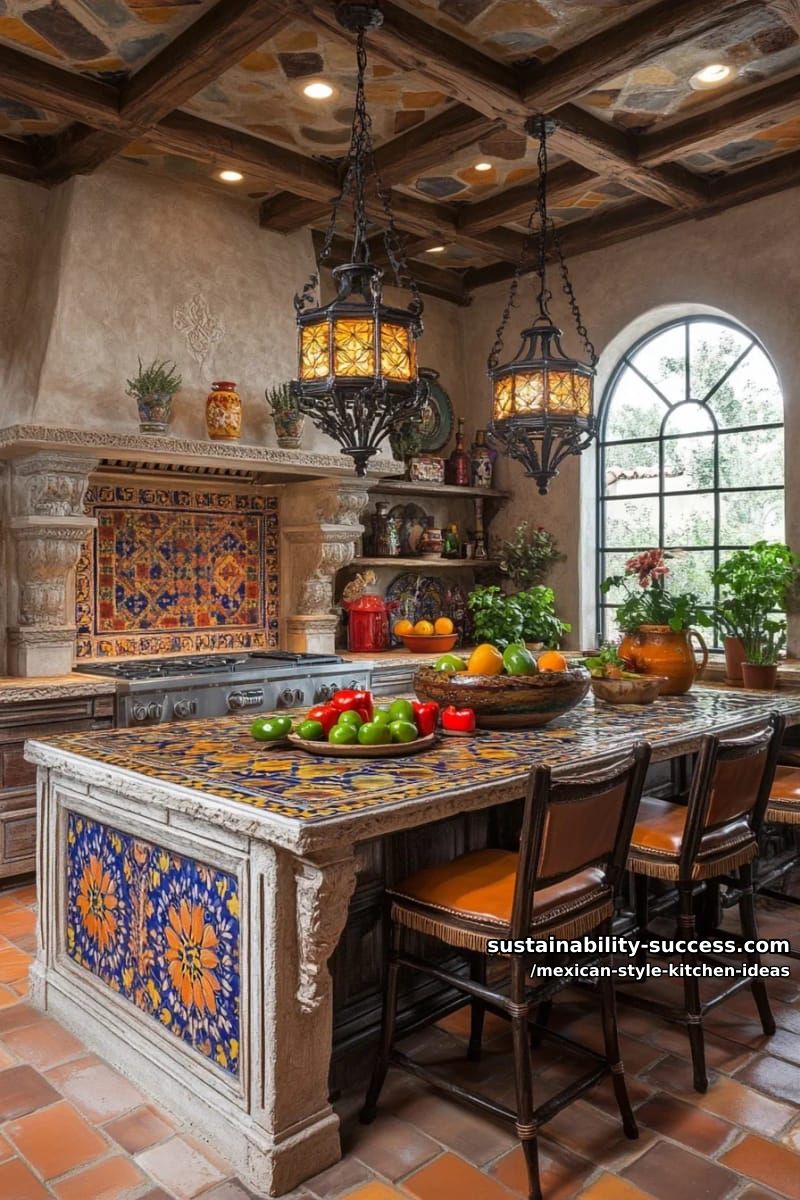
Vigas are the original ceiling treatment , structural and visual at once. In a retrofit you can't add real structural beams without a structural engineer, but you can box-build vigas from rough pine, glue them up, and skin them onto the existing ceiling with French cleats. Spacing matters: real vigas sit on 24 to 30 inch centers, not 48. The wood should be rough-sawn, hand-planed, or distressed , never the smooth finger-jointed pine sold as "rustic" at Home Depot.
Between the vigas, latillas (small split cedar or aspen sticks, roughly 1 inch by 1 inch) laid diagonally in a herringbone is the detail you almost never see in American copies. It's what separates a real ceiling from a Tuscan villa knockoff. If that's too much, tongue-and-groove planks running perpendicular to the vigas, stained warm brown, is the faster substitute.
10. A built-in comal griddle next to the cooktop

This is the one that gets you texted by every Mexican friend you have. A flat carbon-steel or cast-iron comal set permanently into a cutout in the counter next to the cooktop, with its own dedicated burner underneath. For tortillas. For charring chiles. For quesadillas. The dedicated heat source means you leave the comal seasoned and you stop dirtying a skillet every time you want to blacken a poblano.
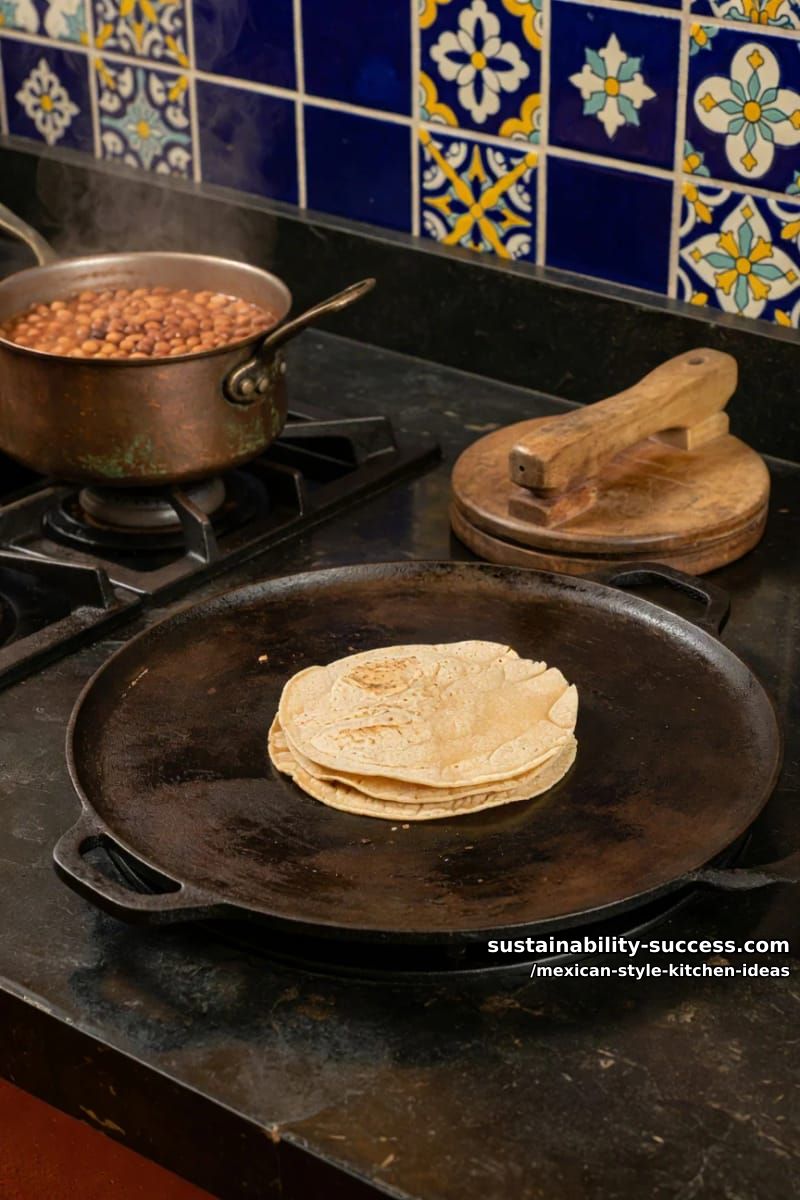
You install it the same way as a built-in teppanyaki griddle. The cutout fits a 16-inch round commercial comal over a single high-BTU burner , Wolf or BlueStar make add-on modules that work , with a high-temperature gasket between the counter material and the comal flange. The cooktop next to it stays a standard 30-inch four or five burner. Not a project for laminate or butcher block.
A 36-inch cantera counter run with a 16-inch built-in comal
Single burner module + comal + heat-rated counter cutout, retrofit alongside an existing 30-inch range.
Adding this to an existing kitchen with cantera or soapstone counters runs about $1,400 to $2,500 done right, mostly because you’re paying a plumber to run a new gas line for the dedicated burner. The DIY path , a portable comal on a single butane burner kept in a drawer , is roughly $80 and works fine until the day you have it built in and never go back.
Shopping list
| Qty | Item | Spec | Price |
|---|---|---|---|
| 1 | Built-in single high-BTU gas burner | 15,000+ BTU, drop-in module | $400 to $700 |
| 1 | Heavy carbon-steel comal | 16-inch round, 1/4-inch thick | $60 to $120 |
| 1 | Stone fabrication cutout | Round hole + chamfered edge in cantera or soapstone | $200 to $400 |
| 1 | Gas line run + connection | Licensed plumber, 1/2-inch flex line | $500 to $1,000 |
| 1 | High-temp silicone gasket | 600°F+ rated, food-safe | $15 to $25 |
| Total | $1,175 to $2,245 | ||
Prices are approximate ranges as of late 2025; verify before purchase.
11. Open shelves of green-glaze Atzompa pottery

If you do one open shelf in this kitchen, fill it with green-glazed Atzompa pottery , the deep moss-green clayware from Santa María Atzompa, just outside Oaxaca City. It's the single most distinctive piece of Mexican kitchen styling, and the green sits against cream plaster in a way that white ironstone never will. Mix the forms (bowls, a jarra, two cazuelas, a pitcher) but keep the glaze consistent. A rainbow of greens reads as souvenir, not collection.
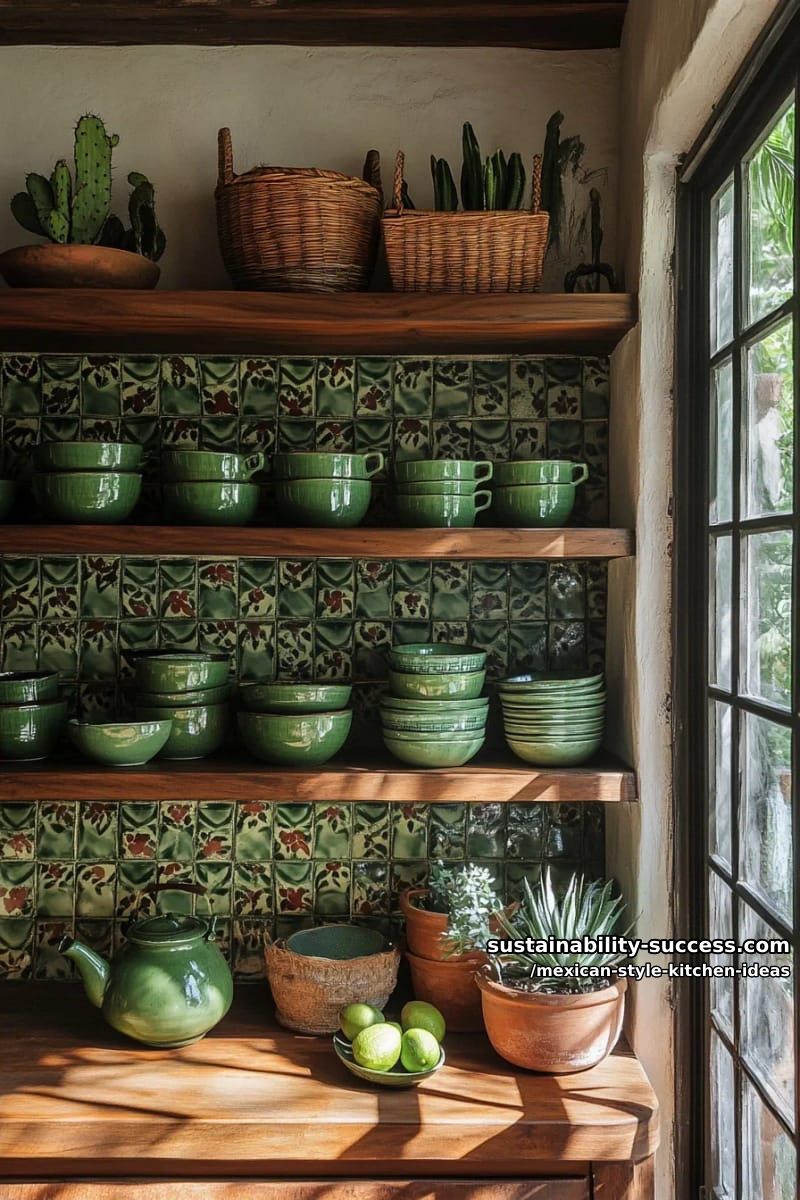
One caution: traditional Atzompa glaze historically contained lead. Buy from importers who certify lead-free production , Clayhaus, Casa Bonita, or directly from cooperatives like MAGA in Atzompa. Use them for serving and display, not cooking, unless the piece is specifically labeled food-safe.

Conclusion
If the budget is finite , which it is , start with the plaster hood, the talavera, and a shelf of green Atzompa. Those three together carry color, texture, and craft, which is most of what makes a Mexican kitchen feel Mexican rather than Mexican-adjacent. The copper sink comes next. The cocina integral comes when you're willing to give up upper cabinets, which most American clients are not.
One note I haven't put anywhere else in the piece: don't try to do all eleven. A real Mexican kitchen is restrained, not maximalist. Pick four, do them properly, leave the walls some breathing room. And whatever the budget, skip the printed peel-and-stick talavera. There is no version of it that doesn't look like vinyl by month six.