
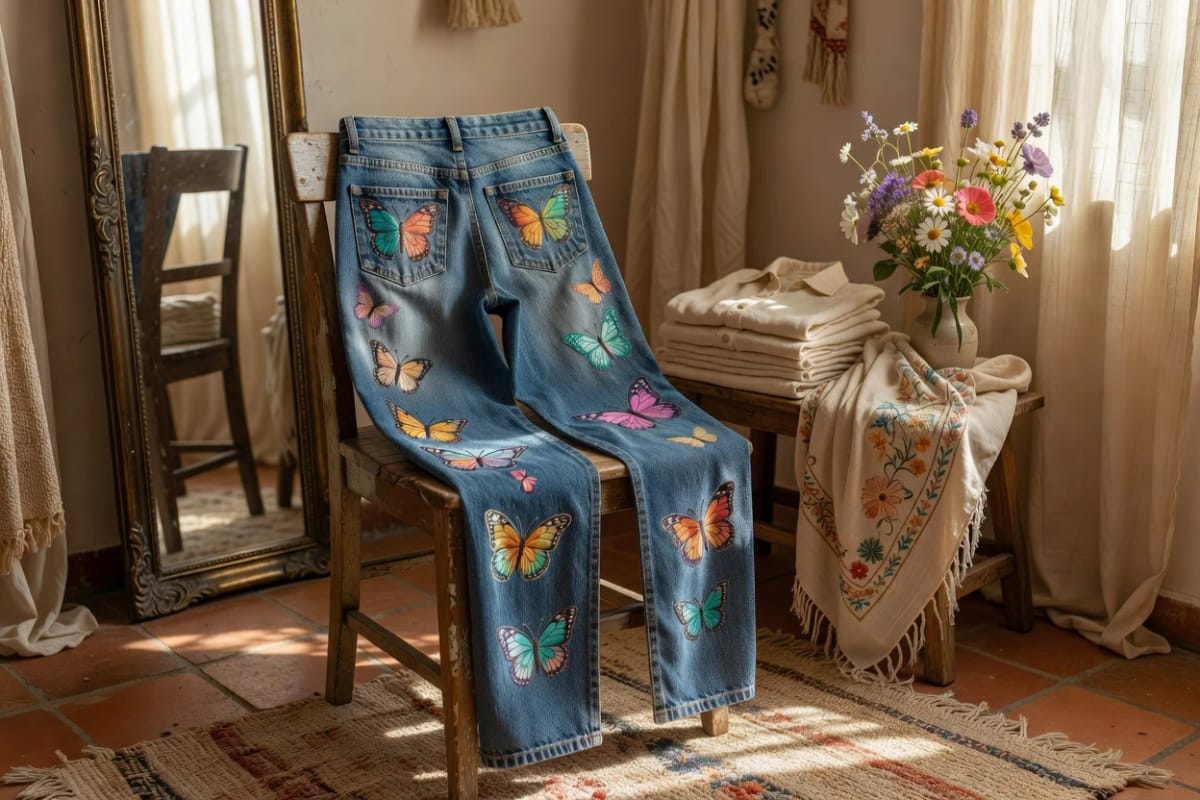
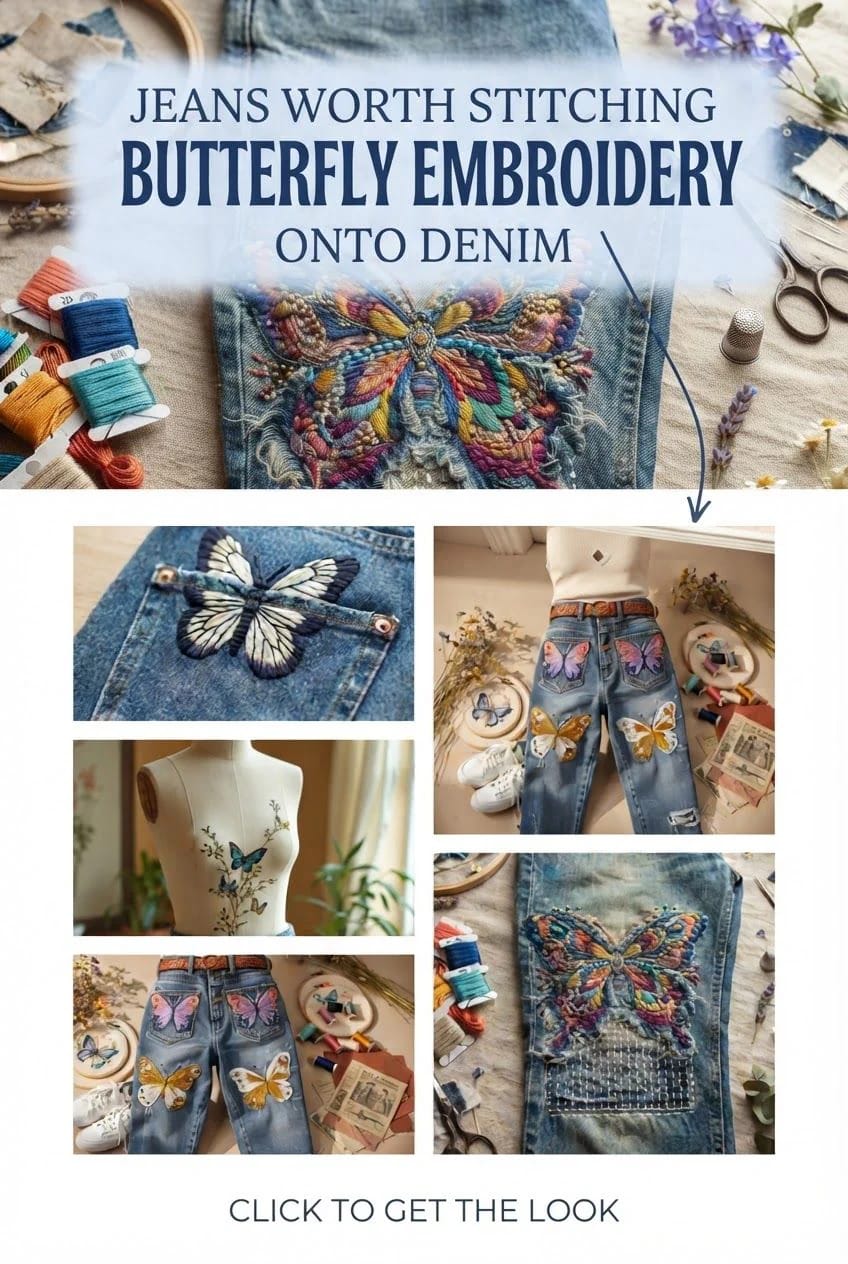
Every idea below puts the butterfly on a line the jeans already have: a pocket edge, a felled outseam, a hem, a knee that has gone thin. That placement is the whole difference between embroidery that looks like part of the garment and embroidery that looks like a sticker somebody stitched down. Eleven treatments follow, with the needle and floss specs that hold up through a wash cycle, plus the two mistakes that cost people a wearable pair.
The Back Pocket Butterfly Has to Cross the Top Edge
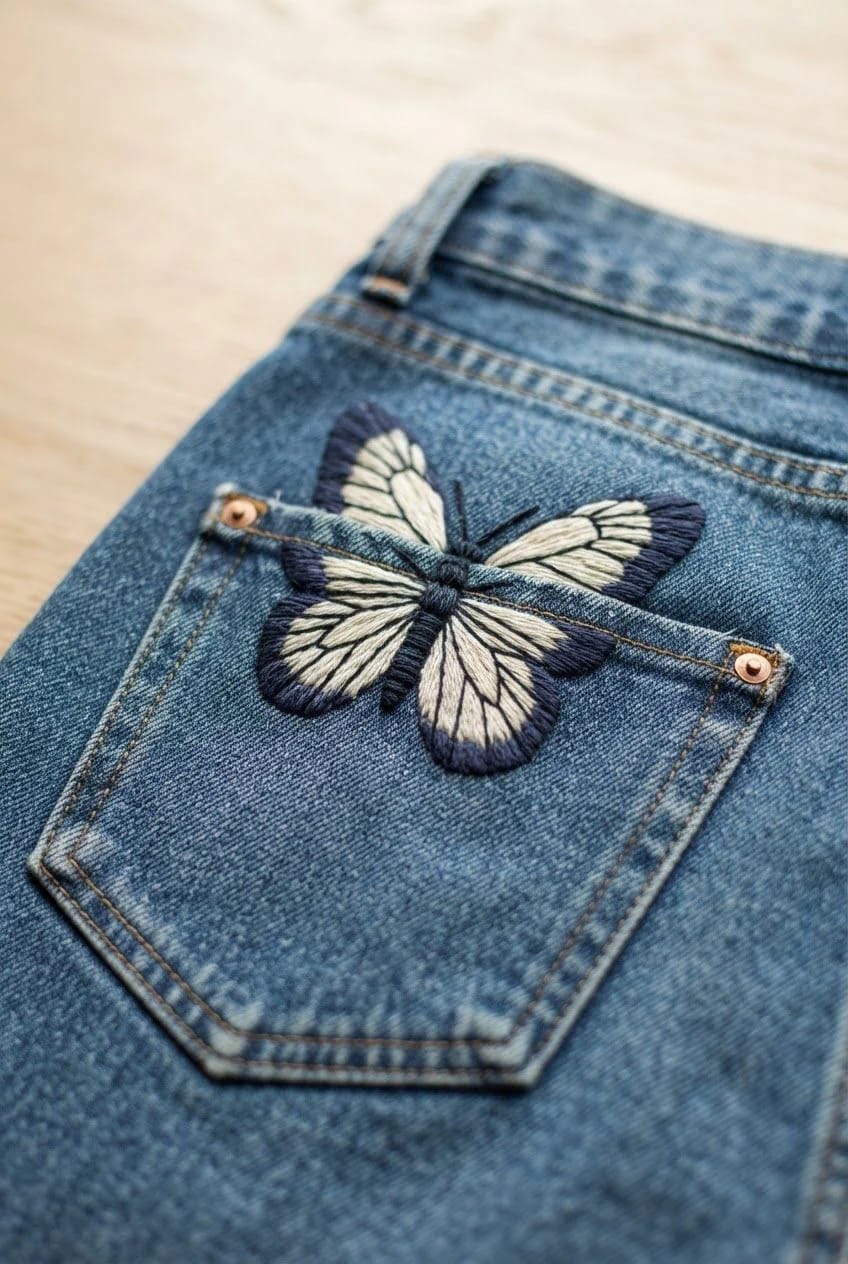
Set the butterfly so one wing lands on the pocket and the other lands on the seat of the jeans, with the body sitting roughly on the pocket's top hem. A butterfly centered inside the pocket rectangle reads as a logo, because a rectangle with a symmetrical shape inside it is what a logo is. Crossing the edge breaks that, and it also gives the wings two slightly different fabric textures to sit on, which is more interesting than one flat panel.
Four layers, and where they actually are
Granted, this only works if you know what your needle is going through. The pocket's top hem is folded denim plus the pocket bag plus the seat panel, usually four layers and sometimes five where the bar tack sits. That is the point where a standard sharps needle bends. Chenille needles in sizes 18 to 22 have the sharp point and the heavy shank to clear it, and the large eye takes three strands of floss without shredding them. A leather thimble helps more than a metal one on denim. Keep floss lengths to about 18 to 24 inches; longer strands abrade against the weave and go fuzzy before you finish the wing.
A six-pack of DMC chenille hand needles in sizes 18 to 22 costs less than a spool of thread and is the single thing that decides whether this section is enjoyable or miserable.
Hoop it or unpick it
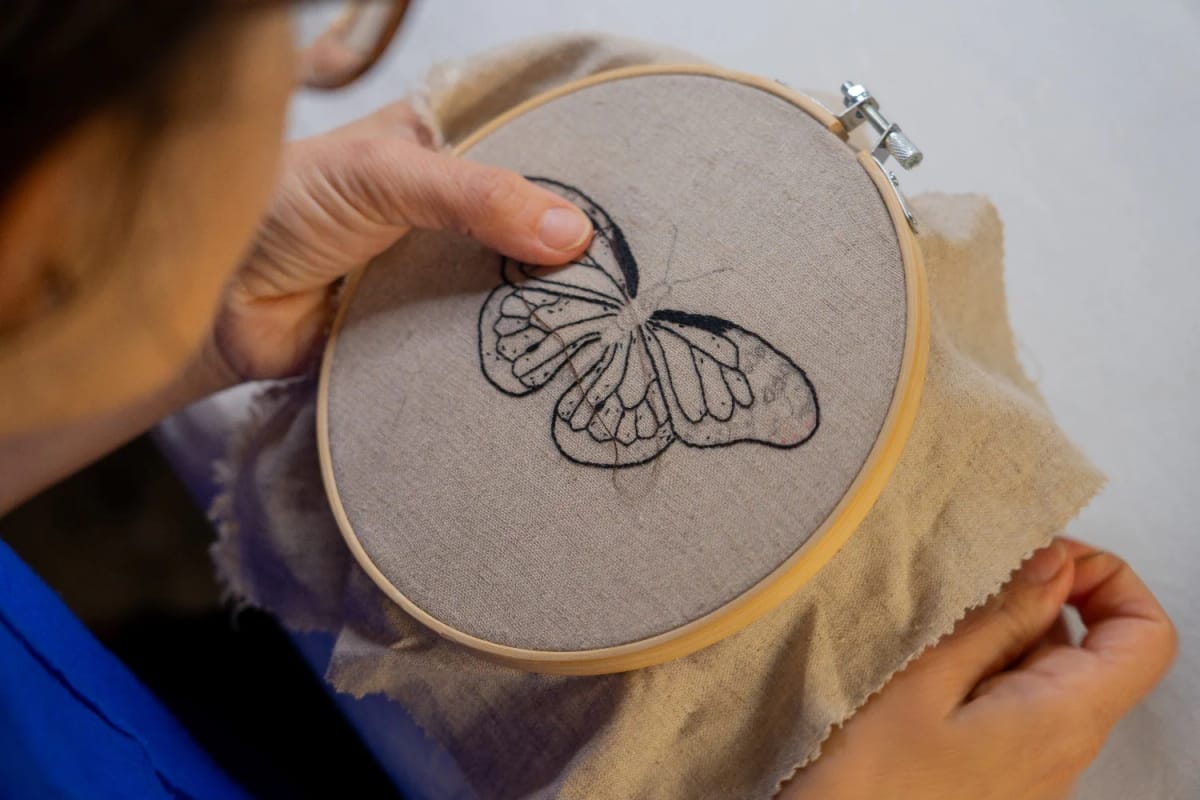
Two options, and they are not equally good. You can slide a small hoop or a piece of stiff card inside the pocket so you only catch the outer layer, which is fast and keeps the pocket usable, though the tension is never quite even. Or you can unpick the pocket with a seam ripper, embroider it flat, and sew it back down along the original stitch line, which is fussier and gives a visibly better result. On a pair you actually wear, unpick it.
Stitching through the pocket bag sews the pocket shut, and you will not notice until you try to put your phone in it. Every stitch on an attached pocket has to stay in the outer layer only. Check by sliding two fingers into the pocket after every few stitches; if they catch, unpick immediately, because floss pulled out of denim leaves needle holes that take a wash and a press to close.
Black Thread on Pale Denim Beats a Rainbow Butterfly
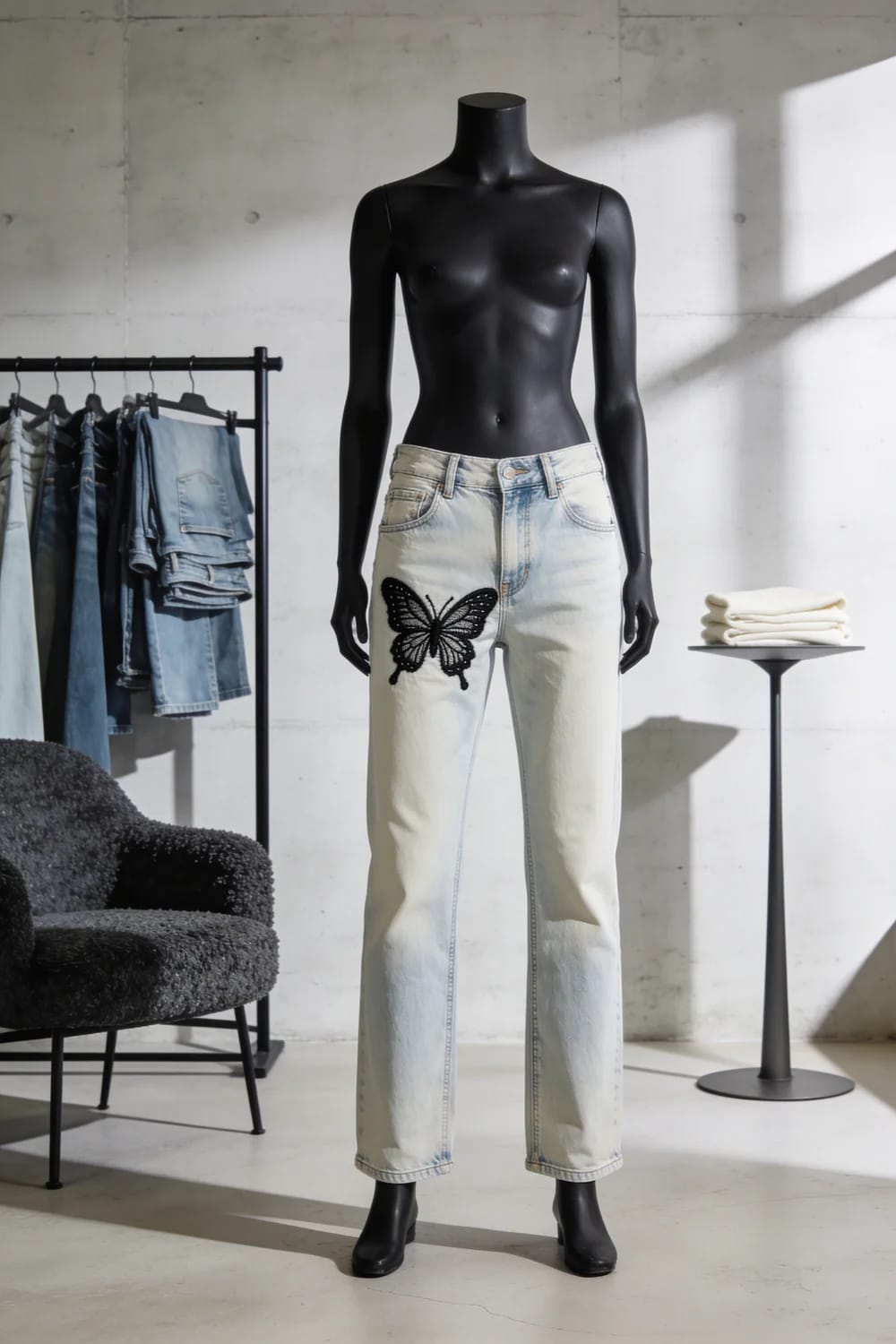
Skip the color. A butterfly worked entirely in black floss on light or mid-wash denim is the version that still looks deliberate in two years, and it is the version that goes with the rest of your clothes instead of dictating them. DMC 310 is the flat true black; 3799 is a very dark grey that reads softer and shows the stitch direction better on faded indigo.
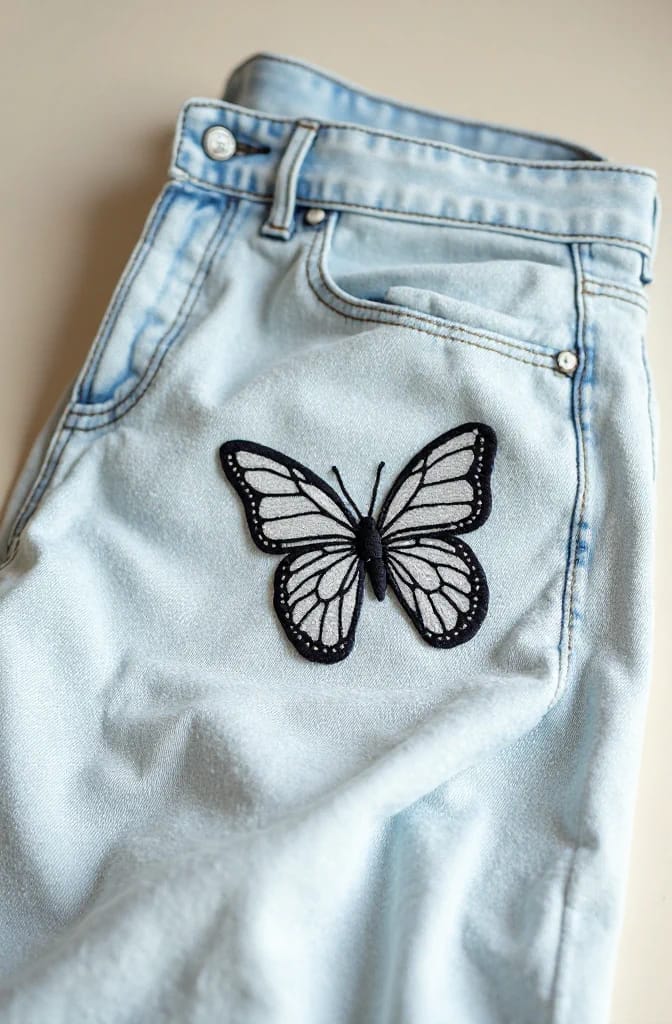
Two weights do all the work. Three strands for the wing outline and the body, two strands for the interior veining, so the veins stay hairline and the silhouette stays crisp from across a room. If you want more than that, add density rather than hue: fill one wing panel with tight satin stitch and leave the matching panel open, so the butterfly is half solid and half drawn. That asymmetry is a better idea than the eight-color version and it takes a third of the time. I would rather see one carefully worked black butterfly than six shades arguing on a thigh panel.
Stitch a Moth Instead and the Jeans Stop Looking Like Everyone Else's
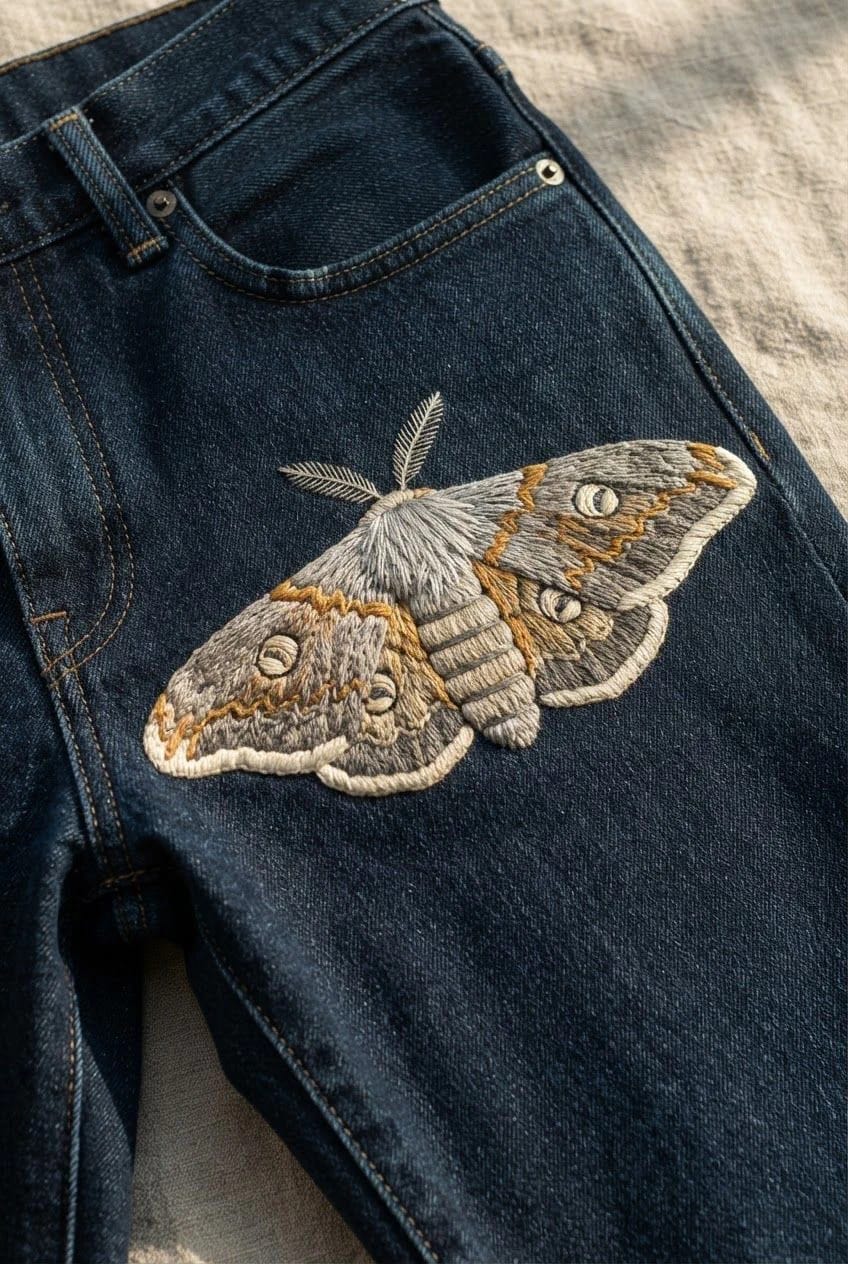
Moths are the better motif on denim and almost nobody does them. The proportions suit the fabric: broad triangular wings, a heavy furred body, colors that live in the dust-grey and ochre range where indigo actually flatters them. A luna moth gives you pale green with long tails; an atlas moth gives you rust and cream with a wing shape that fills a thigh panel without needing to be enormous. Butterflies want bright fields; moths want the dark blue, which is what you are stitching on.
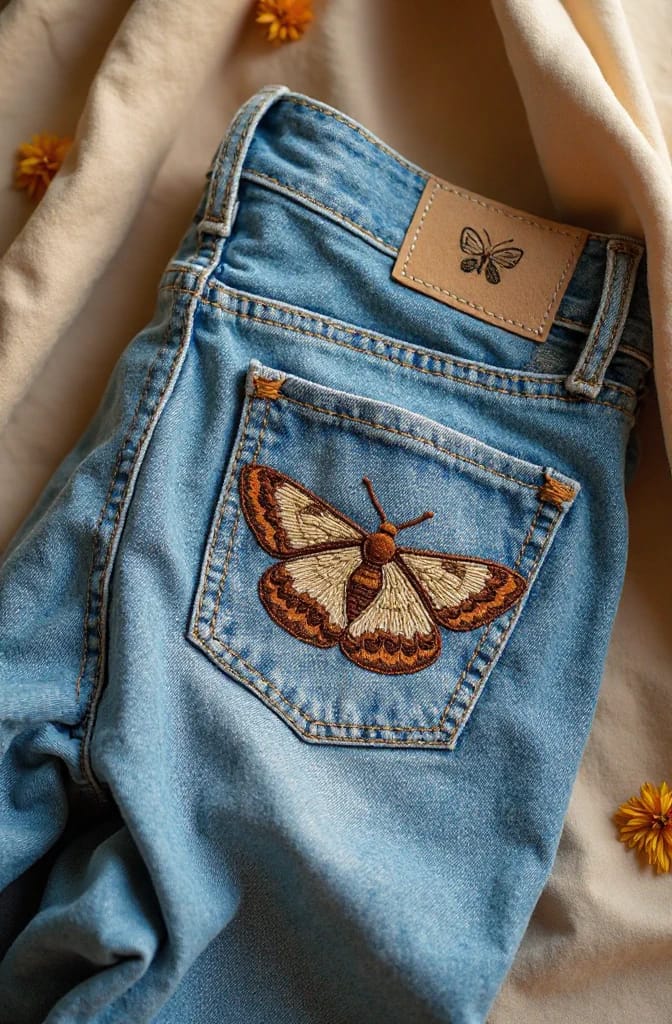
The body is what sells a moth
Work the body first, in three or four rows of stacked satin stitch running across the abdomen rather than along it, so the segments read as segments. Then come back with single straight stitches in a lighter shade fanning out from the thorax to fake the fur. Wings after that. If the body is thin, the whole thing reverts to butterfly and the point is lost. This is also the one motif where a full color plan matters up front, since a moth's palette is four or five closely related muted shades rather than contrast, and picking them one at a time as you go produces mud.
A moth’s wing pattern is too detailed for a chalk pencil, and nothing transfers cleanly onto dark denim. Print the design onto this, stick it down, stitch through it, then rinse the whole sheet away under the tap.
Sulky Sticky Fabri-Solvy printable water-soluble stabilizer, 8.5 by 11 inch, 12 sheetsThe wider move here is treating a worn pair as a surface rather than a garment to be replaced, which is the same instinct behind most upcycled fashion projects that turn tired clothes into something closer to wearable art. Denim just happens to be the most forgiving base for it.
A Butterfly Swarm Up One Leg, Sized Large to Small
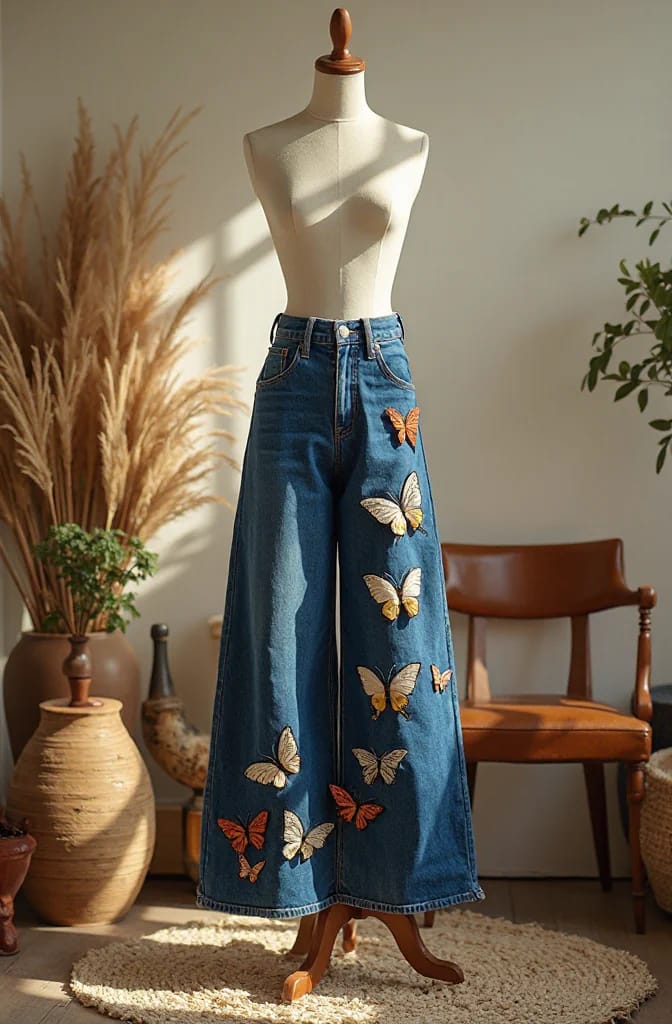
Five to seven butterflies climbing one leg, largest near the hem and smallest by the hip, gives the eye somewhere to travel. Keep them all on one leg. A matched swarm on both legs looks like a print, and a print is what you were avoiding by hand-stitching in the first place.
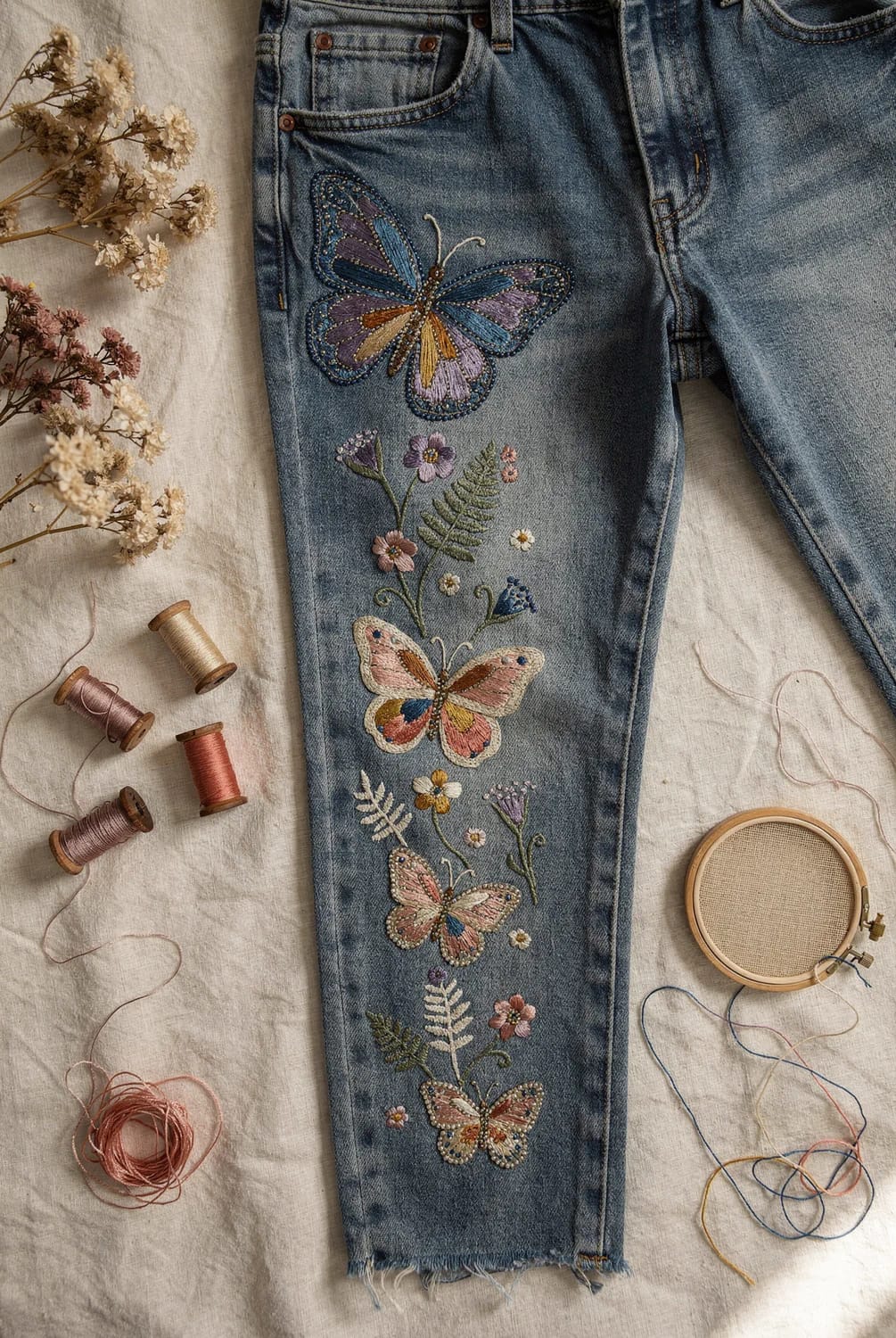
Provided the angles vary, the descending scale carries the whole idea on its own. Scale the set roughly three inches, two and a half, two, one and a half, one, and let two of them overlap a seam so the group is not floating in the middle of the panel. Vary the angle: one flat and open, one tilted, one showing a half-closed profile with a single wing. Identical butterflies at descending sizes read as clip art, and this is where a large floss assortment earns its keep, because a swarm wants five or six related shades rather than one repeated. A DMC 100-color embroidery floss assortment covers a project like this and about ten more after it.
Turn a Worn Knee Into a Butterfly Instead of Patching It Flat
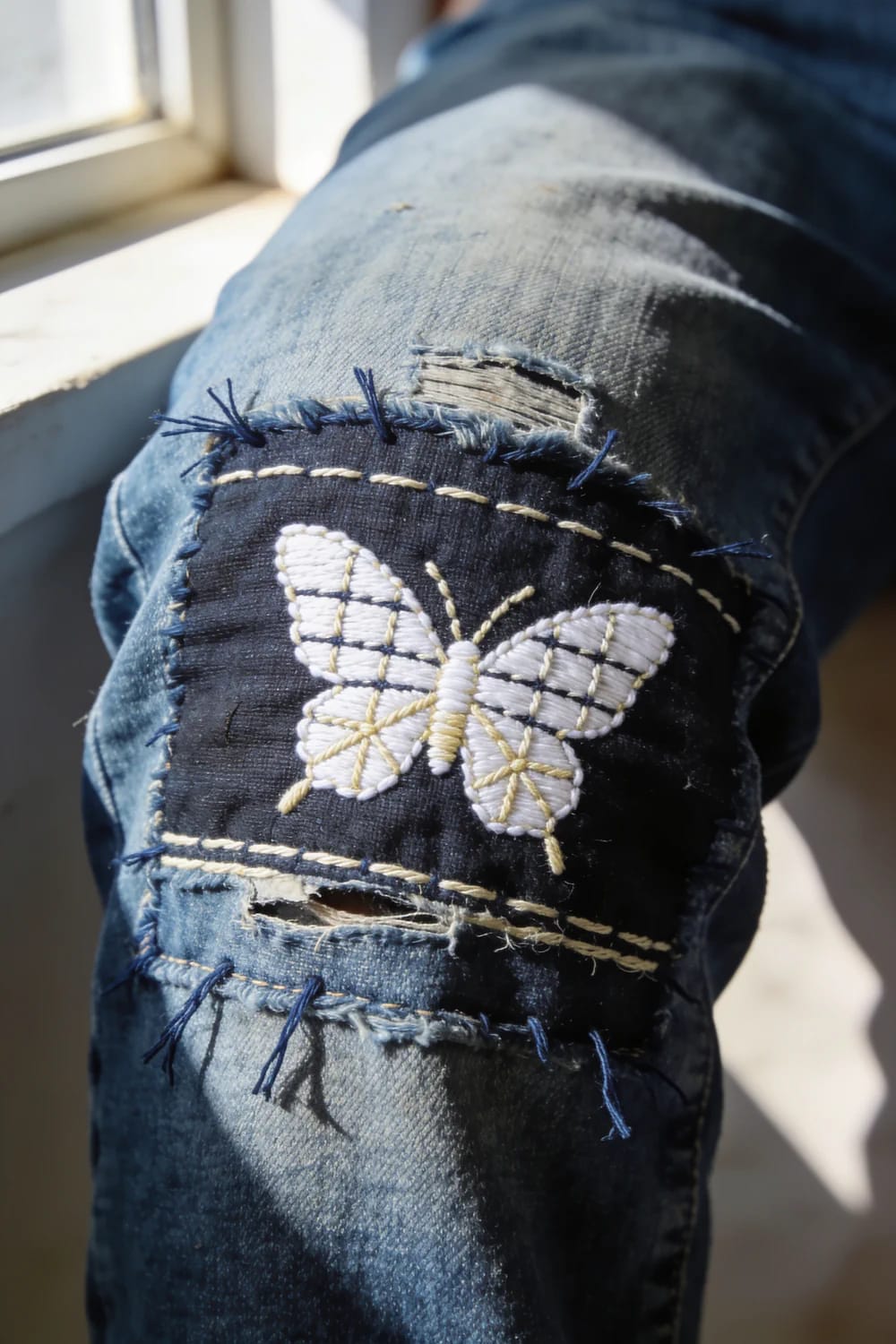
A hole at the knee is the best butterfly placement on the entire garment, because the shape has a reason to be there. Back the damage, then draw a butterfly whose body runs along the axis of the wear and whose wings cover the thin area on both sides. The repair disappears into the motif and the jeans get another few years, which is the actual environmental argument for any of this and a far bigger one than most people assume.
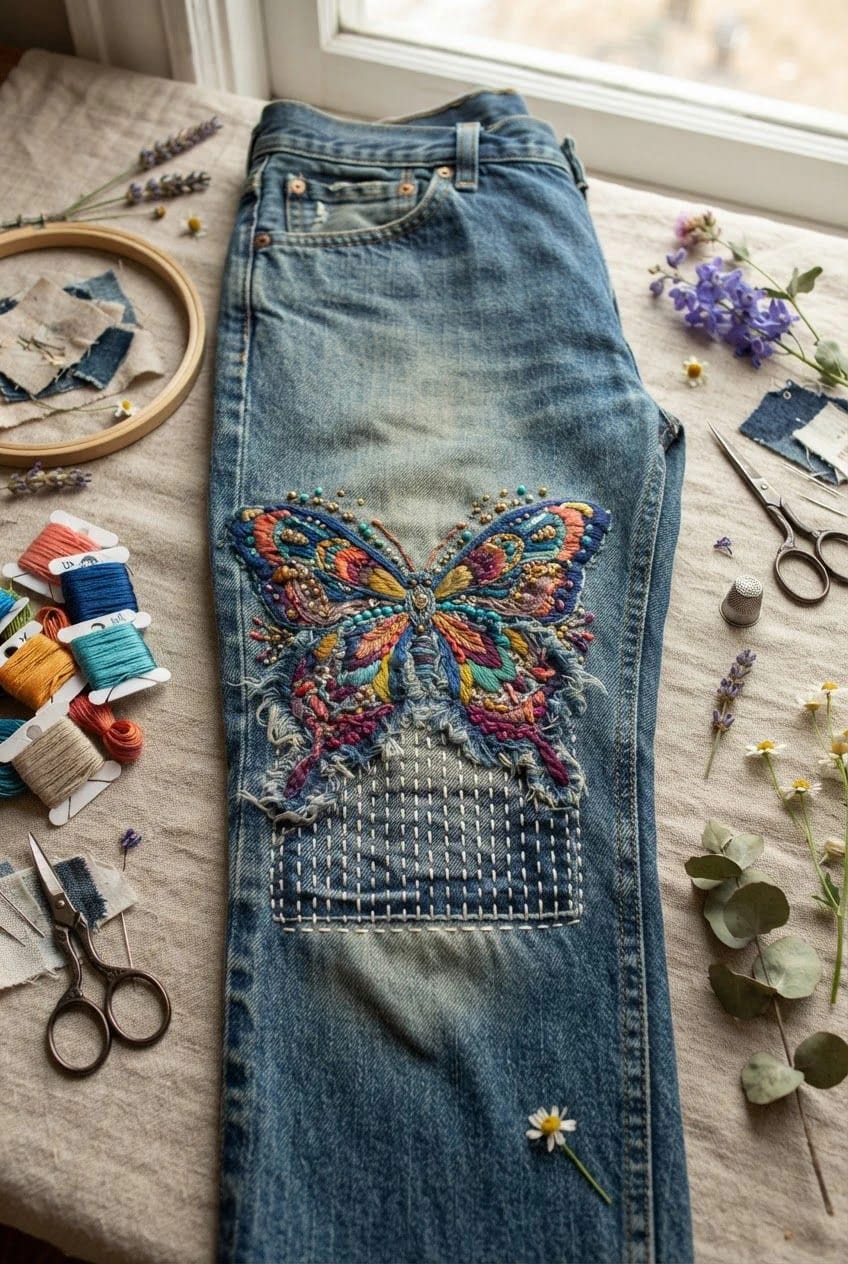
Back it from behind, never patch on top
Cut a scrap of similar-weight denim about an inch larger than the thin area on every side, and pin it to the inside. Stitching down through the hole into that backing is what makes the repair structural. A patch applied on the outside will lift at the corners within a month of wear, no matter how neatly it is stitched.
Sashiko running stitch does the wings
Rows of plain running stitch about an eighth of an inch long, spaced an eighth apart, worked in parallel rows across each wing panel. It is faster than satin stitch by a wide margin, it flexes with the knee instead of cracking, and the visible grid of stitches over a repair is the whole boro tradition rather than an apology for it. White or ecru thread on indigo is the standard contrast; a copper or mustard shade is less expected and does the same job.
Where to stop
Do not carry the stitching past about four inches of total width. A knee flexes hard, and a large solidly-stitched area becomes a stiff plate that fights the joint and eventually pulls at its own edges. The wings can be open and airy at the outer edges; only the middle needs density.
Do this
- Wash and dry the jeans before you start, so the backing and the shell shrink together rather than puckering later.
- Match the backing denim’s weight, not its color. A lightweight scrap behind a heavy shell will fail first.
- Stop the stitching about half an inch short of any seam so the seam allowance stays free to move.
Avoid
- Fusible interfacing as backing. It stiffens, then delaminates in the wash and leaves a crust.
- Working a knee in a hoop that stretches the denim. Hoop tension plus knee flex equals a rippled patch.
It is worth being honest about the scale of the saving. Levi Strauss put the embedded water in a single pair of 501s at roughly 3,781 liters across its life, with cotton growing and consumer laundry accounting for most of it, according to the company’s own lifecycle assessment fact sheet. Keeping one pair in rotation for two extra years is a real number, not a gesture, and it sits inside the broader question of what sustainability in fashion actually measures.
 12 Clever Scrap Fabric Projects With Almost No Sewing Boro patches for a worn knee, plus eleven other uses for offcuts too small to keep and too good to bin.
Hem Butterflies for Flares and Wide Legs
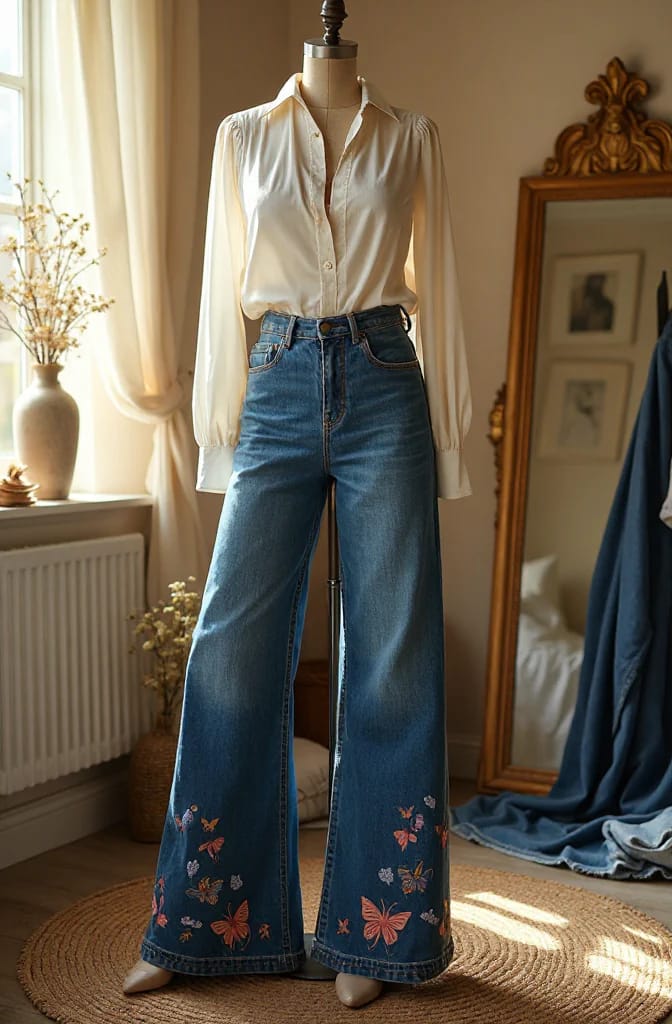
On a flare or a wide leg, put the butterflies two to three inches above the hem rather than on it. The hem itself scuffs against the ground and abrades stitching faster than any other part of the garment, and the fabric two inches up is the part that swings and catches light when you walk. Three butterflies spaced around the circumference of one leg, or a single larger one on the outer face of each leg, both work.
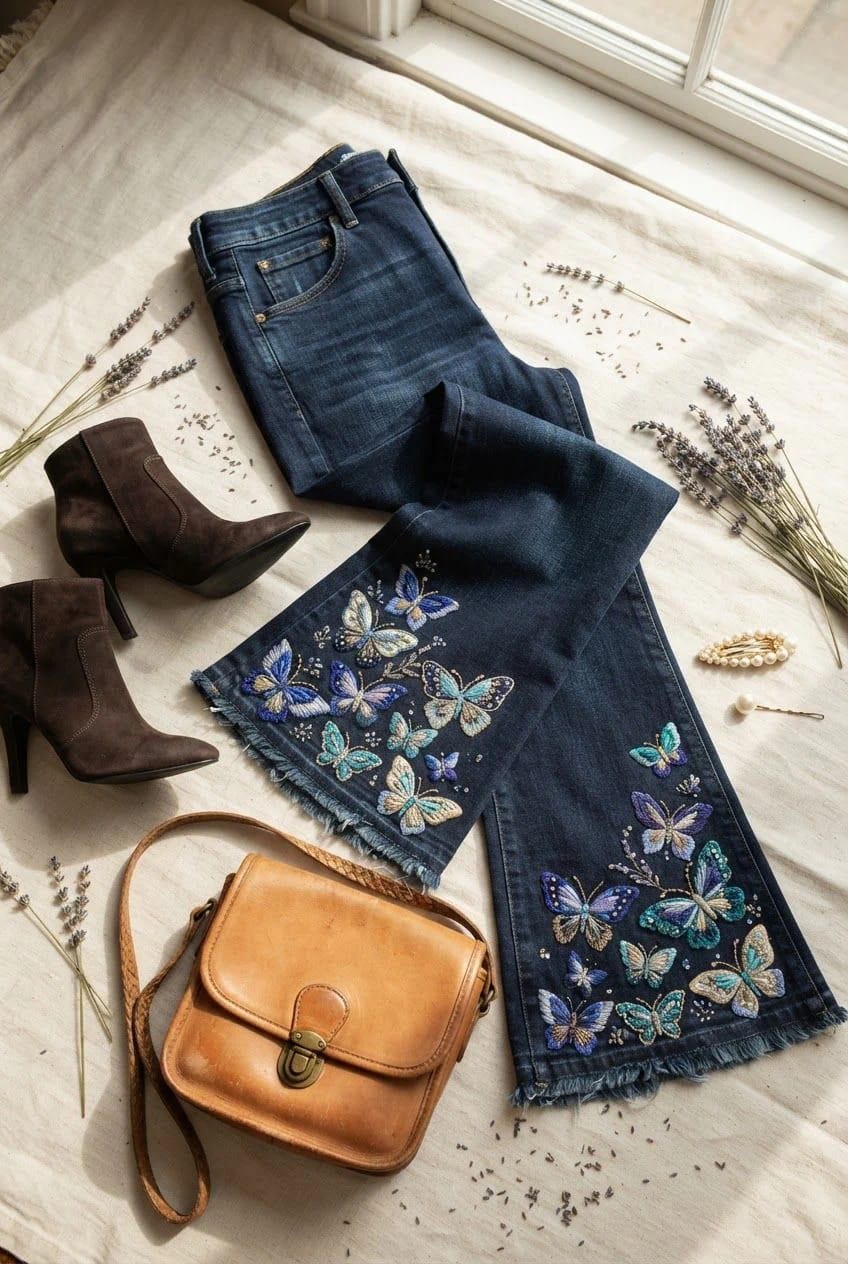
Skinny jeans are the exception. There is no swing, the fabric sits flat against the ankle, and the motif just gets creased. If the pair is skinny, move the idea to the pocket or the knee. A thrifted pair of flares costs less than the floss you will put into them, and the same logic applies to most thrift store flips that are worth the effort rather than the photograph.
One Butterfly Walking Down the Outseam
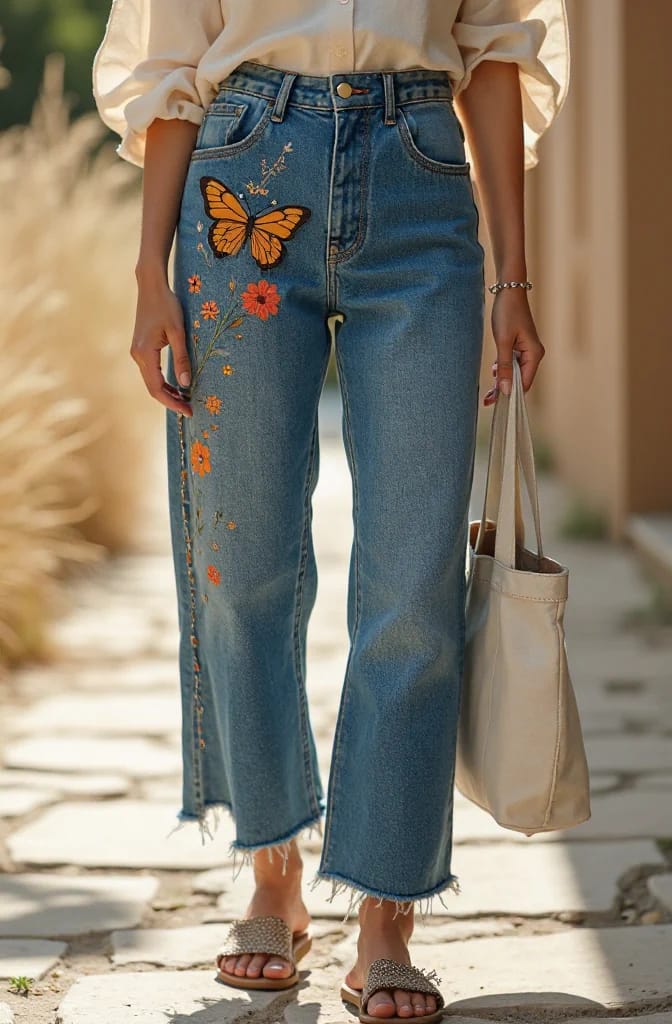
Straddle the felled side seam with the body of the butterfly, so the seam itself becomes the insect's spine and the wings open onto the front and back panels. The seam gives you a perfectly straight axis for free, which solves the hardest part of drawing a symmetrical motif freehand.
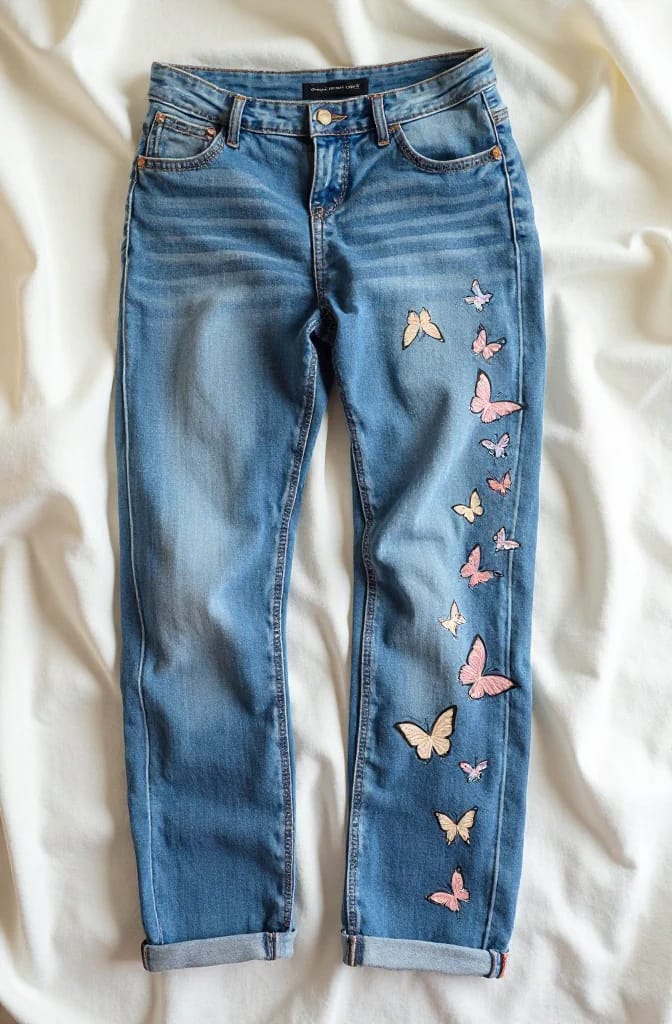
The trade-off is that the wings sit on two different planes and one of them is always partly hidden. Lean into it: work the front wing fully and leave the back wing as an outline only. Two or three of these descending the outseam at irregular intervals looks considered. Evenly spaced, it looks like trim.
Match the Gold Topstitch Thread and Let the Butterflies Read as Factory
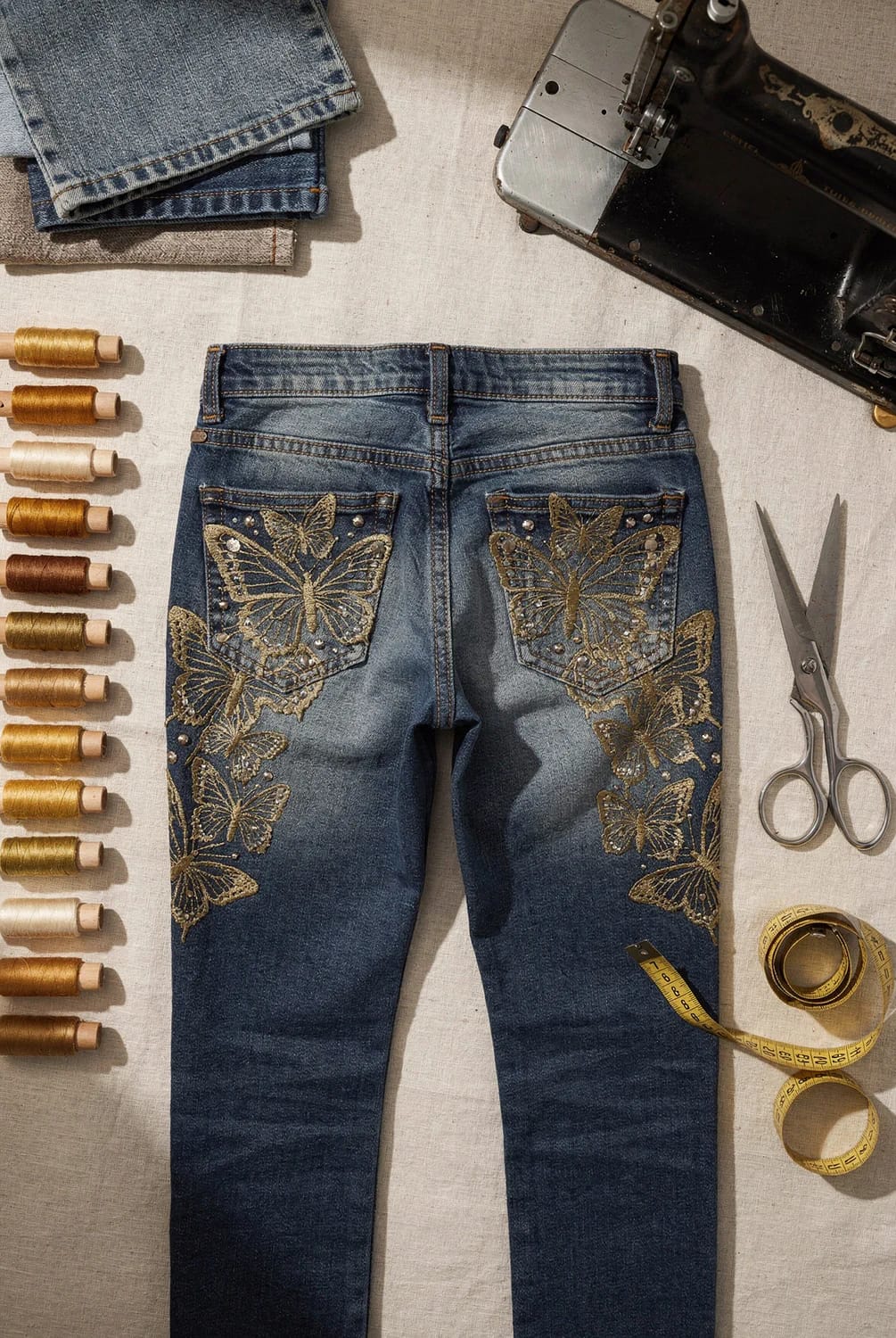
Use the jeans' existing topstitching color and nothing else. That gold-amber shade on the yoke, belt loops and outseam is already the garment's accent, and butterflies worked in the same tone across the back yoke look like a manufacturing detail rather than a craft project. This is the version to make if you have to wear the jeans somewhere that a rainbow moth would not survive.
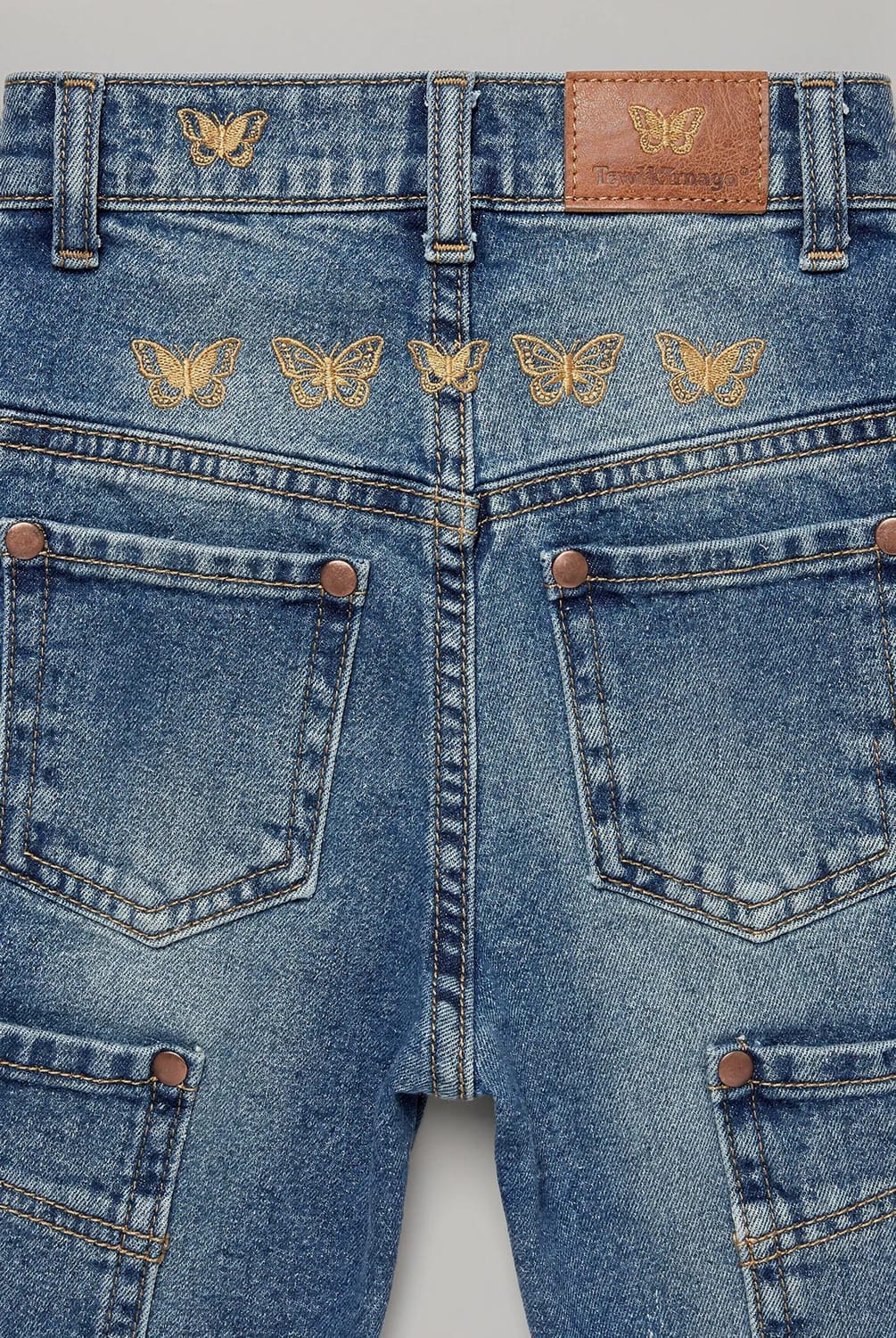
That only holds if the thread weight matches. Topstitching thread, or all six strands of floss, sits at roughly the same visual weight as the factory seams, where three strands look thin and hesitant beside a felled outseam. Keep the shapes simple, closer to a stamped outline than a rendered insect, since the whole illusion depends on the butterflies looking machine-repeatable. It is the only idea here I would call subtle, which is either its virtue or the reason you will skip it.
Coin-Pocket Butterflies Are the Y2K Version, Scaled Down
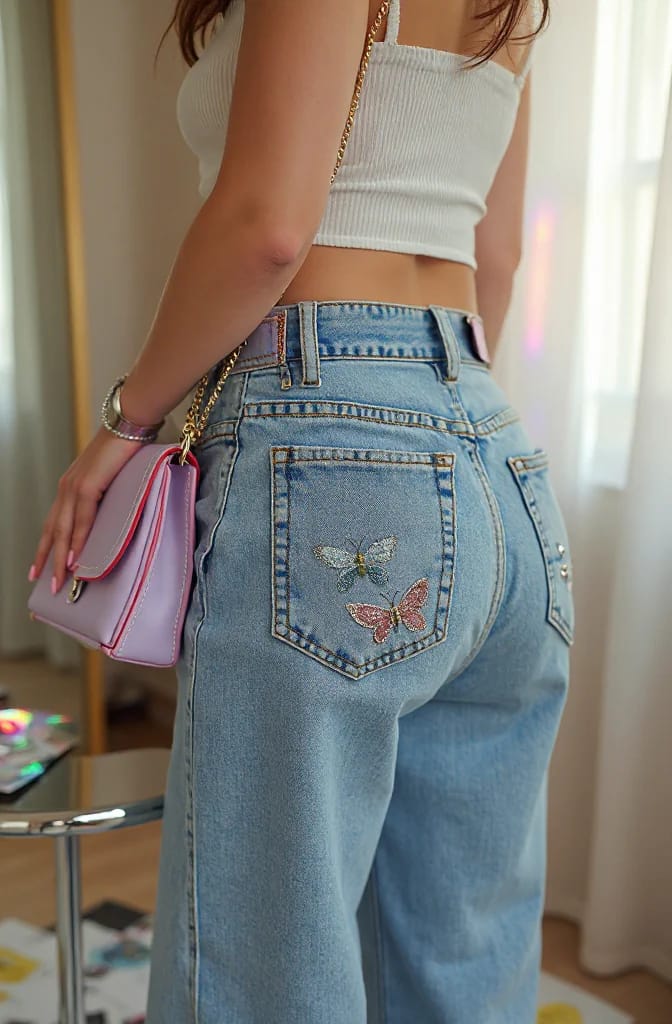
Small ones, one to one and a half inches, clustered around the coin pocket and the front rise. That scale is the reason this reads as early-2000s rather than folk-craft: the era's denim carried tiny motifs low on the front, not large ones on the thigh. Three to five is the right number, and they should crowd slightly rather than sit in a neat arc.
Low-rise and mid-rise both take it. Keep the floss to two strands at this size, because three fills the shape and turns a butterfly into a blob at anything under an inch and a half. If the rest of the outfit is doing enough already, one butterfly on the coin pocket alone is a cleaner call, and it slots into most sustainable outfit formulas that rely on one detail carrying the look without competing with anything.
Butterflies Plus a Branch Fix a Placement That Isn't Working
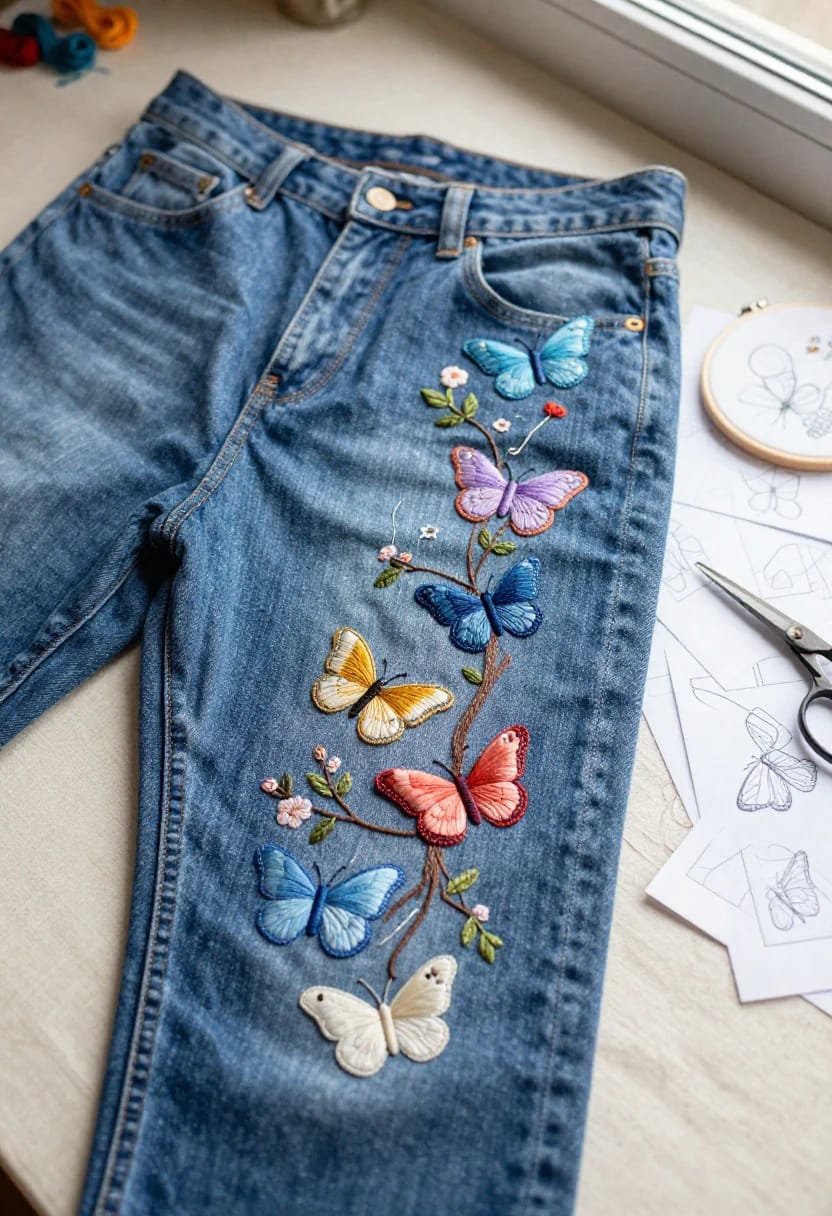
When a butterfly floats in the middle of a panel and you cannot work out why it looks wrong, the answer is usually that it has nothing to be near. Add a stem. A single thin branch in chain stitch running from a seam or a hem, with two or three small blossoms and the butterfly landing at the end of it, anchors the whole arrangement to the structure of the garment.
Cherry blossom is the obvious pairing and it is obvious for a reason: five simple petals, small enough to work in two strands, and the branch reads as a branch even when drawn badly. Keep the flowers under an inch. The moment blossoms compete with the butterfly for size, you have two motifs arguing instead of one motif with a setting.
 15 Fresh Upcycled Clothing Ideas to Try This Season Fifteen ways to redirect worn-out clothes away from the bin, most of them quicker than an evening of hand stitching.
Iron-On Patch First, Embroidery Over the Top
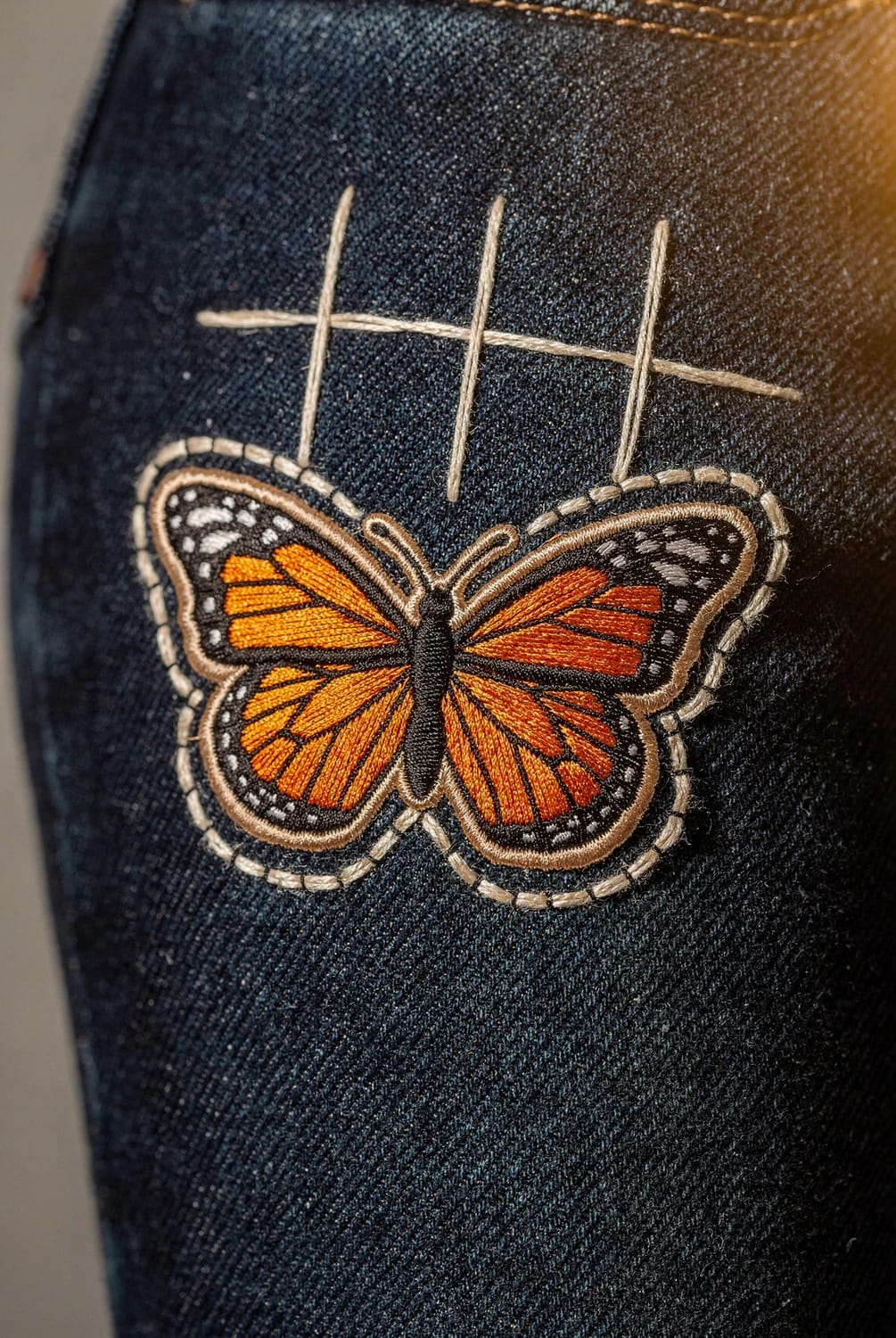
Fuse a ready-made butterfly patch where you want it, then hand-stitch over and around the edge so it stops looking fused. This is the entry point if you have never held an embroidery needle, and it takes about twenty minutes rather than an evening.
The stitching is what matters. Run a line of small backstitches just outside the patch’s satin edge, add three or four straight stitches crossing from the patch onto the denim like antennae or a shadow, and the join stops reading as a hard machine border. Iron-on adhesive alone lifts at the corners after five or six washes anyway (the fast-fashion version of this look, sold pre-fused on new jeans, fails in exactly the same place), so the stitches are structural as well as cosmetic. A pack of 20-piece monarch butterfly iron-on patches in two sizes gives you enough to practice the outlining on a scrap leg first. The offcuts, incidentally, are exactly the material behind most upcycled denim decor projects for the pile you cannot bring yourself to throw out.
Before You Put a Needle Through a Pair You Actually Wear
Practice the specific motif on a cut-off leg first, at full size and with the same floss. Butterflies look simple as a line drawing and get difficult at the wing tips, where satin stitch has to change direction inside a narrow taper. The second attempt is always noticeably better than the first, and you want the first to happen on a scrap.
Then treat the finished pair correctly: inside out, cold wash, mesh bag, hang dry. Heat in a tumble dryer is what shrinks the denim around a dense area of stitching and puckers it permanently, and it is the reason so much hand embroidery on jeans looks fine in the first photograph and warped by the third wash.
If you only make one of these, make the knee. The back pocket is the prettiest and the moth is the most satisfying, but the knee repair is the one that adds years to a garment that was otherwise heading for a bin bag, and it is the only idea here where the stitching is holding something together.
Related Posts
- 57 Innovative Upcycled Jeans Ideas: Transform Your Old Denim into Chic Fashion and Home Decor
- How to Make Stunning Angel Wings from Old Jeans for Your Home
- 11 Upcycled Jeans Decor Ideas for the Pile You Can’t Toss
- 15 Creative Upcycled Jeans Valentine’s Day Crafts
- 25 Creative Christmas Crafts Using Upcycled Jeans For Unique DIY Decorations
- Navy Blue Bedroom: 19 Decor Ideas Made with Upcycled Jeans