
Cut a branch of berried holly in early December and, if a holly tree grows anywhere near you, the birds will have stripped half the red off it before your first guest arrives. That is the thing nobody mentions about decorating with what grows outside: the garden keeps its own calendar, not yours.
What follows is a way of working with that rather than against it, eleven ways to dress a house for Christmas using holly, ivy and a few odds you can cut yourself, from the wreath everyone expects to a living ivy ball you keep long after the tree comes down. Most of it costs a reel of wire and an afternoon, and all of it reads as greenery instead of the plastic stuff (which fools nobody).

A foraged door wreath of holly, ivy and box

If you make one decoration, make the door wreath, and build it on a bare wire ring rather than a moss base. The moss soaks up water, doubles the weight on your door, and does nothing a few overlapping bunches of foliage wired to a frame cannot do for free. Bind small fistfuls of greenery to the ring with reel wire, each bunch hiding the stems of the last, working one direction until you close the circle.
Granted, holly alone makes a thin, gappy wreath, because the leaves sit on stiff stems and shed once they dry. Box (the same buxus people clip into hedging) is the filler that holds the shape, with holly worked in as accents where you want the berries to catch, and a strand or two of ivy run round to soften the outline. I spent years jamming holly into wet floral foam and wondering why it browned by the second week; the foam was the problem, not the holly, which barely drinks through cut stems anyway.
On an exposed door in the cold a wreath of fresh greenery holds four to five weeks, far longer than the same foliage indoors. Hang it late, keep it off direct afternoon sun, and accept that a few berries will drop regardless.
Variegated holly, not plain green, for a dark hall

In a dark hall, reach for variegated holly over the plain green, because the cream or gold leaf margins throw light back at you where a solid dark leaf just disappears into the shadow. A jug of cut 'Argentea Marginata', with its silvery-white edges, does more in a gloomy corner than three times the volume of ordinary holly.
Here is the catch worth knowing before you plant for next year. Holly is dioecious, meaning the berries only come if a male plant grows somewhere nearby to pollinate the female, and the cultivar names are a trap: ‘Golden King’ is female (and conveniently less spiny than the species), while ‘Silver Queen’ is male and carries no berries at all. So if you bought one labelled like royalty and got no fruit, the name lied to you, not the plant. For cutting, ‘Golden King’ earns its place twice over, gold-margined leaves to lift a dim spot and fewer spines to draw blood while you arrange it.
An ivy garland down the bannister that needs no water

For the staircase, run ivy and forget the holly, because ivy is the one piece of foraged greenery that genuinely does not need water. Its leaves are waxed enough to hold for a fortnight out of any vase, which is why it has draped British mantels and bannisters for centuries while the cut flowers wilted. Snip the longest trailing strands you can find, the ones already creeping along a wall or fence, and wind them round the rail, tucking the cut ends under as you go.
A holly and ivy table runner instead of a centrepiece

Skip the single centrepiece and lay a loose runner of greenery straight down the middle of the table instead. One tall arrangement blocks the sightline and gets shoved aside when the food arrives; a flat trail of ivy with short berried holly sprigs threaded through it sits below eye level, takes thirty seconds to make, and you bin it without a thought afterwards. Set a few low candles into the gaps and leave the wood showing between the leaves.

The kissing bough: ivy, holly and a sprig of mistletoe

Before the imported fir tree took over, English houses hung a kissing bough, and it is the decoration most worth reviving from your own hedge. Bend two willow or even coat-hanger hoops into a sphere, bind them at top and bottom, then wind the frame with ivy and holly until the green reads as a globe with the air still showing through. A single bunch of mistletoe hangs from the base, which is the whole point of standing under it.
True, it asks more of you than draping a garland, perhaps an hour of fiddling to get the sphere even. But it hangs in a doorway or over the table where nothing else goes, and it is the rare foraged piece that looks deliberate rather than gathered.
A living ivy ball you plant out in January

Train a living ivy ball and you get a decoration with a second life. Push the rooted ends of small-leaved ivy into a pot of compost, tease the strands over a wire sphere, and it knits into a green globe within a season; indoors over Christmas it needs nothing but the odd splash of water. Come January, plant it out and it carries on. (The cut version works too, wound onto a moss ball, but it is dead by Twelfth Night and the living one is barely more effort.)
Holly and ivy in a jug, treated like cut flowers

For an arrangement that lasts, treat the stems like cut flowers, not like a wreath: slice the bottom inch at an angle, strip the leaves that would sit below the water, and stand them in a jug of cool water somewhere out of the heat. Holly held this way keeps roughly one to two weeks indoors, a little longer in a cold room, which is about as good as it gets with a stem that woody.
That said, the honest answer is that cut holly barely drinks, and conditioning it is mostly theatre. The single thing that matters more than any water trick is when you cut it. Branches harvested on a dry morning a few days before you need them, above freezing and out of wind, hold their berries far better than the same branches cut three weeks early and nursed in a bucket. If you want insurance against the berries dropping, a light pass of artist’s matte sealant or a florist’s anti-desiccant spray helps; the old hairspray trick does not, since the alcohol in it dries the leaves and leaves a sticky film that grabs dust.
Cutting and handling
- Cut on a dry day, above freezing, as close to the day you need it as you can manage.
- Slice woody stems at an angle and strip anything that would sit underwater.
- Wear thornproof gloves. Holly spines draw blood and ivy sap leaves some people with an itchy rash.
- Leave plenty of berries on the tree for the thrushes and waxwings, who need them more than your mantel does. The Woodland Trust foraging guidance is the short version: take a little, for yourself, with the landowner’s say-so.
Avoid
- Wet floral foam for holly. It browns the leaves and the stems can’t use the water anyway.
- Cutting weeks ahead “to be safe.” The berries drop and the leaves dull.
- Stripping one tree or hedge bare. Spread the cutting around.
- Hairspray to glue berries on.
Ivy candle rings and hurricane lamps for the dark corners

In a room with poor light, wind a low ring of ivy round the base of a few pillar candles and let the flame do the work. The leaves catch and bounce the candlelight, and a collar of greenery at the foot of a glass hurricane lamp turns a plain candle into something that looks arranged. Keep the foliage flat and below the flame, and swap it when it crisps; ivy near heat dries faster than ivy on a cold bannister.
One holly sprig at each place setting
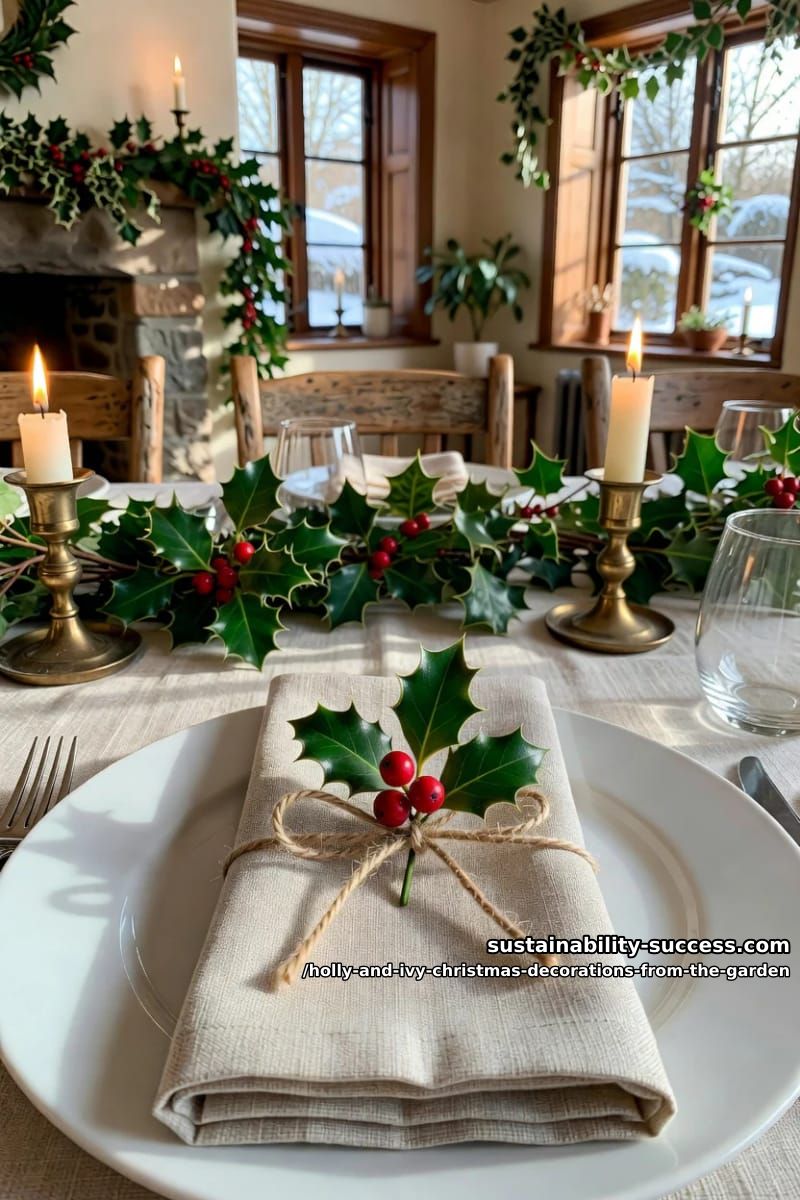
For next to nothing, tuck a single holly sprig under a string or napkin tie at each place. It is the cheapest flourish in the whole list, three leaves and a berry cluster per guest, and it pulls the table together without another arrangement to find room for. Snip them at the last minute so they look fresh when people sit down.

Holly berries are not decorative-only by accident. They contain saponins (the compound called ilicin), and a child or pet that eats a handful can end up with vomiting, diarrhoea and drowsiness. Ivy is in the same camp: its berries are mildly toxic and the sap irritates a lot of people’s skin. None of this rules holly and ivy out, but it does mean the place-setting sprigs and any low, reachable garland are the wrong idea in a house with a crawling toddler or a cat that chews greenery. Keep the berried pieces high, and sweep up the ones that drop.
A holly festoon along the mantel, the Irish way

Lay a thick festoon of berried holly straight along the mantel and you are doing the oldest version of this there is. In Ireland the house was filled with holly and evergreens at Christmas, a custom older than the tree, and a mantel heaped with it still looks right in a way a shop-bought garland never quite manages. No wiring needed: just bundle short branches and lay them overlapping along the shelf, berries facing out, the densest part in the middle.
A foraged mantel for the price of a reel of wire
One 5 to 6 ft mantelpiece, an afternoon’s cutting, no florist’s order.
Most of what this costs is wire, because the holly, ivy and box come off your own plants or the hedge with permission. Cut two carrier bags of mixed greenery, wire a dozen short bunches, and lay them overlapping along the shelf with a few longer ivy trails left to drape over each end. If you already own secateurs and gloves, which most gardeners do, the real outlay is a single reel of binding wire.
What you actually buy
| Qty | Item | Spec | Price |
|---|---|---|---|
| 1 | Florist’s reel wire | 56mm green binding wire | £3 to £6 |
| 1 | Bypass secateurs | if you don’t own a pair | £8 to £20 |
| 1 | Thornproof gloves | leather or coated palm | £5 to £12 |
| Total (or just the wire, if you garden already) | £3 to £38 | ||
Prices are approximate UK ranges as of late 2025; verify before buying.
A bare branch dressed in ivy as an alternative tree

For a small room or a second tree, stand a single bare branch in a gravel-weighted pot and wind it with ivy and a few berried sprigs. Holly and box were both pressed into service as Christmas greenery for centuries before the fir arrived, so a dressed branch is not a modern compromise so much as an older habit. It takes up a corner, costs nothing, and reads as deliberate rather than make-do.
Conclusion
If you do all of this, do it in the right order, because the garden will not wait around. Start with the ivy, which keeps for weeks dry and forgives an early start, so the bannister and the candle rings can go up whenever you like. Leave anything holly-and-berried until the last few days: the door wreath, the mantel festoon, the place-setting sprigs, all cut on one dry afternoon close to the day itself, so the berries are still on when people see them rather than scattered across the hall floor. And if there is a single thing to change about how most people approach this, it is to stop nursing cut holly in buckets of water and start cutting it later instead. The timing does more than any conditioning trick. Then plant the ivy ball out in January and you have one decoration that comes back next year on its own.