
Half the "organic linen" sold for coastal rooms is a polyester blend wearing a beachy product photo, and a lot of the furniture it covers is built to sag by its second summer. The 15 ideas below sort the pieces worth buying once from the ones that only look the part for a season, with a bias toward real flax, salvaged wood, and a coastal look that doesn't need a resin starfish on the mantel. A few are weekend swaps. A few you commit to for a decade.
1. Layered linen sofas in sandy beige with chunky woven coastal throw blankets
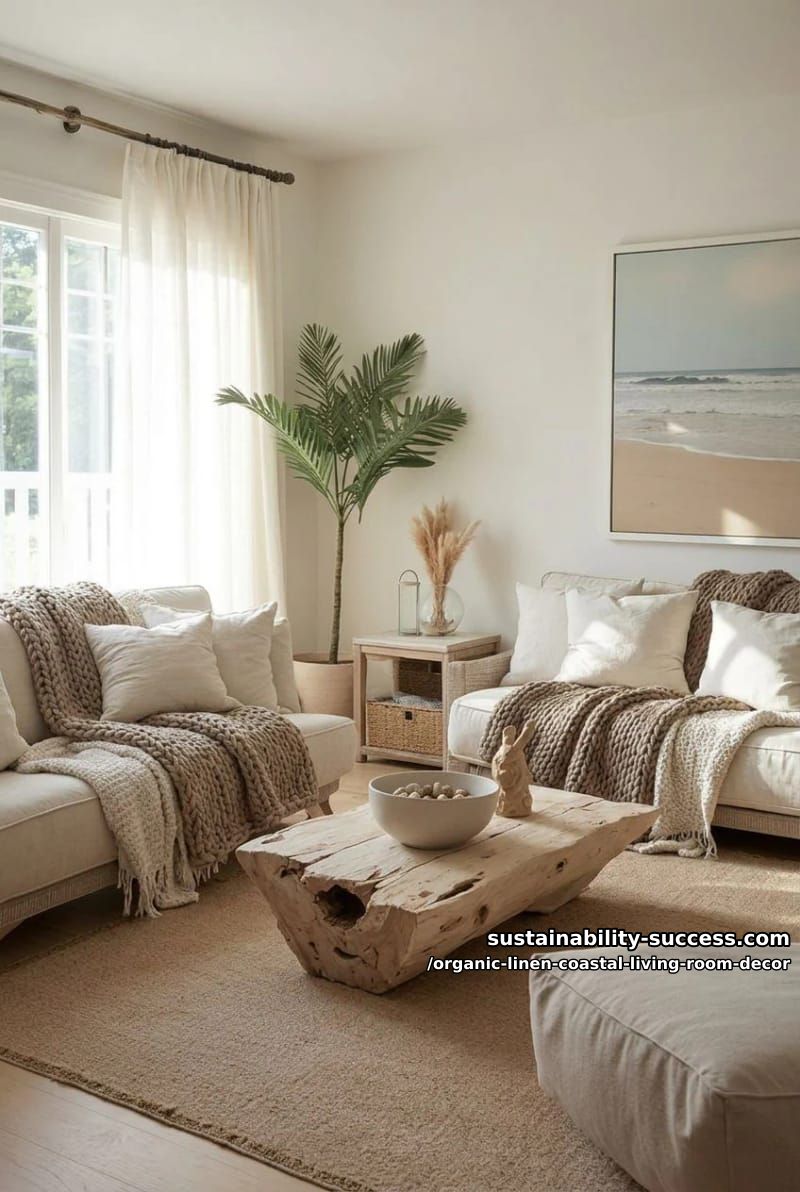
Buy the sofa for its frame, not its slipcover, because the cover is the only part you'll ever replace. A kiln-dried hardwood frame with eight-way hand-tied springs outlives three rounds of fabric, which is the entire sustainability case for the slipcovered look: you re-cover instead of sending a whole sofa to landfill. Bemz and Comfort Works both cut washable linen covers for IKEA frames, so a sagging Söderhamn becomes a sandy beige linen sofa for a few hundred dollars rather than a few thousand.
Get the pre-washed (sometimes labeled "stonewashed") flax, not the crisp stuff. Crisp linen wrinkles into hard creases and stays stiff; washed linen falls into the soft, rumpled folds people actually want and softens further every laundry cycle. Look for European Flax certification on the label, which traces the fiber to flax grown in Belgium, France, or the Netherlands without irrigation.
One thing to skip: the giant acrylic "chunky knit" throws all over your feed. Most pill into fuzz by the second winter and they're plastic. A washed-cotton waffle weave or a real wool throw costs more and holds up, and it won't shed microfibers into your wash water.
2. Driftwood coffee table surrounded by natural linen poufs and ottomans
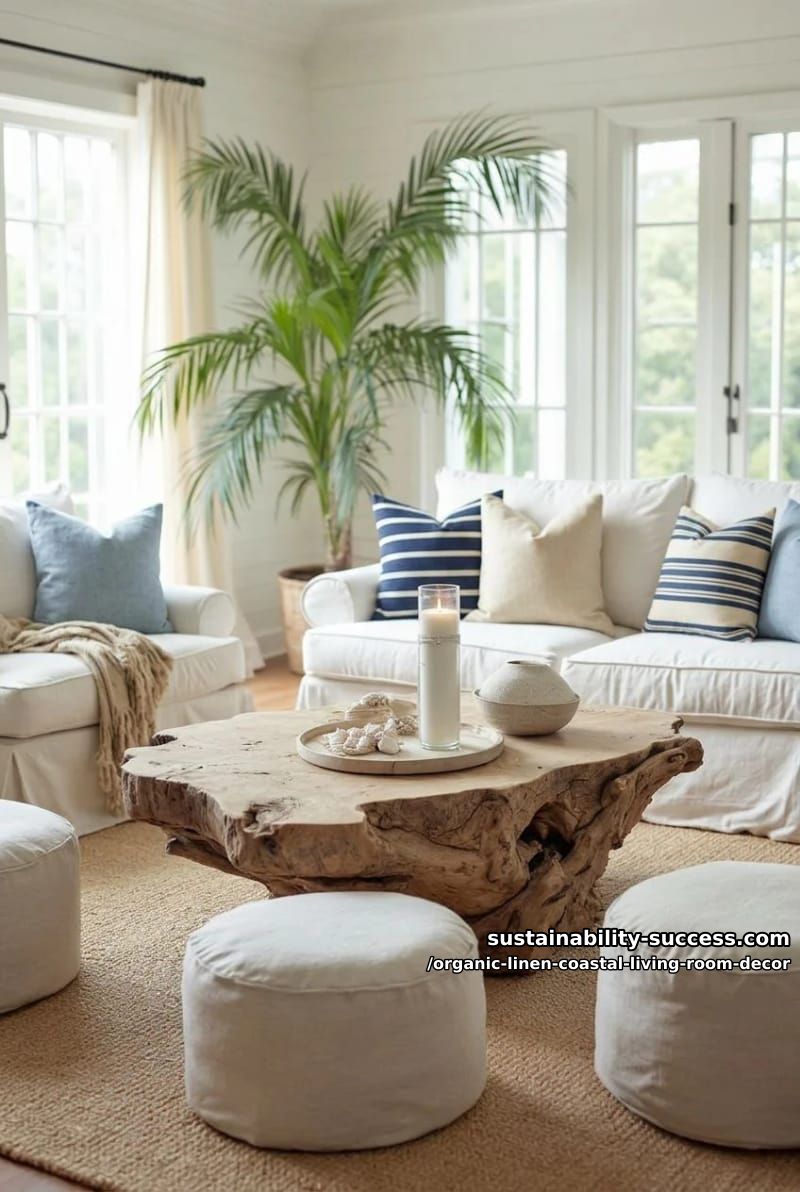
A driftwood-look table gives you the pale, washed-ashore grain without the project that genuine beach wood becomes. Skip the actual beach haul (it carries pests and salt, see the warning below) and start with salvaged elm or a kiln-dried teak slab weathered to that grey-blond tone, then let linen poufs carry the soft, casual part. Poufs earn their place because they move: extra seating when the room fills up, a footrest when it empties out, and a washable cover when a kid spills juice. Choose a firm fill like shredded foam or buckwheat over loose bean fill, which flattens within a year and can't be topped up.
Cluster two or three poufs around the table at different heights so it reads collected over time, not bought in a set. Pale oatmeal and undyed flax sit quietly against a beige sofa; save any color for the throw.
Wood pulled off a real beach often carries salt, boring insects, and mold spores. Salt keeps absorbing humidity and weeping; insects hatch indoors weeks later. If you insist on the genuine article, quarantine it outside for a few weeks, then bake smaller pieces at a low oven temperature to kill larvae, or have a larger slab kiln-dried. Untreated, it can quietly damage other wood furniture nearby.
3. Oversized jute area rug beneath a flax linen slipcovered sectional
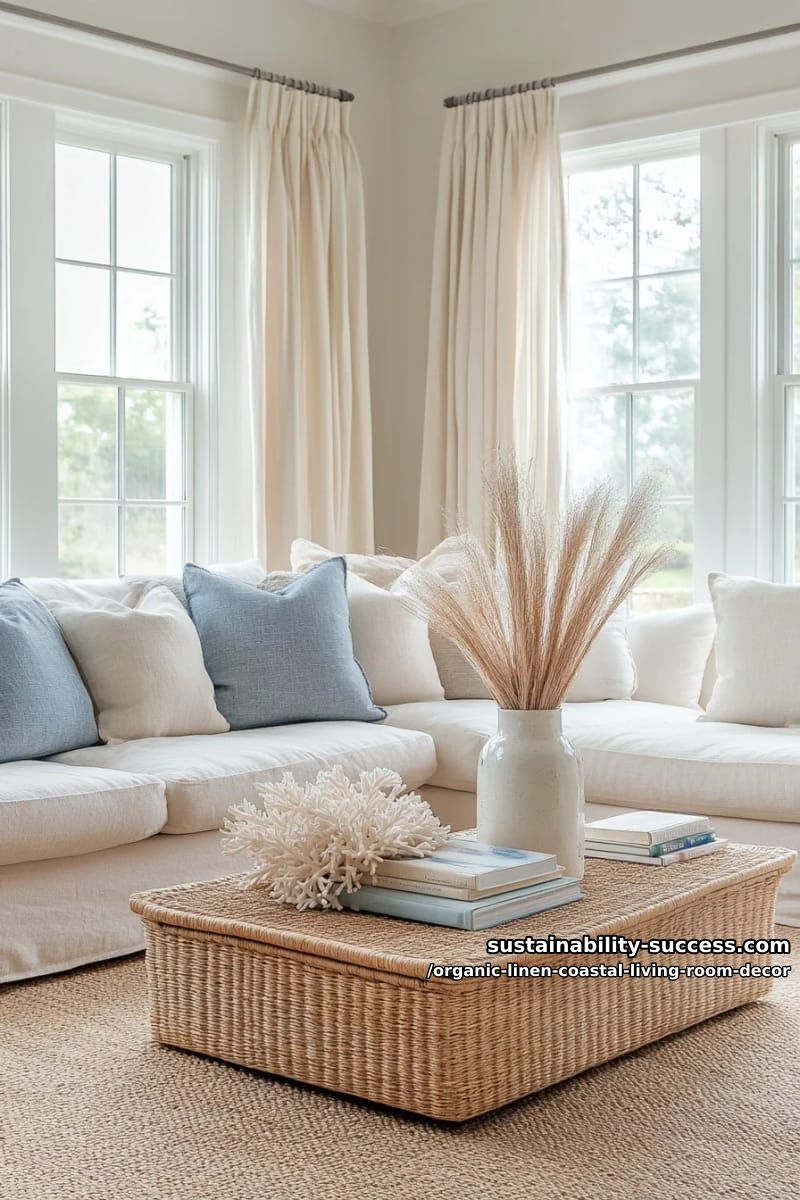
I used to tell people jute hides sand. It doesn't. Sand works down into the open weave and stays there until you flip the rug and beat it outside, which is the one honest caveat nobody mentions. That said, a large jute rug is still the right anchor under a linen sectional: the coarse fiber grounds all that soft beige, and a real 8×10 runs around $150 to $400 depending on weave density, far less than wool. Size it so the front legs of the sectional sit on the rug; a rug that floats in the middle of the seating makes the whole zone look undersized.
Jute is rough underfoot, so if you have floor-loungers, layer a flat-weave cotton or a washed linen throw rug on top in the spot where people actually sit. Keep jute away from doors and damp: it browns and smells when it gets wet, and it won't recover.
| Fiber | Underfoot | Sand & water | Where it belongs |
|---|---|---|---|
| Jute | Coarse, softens slightly | Traps sand; browns when wet | Under furniture, dry rooms |
| Sisal | Hard, scratchy | Stains and warps with any moisture | Low-traffic, never near a door |
| Seagrass | Smooth, almost slick | Most water-tolerant of the three | High-traffic, kids and pets |
4. Wall art featuring coastal landscapes above a whitewashed linen settee
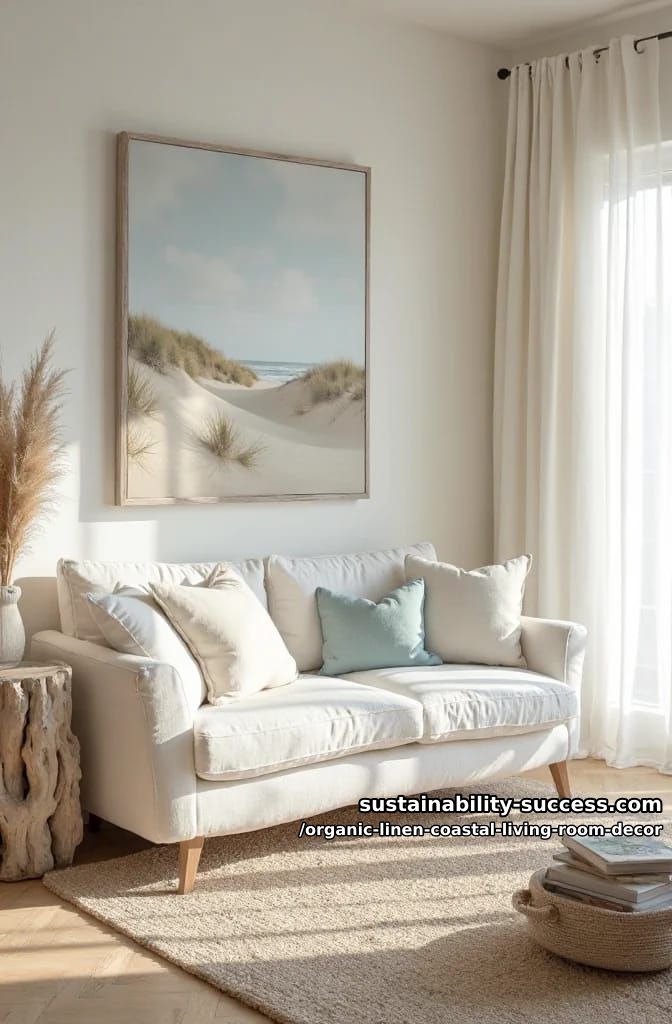
One real photograph beats a triptych of generic sailboats. The mass-produced "coastal" canvas sets from the big chains all read the same way, like hotel-corridor art, because they are printed from the same stock libraries. A single large piece (a black-and-white shoreline photo, a quiet oil of dunes, a print from an artist whose name you actually know) does more for the wall and tends to be the more sustainable buy, since you keep it.
Hang it so the center of the image lands at roughly 57 to 60 inches from the floor, eye level for most people. Over a settee, the art should span about two-thirds of the settee's width, and the bottom edge sits 8 to 10 inches above the back so the two pieces relate instead of crowding.
If you're framing something, ask a local framer about FSC-certified or salvaged-wood mouldings. It costs a little more than the plastic frame from the craft store, and you're not buying a frame designed to warp and get tossed in three years. A windswept beach you actually visited beats a stock dune every time, and people can tell the difference even if they can't say why.
5. Textured macramé wall hangings paired with billowy organic linen curtains
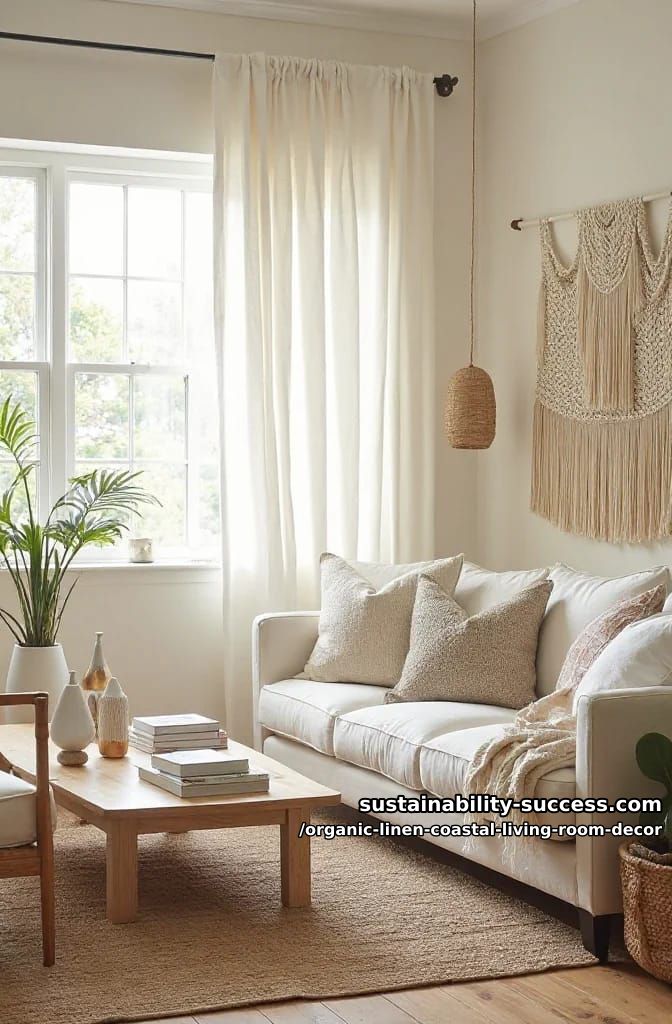
One large macramé piece in undyed cotton, not a gallery wall of them. A wall full of small knotted hangings reads dorm-room circa 2021; a single oversized piece with real scale reads intentional. Buy or commission one in natural, un-dyed cotton cord so there's no synthetic dye runoff, and hang it where side light can rake across the knots and throw shadow.
The curtains do most of the actual work in this pairing. For real billow, the panels need to total 2 to 2.5 times the window width, and the rod should mount close to the ceiling and extend a few inches past the frame on each side so the fabric stacks off the glass. Linen's loose weave filters light into something soft instead of blocking it.
Do this
- Mount the rod 4 to 6 inches below the ceiling, not just above the window
- Order panels that puddle slightly or break at the floor
- Steam, don’t iron; a handheld steamer relaxes linen without flattening it
Avoid
- Panels that stop above the sill (they make the window look smaller)
- Polyester “linen-look” sheers; they hang stiff and never billow
- A cluster of tiny macramé pieces fighting the curtains for attention
6. Seagrass baskets filled with pale blue and ivory linen pillows
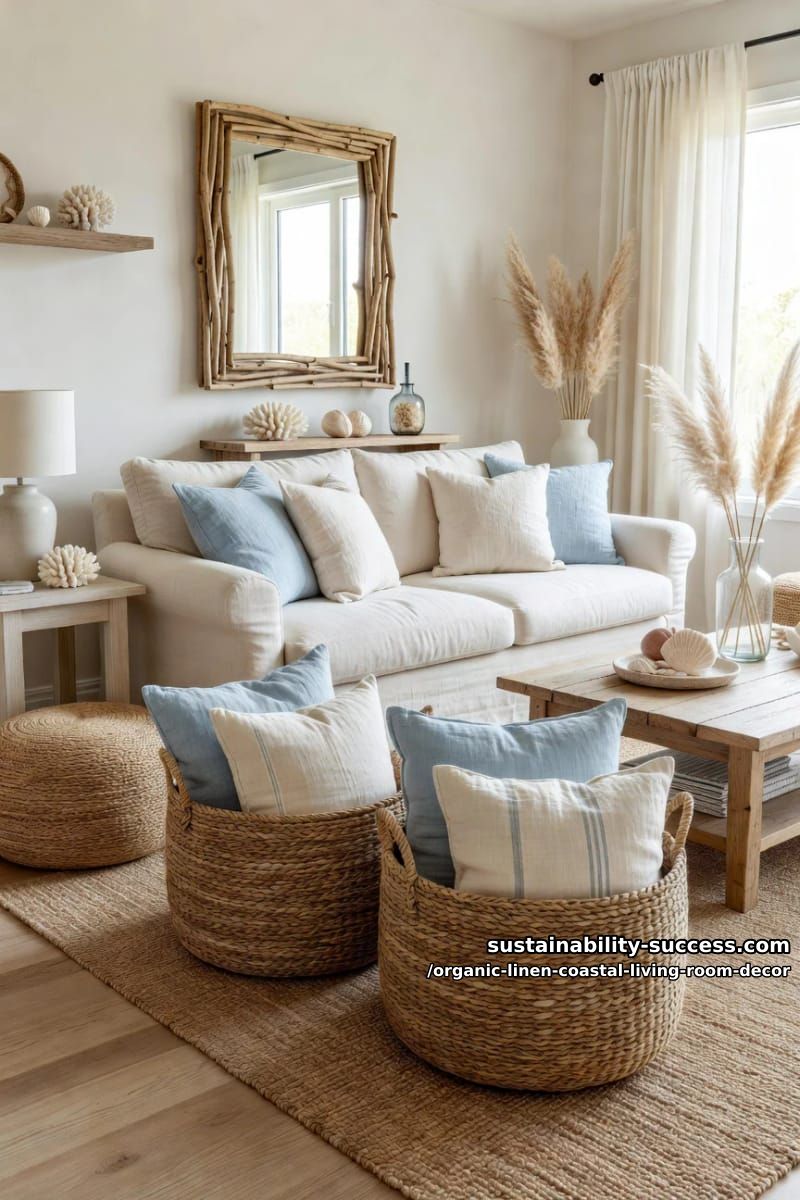
The pillows matter more than the basket, and most people get this backwards. A linen cover stuffed with a cheap polyester insert goes flat and lumpy fast; buy the cover and the insert separately, and size the insert 2 inches larger than the cover so it fills the corners. MagicLinen and Cultiver both sell washed-flax covers in the pale blues and ivories this look wants, and a feather-down or kapok insert holds shape for years where poly does not.
For the palette, keep most of the pillows solid and let one carry a subtle pattern (a faded stripe, a slubby weave), not the other way around. Stack a few in the basket and use the rest on the sofa so it looks lived-in rather than merchandised.
Seagrass frays at the rim over time and hates damp, so keep the basket off a cold tile floor and rotate it now and then. A frayed edge is fixable with a dab of clear craft glue, which is more than you can say for a split poly insert.
7. Rattan pendant lights suspended over a linen slipcovered lounge chair
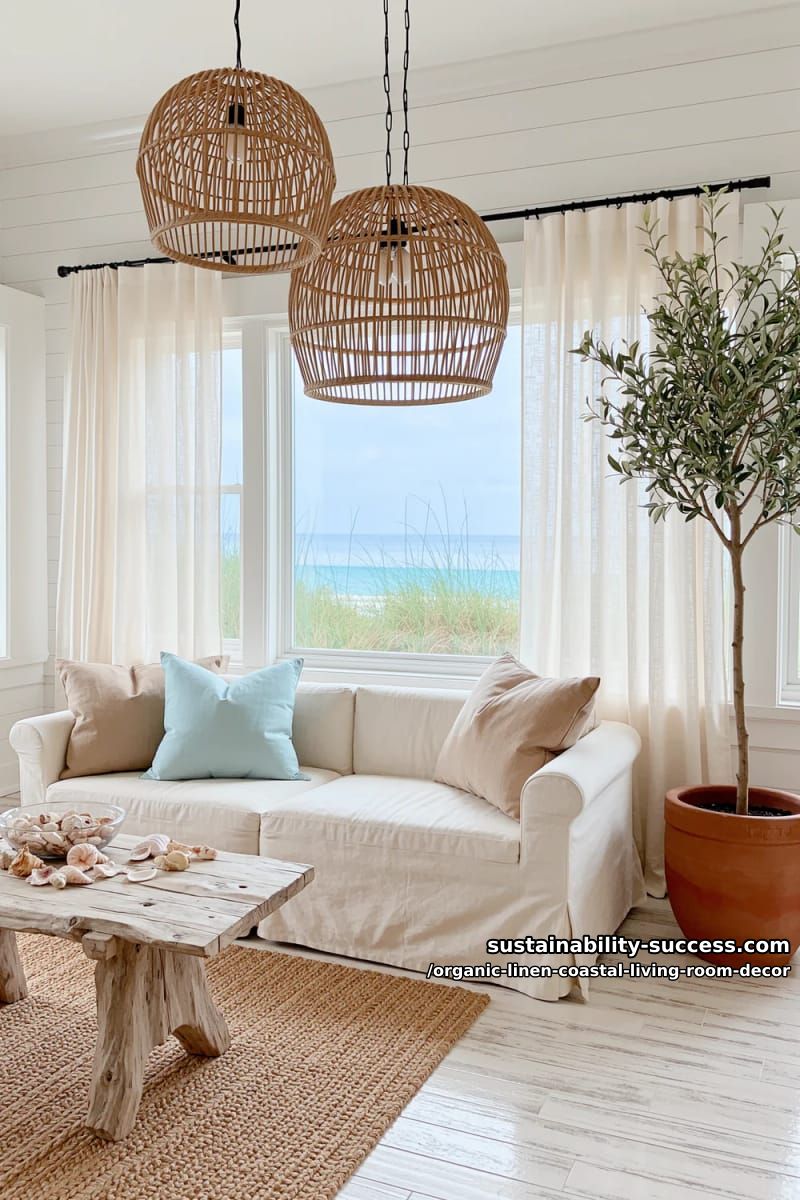
Check that it's real rattan, not the molded look-alike, before you buy. The genuine cane has weight, a faint grassy smell, and slight irregularity in the weave; the imitation is suspiciously uniform and cracks at the joints within a year. Rattan is a fast-growing climbing palm and fully biodegradable, so a solid, well-made pendant you keep for a decade earns back even the cost of shipping it across an ocean.
Over a lounge chair the pendant is ambient, not task, so hang it to one side rather than dead-center over someone's head, with the bottom of the shade around 6.5 to 7 feet off the floor in a standard room. A woven shade throws patterned shadow on the wall, which is half the reason to hang one.
Use a 2700K warm-white LED, not the bluish 4000K or 5000K bulbs that come standard with many fixtures and make linen look grey and clinical. Put the pendant on a dimmer and aim for roughly 450 to 800 lumens for a reading corner. A frosted bulb hides the filament and softens the shadows the rattan casts.
8. Rustic wooden beams with airy linen drapes framing ocean-view windows
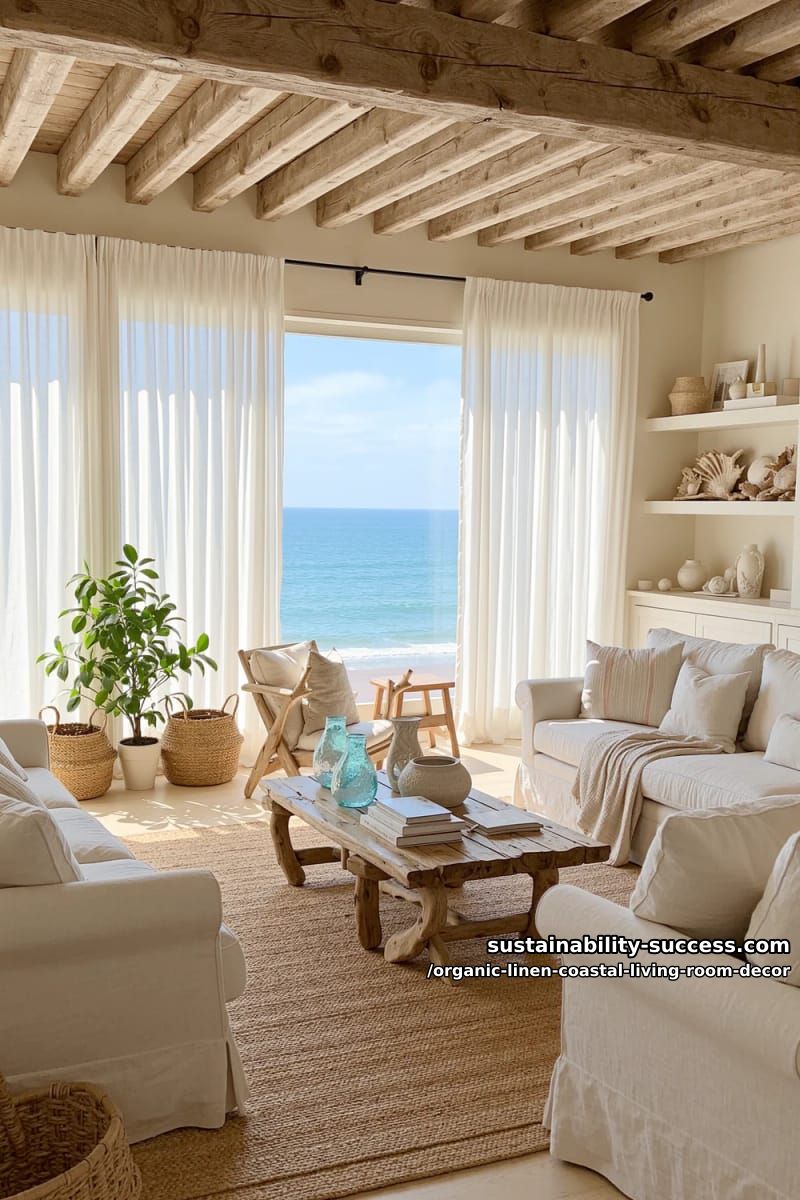
Most readers have neither beams nor an ocean, so let's be honest about the workaround. If you want the beamed ceiling, build hollow box beams from salvaged barn boards or pine you stain yourself, never the spray-foam "faux beams" sold at home centers. The foam ones photograph fine and look like pool noodles in person, and they head to landfill the day you take them down. Box beams from real timber cost more in labor and pay you back in a surface that earns a patina instead of yellowing.
The drapes are what soften all that structural wood. Hang them high and wide, the same rule as any window, and let the linen pool an inch at the floor so it reads relaxed. Linen's weave breaks up hard noon light into something you can sit in.
If you rent, skip the beams entirely and put the budget into the drapes and a single weathered-timber mantel or floating shelf. Faking the architecture badly looks worse than not faking it, and a landlord will charge you to pull the foam down anyway.
9. Statement greenery in terracotta vases beside an oatmeal linen daybed
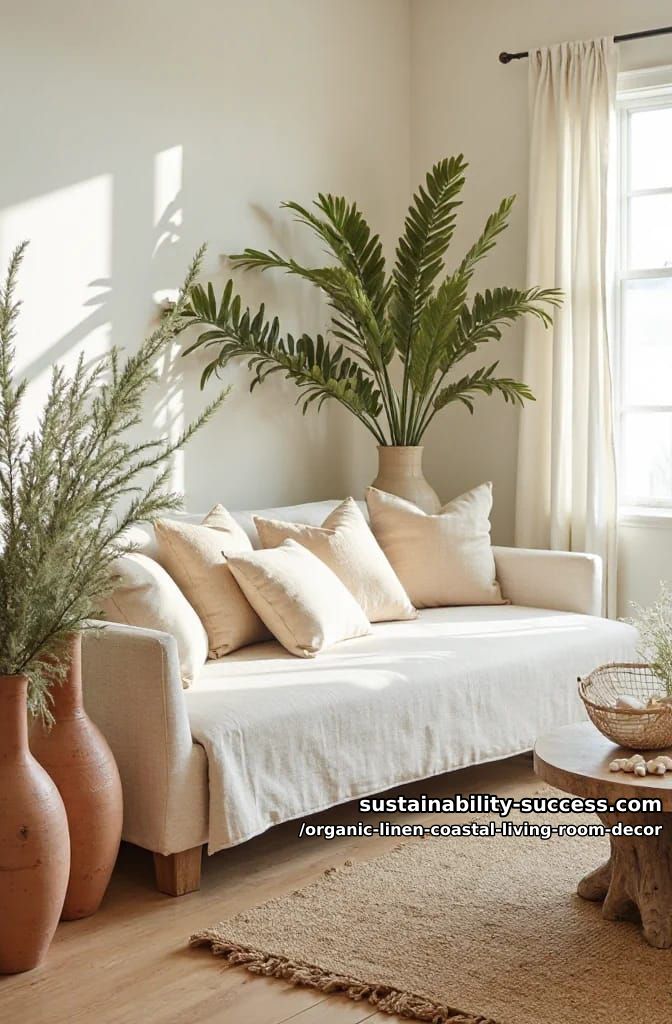
Real plants over faux, and if you must go faux, spend real money or use dried instead. The discount-aisle fern looks like exactly what it is, fades within a year, and goes straight to landfill, where dried palm or preserved eucalyptus is compostable and ages gracefully. Unglazed terracotta wicks moisture out through its walls, which suits drought-tolerant species and is the opposite of what a thirsty fern wants, so match the plant to the pot.
For coastal light (usually bright and indirect near big windows), an olive tree, a rubber plant, or a sculptural snake plant holds its shape against the daybed without the fuss of a fiddle-leaf fig throwing a tantrum every time you move it.
Do this
- Pick one large plant over three small ones for real impact
- Use dried palm, preserved eucalyptus, or grasses if you can’t keep things alive
- Match the species to terracotta’s quick-drying soil (olive, snake plant, rosemary)
Avoid
- Cheap faux stems that fade, gather dust, and won’t compost
- Moisture-loving ferns in unglazed terracotta (they dry out constantly)
- Dyed pampas grass, which is everywhere and sheds fluff endlessly
10. Shell and coral arrangements atop a reclaimed wood console with linen runners
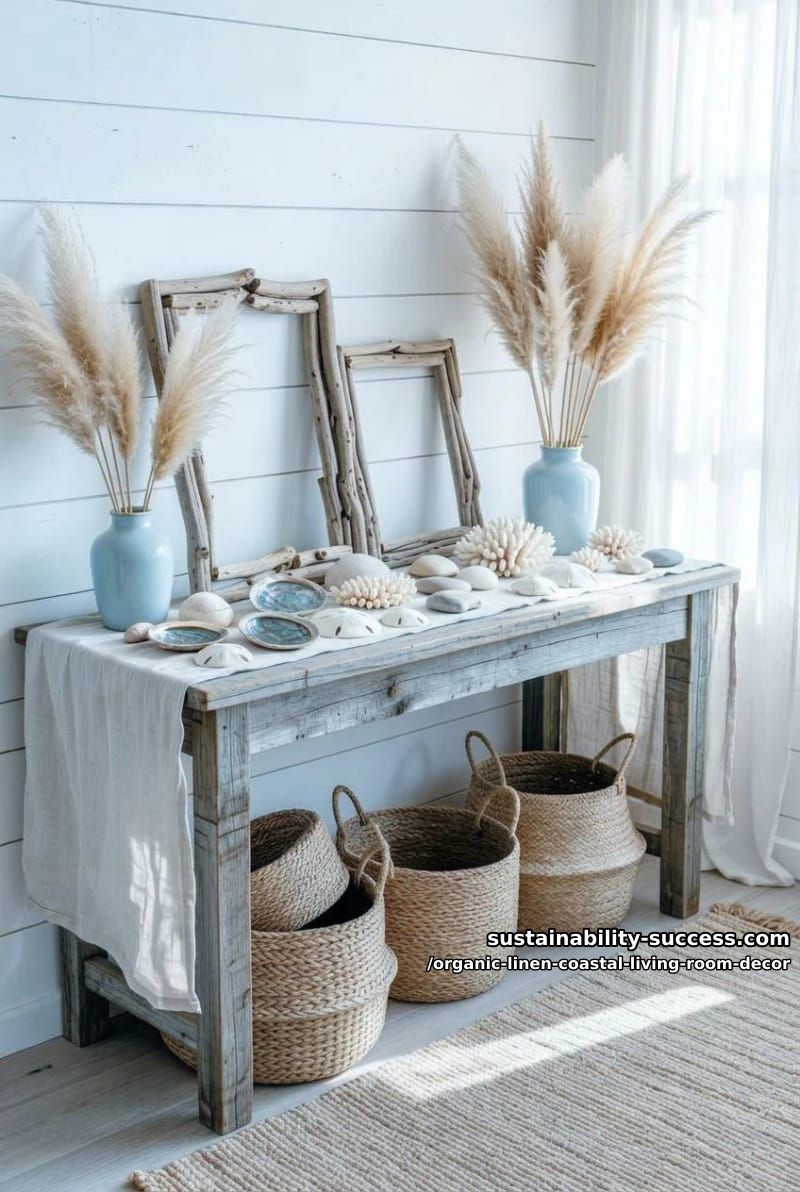
Don't buy coral. On a sustainability blog this has to be said plainly: most decorative coral is harvested from living or recently living reefs, the trade contributes to reef damage, and many species are protected under CITES, so importing the wrong piece is illegal as well as ugly in the moral sense. Use shells you collected yourself where local rules allow it, or ceramic and plaster pieces that read as shells without stripping a reef to do it.
However you source them, restraint reads as the more expensive choice: three or four larger neutral shells in a shallow bowl say more than a scattered pile of twenty. A weathered console keeps the display from feeling precious, and a flax runner gives the cluster a soft base without the formality of a tablecloth.
Sellers describe wild-harvested coral as “natural” or “ethically sourced” with no proof behind the words. If a piece has no clear documentation, assume it came off a reef. Ceramic, resin-free plaster, or beachcombed shells get you the same look with none of the legal or ecological baggage. This is one decor trend worth letting go of entirely.
11. Natural wood round coffee table with stacked linen-bound coffee books
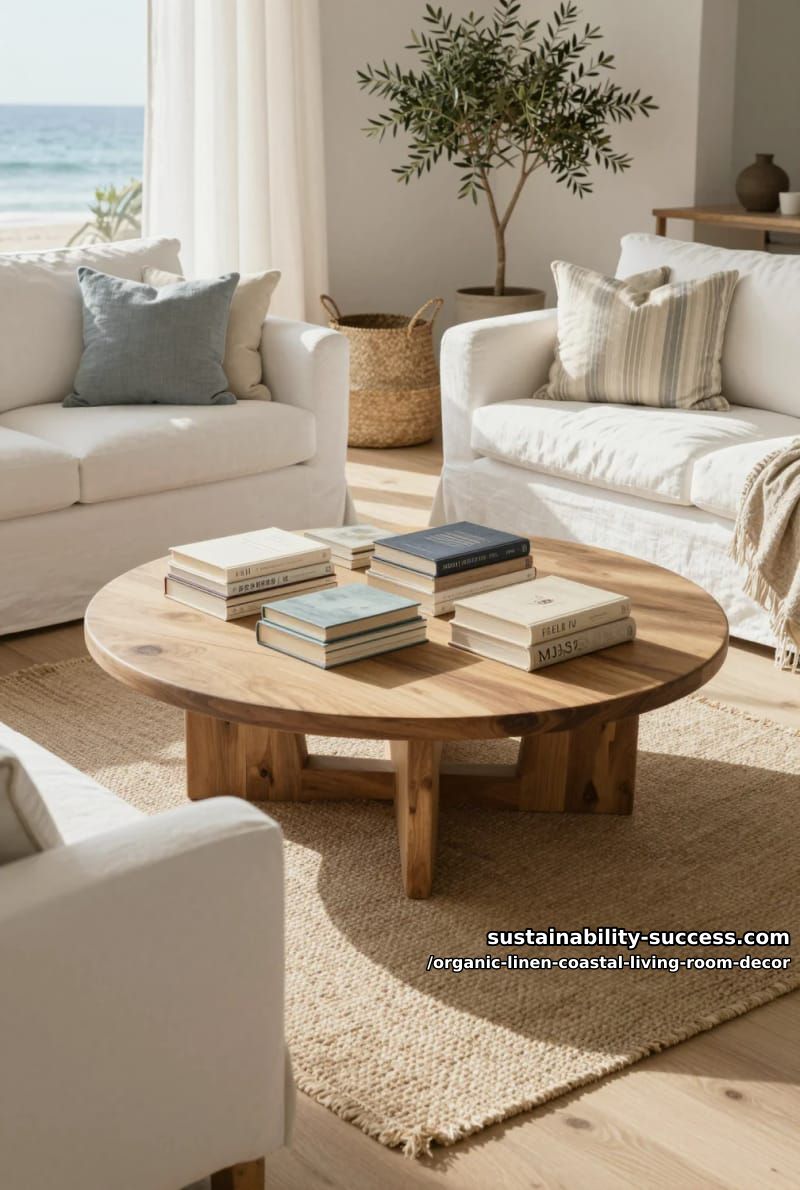
Buy books you'll actually open, not "linen-bound coffee books" bought by spine color and never read. The whole bought-by-the-yard decor-book thing is a styling cliché that turns a bookshelf into wallpaper, and secondhand shops are full of beautiful oversized photography and architecture titles for a few dollars each. A round table softens a room full of straight linen-covered furniture, and the raw grain gives your eye something to land on.
On the table itself, go solid wood or FSC-certified over MDF with a printed wood veneer; the veneer chips at the edges and there's no refinishing it once it does. Solid timber you can sand and re-oil for decades, and it picks up a deeper patina as it goes.
And use coasters. Linen-bound covers and a raw or oiled wood top both ring and stain from a sweating glass, and a water mark on an unsealed table is permanent in a way nobody mentions in the styled photos.
12. Woven cane accent chairs with blush pink linen cushions
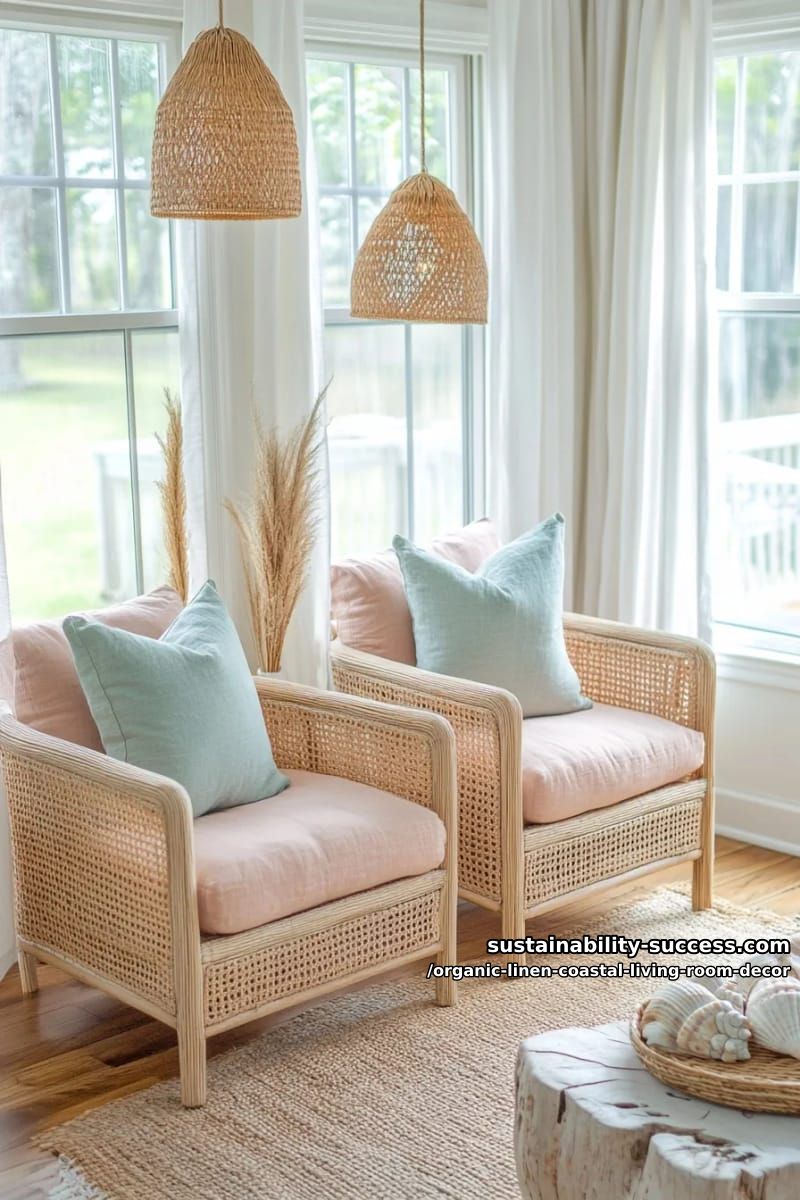
Buy the cane chair secondhand, not new. Estate sales and consignment shops are full of vintage cane and bentwood seating that was made with denser weave and better joinery than most new imports, it costs less, and rescuing one is the lower-carbon choice by a wide margin. Check that the cane is tight and unsplit before you hand over money; re-caning a seat runs more than the chair is often worth.
Granted, blush pink is a fork in the road for a coastal palette. Pushed bubblegum, it tips the whole room toward farmhouse-nursery; kept muted, more of a clay or dusty rose, it stays grounded and reads sun-faded instead of sweet. Pick the dustier end and you keep the coastal read.
One climate note people get backwards: cane likes a little humidity and cracks in dry heat, so a chair living next to a radiator or in a desert-dry room needs the occasional light misting on the underside of the weave to keep it from going brittle.
13. Minimalist open shelves styled with coastal pottery and folded linen throws
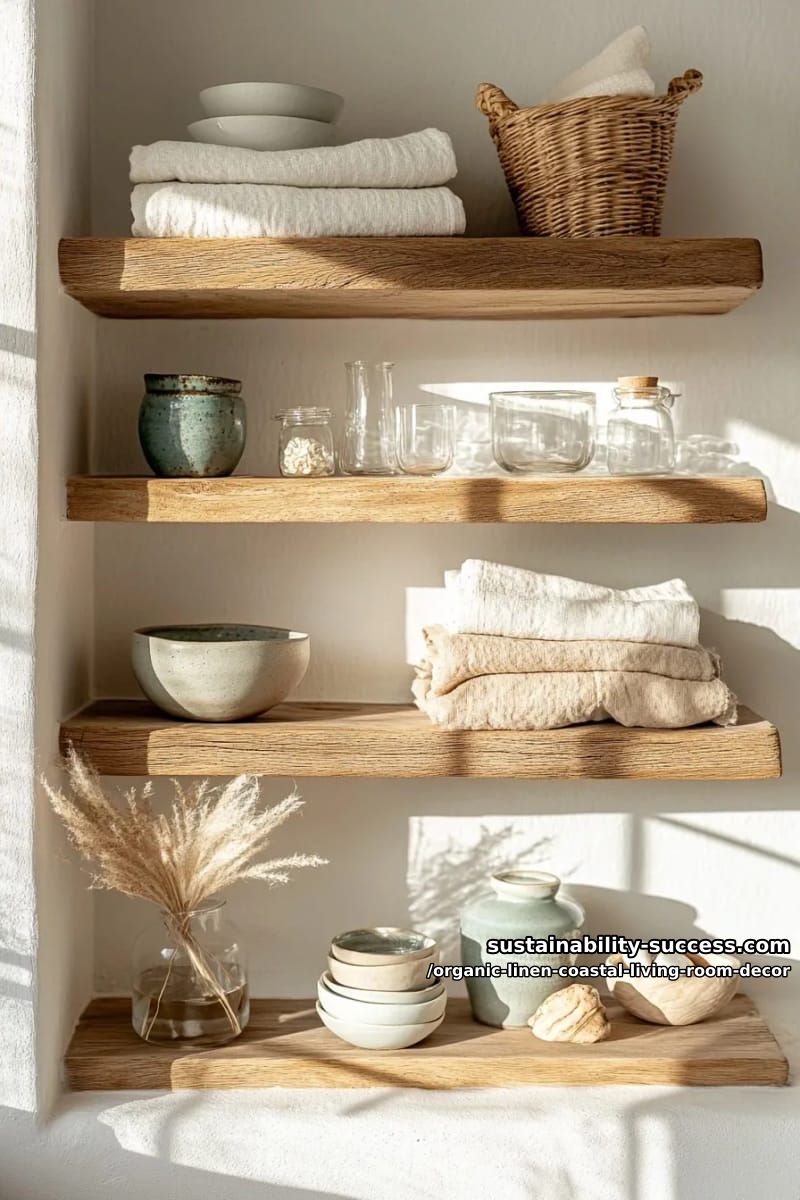
Open shelves are dust magnets, so style them only if you'll actually dust them. With that out of the way: negative space is what makes this look work. Group objects in odd numbers, vary the heights so your eye moves up and down the shelf, and leave a good third of each shelf empty. A single matte-blue vase with room to breathe outperforms a shelf packed edge to edge.
Source the pottery secondhand or from a local potter rather than a big-box "coastal collection." Thrifted ceramics carry small irregularities that catch light, support someone other than a warehouse, and cost less; folded linen throws stacked on the lowest shelf add the soft texture that keeps the whole thing from looking like a showroom.
Styling a three-shelf unit
One narrow open shelving unit, three shelves, beside a sofa
Top shelf: one tall stoneware vase off to one side, a small framed photo leaning behind it, the rest left open. Middle shelf: a stack of three or four photography books lying flat, a low bowl on top as a weight. Bottom shelf: two folded linen throws and a shallow seagrass tray for remotes. Nothing centered, nothing symmetrical, and at least a third of every shelf bare.
14. Textured sisal rug layered with a fringed linen blanket and driftwood tray
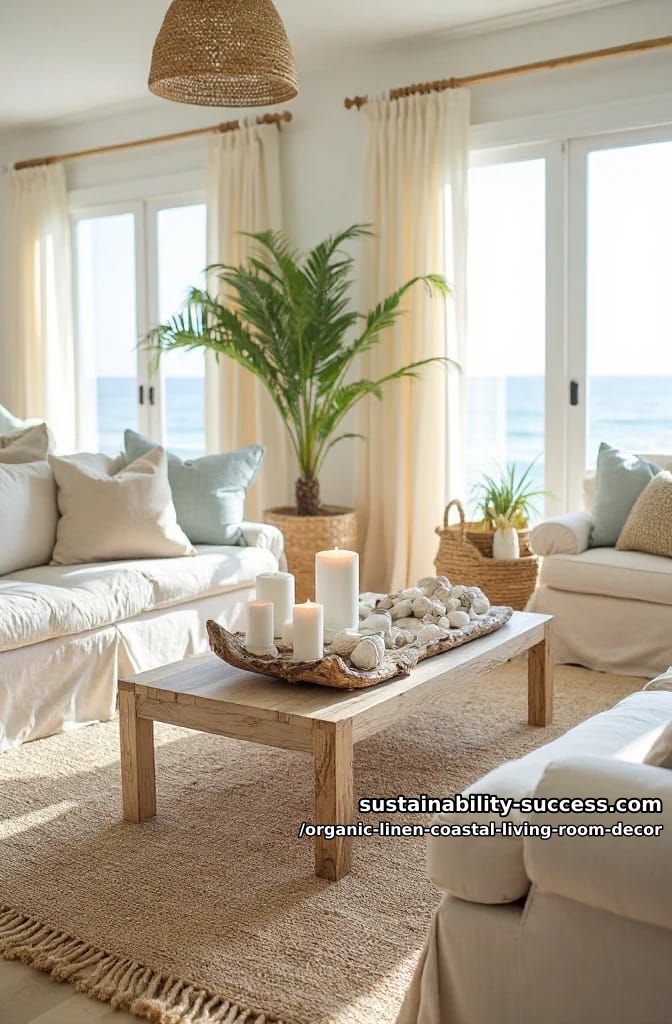
Sisal is the wrong rug for sandy feet and beach-loving pets, despite what every list (including, honestly, the one this rewrites) says. It's worse with moisture than jute: a single spill leaves a stain and can warp the backing, and you can't wet-clean it. So put sisal where it'll stay dry, away from the door, away from the dog's water bowl, and enjoy the tight, even texture it gives underfoot.
Layer a fringed linen blanket across one corner to break up the flat weave and add a spot that's soft to sit on, then set a driftwood or weathered-timber tray on top as a catchall for books and a glass. The tray keeps the linen from sliding and gives the corner a reason to exist beyond looking nice.
If you genuinely need a natural-fiber rug near a wet entry, flip back to seagrass from idea three. It's the one that shrugs off a spill.
15. Neutral coastal palette using white linen, sandy woods, and olive green plants
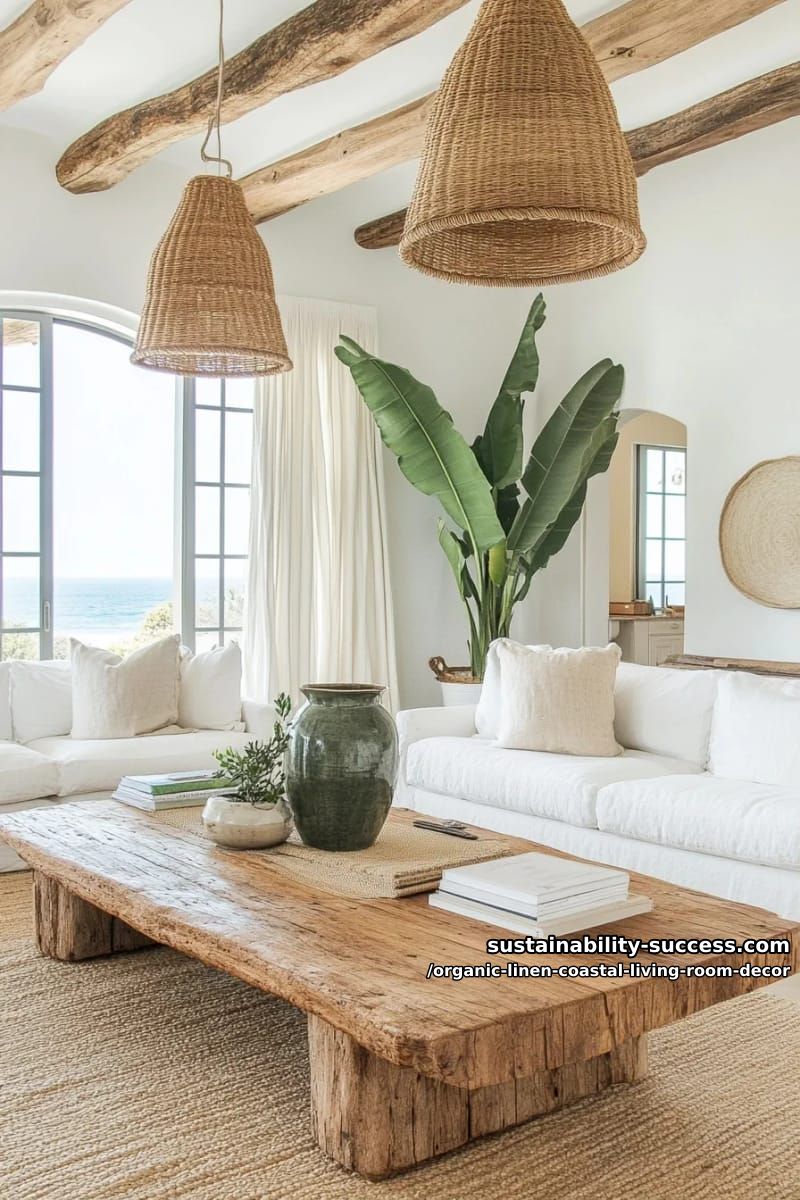
All-white linen with kids or pets is a fantasy unless the covers come off and go in a hot wash, so go greige instead of true white and choose slipcovers over fixed upholstery. A warm off-white (think wet sand, not printer paper) hides life better and won't fight the wood tones the way a cool blue-white does. Build the room on roughly 60% the soft neutral, 30% the sandy wood, and 10% something living.
That last 10% is the olive green: a tree, a few stems, one glazed pot. The interest in a neutral room comes from texture, not color, so mix a crumpled linen against a smooth ceramic against a coarse jute and the "bland" problem disappears without adding a single bright accent.
Skip the matchy "coastal collection" bundles that try to sell you the whole palette in one click. They date fast and lock you into one brand's idea of beige.
Conclusion
If you do these in order, start with the two that change the room most for the least money: a washable linen slipcover on the sofa you already own, and one large natural-fiber rug sized so the furniture sits on it. Those two alone move a room most of the way coastal before you spend on a single accent.
The one thing I'd push back on from the usual version of this list is the coral. Leave it on the reef and let ceramic do the job; your living room won't know the difference and the ocean will. Everything else here rewards buying slowly: real flax over the blend, an heirloom cane chair over a new import, books you'll read over books you'll dust. A coastal room that lasts is mostly a matter of not buying the disposable version twice.