
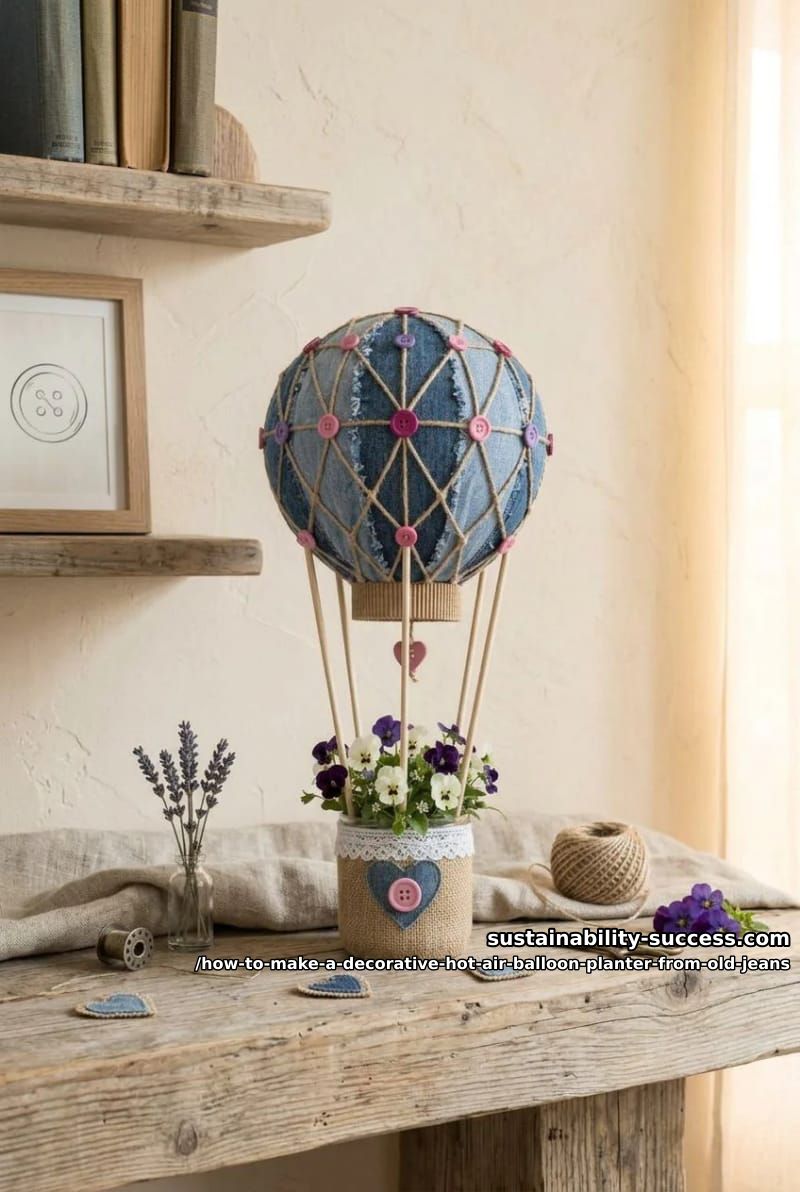
This planter turns one worn-out pair of jeans and a leftover foam ball into a tabletop hot air balloon with real flowers riding in the basket, and the build is almost entirely glue work, no sewing machine required.
The only steps people get wrong are the two that decide whether it lasts: which foam you decoupage onto, and how you anchor four dowels into a basket light enough to hang under a sphere. Both are covered below, along with a split shopping list so you can see what the project actually costs if your scrap drawer is already full.
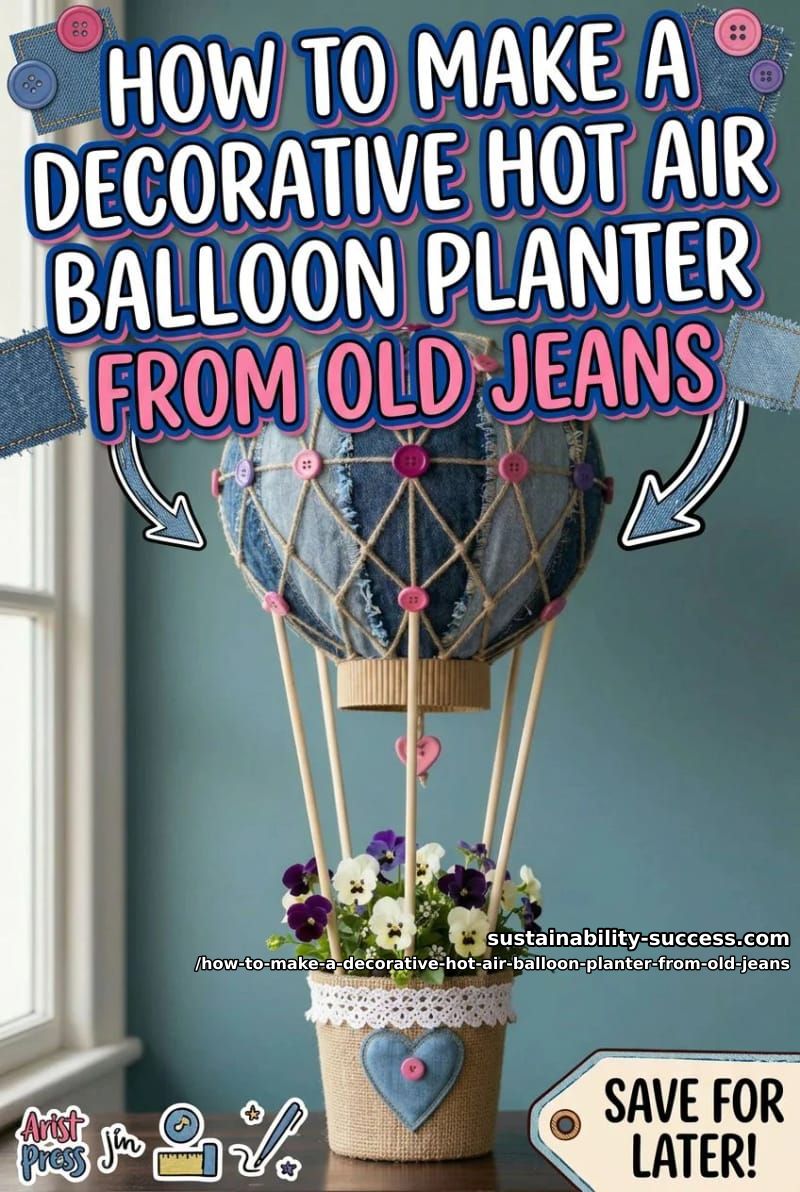
Finished height lands around sixteen to eighteen inches with a six-inch ball and twelve-inch dowels trimmed down. Everything is held with hot glue except the denim skin, which goes on with decoupage medium. Read the foam note before you buy anything; it is the single decision that ruins the most attempts.
What you need
The denim and the basket vessel are free if you raid a closet and a recycling bin. Everything else is a craft-aisle staple you will have left over for the next three projects. Prices below are worst case, every pack bought new.
Materials (consumables)
| Qty | Item | Spec | Price |
|---|---|---|---|
| 1 | Smoothfoam 6-inch craft ball | smooth polystyrene, not coarse bead foam | $8 to $14 |
| 1 pair | Old jeans | soft, worn, ideally mixed washes | Free |
| 1 | Mod Podge Matte, 16 oz | decoupage medium for the denim skin | $8 to $13 |
| 1 | Natural burlap roll, 12 inch | sewn-edge, low fray | $10 to $16 |
| 1 | Single-face corrugated kraft roll | ridged one side, bends around curves | $10 to $16 |
| 4 | Bamboo dowels, 1/4 in x 12 in | sold in 50-packs; you use four | $7 to $12 |
| 1 | Jute twine, 2mm | natural color for the net | $6 to $10 |
| ~12 | Assorted craft buttons | mixed colors and sizes | $6 to $10 |
| 1 | White cotton crochet lace trim | half-inch to one-inch scalloped | $7 to $11 |
| 1 bunch | Small artificial flowers and greenery | pansy-style blooms plus filler sprigs | $12 to $20 |
| 1 | Small jar or tub | jam jar, yogurt cup, small planter, the basket core | Free |
| scraps | Felt offcuts | for the basket heart and bunting flags | $0 to $6 |
| Materials subtotal | $74 to $128 | ||
Tools (reusable)
| Qty | Item | Spec | Price |
|---|---|---|---|
| 1 | Full-size hot glue gun kit | comes with sticks and a silicone mat | $12 to $20 |
| 1 | Fabric scissors | sharp enough to cut denim cleanly | $8 to $15 |
| 1 | Flat brush | half-inch to one-inch, for the medium | $2 to $6 |
| 1 | Cup or bowl | a stand to rest the ball while it dries | Free |
| Tools subtotal | $22 to $41 | ||
| Combined total, everything new | $96 to $169 | ||
Prices are approximate ranges as of June 2026; verify before purchase. If you own a glue gun and have a button jar, the real out-of-pocket is closer to $40.
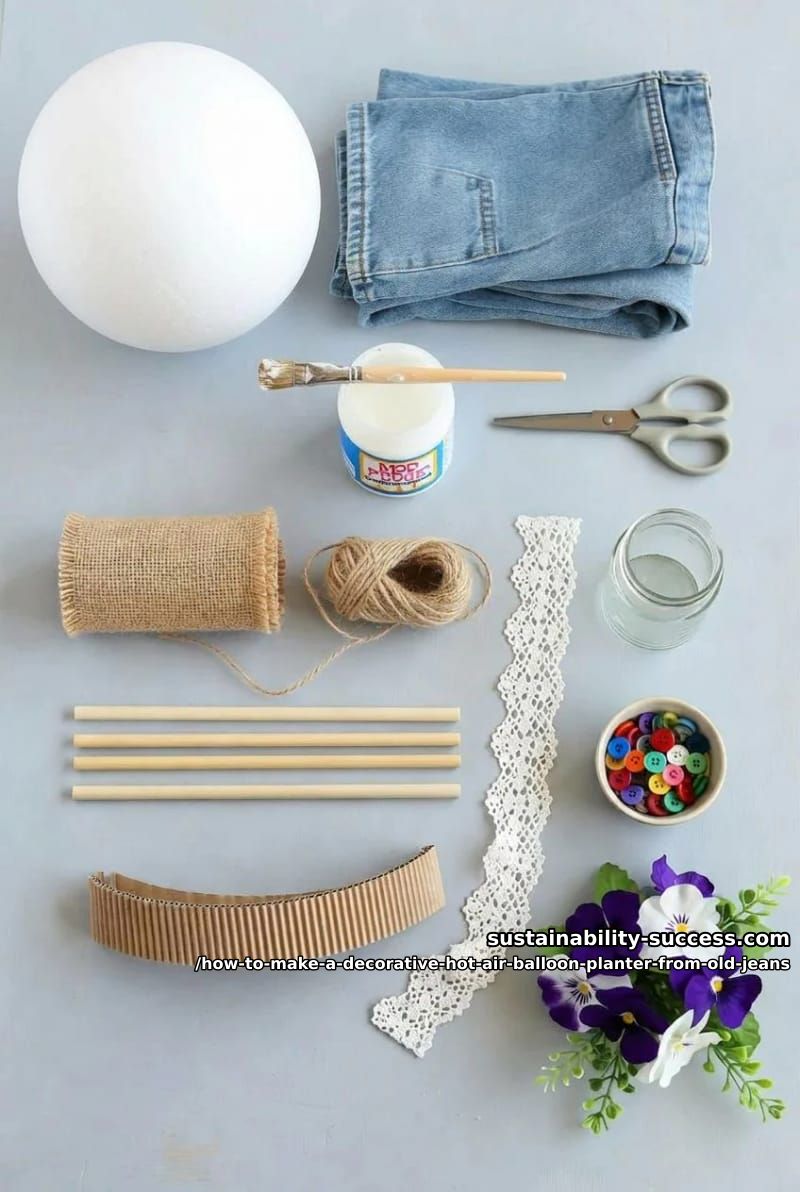
Pick the right ball and the right denim
Use smooth polystyrene foam, not the coarse white kind that sheds little beads. Decoupage medium grips a smooth surface and sinks straight through an open-cell one, so the denim peels at the edges a day later. This is the failure mode behind most sad-looking attempts, and no amount of extra glue fixes it after the fact. The Mod Podge Rocks blog has been saying the same thing for years and they are right.
For the skin, raid worn jeans rather than buying yardage. Old denim has gone soft, so it molds over a sphere; stiff new selvedge fights the curve and frays into hard ridges. Mixing washes is the whole charm of the patchwork, so cut from the faded thigh, the dark inseam, and a back pocket if you have one.
Reach for
- A smooth polystyrene ball, six inches, light enough to lift with two fingers.
- Soft, broken-in denim in two or three shades.
- Matte decoupage medium. Gloss makes the denim look shrink-wrapped in plastic.
- Hot glue for everything structural; the medium is only for the fabric skin.
Avoid
- Coarse bead foam. The medium vanishes into it and the patches lift.
- A plaster or ceramic sphere, which makes the planter top-heavy and prone to tipping.
- Spray adhesive, despite what half the internet says. It will not hold fabric weight on a curve.
- Thick upholstery denim that bunches into lumps at every seam.
Step 1: Cover the ball in denim patchwork
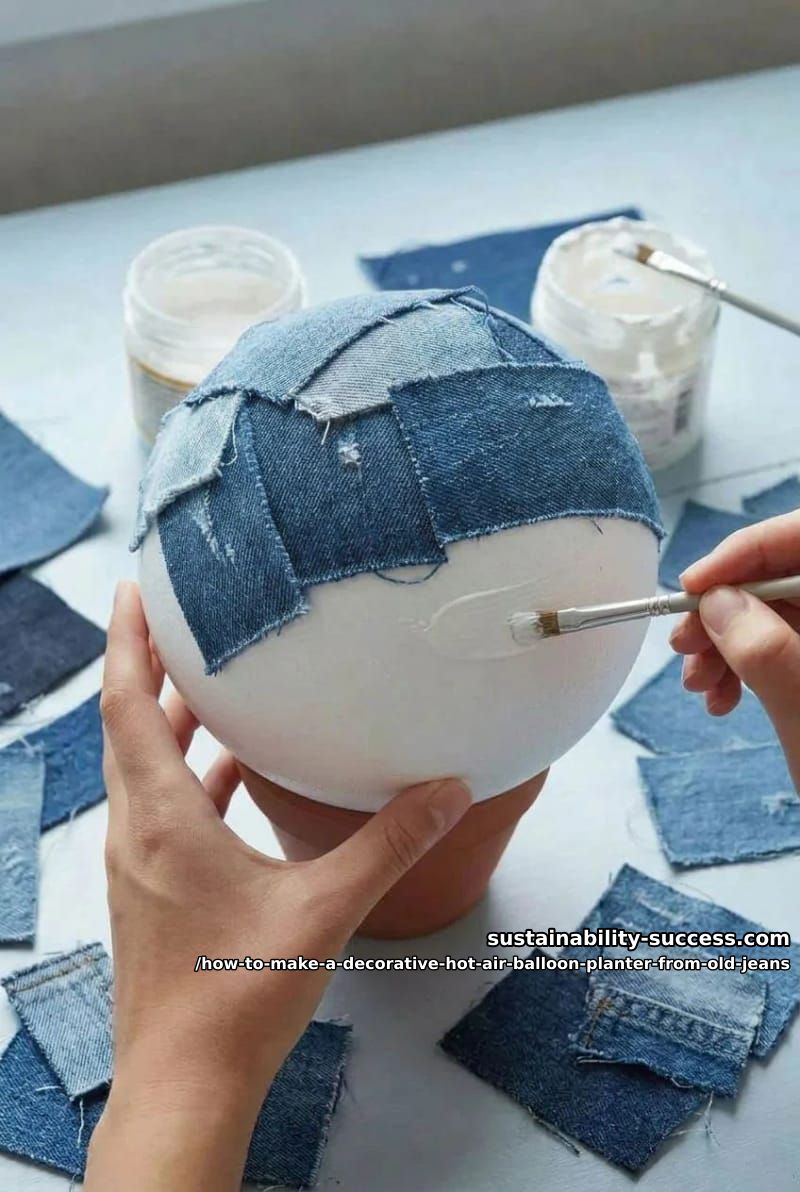
Work in small sections and let one half dry before flipping, or you will leave fingerprints in wet patches and flatten the ones underneath. Rest the ball in a cup or bowl so it sits still while you glue, the same trick of using a stand that keeps it from rolling off the table.
- Cut the denim into irregular patches roughly two to three inches across. Curved and angular pieces tile a sphere better than neat squares.
- Brush medium onto one section of the ball, press a patch into it, then brush a second coat over the top, smoothing from the center out so the edges lie flat.
- Overlap each new patch slightly over the last. Overlaps hide the foam; gaps show it.
- Cover one hemisphere, let it dry fifteen to twenty minutes, then do the other half. Leave a clean ring at the very bottom where the cardboard collar will sit.
Soaking the patches in too much medium turns the denim dark and stiff and takes hours to dry. You want a thin coat under and a thin coat over, visible white while wet, clear when dry. If a patch slides, you used too much.
Step 2: Build the burlap basket
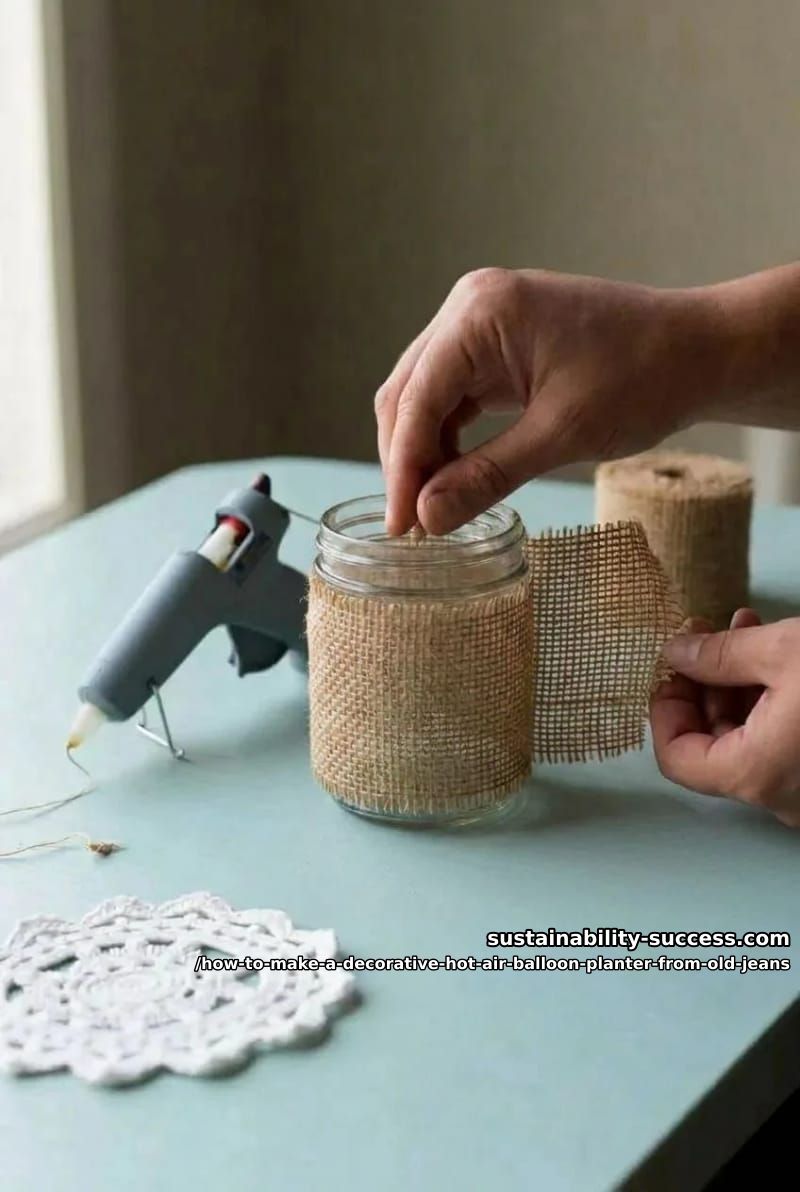
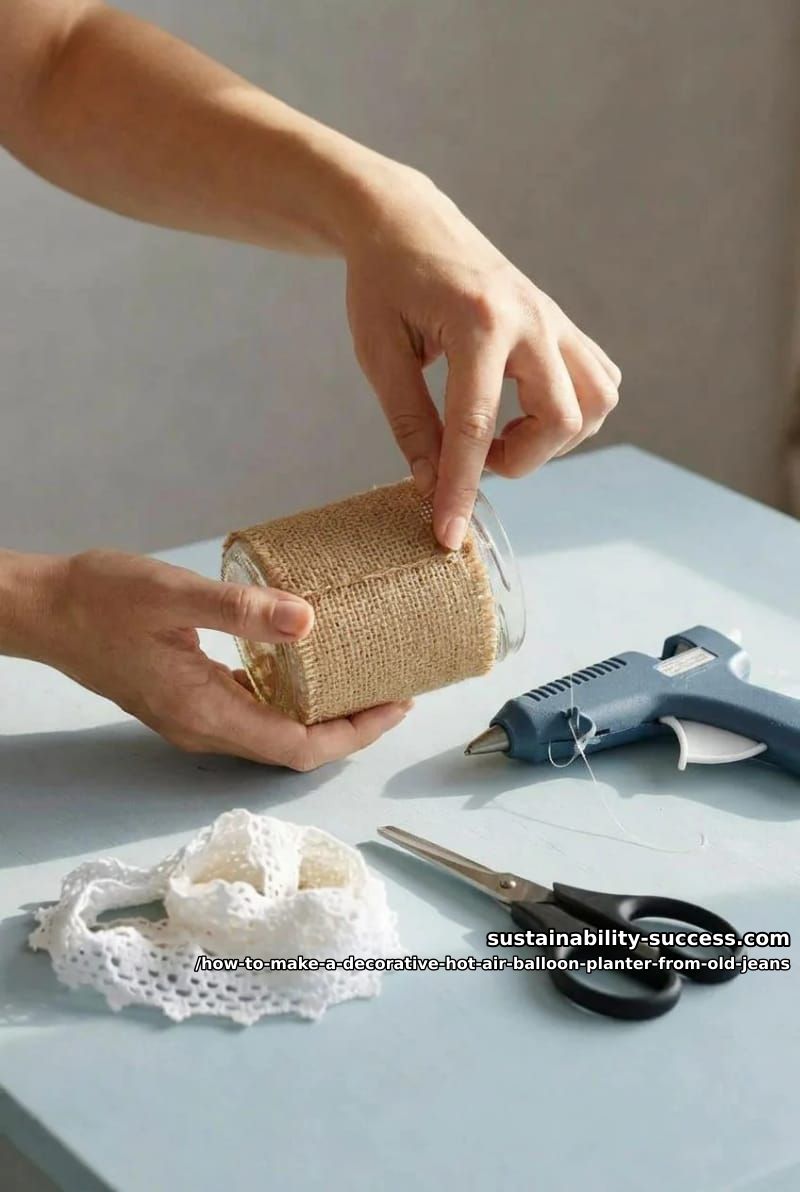
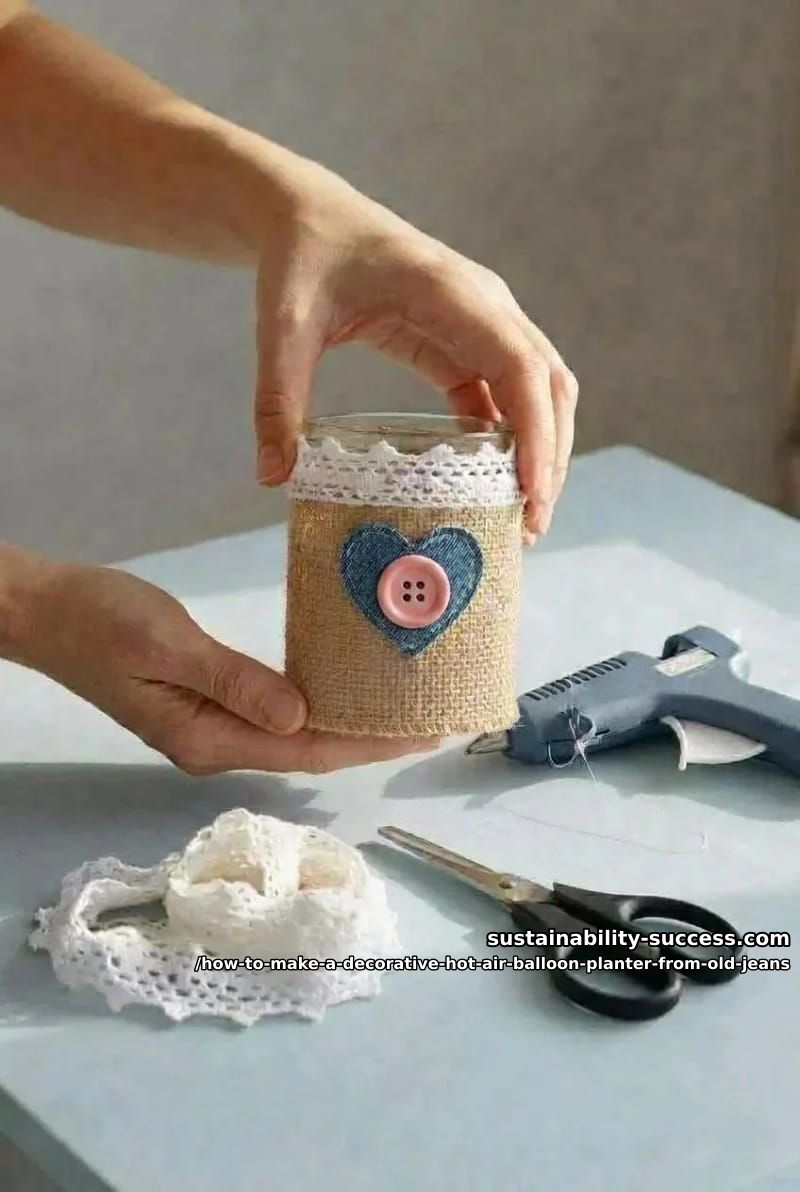
The basket is a small jar, planter, or tub dressed in burlap, and lighter is better since it hangs under the balloon. A glass jam jar works; an empty yogurt tub works and weighs less. Wrap, glue, then decorate.
- Cut a burlap strip tall enough to stand an inch above the jar rim and long enough to wrap with a small overlap.
- Run a line of hot glue up one side of the jar, press the burlap start onto it, wrap, and glue the overlap seam.
- Fold the extra inch inward over the rim and tack it down inside, or leave it standing as a frayed cuff.
- Glue lace around the top and bottom edges, then add a small felt or denim heart on the front with a button at its center.
Step 3: Set the four dowels into the basket
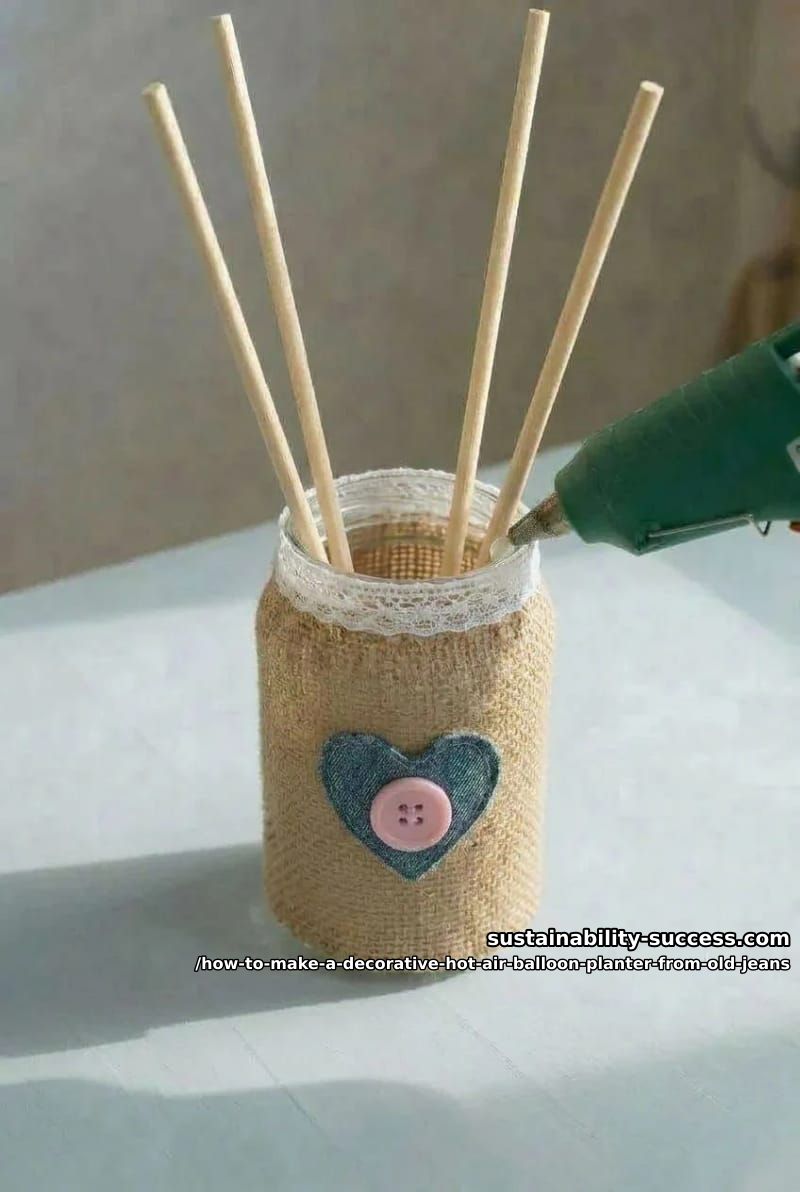
Stand four dowels upright inside the finished basket and glue them so they splay out very slightly toward the top, which is what makes the balloon look like it is floating rather than skewered. Glue them to the inside wall of the jar, not just the base, so a knock does not tip them.
Four dowels spaced evenly form a square footprint that resists sideways wobble far better than three.
A slight outward flare at the top spreads the load across the sphere’s lower curve instead of stabbing one point.
Glue each dowel to the jar wall along an inch of contact, not just a dab at the bottom, so the joint has leverage to fight against.
Step 4: Add the corrugated collar to the balloon
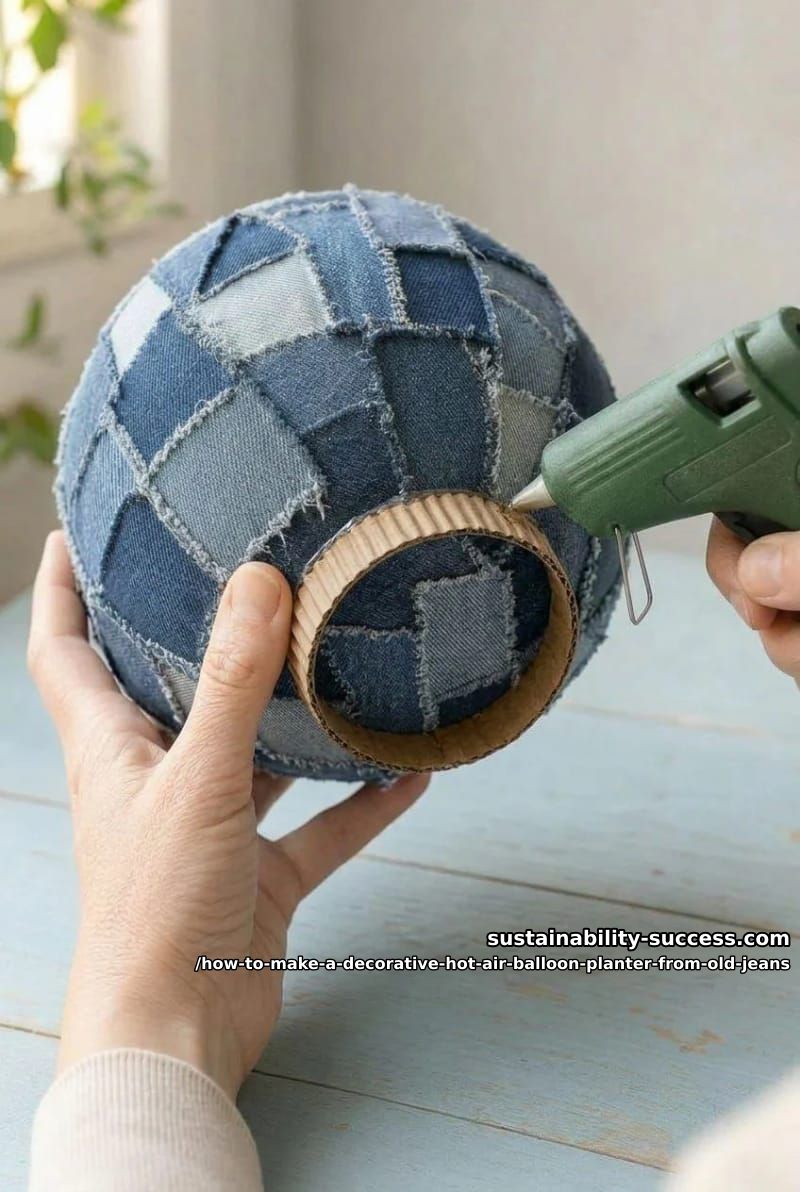
Wrap a short band of single-face corrugated cardboard, ridged side out, around the bare ring you left at the bottom of the denim ball. This is the little kraft-colored rim that reads as the balloon's mouth and hides the seam where the patches stop.
- Cut a strip about an inch and a quarter tall, long enough to circle the base.
- Hot glue it around the bare ring, ridges facing out, overlapping the ends.
- Press it firm while the glue sets so it follows the curve rather than standing proud.
Step 5: Rig the twine net and buttons
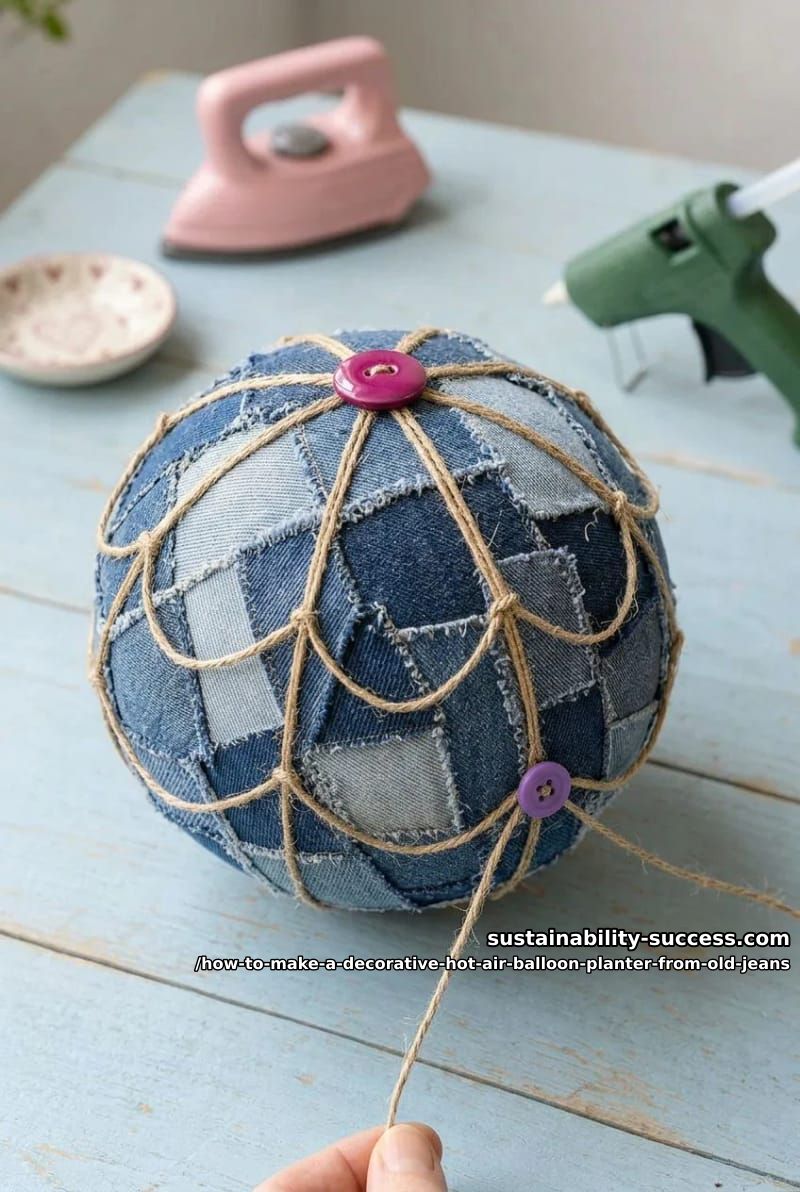
The net is what sells the hot air balloon, and it is just jute twine looped from a single button at the crown down into scalloped swags. Glue as you go rather than trying to knot it.
- Glue one button at the very top of the ball as the anchor.
- Run strands from under that button straight down the sides, spacing them evenly around the sphere, gluing each at the cardboard collar.
- Add horizontal swags dipping between the vertical strands so the net forms a row of shallow U shapes.
- Glue a button at every point where strands cross. Mismatched colors look intentional here.
- Cut tiny felt triangles and string them as a bunting flag across the front if you want the extra detail from the reference photo.
Step 6: Join the balloon to the basket, then plant it
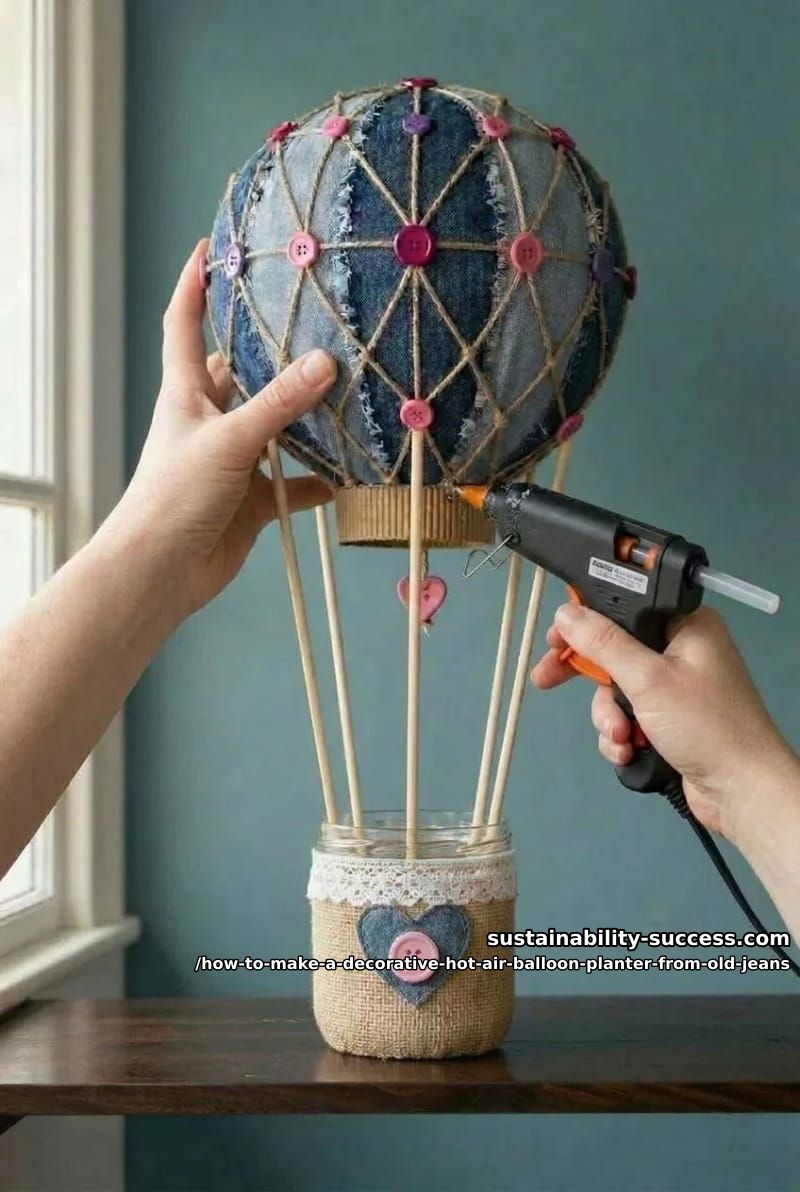
Lower the balloon onto the four dowel tips and glue each contact point, holding the sphere level until the glue grabs. Go light on the glue and quick on the placement, because the cardboard collar gives you only a small landing zone and a heavy bead will show.
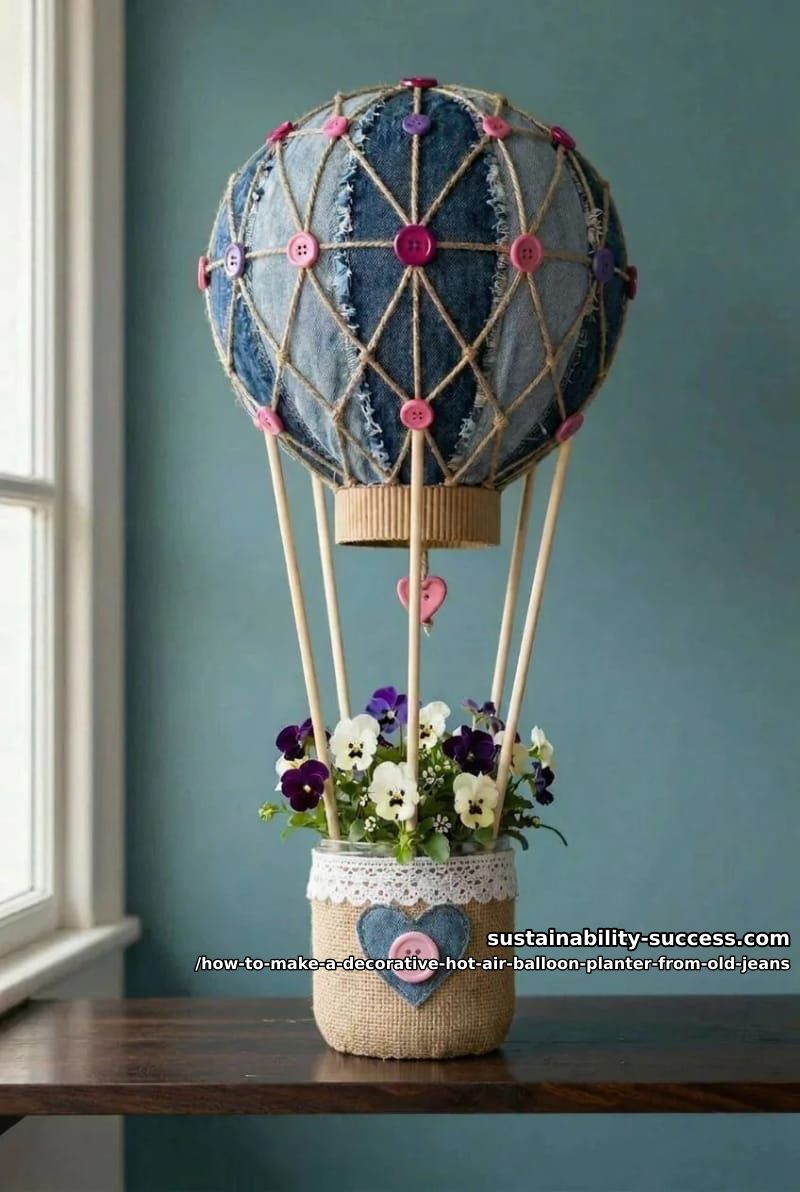
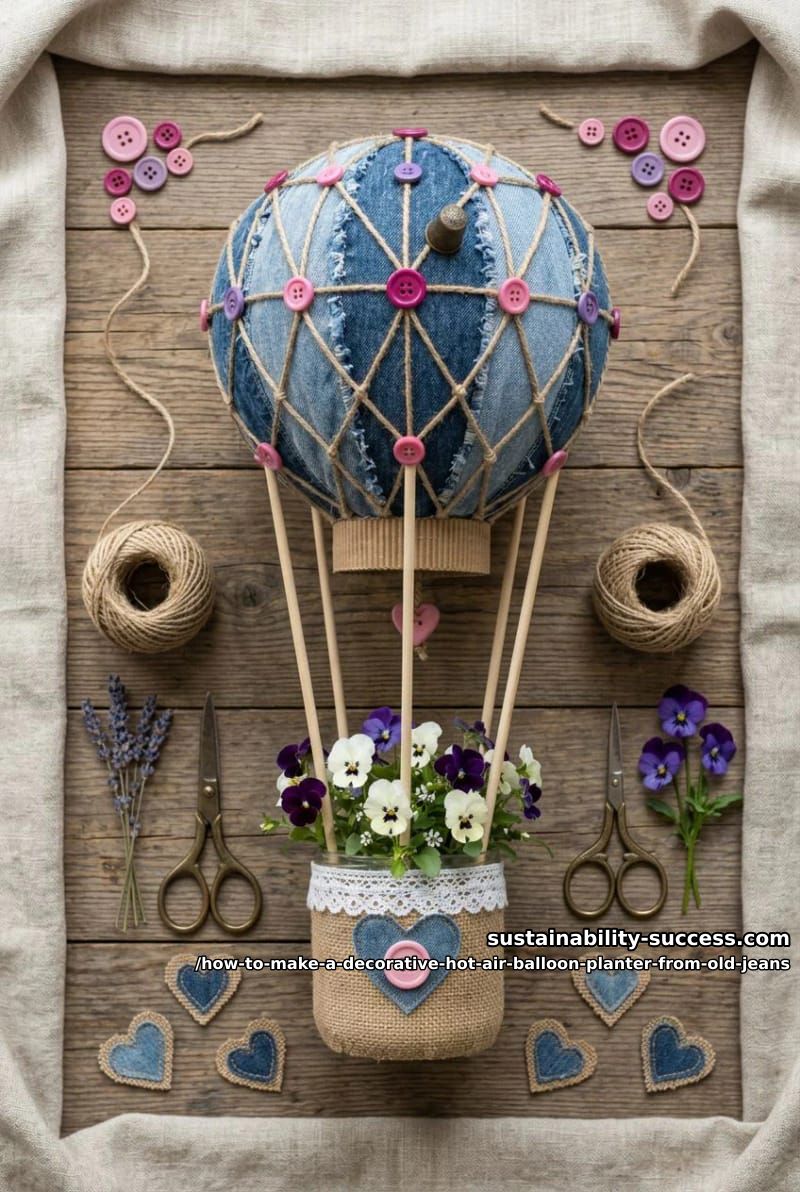
Once it is set, tuck your artificial flowers and greenery into the basket so they mound over the rim and hide the dowel bases. If you would rather use the planter for a tiny live plant, drop in a small nursery pot rather than soil, since wet soil against burlap and cardboard is a slow disaster.
If the balloon leans, one dowel is shorter or seated lower than the others. Pop it loose while the glue is fresh and reset it level, rather than trying to correct the tilt by piling flowers on the heavy side.
Mistakes that ruin this planter
- Wrong foam. Coarse bead foam drinks the medium and the denim lifts within a day. Buy smooth polystyrene.
- Drowning the denim. Heavy medium stays tacky for hours and dries dark and stiff. Thin coats, both sides of the patch.
- Three dowels, or four glued only at the base. Either way it wobbles. Four, glued along the jar wall, splayed at the top.
- A heavy ball. Plaster or solid ceramic spheres turn the whole thing into a tip hazard. Keep the top light.
- Soil in the basket. Burlap and cardboard wick water and rot. Use faux stems or a hidden nursery pot.
Build-day timing
- Cut denim and tile the first hemisphere, then stop. Roughly 30 minutes.
- After 15 to 20 minutes of drying, flip and cover the second hemisphere. Let the whole ball cure an hour.
- While it cures, build the basket and set the dowels.
- Add the cardboard collar, then rig the net and buttons. About 30 to 40 minutes.
- Join balloon to basket, hold level until set, then plant. The glue grabs in under a minute.
Conclusion
The two things worth slowing down for are the foam choice and the dowel anchoring; nail those and the rest is forgiving, because hot glue and patchwork hide a lot of rough edges. If this is a gift, make the basket from the back pocket of the jeans so the original stitching and rivet show, which reads as a deliberate detail rather than a scrap. And if you plan to make several, mix the button colors differently on each one, since that is the cheapest way to make a batch look handmade instead of mass-produced.