

One pair of jeans is enough denim for a whole tree's worth of ornaments. What separates the ones worth hanging from the ones that look like a scrap-bag accident is usually a single decision made before you cut: whether you fray the edges on purpose or lock them down, and whether you keep the gold topstitching and rivets or hide them. The ideas below split into ornaments built straight from a jean's existing parts, flat shapes you cut and stitch, and a few with real dimension, and most cost nothing but thread.

Ornaments made from a jean's existing parts
Jean-pocket angels
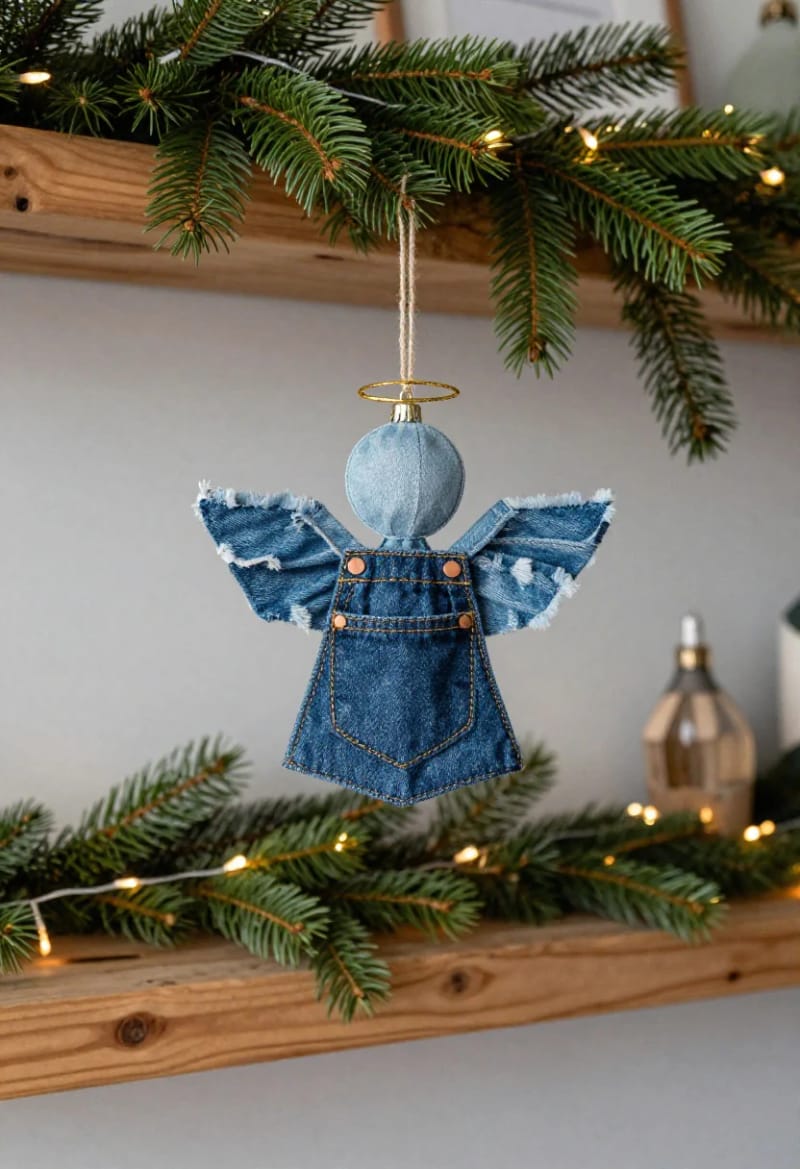
The back pocket is already an angel's body; you add a head and wings and the hard part is done. Cut the pocket off with a half-inch border of the surrounding denim still attached, fold that border back so the pocket's own topstitched outline frames the front, and set a head above it from a wooden bead or a knotted ball of denim. The wings are two folded triangles, or a small bow tied from the waistband, tacked behind the shoulders.
What most versions get wrong is the face, so I leave it blank. A plain denim head with a thin wire halo reads as deliberate; two dots of paint and it becomes a fridge magnet. Keep the halo to gold craft wire or the metallic topstitching thread you can unpick from an old inseam, and let the pocket's rivets show at the hem.
Do this
- Cut the wings from the lighter inner pocket lining so they sit a shade apart from the head and body.
- Leave the wing tips raw. A little fray there is what signals denim rather than felt.
Avoid
- Googly eyes and pipe-cleaner halos.
- Sealing every edge until the whole thing goes stiff and reads as a store kit.
No-sew denim seam coils
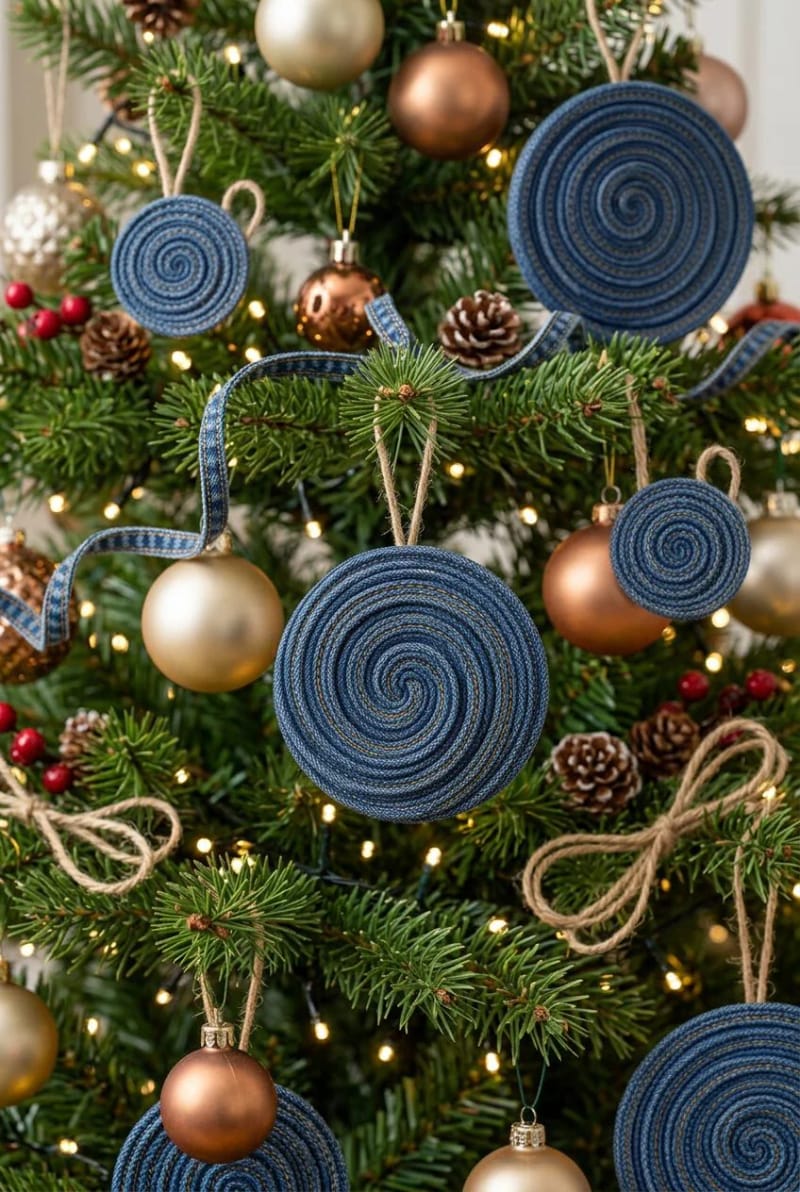
Skip the needle entirely: the flat-felled seam running up the inside of a jean leg is a ready-made rope, and coiled flat like a cinnamon bun it becomes a disc ornament. Rip the seam out in one long strip, then wind it from the center outward, gluing as you go, until you have a coin the size you want. Two seams from a single pair give you a small stack of them.
Vary the diameter across the batch and they read as a set instead of repeats. Start a second, lighter-blue coil off-center partway through and the disc turns into a snail-shell spiral rather than a flat target.
Hot glue on a tight denim coil holds for a week, then pops loose as the fabric relaxes and the tension slowly unwinds. For anything that will be handled, run washable fabric glue (Dritz Fray Check works, so does a tacky craft glue) into the coil as you wind and clamp it with a clothespin until dry. The bond has to live inside the roll, not just dot the outside.
Snowflakes from belt loops and waistbands

Belt loops are the most wasted part of a pair of jeans, and five or six of them arranged like spokes make a passable snowflake. Cut them off at the base with their bar-tack stitching intact, fan them out from a small denim center circle, and glue or stitch the inner ends down. Open a waistband flat and you get longer straight arms for a bigger flake, or a whole second size.

Flat denim shapes you cut and stitch
Layered denim stars
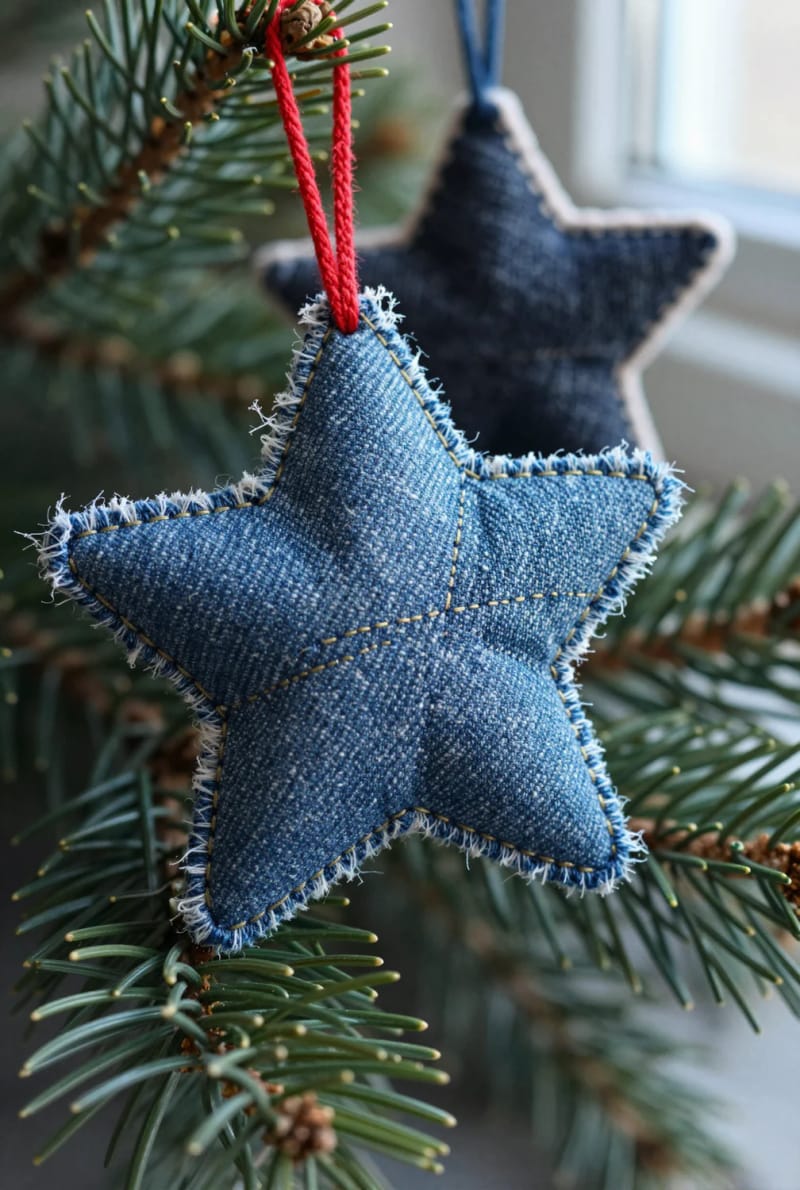
Stars work best as a quilted sandwich, not a single layer. Stack two squares of denim with a scrap of cotton batting or an old flannel shirt between them, run a few rows of straight stitching across the face in gold thread, then mark the star and cut it through all three layers, adding one line of stitching just inside the edge to hold it shut. Trim two or three millimeters outside that stitch line and let the raw edge fray to a soft outline.

Indigo is the default, but a star cut from black denim looks more elegant on a lit tree, and a bleached or acid-wash pair gives you a pale grey-blue that photographs better against green branches than mid-blue does. Cut all three weights in one batch and hang them together.
Frayed denim hearts
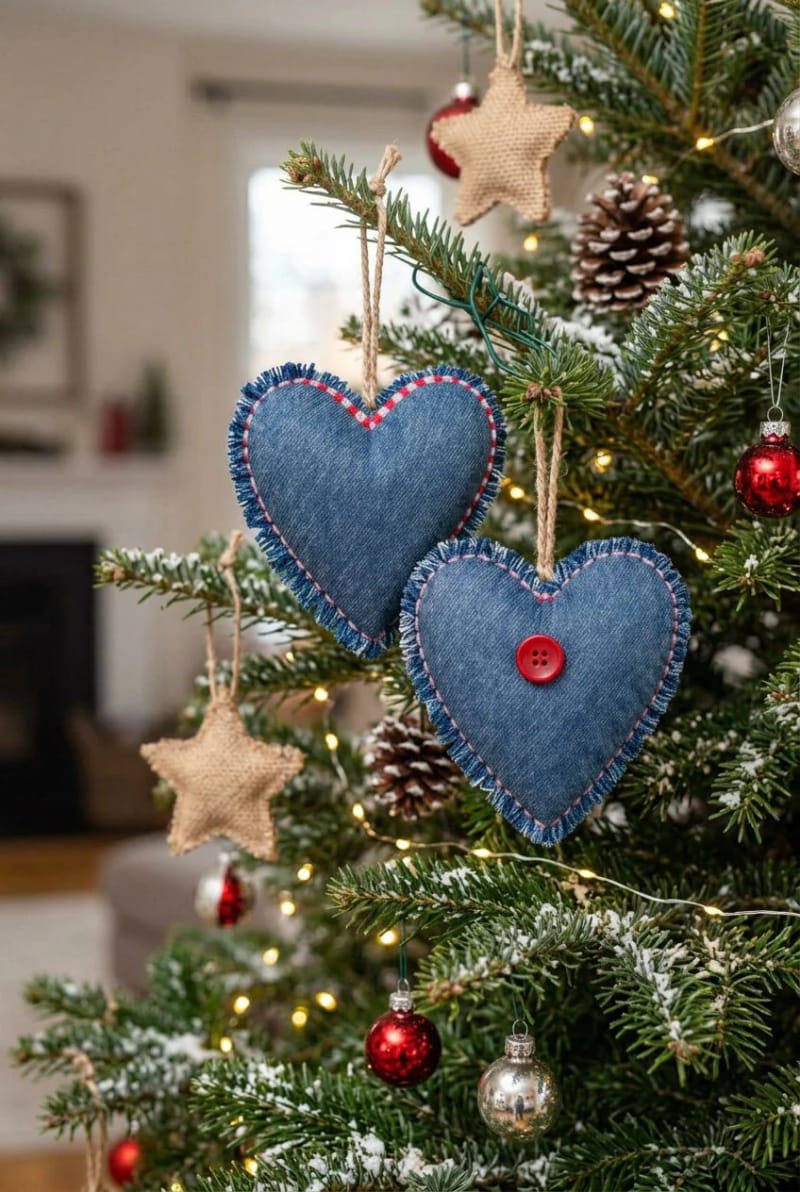
Hearts are the easiest entry point and the one most likely to look generic, so the finish carries the whole thing. Cut two layers, topstitch a border a quarter inch in, then pull the outer threads back to that line for a fringed edge. A sliver of red gingham or mattress ticking showing between the layers, or one red button placed off-center, keeps it from reading as a Valentine leftover.
Denim gingerbread people

A gingerbread cutter traces straight onto denim, and the joke of a blue gingerbread man is the point. Cut two layers, stitch around the outline, leave a gap to stuff lightly with batting, then close it. White puff paint or a few running stitches in white floss stand in for the icing, and a scrap of pocket makes a tiny apron.
Little denim stockings

A stocking is the one shape where you want the jean's original hem doing the work. Cut it so the finished trouser hem becomes the stocking cuff, and you skip the fiddliest seam entirely. Hung in a row on a garland, or clipped as place-setting markers holding a candy cane, a set of five reads as intentional.
Denim ornaments with real dimension
Cone-shaped mini denim trees

For a three-dimensional tree, wrap a paper or foam cone in denim rather than trying to sew one from scratch. Cut fringed strips and glue them up the cone in overlapping rings so the frayed edges layer like branches, or spiral a single bias strip to the point. Top it with a star cut from the method above. Sit one on a mantel, or shrink the cone to two inches and it hangs from a branch.
Patchwork denim baubles
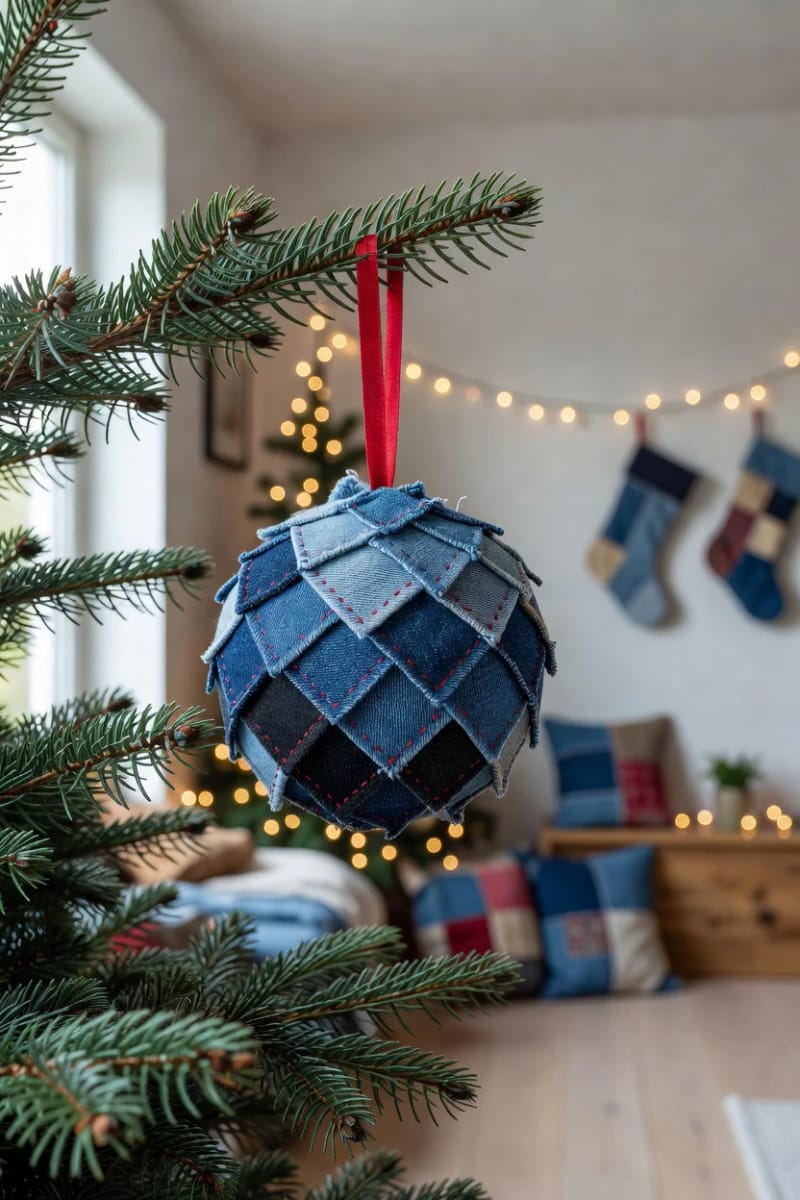
Wrapping a foam ball in denim patches turns the whole range of blues in your scrap bag into the feature. Cut two-inch squares from every wash you have, from near-black to pale worn knee, then pin them over a foam ball overlapping like fish scales and pin the raw edges down with a scrap of ribbon or a run of stitching where the rows meet. The no-sew version presses each square into a ball scored with a craft knife, tucking the edges into the slits with a butter knife.
Keep the value range wide. A ball made only from mid-blue squares disappears into itself, while one that runs dark at the bottom to almost-white at the top catches the tree lights on its pale side.
Conclusion
If you have never taken scissors to a pair of jeans for this, start with the seam coils. No needle, no pattern, and a finished ornament in ten minutes, which is enough to build the nerve for a quilted star next.
Batch the cutting. One afternoon spent deconstructing three or four pairs and sorting the seams, pockets, waistbands, and flat panels into piles turns every ornament after that into a fifteen-minute job instead of an hour. If you seal edges, match your interfacing weight to the denim; a heavy iron-on facing on lightweight chambray will buckle.
And keep the parts you would normally cut around. The rivets, the little fifth pocket, the frayed knee with a paint stain on it: those read as history, and the paint stain in particular is worth building an ornament around rather than hiding.