

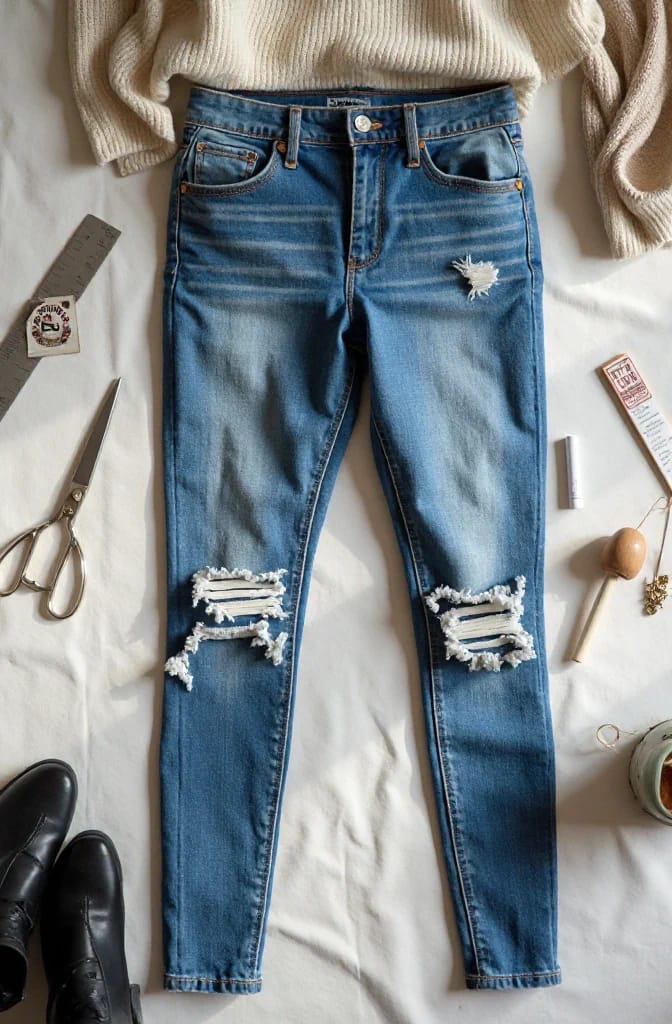
Cut a knee slit the wrong way and it will not fray. It curls, then splits, then travels down the leg until the jeans are a pile of blue cotton with a hinge in the middle of it. The frayed knee slit that keeps a clean white ladder of threads across the gap is a piece of construction, not a random slash, and most of it is decided before the scissors ever touch the denim.

Cut Across the Leg, Not Along It: How Frayed Knee Slits Get Their White Ladder
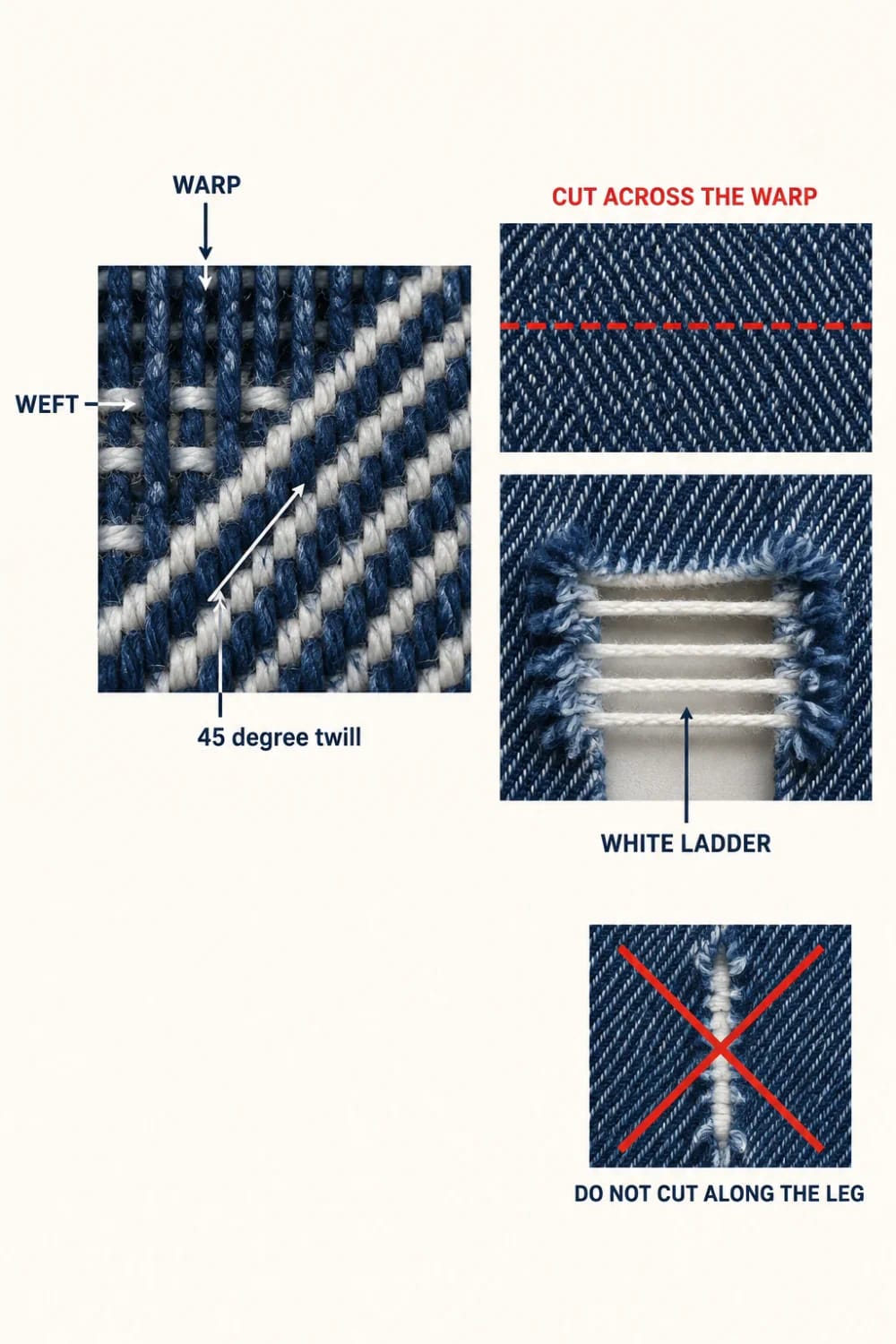
Every cut runs side to side across the leg, never up and down it. Denim is a warp-faced twill: the indigo-dyed warp yarns run the length of the leg, and the undyed weft yarns run around it, which is why the inside of a cuff is pale and the outside is blue. Cut across the leg and you sever the blue warp. Pull those severed ends out and the white weft survives, spanning the opening as the ladder of white threads anyone recognizes on a knee that wore through on its own.
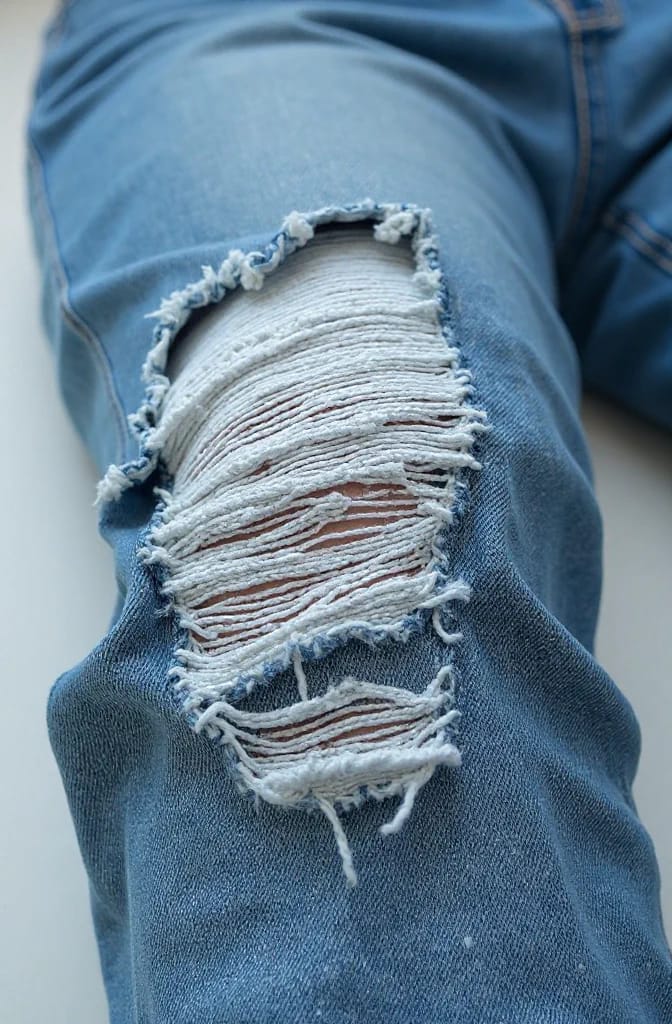
Granted, that only holds if you cut one layer. Lay the leg flat, slide a cutting mat or a folded magazine inside so the back of the leg is out of reach, and open each slit with a craft knife or a Combicut seam ripper with a built-in tweezer end rather than dressmaking shears, which want to keep going. Two to three inches is the working length on a straight or wide leg. On anything slim, keep it under two, because the fabric is already under tension across the knee and the slit will open itself the first time you crouch.
Stretch Denim Will Not Give You a Frayed Knee Slit
Read the composition label before you do anything else. Above roughly two percent elastane, the slit will not fray into a ladder, because each warp yarn is wrapped around an elastic filament that retracts the moment it is cut, rolling the edge into a fuzzy lip instead of releasing loose threads.

Assuming the label comes back clean, what you want is rigid cotton, ideally 12 to 14 ounce, which is where thrifted Levi’s 501s and old Wranglers earn their reputation: heavy enough that the ladder threads hold their line, dry enough that the abrasion bites. Lighter 9 ounce denim frays fast and then keeps fraying. It is the same fork every denim project arrives at, the choice between fraying an edge on purpose and locking it down, made before the cutting rather than after.
Mark the Slits Sitting Down, Because That Is Where the Knee Actually Is
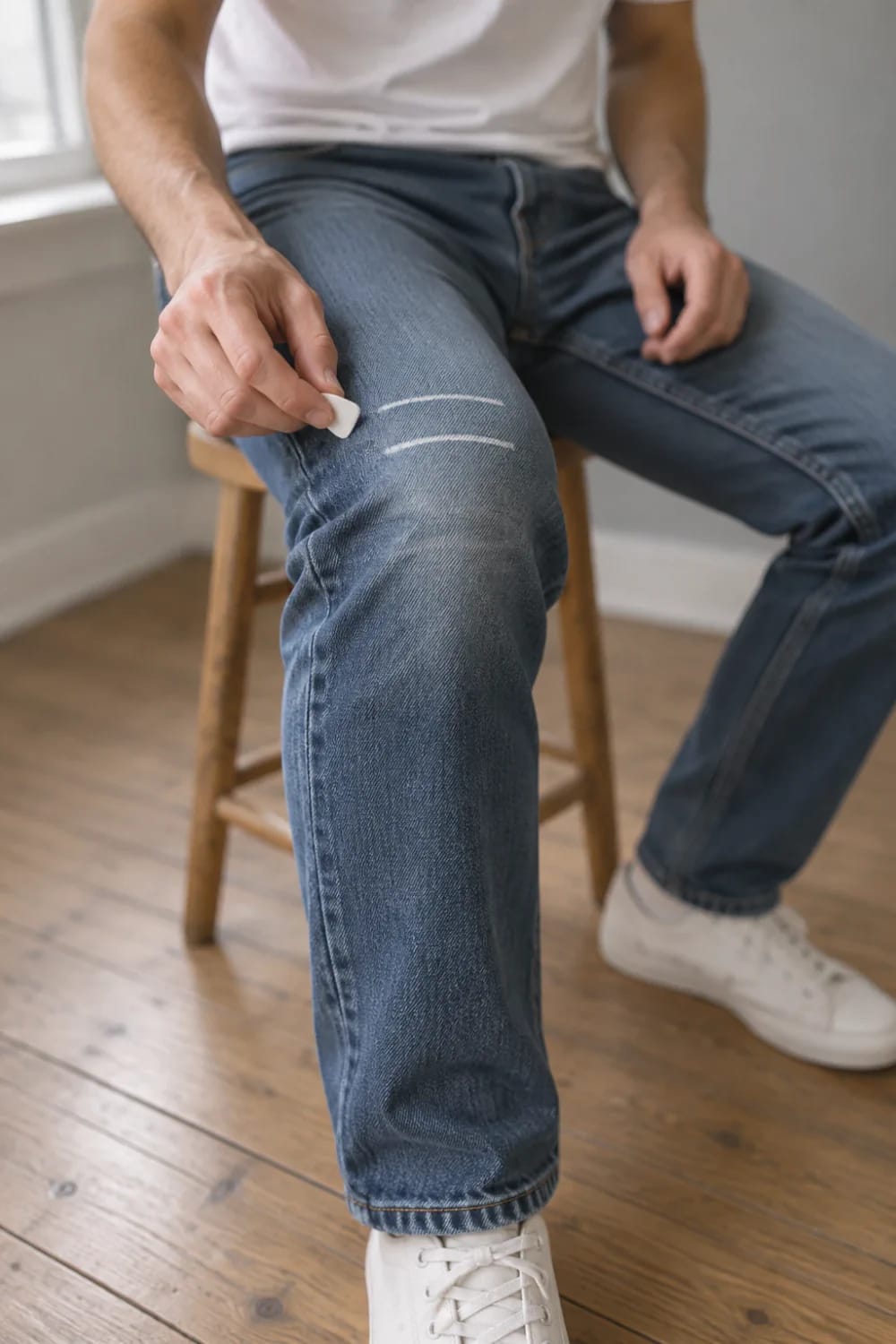
Assuming you want the slits on your knee rather than your shin, put the jeans on, sit down, and mark. A kneecap climbs an inch and a half to two inches when you bend the leg, so slits marked while standing land below the knee and gape open across the shin every time you take a seat, which is the single most common reason a pair looks wrong on a body but fine on a hanger.
Marking the jeans flat on a table. A folded leg puts the front and back panels in the same plane, so a line drawn on the table looks level and lands crooked once the jeans are worn, and the two legs never match. Chalk them on the body, then take them off and check that both marks sit the same distance from the hem before you cut anything.
Back the Knee Before You Cut, or the Slit Becomes a Hole by March
Fuse something to the inside of the knee first. A slit cut into unsupported denim has nothing holding its ends, so it lengthens a little with every wash until the two halves of the leg are joined by about an inch of fabric at each side seam. Cut the backing from a dead pair if there is one in the closet, which is where most of the scrap denim in a house eventually goes anyway.
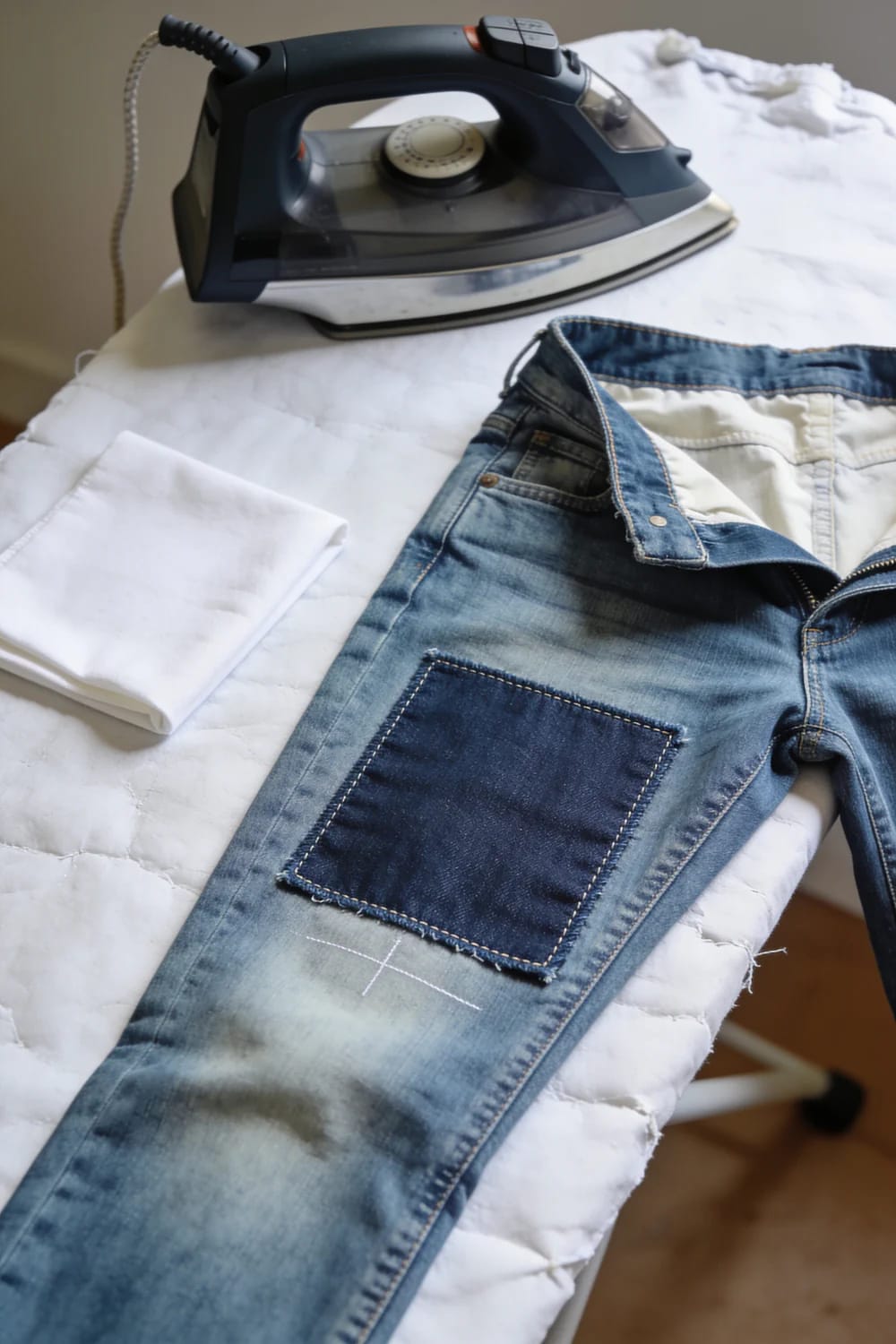
Knit fusible interfacing is the better choice over woven, because the knee has to bend and a rigid woven patch becomes a plaque you can feel through the fabric when you kneel. If you want the backing to be part of the look rather than hidden structure, a pack of Dritz dark blue iron-on denim patches in the 2 by 3 inch size disappears behind an indigo leg and costs less than a coffee.
Sandpaper and Tweezers Do the Fraying; the Scissors Only Open the Slit
The fringe comes from abrasion and plucking. A cut edge on its own is a cut edge, and it will still look like one after ten washes.
Sandpaper opens the weave
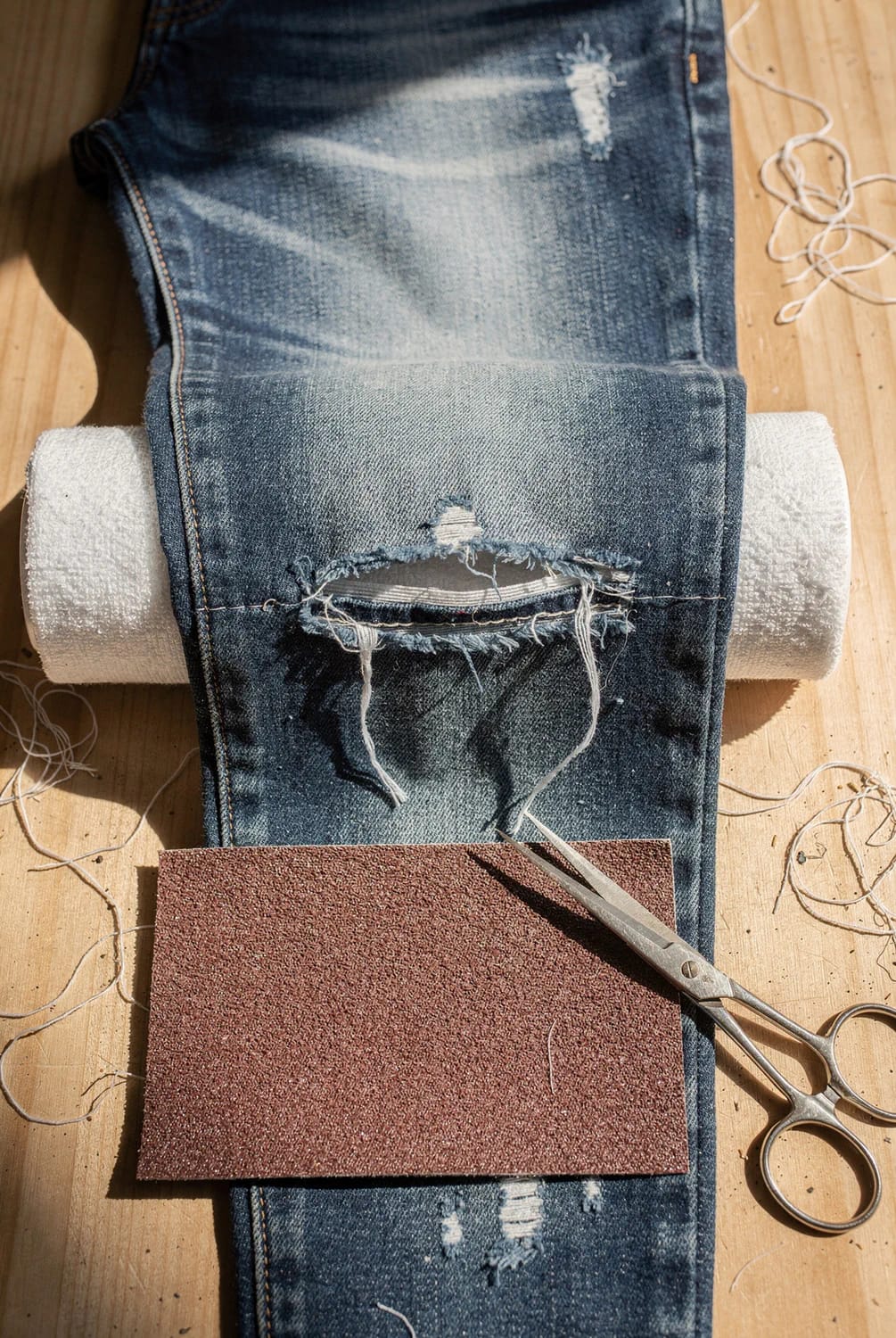
Provided the leg is stretched over something hard, a rolled towel or the edge of a wooden board, 80 to 120 grit paper is the whole tool kit: work it back and forth along the cut edge, keeping the strokes in one direction rather than scrubbing in circles. Circles produce a gray smudge; straight passes lift the indigo warp and leave the white weft showing through, which is the same fade you get from years of a car seat. A Simplicity denim distresser rasp does it faster and with less arm ache, though sandpaper from the garage works and costs nothing.
Tweezers pull the blue out
This is the step almost everyone skips, and it is the whole difference. Take the severed indigo warp ends at the edge of the slit and pull them out one or two at a time, working a quarter to half an inch back from the opening on both sides. What is left behind is a clean run of white weft threads bridging the gap. Two cold washes afterward will bloom the fringe; a third will start eating it, which is why the mesh laundry bag matters more here than anywhere else in a wardrobe.
One Wide Slit for Baggy Jeans, a Ladder of Narrow Ones for Slim
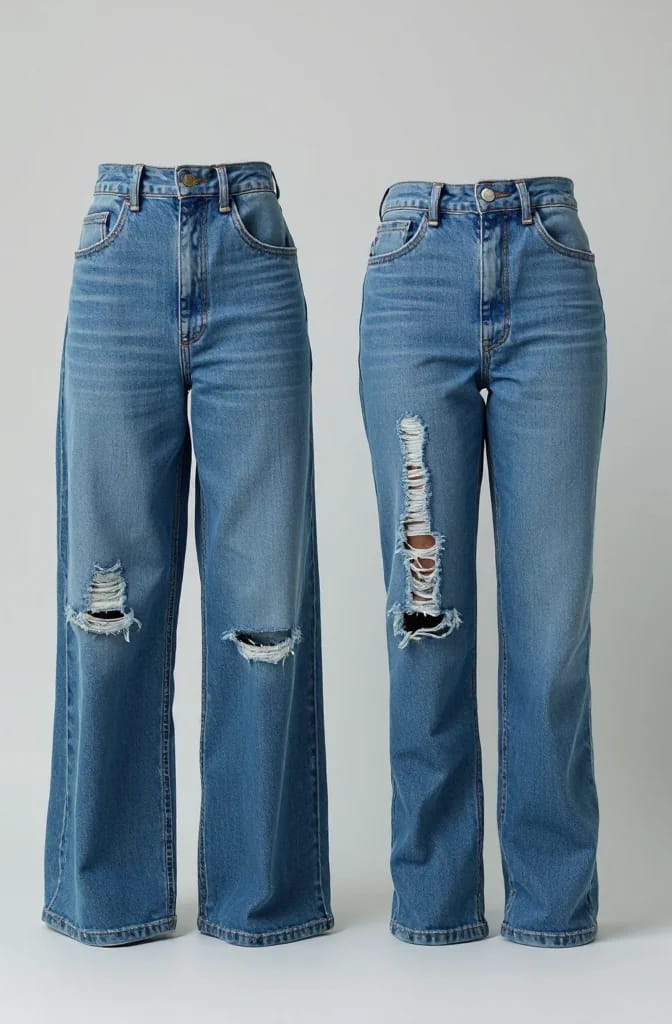
Baggy and low-rise: one slit, wide, sitting low
Leg width decides the count, and on a leg opening past 20 inches, a single four inch slit across the knee is the only version that survives the drape. Cut three narrow ones into a baggy leg and the folds swallow them; from six feet away it reads as a stain rather than a rip. This is the shape the current low-rise revival is built on, and it is also the most forgiving, since a wide leg keeps the fabric off the knee and off the frayed edge.
Slim and bootcut: three or four narrow slits, stacked
Two inch slits, three quarters of an inch apart, all sitting above the kneecap. The stack has to be tight, because a slim leg holds the denim against the knee and a lone slit there is just a hole. Keep the top slit at least an inch clear of where the thigh starts to taper or the whole ladder migrates upward as you walk.
What is on your feet changes what the knee does
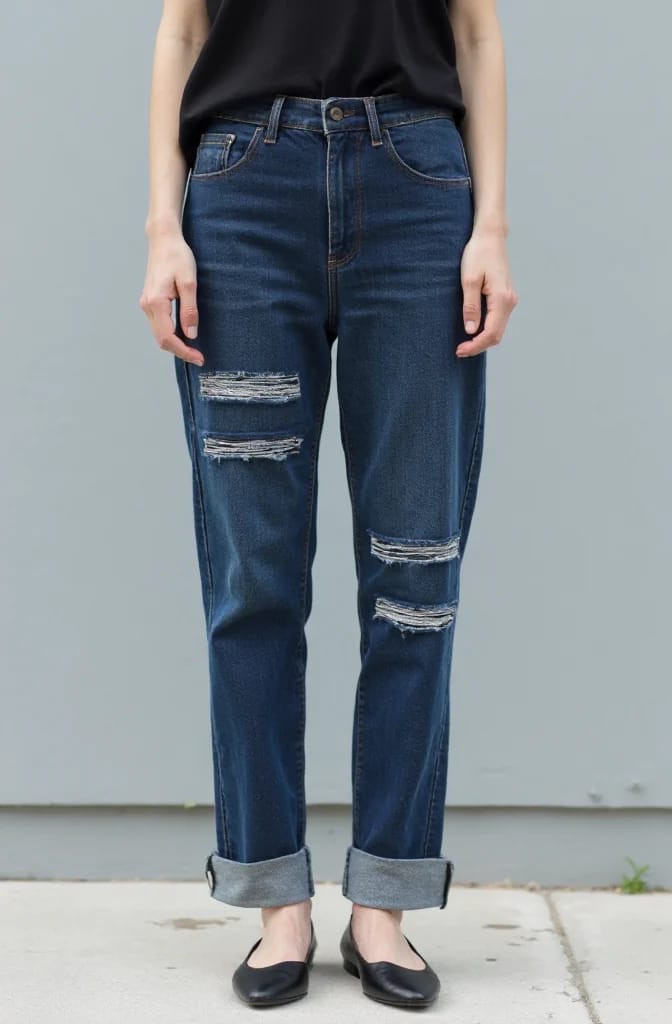
Granted this is preference rather than rule, but flat shoes and a hem that breaks long leave the knee as the only interruption on the leg, and the slits read as deliberate because nothing else is competing. A chunky boot puts a second loud thing on the same leg, roughly ten inches below the first.
Fade a Halo Around the Slit So the Denim Reads Worn, Not Cut
Sharp indigo running right up to the edge of a slit is what gives a home job away. Denim that wears through in real life fades first and opens second, so the pale halo has to be there before the hole makes sense.
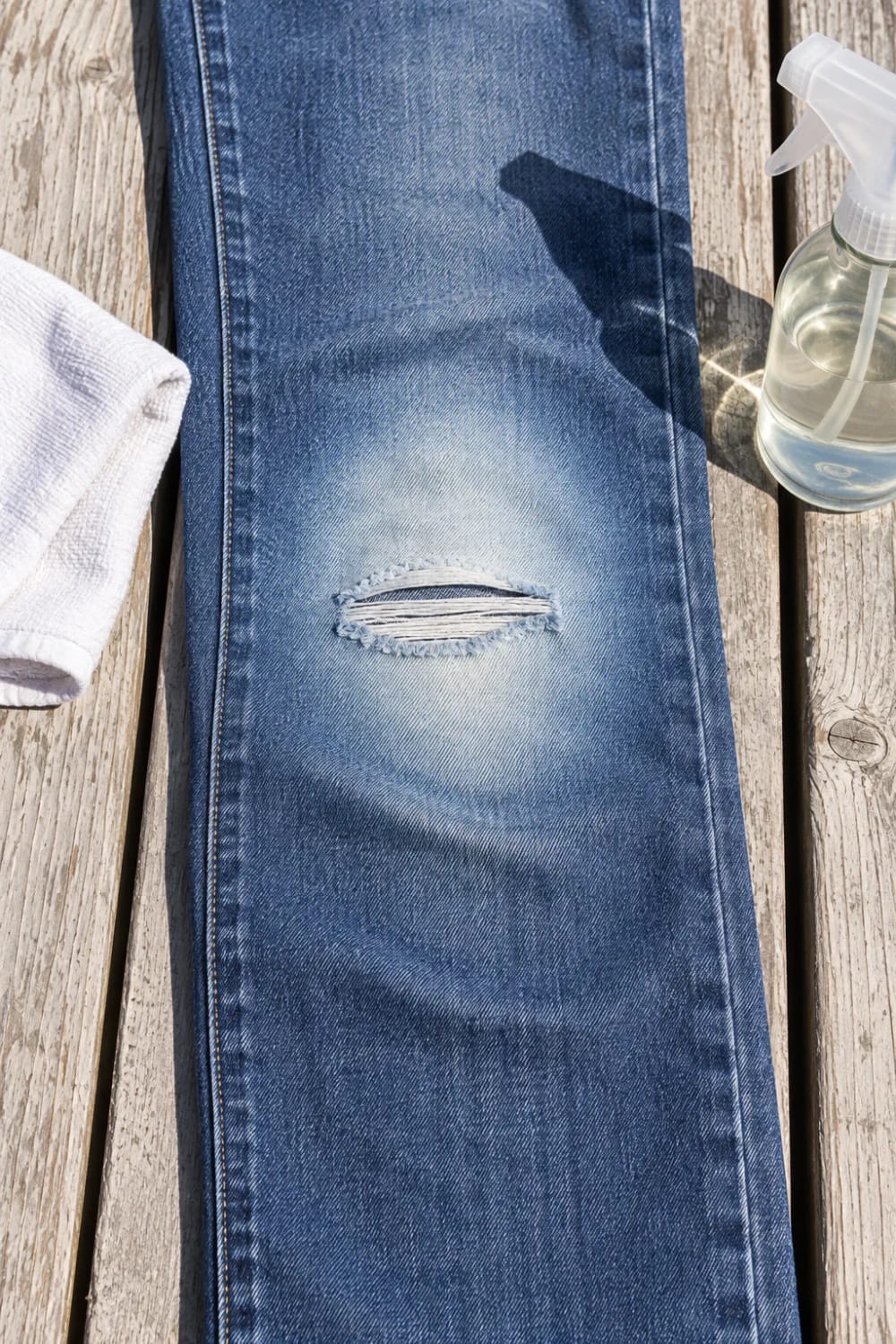
Given two or three clear afternoons, sunlight is the low-risk route: lay the jeans knee-up outdoors and the indigo lifts unevenly, which is what makes it look real. Dilute household bleach at roughly one part to five parts water in a spray bottle is faster, though it keeps working on the cotton until you stop it, so rinse hard and neutralize with a hydrogen peroxide solution before the jeans go anywhere near a machine. Skipping that step is how a faded knee becomes a blown knee in one wash. There is also a decent argument for the slow version, which is that the industrial shortcut was far worse than a spray bottle: sandblasting denim to fake wear caused a silicosis epidemic among Turkish garment workers, and Turkey banned the process outright in 2009.
Sashiko Behind the Slit Turns a Frayed Knee Into Visible Mending
Put a backing scrap behind the slit and stitch a grid of running stitch through both layers, so the white ladder floats over a field of visible thread instead of over a gap. Unlike everything else on this list, this one leaves the knee stronger than it found it, which starts to matter on a pair you cut a year ago and still wear twice a week.
Stitch through a backing scrap, not through air
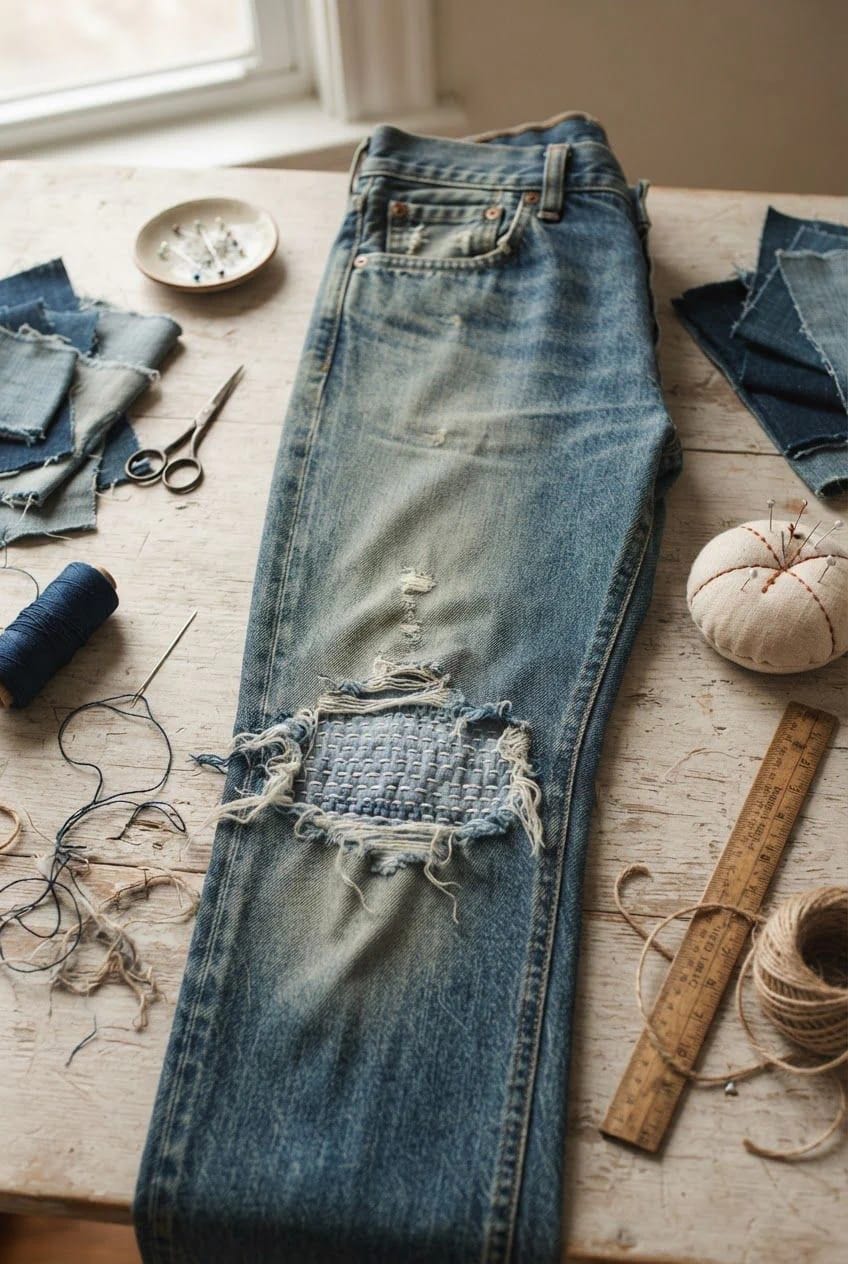
Tack a four by five inch scrap of thin cotton or lightweight denim behind the knee, right side facing outward so it is what shows through the gap. Then run rows of straight running stitch across the whole knee, a quarter of an inch apart, three to four stitches per inch, going right over the slit rather than stopping politely at its edges. A 32 piece sashiko thread and needle kit in graduated blues covers a lot of knees for the price of one pre-ripped pair.
White on indigo, or the reverse
Sashiko thread is thicker than embroidery floss and does not sink into the weave, so it reads from across a room. White on dark indigo is the loud version; a mid-blue thread on a light wash almost disappears until you are close, and it holds up better on jeans you actually wear to work. The same placement logic applies to any stitching you add to denim you already own, which is to say it should sit on a line the jeans already have.
Let Something Show Through the Gap: Tartan, Bandana, Lace
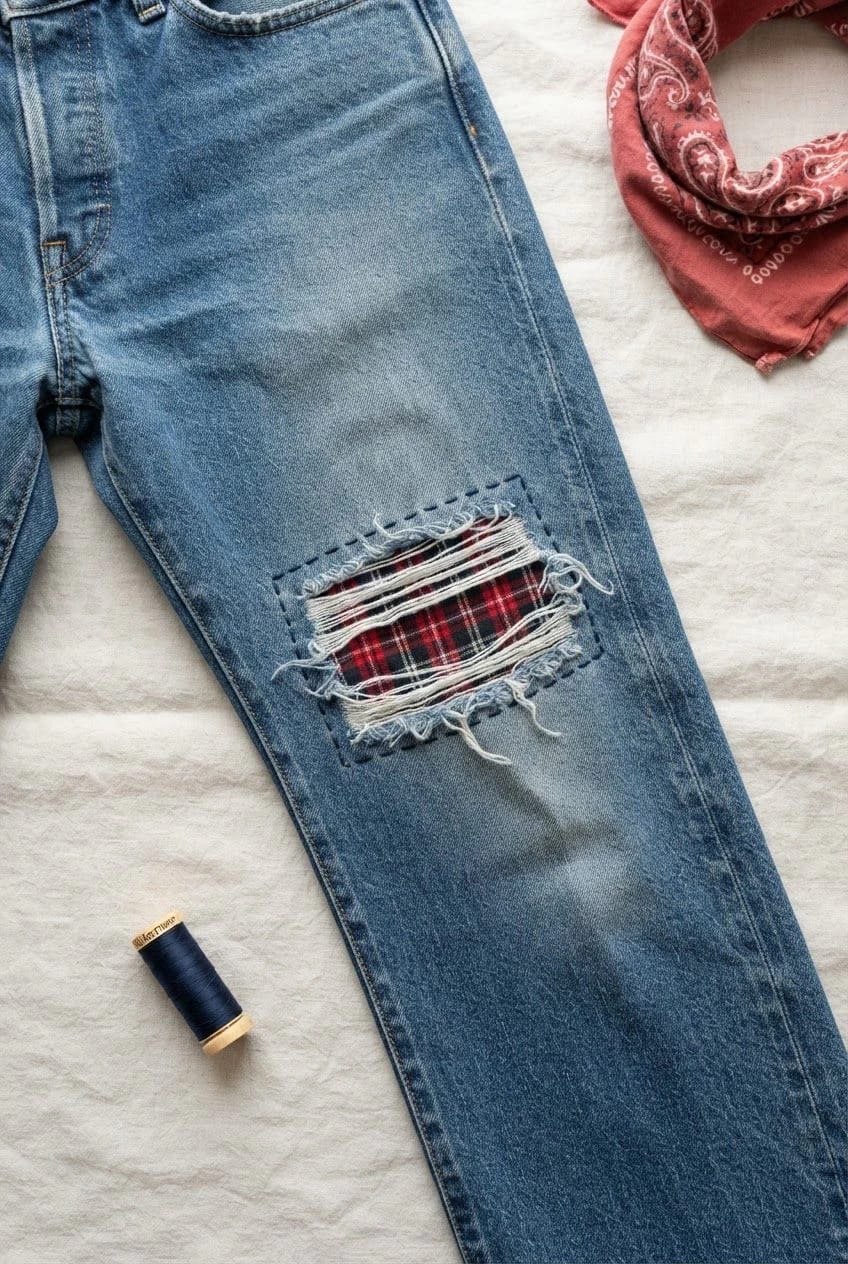
Since you are backing the knee anyway, back it with something worth looking at. Red and black tartan behind an indigo slit gives you a hard color edge under a soft frayed one; a faded paisley bandana costs about five dollars and reads warmer; a scrap of any cotton print from the offcuts drawer works as long as it is a similar weight. Stitch it down half an inch clear of the fringe so the white weft threads still hang free rather than being caught in the seam.
Lace is the exception, and it is worth being blunt about it. It photographs beautifully and wears badly: three washes on a knee that bends a few hundred times a day and cotton lace turns gray and stringy, which is fine for a costume and disappointing on jeans you meant to keep.
 57 Innovative Upcycled Jeans Ideas: Transform Your Old Denim into Chic Fashion and Home Decor Fifty-seven things to do with the pairs that are past wearing, from wearables to home pieces.
When the Slit Blows Through, Patch the Knee Instead of Binning the Jeans
A slit that has opened into a hole the size of a fist is a patch job, not a write-off. Back it with a denim scrap cut two inches larger than the hole all round, pin it flat, then machine-darn straight rows back and forth across the opening with the stitch length dropped to about 1.5 millimeters. Twenty or thirty passes across the hole, feeding the fabric slowly by hand so the rows overlap rather than gap.
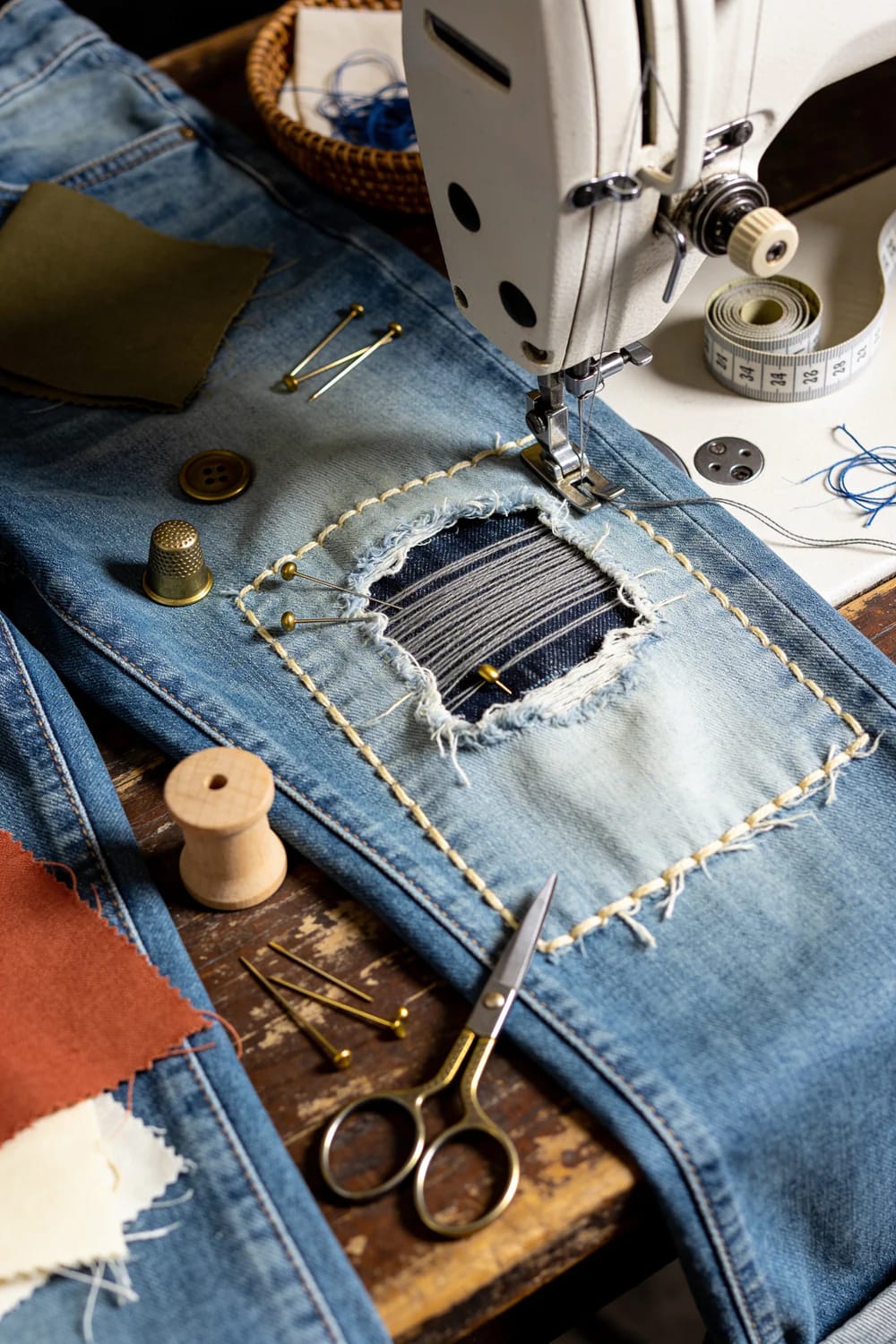
The reason to bother is arithmetic. Levi Strauss put a pair of 501s through a full life cycle assessment and landed on roughly 3,780 liters of water across the life of one pair, most of it in cotton growing and in the washing we do at home. A knee that gets darned instead of discarded is the cheapest water saving available to anyone who owns a sewing machine, and gray thread on a light wash hides the darn far better than blue does.
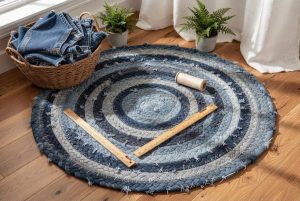 How to Make a Braided Denim Rag Rug From Old Jeans The one denim project that eats a whole pile of dead jeans rather than one good pair.
Before You Take the Scissors to a Good Pair
Do it in this order and almost nothing can go wrong: check the composition label, fuse the backing, chalk the marks while sitting down, cut across the leg, then sand and pluck, and leave the fading until last because it is the only step you cannot walk back. Start on the pair you were already close to retiring rather than the pair you like, since the first knee you cut will teach you something about slit length that no amount of reading does, and a thrifted pair of rigid 501s at twelve dollars is a cheaper classroom than a new pair sold pre-shredded for a hundred and forty.
Related Posts
- Butterfly Embroidery Jeans: Ideas Worth Stitching Onto Denim You Already Own
- 57 Innovative Upcycled Jeans Ideas: Transform Your Old Denim into Chic Fashion and Home Decor
- 11 Upcycled Jeans Decor Ideas for the Pile You Can’t Toss
- 12 Denim Christmas Tree Skirt Ideas to Make From Upcycled Jeans
- 10 DIY Denim Christmas Garland Ideas to Make From Old Jeans
- 25 Creative Christmas Crafts Using Upcycled Jeans For Unique DIY Decorations