
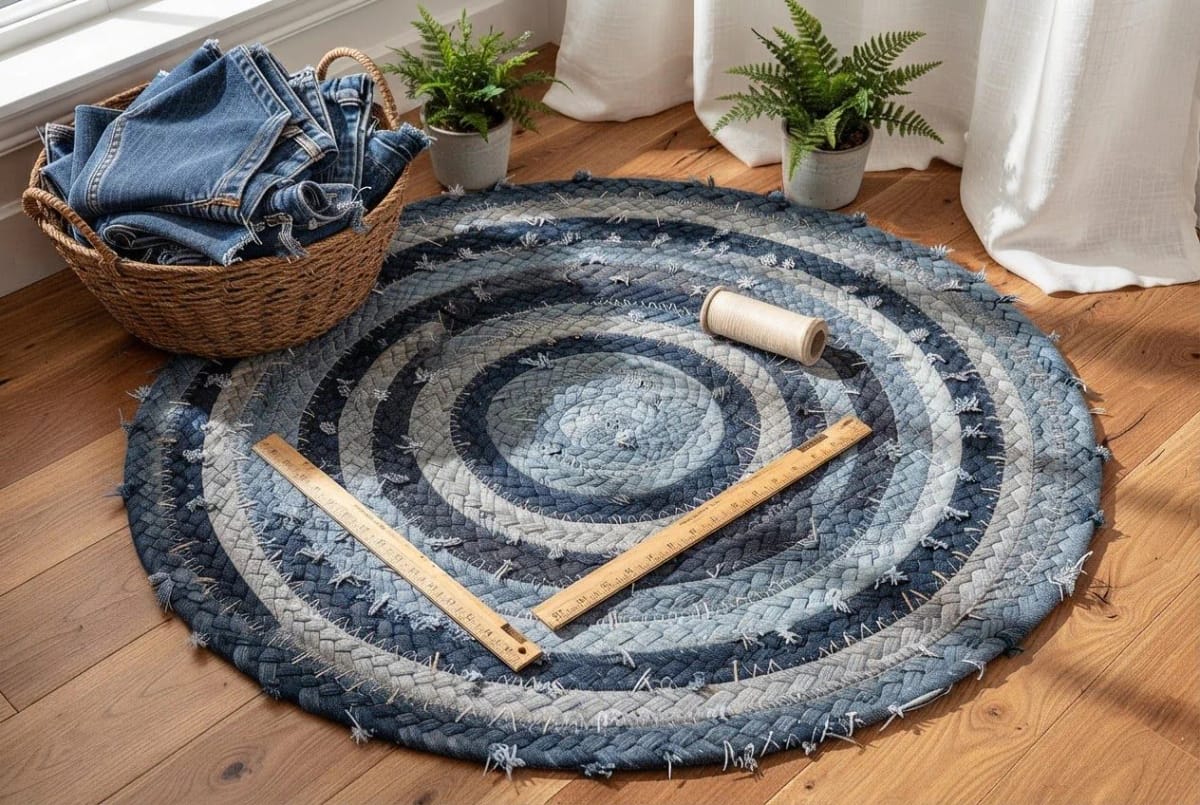
Cut the legs off a worn-out pair of adult jeans and you get four flat panels of heavy cotton, and on most pairs the fabric below the knee never failed at all. A braided rag rug is the only denim project I know of that eats the whole pile rather than one nice pair, and the two decisions that determine whether it lies flat on your floor or curls into a shallow bowl both happen early: how wide you cut the strips, and how you lace the turns.
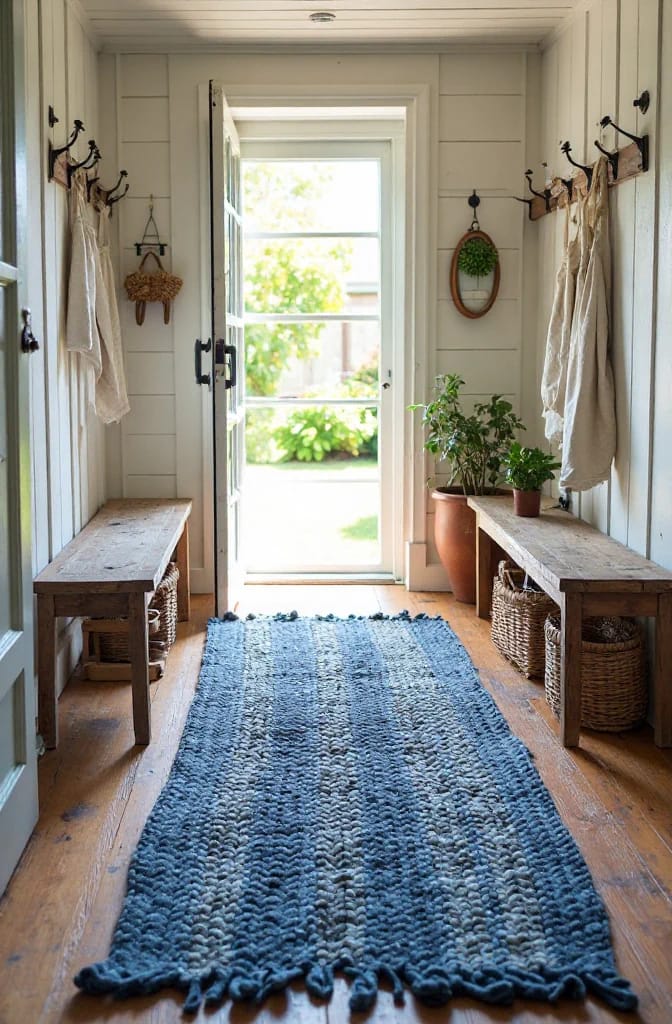
Granted, this is not a Saturday afternoon. A mat the size of a doormat runs somewhere between ten and fifteen hours of cutting, joining, braiding and lacing, spread over several sessions, and the finished thing weighs five to eight pounds. Denim is heavy, which is exactly why it makes a good floor rug and a miserable wall hanging.
One warning before you raid the closet: stretch denim with two percent elastane braids unevenly, grows as you work, and relaxes back into a wavy edge weeks later. Rigid, mostly-cotton jeans are the material this project wants, and the rest of the pile has better uses.
What you need, and what it actually costs
The rug is free; the tools are not, and you probably own half of them already. Everything below assumes strips cut at one and a quarter inches, which braid down to a finished band roughly one inch wide.
Here is the arithmetic, and I want to be straight about where it comes from: I could not find a reliable published measurement for how much strip a pair of jeans yields, so these are derived numbers, not tested ones. Braid length equals rug area divided by braid width. A 2 by 3 foot mat is 864 square inches, so at a one-inch braid you need about 70 to 80 feet of finished braid. A three-strand braid swallows roughly three feet of strip per foot of braid, which puts you near 230 feet of strip. Two legs of an adult pair, once the seams and hems are gone, give somewhere around 45 to 60 feet at that width. Call it five or six pairs for the mat, and eleven to thirteen for a 3 by 5 rug. Cut wider strips and every number moves.
Materials
- Old jeans, 5 to 6 pairs for a 2 by 3 foot mat. Rigid denim, roughly 11 to 14 ounce. Free.
- Lacing thread. Bonded polyester, T70 or heavier, in a color close to your darkest denim. One spool outlasts several rugs: 1,800-yard spool of T70 bonded polyester upholstery thread, about $10 to $18. Regular all-purpose thread snaps under lacing tension, and you will not enjoy finding that out on round nine.
- A non-slip pad, cut to size. Braided rugs walk on hard floors, and a heavy one walks confidently: Mohawk Home 3 by 5 foot felt and latex rug pad, roughly $20 to $35.
Materials come to about $30 to $55 if the jeans were headed for the bin anyway.
Tools
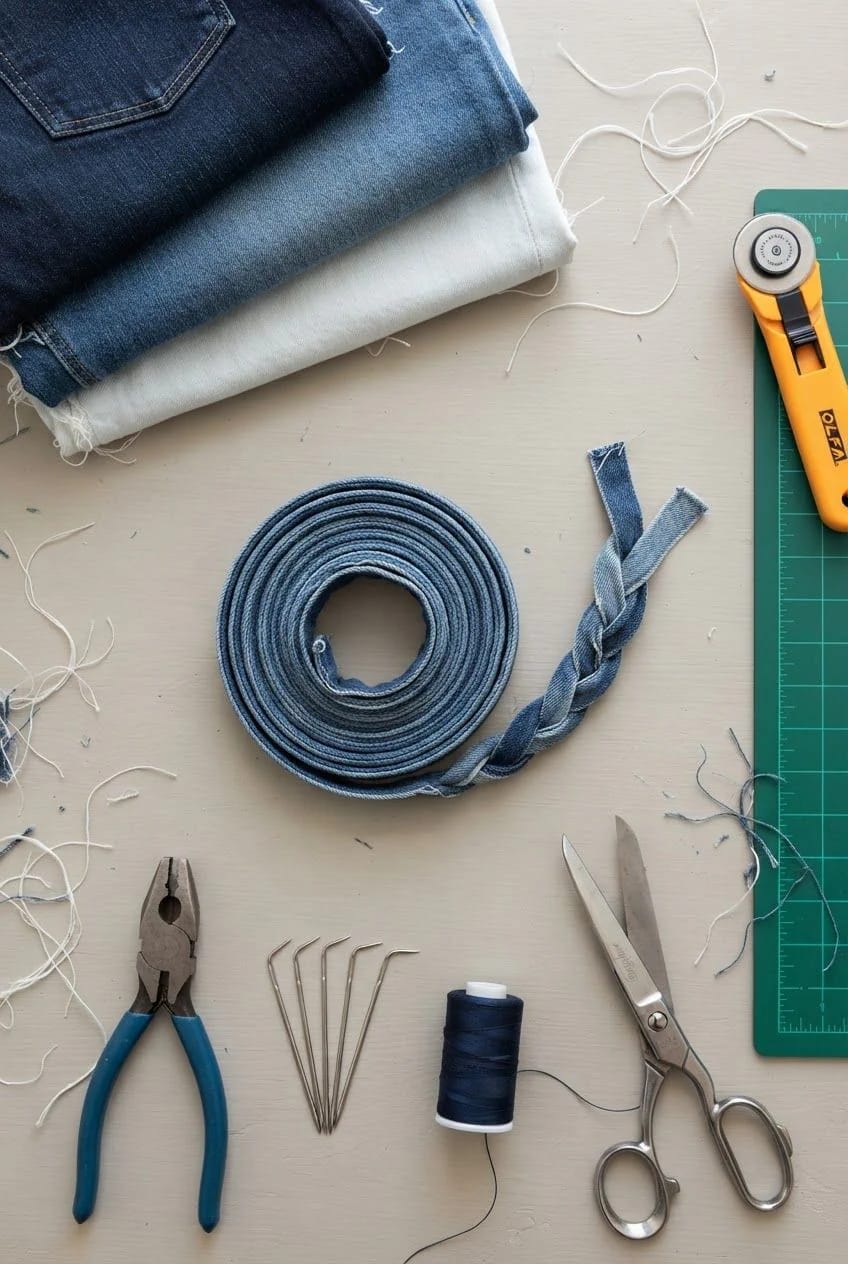
- Bent lacing needles. The one tool with no substitute. A curved blunt needle slides between the folds so no stitch shows on the surface: Piecemakers braided rug needles, pack of 4, around $8 to $14.
- Shears you would not use on paper. Denim dulls cheap scissors in about two pairs: Gingher 8-inch knife-edge dressmaker’s shears, roughly $25 to $40.
- Rotary cutter and a large mat, if you want the spiral cut in step two to go quickly. A Fiskars 45mm classic rotary cutter($12 to $20) on a 24 by 36 inch self-healing cutting mat($25 to $40).
- Denim machine needles, size 100/16, if you are joining strips by machine. Universal needles skip stitches through four layers of indigo: Schmetz jean and denim needles, 100/16, about $12 to $20 for five cards.
- Needle-nose pliers, to pull the needle through when the lacing gets tight. Binder clips or a spring clamp to anchor the braid. Both free from a drawer.
- Optional, if you would rather buy the traditional kit than assemble it: the Braidcraft braid craft starter kit($25 to $40) bundles a clamp, a lacer and 25 yards of lacing cord.
All in, from scratch, tools land between $80 and $170. Most people already own the shears and the pliers, which brings the real out-of-pocket down to roughly $40. Prices are approximate ranges; check before you buy.
Which jeans to cut up, and which to leave alone
Sort the pile before you cut anything, because a rug made from mismatched weights braids lumpy and there is no fixing it later.
Cut these up: rigid 100 percent cotton denim, or cotton with one percent elastane at the most. Blown-out knees, torn crotches, broken zips, stains, anything a thrift store would reject. Mixed washes are an advantage, not a problem: a rug braided only from dark indigo reads as a flat blue blob from across the room, while alternating one dark, one medium and one pale strand gives the rings visible definition.
Leave these out: stretch denim above two percent elastane, which grows under braid tension and ripples afterward. Very light chambray and jeggings, too thin to hold the braid’s shape against the heavier strands. And anything that still has a life as clothing, which is a better outcome than a rug in every case, including the environmental one.
Step 1. Wash the jeans, then break them down into panels
Wash and dry every pair hot before cutting. Shrinkage and indigo crocking should happen now, to loose fabric, rather than later to a laced rug you cannot easily reshape.
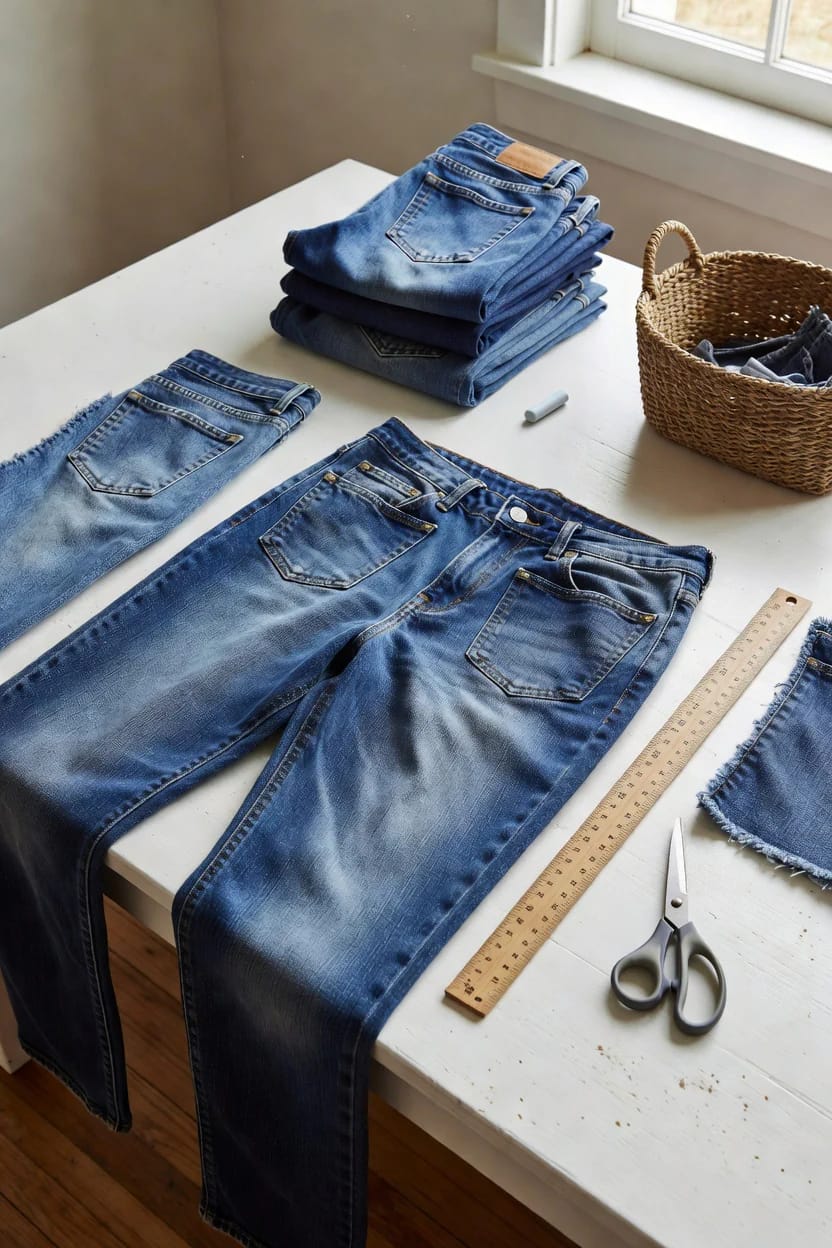
Then take each pair apart with the shears: cut off the waistband below the belt loops, cut away the zip fly and the back yoke with its pockets, cut off the hems, and slice up the inseam and the outseam. What you keep is the four flat panels a denim tree skirt gets cut from: two front, two back, no thick seams anywhere in them. The felled outseam is a double-folded rope of five or six layers and it will not braid; cut it away entirely rather than trying to fold it in.
Do not bin the offcuts. Pockets come off whole, waistbands make ready-made straps, and the gold topstitching is the detail that most good denim decor projects are built around. Keep them in a bag; the rug does not need them.
Step 2. Cut one continuous strip from each panel
Cut at one and a quarter inches for 12-ounce denim. Wider strips make a chunkier, faster rug that flattens unevenly under a chair leg; narrower ones eat your whole weekend.
The efficient method is the spiral: lay a panel flat, start the cut at one corner, and walk the rotary cutter around the panel in a continuous ring, keeping the width constant and rounding each turn rather than cornering it. One panel yields one long strip instead of fifteen short ones, which means fifteen fewer joins to sew. Square-cut strips work too, they just cost you in seams.
Denim sheds heavily along a cut edge. Cut over a bin, and borrow the rag-quilting trick of tumbling the finished strips in the dryer for ten minutes to shake out the loose threads before you braid, then clean the lint trap. Skip that and the fraying happens later, on your floor.
 12 Clever Scrap Fabric Projects With Almost No Sewing Twelve uses for the short strips and hem offcuts a rug leaves behind, most of them requiring no machine.
Step 3. Join the strips with a diagonal seam
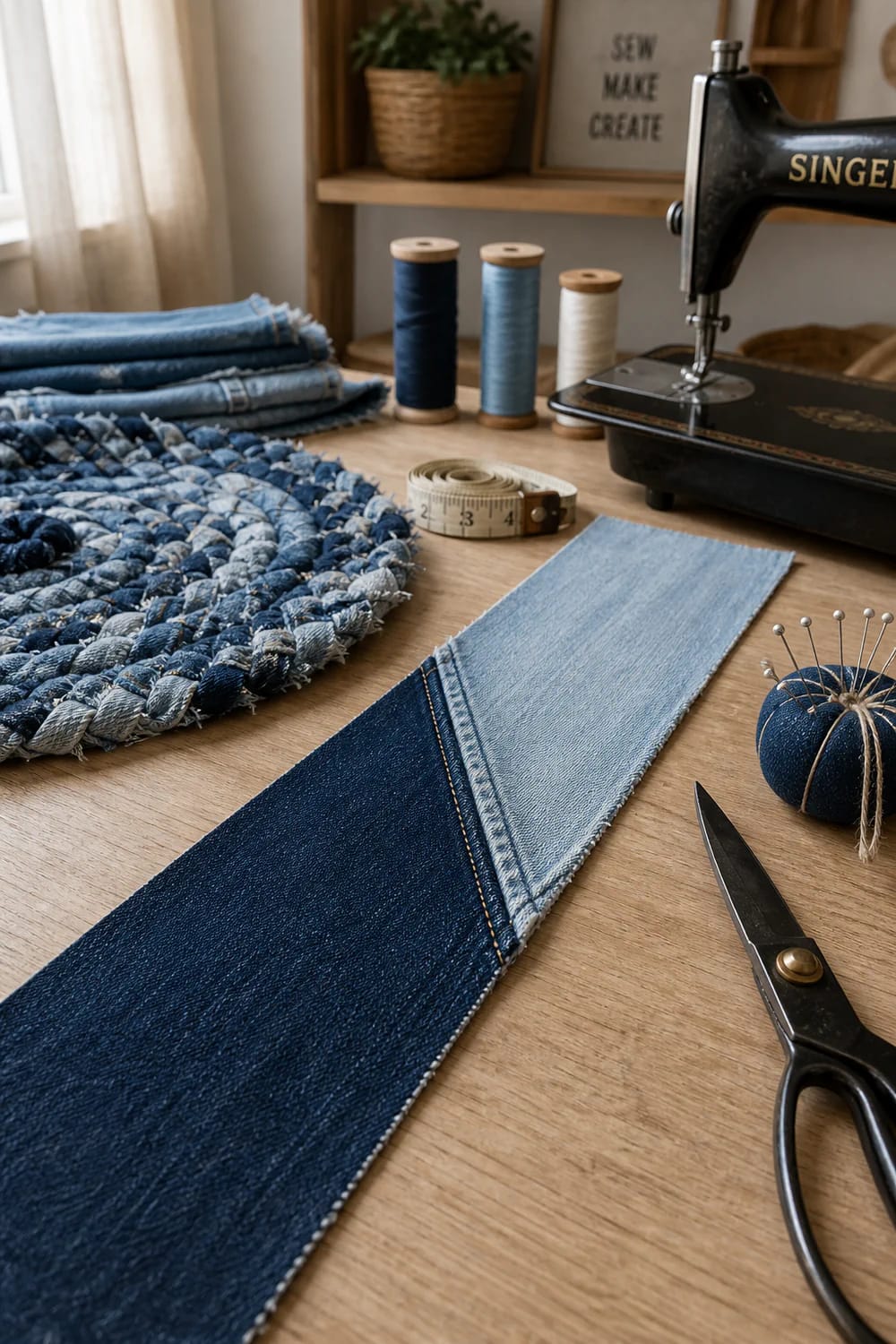
Overlap two strip ends at forty-five degrees, right sides together, and sew across the diagonal, then trim the corners and press the seam open. The angle spreads four layers of denim across an inch of braid instead of stacking them in one place, so the join disappears into the twist.
The no-sew slit-and-loop join, the one every t-shirt yarn tutorial uses, is a poor fit here. In jersey it pulls flat; in 12-ounce denim it makes a hard knot you can feel through a sock, and those knots land at random through the rug. If you have no machine, hand-sew the diagonals with a backstitch in the same bonded thread you will lace with. It is slower and it is still better.
Join strips as you need them rather than building three enormous balls first. Sorting by wash matters more than getting ahead.
Step 4. Braid with the raw edges folded in
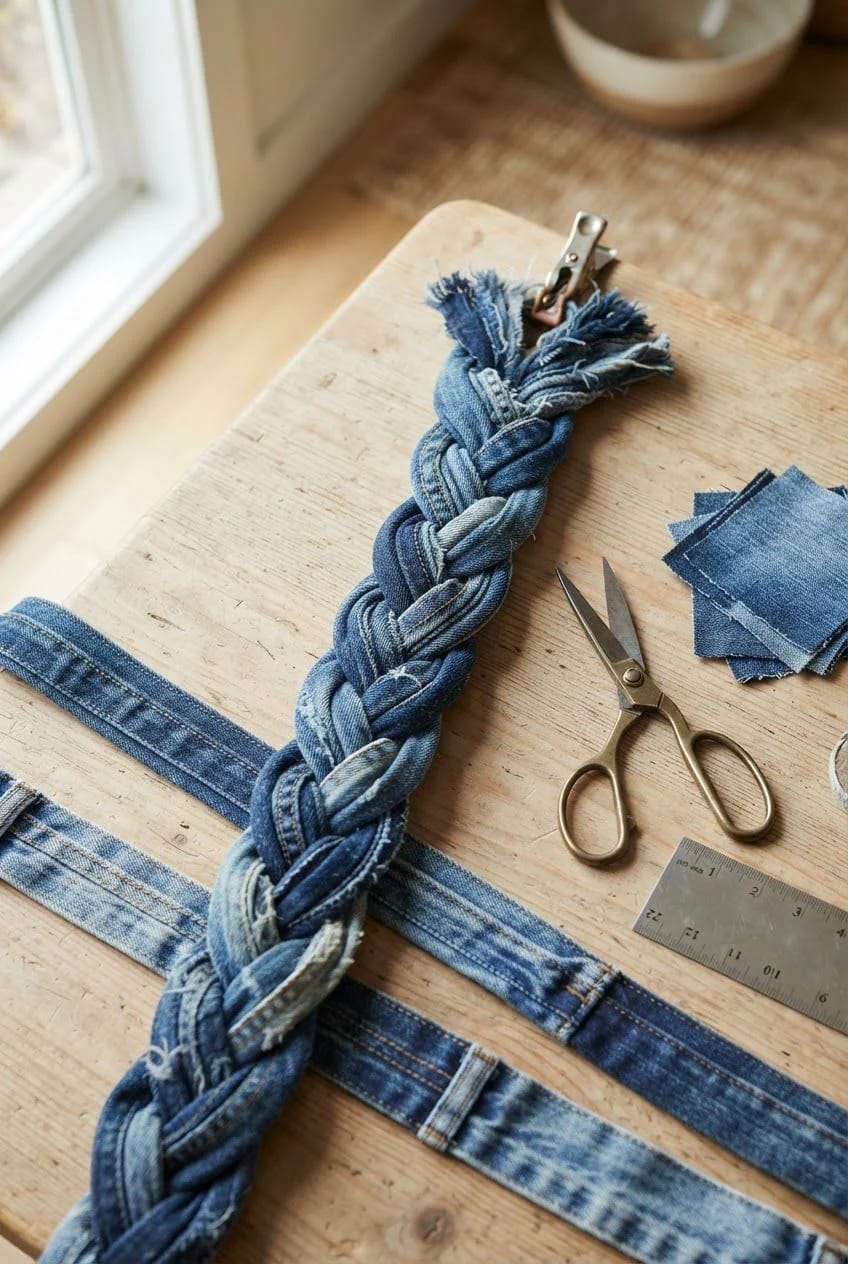
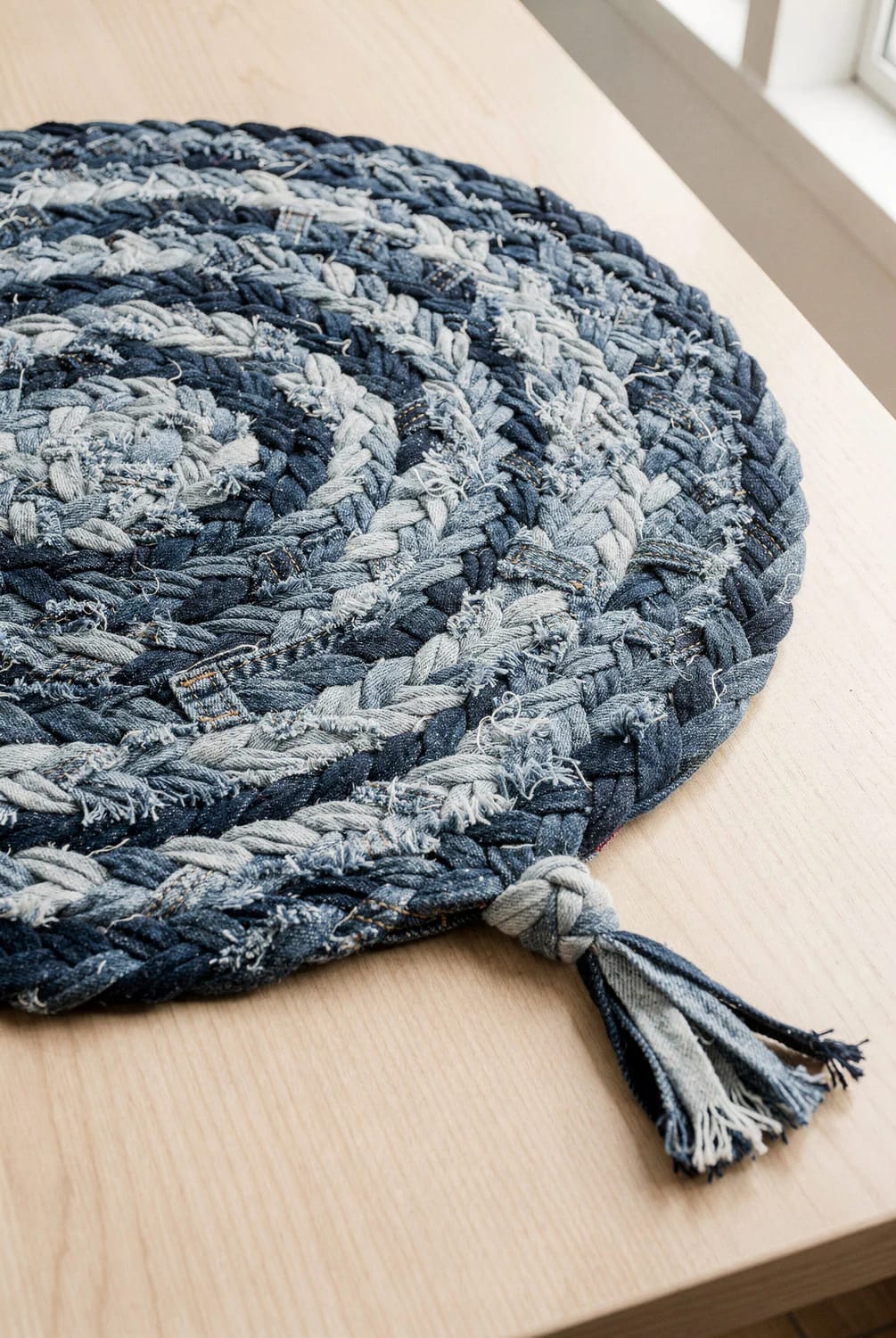
Sew three strip ends together in a staggered stack, clamp that stack to a table edge or a doorknob, and braid a standard three-strand plait. As each strand crosses, fold it in half lengthwise so the raw edges tuck inside and the smooth fold faces the outside of the braid. On denim, fold once, not twice: four layers is enough thickness for a rug that has to lie flat under a door.
Even tension is the whole job here. A braid that tightens and loosens along its length shows up later as a rug with high and low spots that no amount of blocking corrects. Braid a few feet, then let the length hang free so the twist can settle before you carry on.
Stagger your joins deliberately. If the diagonal seams in all three strands land within a few inches of each other, that stretch of braid stiffens noticeably.
Step 5. Coil the braid and lace it, do not sew it flat
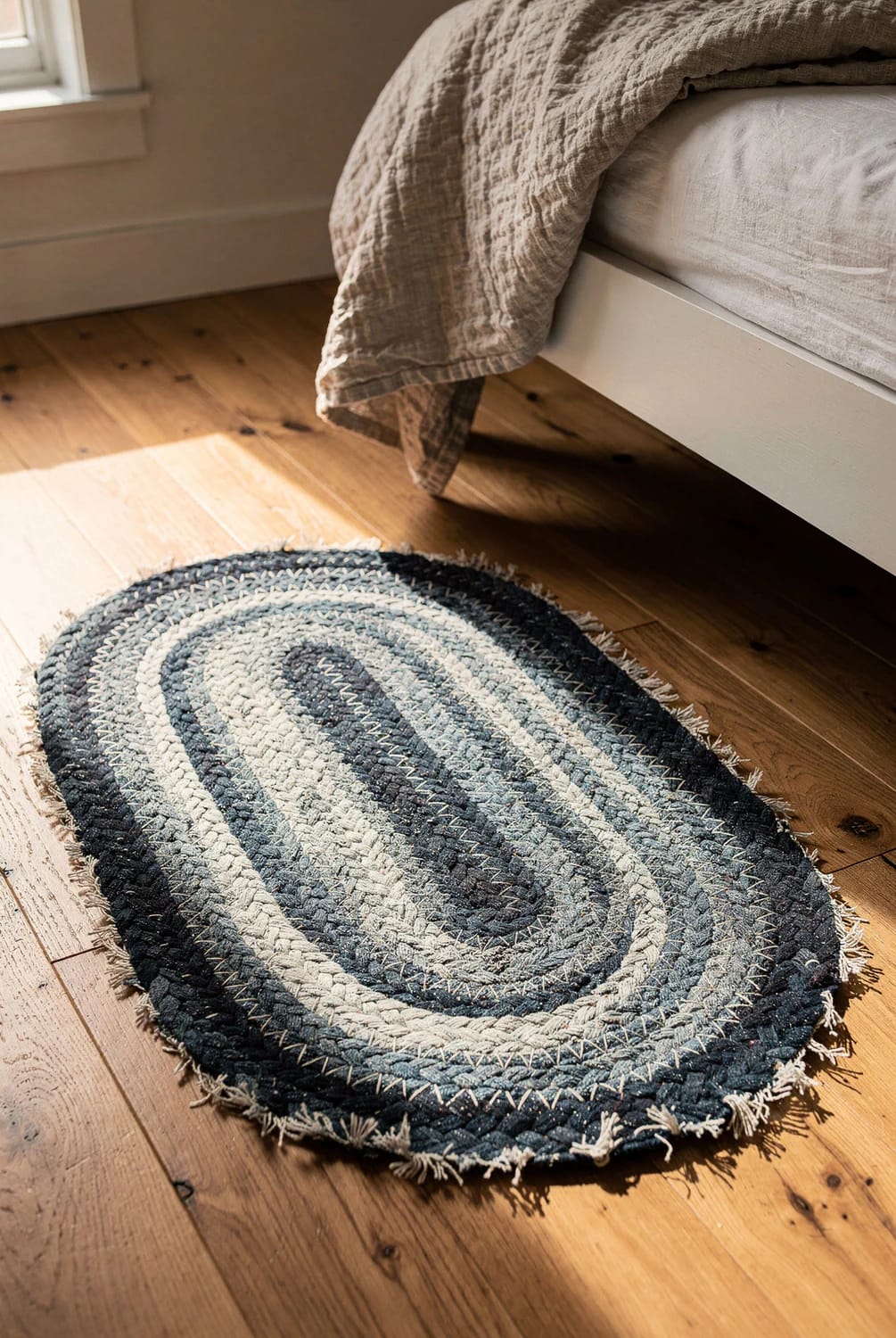
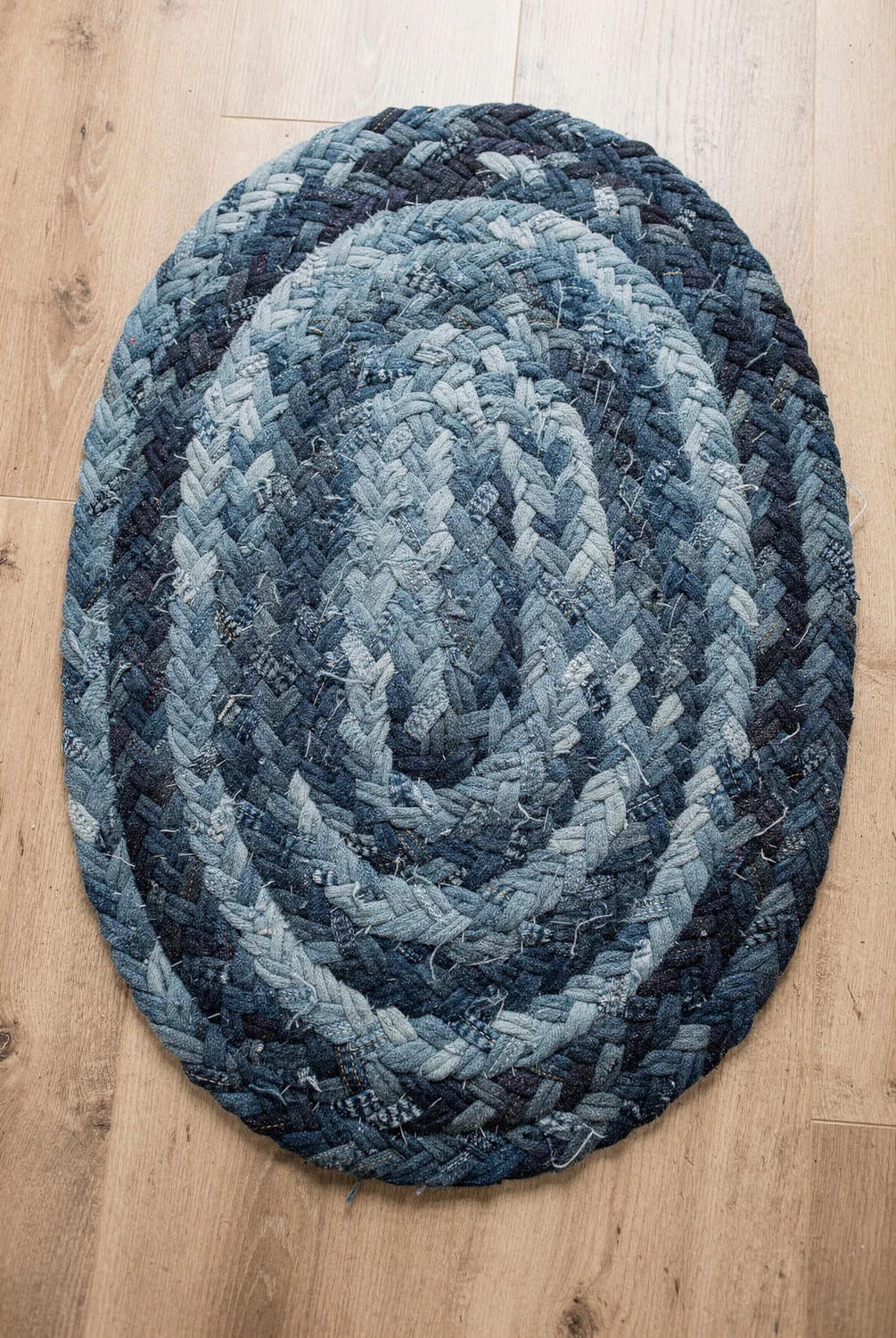
For an oval rug, the center braid is the finished length minus the finished width: a 2 by 3 foot mat starts with a one-foot straight center, a 4 by 6 foot rug with a two-foot one. Fold that center length back on itself, and start coiling the braid around it, working always on the same face so the rug has a consistent right side.
Now the part that separates a flat rug from a bowl. Lace, do not stitch across the top. Run the bent needle through the loop of the working braid and the loop of the braid already laid, passing between the folds so the thread vanishes into the groove, and pull just firm enough to butt the two braids together. Catch alternate loops on the straight runs. On the curves at each end, lace through two loops of the outer braid for every one of the inner braid, because the outside of a turn has further to travel and needs the extra fullness.
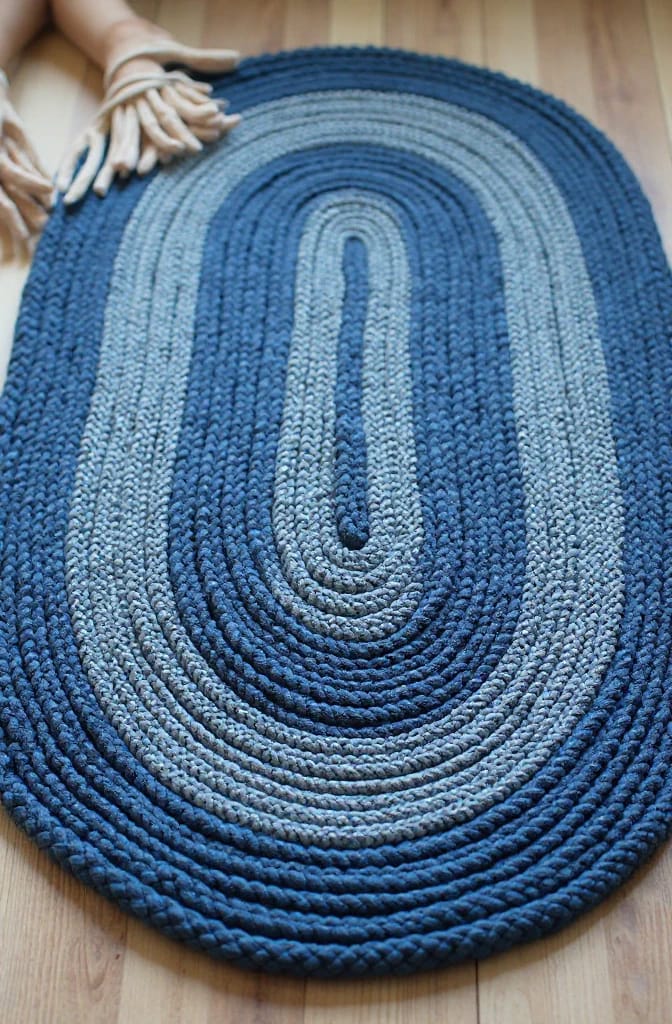
Get the increases wrong in either direction and the rug tells you immediately: too few, and the edges lift into a shallow dome; too many, and the outer round ruffles like a lettuce leaf. Check by dropping the work flat on the floor every couple of rounds rather than judging it in your lap. Denim is stiff enough that a cupping rug will not relax flat on its own, and unpicking six feet of lacing is an evening.
Step 6. Taper the tail, then block it under weight
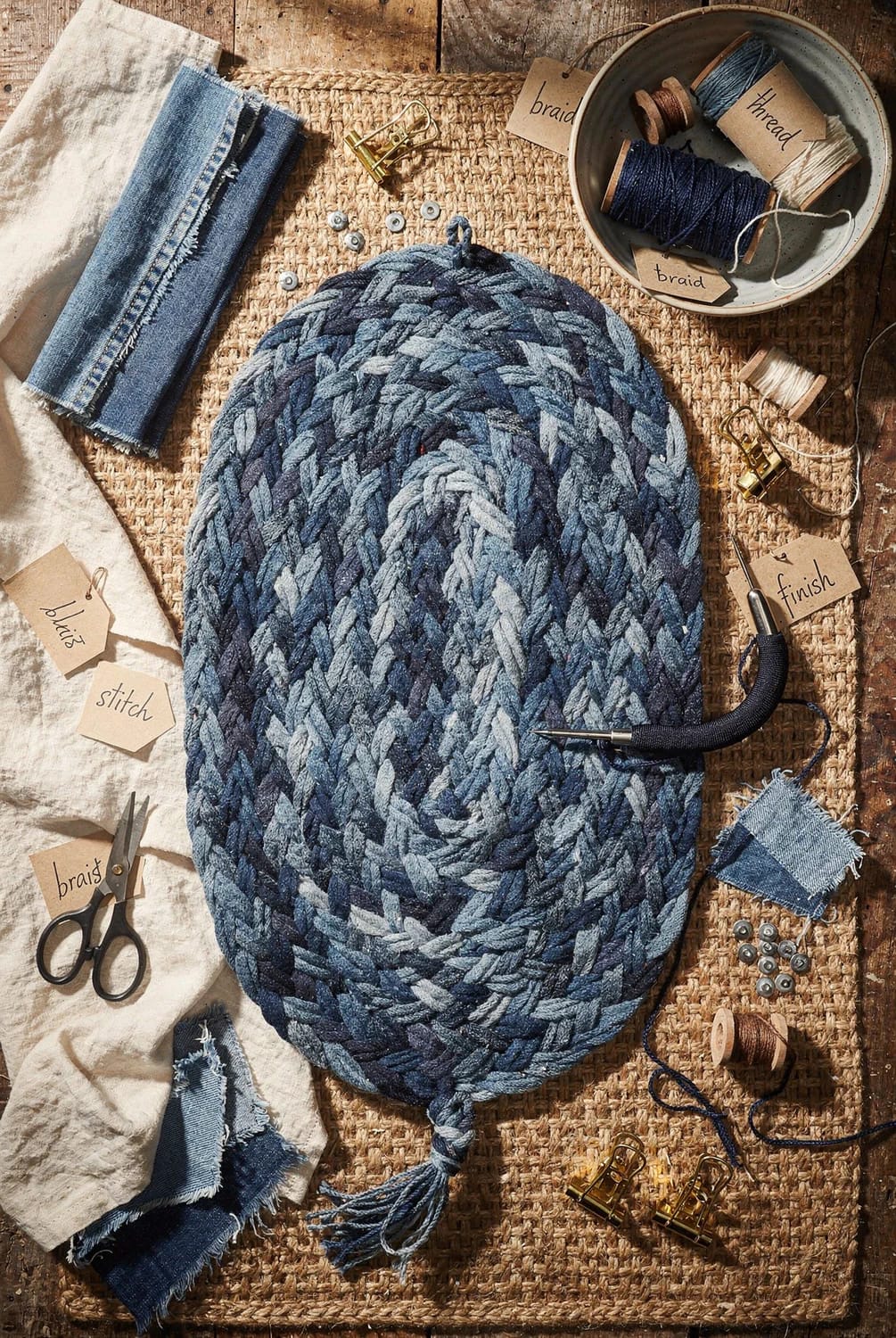
Stop braiding about eighteen inches before the rug reaches its final size. Trim each of the three strands progressively narrower over those last inches so the braid thins to roughly half its width, then lace that tapered tail into the groove between the last two rounds where it dies away invisibly. A blunt cut-off end shows as a lump on the perimeter forever.
Then block it: lay the rug face down on a sheet, steam it heavily, and weight the whole thing under books or boards overnight. Denim holds a press well, which is one of the few places this fabric makes the project easier rather than harder. Any section still domed after blocking needs two or three more increases laced in, and it is worth doing now.
A realistic build schedule
Nobody does this in one sitting, and the strip prep is far and away the dullest part, so plan for it rather than discovering it at hour four.
- Session one, about 2 hours. Wash and dry all the jeans. Break down six pairs into panels. Bag the offcuts.
- Session two, 3 to 4 hours. Spiral-cut every panel. Tumble the strips, clean the lint trap, sort the coils by wash.
- Session three, 1 hour. Sew the diagonal joins for the first third of the strips. Set up the clamp.
- Sessions four to six, 4 to 6 hours total. Braid and lace in alternating stretches. Check flatness on the floor every couple of rounds.
- Final session, 1 hour plus overnight. Taper, lace down the tail, steam, weight it, and leave it under the books until morning.
Where these rugs go wrong
- Cupping from over-tight lacing. The most common failure by a wide margin. Pull the thread firm, not tight; the braids should touch, not compress.
- Mixed fabric weights. A pair of thin chambray strands braided against heavy raw denim gives a braid that changes width, and a rug that changes height.
- Bulky joins. Straight-across seams, felled outseams left in, or slit-and-loop knots. All three read through the surface underfoot.
- A latex or glue backing. Skip it. Painted-on rug backings crack, yellow, and glue the rug to a finished floor over time, and they make the thing unwashable. A separate pad does the same job and comes off.
- Running out of one wash. If a pale strand disappears two-thirds of the way through, the outer rounds shift color abruptly. Ration the palest jeans across the whole build.
Washing it without wrecking it
A doormat-sized denim rug goes in a home machine on cold and gentle, in a mesh bag if it fits, and then flat on a rack or a couple of towels to dry. Do not put it in a dryer. Anything over about 3 by 5 feet is a laundromat job or a spot-clean job, because a wet denim rug can carry twice its dry weight and a domestic drum will not handle the load. Shake it out and vacuum it face down between washes; braided rugs hold grit in the grooves.
The reason to bother with any of this sits in the water figures. Levi Strauss’s own life cycle assessment put a single pair of 501s at 3,781 liters of water across its lifetime, most of it in cotton growing and consumer washing, and the EPA counted 11.3 million tons of textiles landfilled in the US in 2018. Six pairs kept out of that stream and turned into something you walk on for a decade is a better answer than most of what sustainable fashion currently offers.
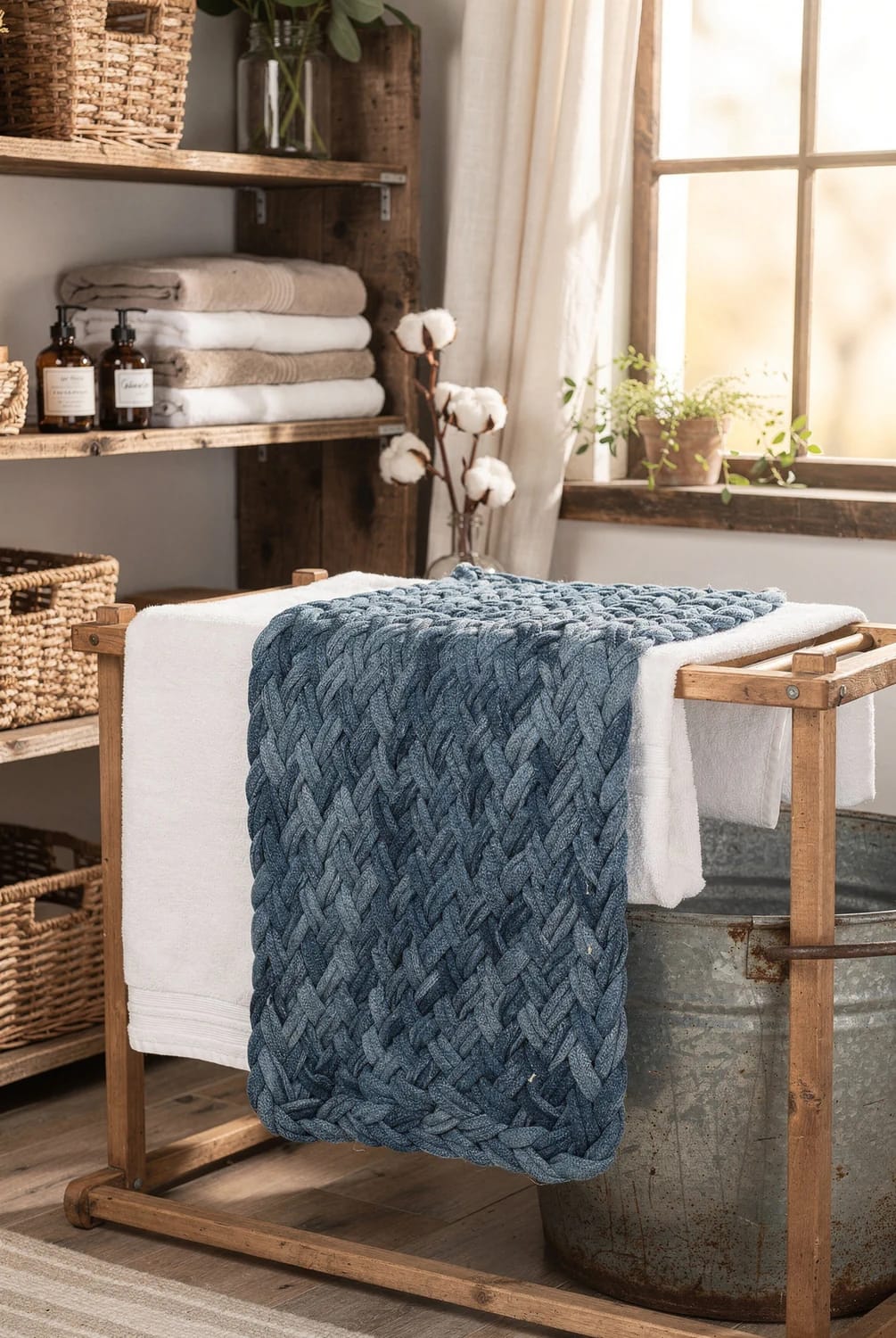
 57 Innovative Upcycled Jeans Ideas: Transform Your Old Denim into Chic Fashion and Home Decor Where the stretch pairs, the pockets and the waistbands go once the rug is laced.
If you are going to make one, make the doormat first rather than the 3 by 5. Five pairs and a one-foot center braid will teach you what lacing tension feels like in your hands, and the mistakes will be confined to something you can put by a back door and stop looking at, which is more or less how everyone's first braided rug ends up living.
Related Posts
- Upcycled Denim Christmas Ornaments From Old Jeans
- 10 DIY Denim Christmas Garland Ideas to Make From Old Jeans
- 13 DIY Denim Christmas Stockings From Old Jeans
- How to Make Stunning Angel Wings from Old Jeans for Your Home
- How to Make a Decorative Hot Air Balloon Planter from Old Jeans
- 57 Innovative Upcycled Jeans Ideas: Transform Your Old Denim into Chic Fashion and Home Decor