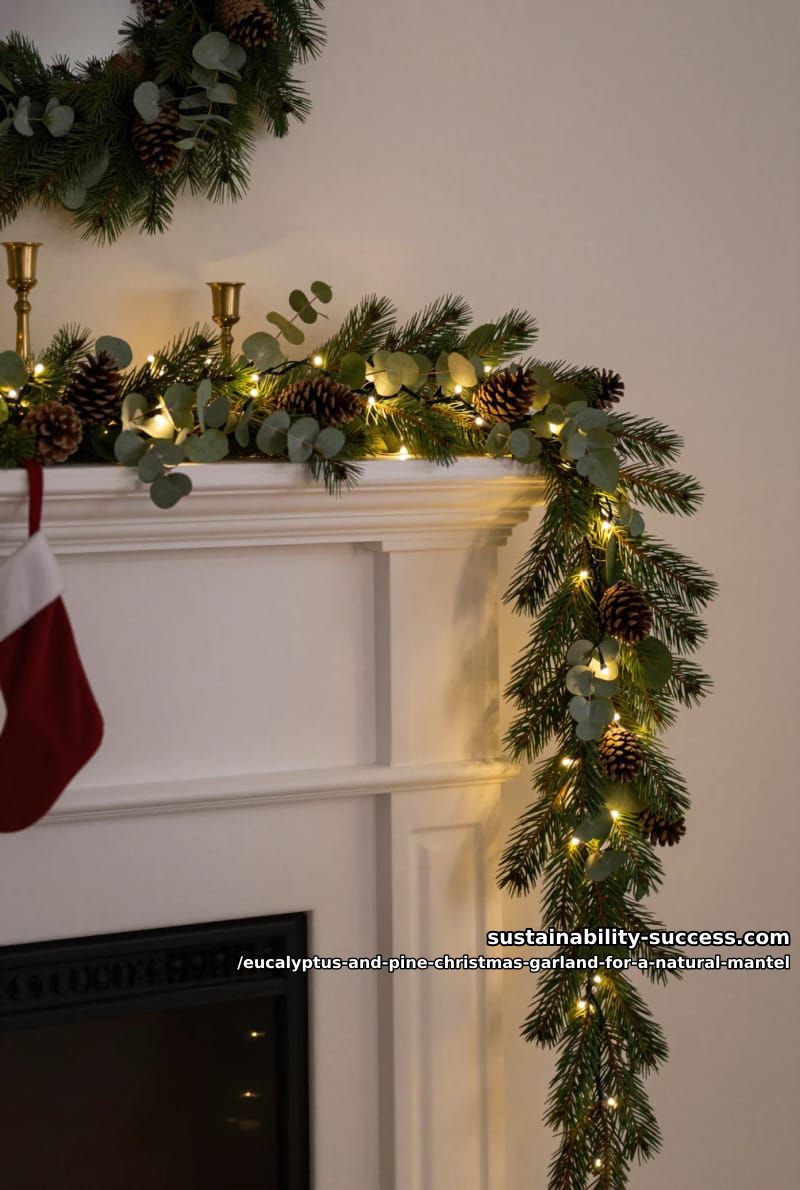
A plain eucalyptus garland and a handful of pine picks will get you a mantel that reads like the $200 designer version, for roughly a quarter of the price. The move is to buy a base garland that nobody has labeled "Christmas" yet, then layer pine into it until it looks foraged instead of bought. Below is the exact build, the prices, where the cheap stuff gives you away, and how to hang it without putting a single hole in your paint.
The real trick: build on a base you already half-like
You are not making a garland from scratch. You are buying one boring strand of faux eucalyptus and tucking pine into it until the eye stops reading "plastic." That is the entire project, and it takes about twenty minutes once the parts are on the table.
The reason this works is sneaky. A plain seeded eucalyptus garland sold for weddings or year-round decor usually costs less than the identical-looking thing once a retailer prints "holiday" on the box. So you buy the wedding one in November, layer in the Christmas, and skip the markup. The pine is what does the seasonal work; the eucalyptus just gives it body and that soft grey-green color that keeps the whole thing from looking like a hardware-store wreath.
What you'll need, and what it actually costs
Quantities depend on your mantel. Measure it, then plan on roughly one and a half times that length in garland so it can swag and trail instead of stretching tight across like a clothesline. A standard 4 to 6 foot mantel wants about 9 to 12 feet total, which two 5 to 6 foot strands cover with overhang to spare.
Materials (the stuff that gets used up)
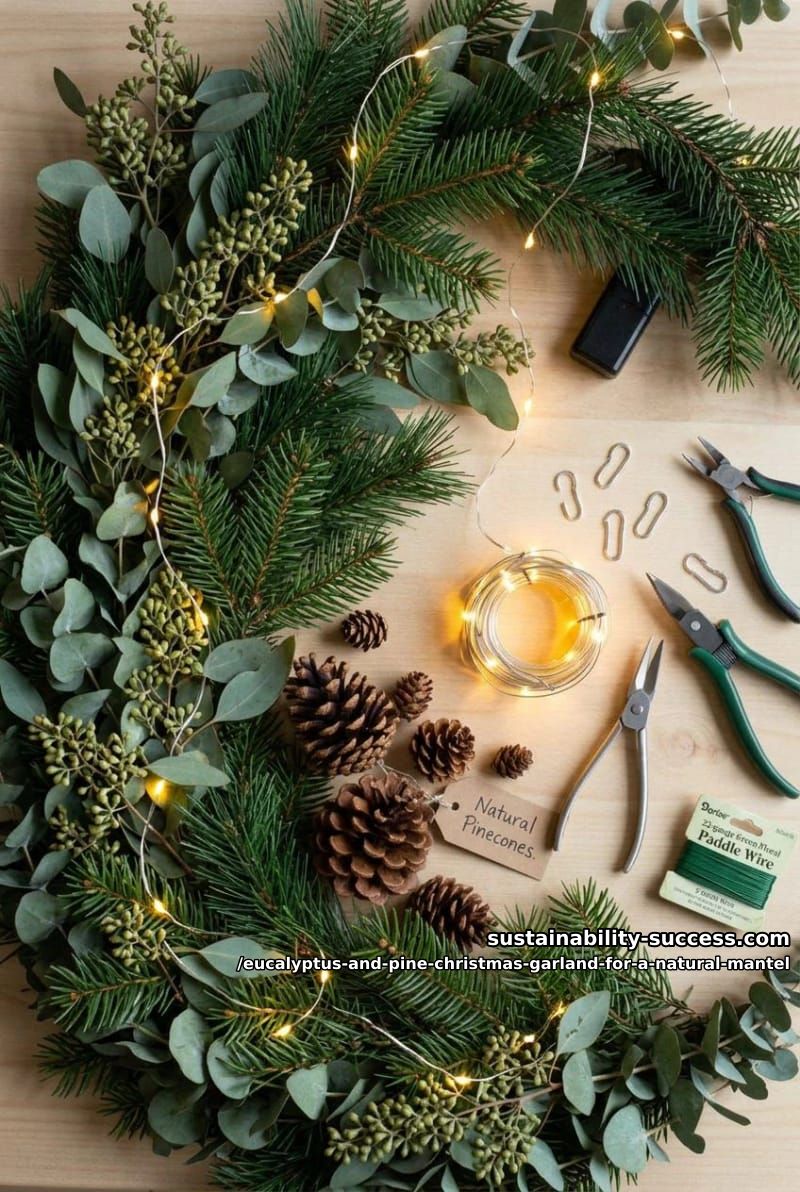
- Seeded eucalyptus garland, 2 strands of 5 to 6 feet. Roughly $12 to $25 a strand. One honest warning: listed lengths run optimistic, so a “6 foot” strand is often closer to 5 feet of useable greenery once you subtract the bare ends. Buy one more than the math says. 5.5 ft faux seeded silver dollar eucalyptus garland
- Faux pine picks, the soft bendable kind with a wire core, about 8 to 12 stems. Around $10 to $18 for a multi-pack. A Target Wondershop mixed-greenery pack runs about $5 if you only want a few. 50-piece bendable artificial pine branch stems
- Green floral paddle wire, 22 gauge, about $4 to $8. You may not even need it if your pine picks are bendable enough to twist on by hand. Darice 22-gauge green floral paddle wire
- Warm-white battery fairy lights with a built-in timer, about $8 to $15. Optional, but they are what make the mantel glow at night without you flipping a switch. 20 ft warm-white battery fairy lights with 6-hour timer
- A few pinecones, free off the ground or a couple dollars for a bagged set.
Tools (the stuff that goes back in the drawer)
- Clear command hooks, medium, rated to about 2 pounds. Around $5 to $10, and worth every cent for not patching nail holes in January. Command medium clear damage-free hooks
- Wire snips or any sharp craft scissors. Free if you own scissors, which you do.
Materials land around $40 to $90 depending on how many strands you need and whether you spring for lights. Tools add only $5 to $20, and most of that is hooks. Someone starting from absolutely nothing is looking at $45 to $110 all in, which is still less than one ready-made designer garland of the same length.
Building it: layer the pine in, don't line it up
Lay both eucalyptus strands end to end on a table or the floor first. If they arrived coiled in a box, give them a few hours to relax and fluff before you do anything; shipped greenery holds its packing shape and looks thin until the branches fall open.
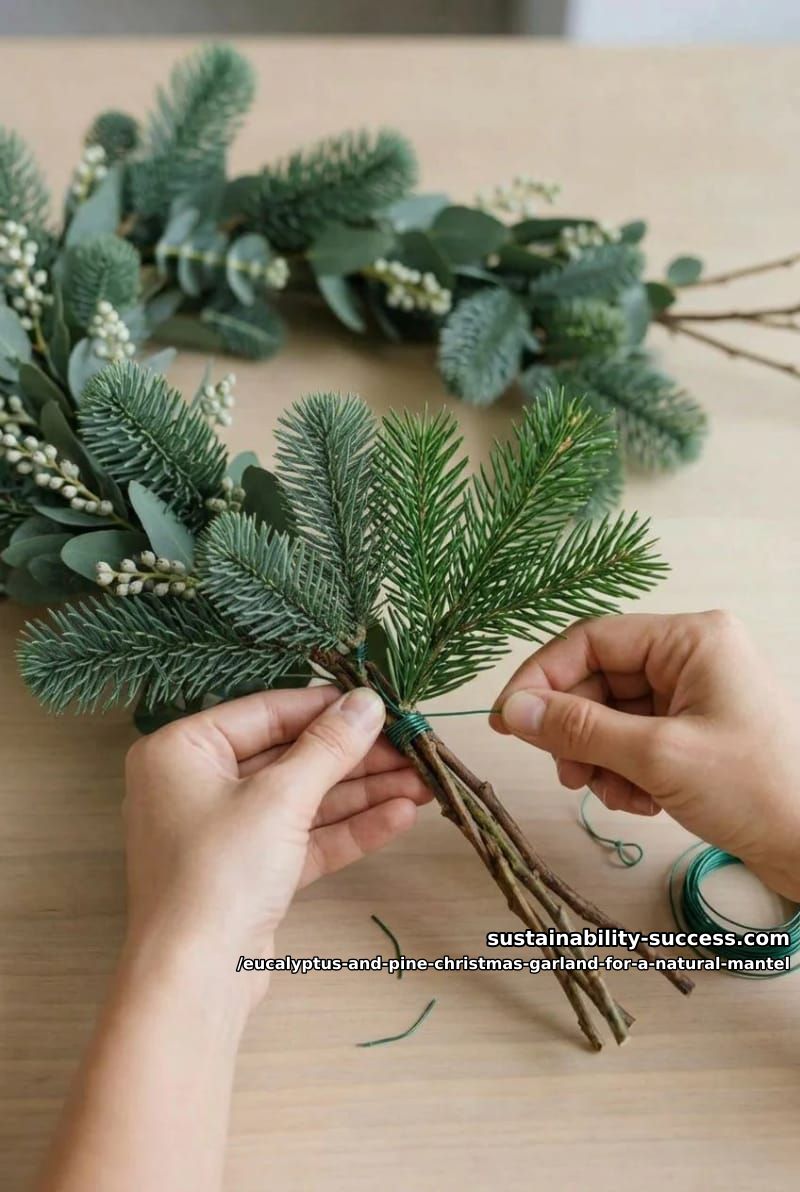
Now work the pine in. Tuck each pick under a eucalyptus branch so the wire stem hides behind leaves, then either bend the pick's own wire around the garland spine or lash it with a short length of floral wire. Vary the spacing. This is the part I got wrong the first year: I spaced the pine evenly, every eight inches, dead straight, and it looked exactly as manufactured as it was. Cluster two or three picks in some spots, leave gaps in others, and let a few angle off at the front so they catch light. Real greenery does not grow on a grid.
Wiring the pine down tight and flat. Crushed against the spine, the picks read as a stiff hedge and the eucalyptus loses its drape. Leave the picks slightly proud of the surface and let them fan out a little. If you can see the green wire or the bare base garland from three feet away, you have too few picks or they are tucked too shallow; add more and bury the mechanics.
One sourcing note while your hands are in it: buy the plain seeded eucalyptus, not a "Christmas eucalyptus" with frost or glitter baked on, which dates fast and reads cheap up close. For the pine, skip the stiff flat-needle picks that look like bottle brushes. The soft, slightly drooping bendable stems are the ones that disappear into the eucalyptus and sell the foraged look.
Hanging it on the mantel without wrecking your paint
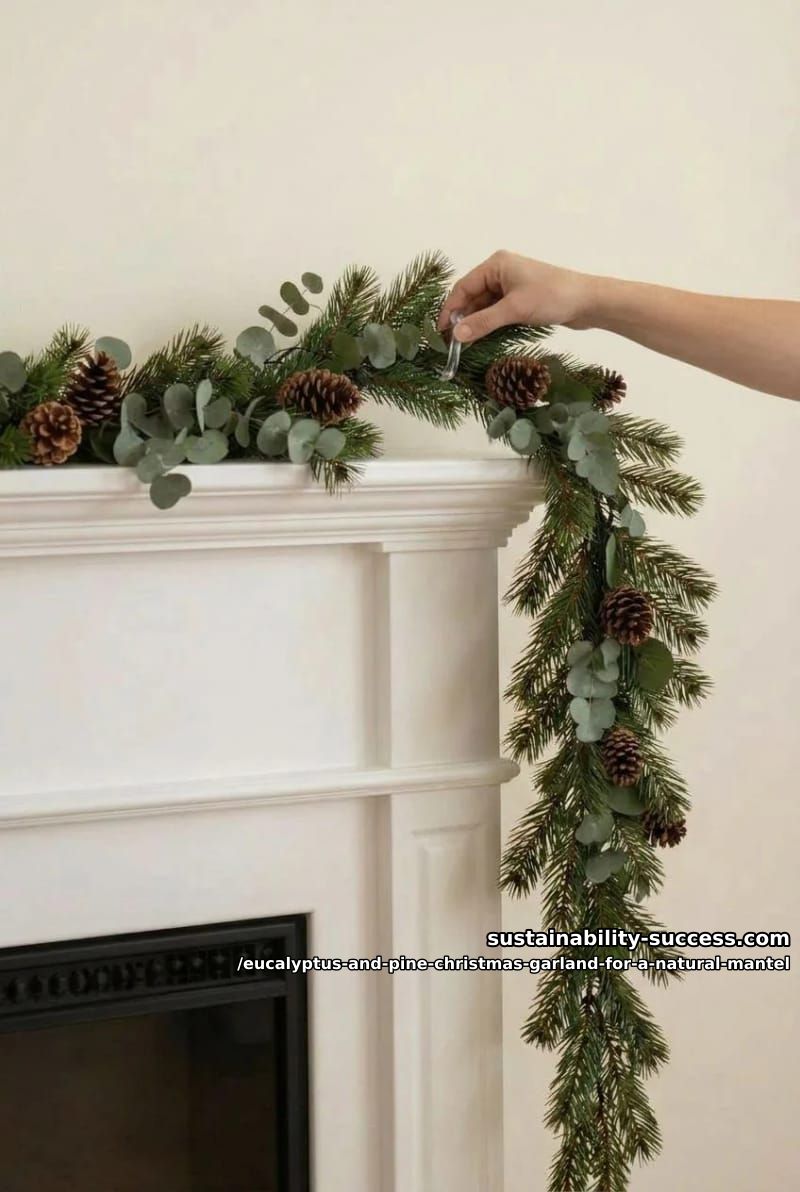
Press two or three clear command hooks onto the underside lip of the mantel, spaced across its length, and let the adhesive cure for the full hour the package asks for before you load any weight. People skip the wait and then wonder why their garland slid off at 9pm; the glue needs that hour.
Drape, don't stretch. Hook the garland so it dips into a low swag between supports and trails longer off one end than the other. That off-center weight is what the designer versions do, and it is the single fastest way to make a homemade garland look intentional. A perfectly symmetrical garland pulled taut from corner to corner looks like bunting; an uneven one with a heavier tail looks like someone with taste arranged it.
Lights, pinecones, and the layer that finishes it
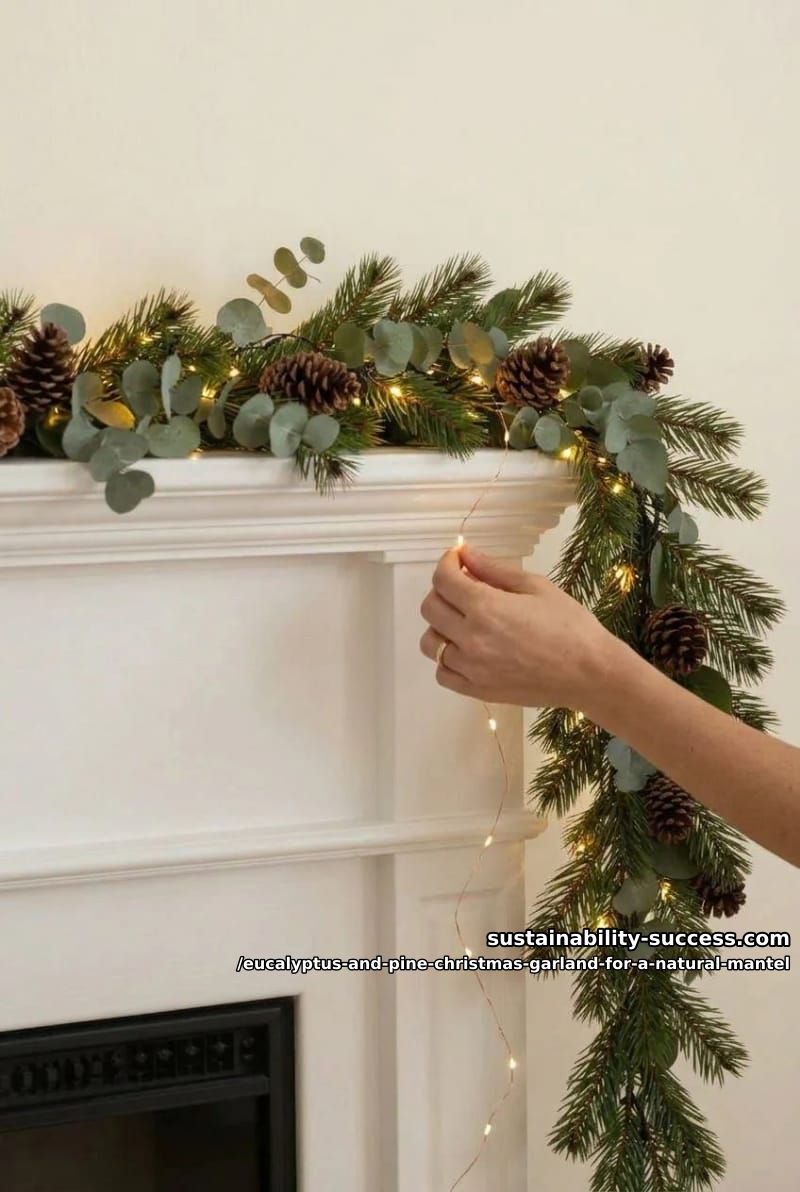
Weave the fairy lights through the back of the garland, not the front, so you see glow rather than wire. Tuck the battery box behind a candlestick or a stack of books at one end. Warm white is the only color that flatters greenery; cool white turns eucalyptus a sickly blue, and I will die on that hill. Set the box to its timer mode (most run 6 hours on, 18 off) and you never think about it again.
Then nestle a few pinecones into the gaps where the pine clusters, pressing them down into the greenery rather than perching them on top. That is the finishing layer. Resist adding more; a eucalyptus-and-pine garland earns its quiet, and piling on red berries and bows buries the thing you just built.
Keep greenery and any string lights at least three feet from an open flame, and if you actually light the fire, take the garland down or swing it well clear first. Choose LED fairy lights that stay cool to the touch, and remember the battery box is not waterproof, so keep it off the firebox and away from any misting if you go the fresh route below. Faux greenery is less flammable than dried fresh greens, but neither belongs draped over a working firebox.
If you want it fresh instead of faux
Fresh is the more beautiful option and the more demanding one, so be honest with yourself about misting. Real eucalyptus on its own lasts only a couple of days out of water, but treated and kept cool it holds for around two to three weeks, which gets you through the season if you start in December. Pine, spruce, fir, and cedar all hold longer than most greens, so a fresh pine-and-eucalyptus mix is a sensible pairing rather than a doomed one.
The care routine is short but non-negotiable. Cut every stem end at a 45 degree angle and soak the whole garland in a tub of cool water overnight before you hang it, which lets the leaves and needles drink. Let it drip dry, then coat it with an anti-transpirant spray (the Wilt-Pruf or Wilt Stop type, made from pine resin) to lock moisture in; testers report eucalyptus that normally lasts two days holding for two weeks after treatment. Once it is up, mist it every day or two, and keep it out of direct heat. A mantel over a working fireplace is the worst possible spot for fresh greens, so this is where the faux version quietly wins for most people.
Sourcing fresh is cheaper than you would guess. Trader Joe's sells eucalyptus bunches and short garlands in the single digits in season, florists will special-order cedar and pine, and a Christmas tree lot will usually hand you trimmings for free if you ask. Forage what you can, buy the rest, and wire it into a base the same way you would the faux version.
Conclusion
Build the faux base first even if you plan to go fresh later, because the layering technique is identical and the faux strand becomes your reusable skeleton for next year: you strip the pine and lights, bag the eucalyptus, and rebuild in twenty minutes each December. The order that matters is base, then pine, then hooks and drape, then lights, then pinecones last. Skip ahead and you end up rewiring around lights you already strung, which is its own small misery.
If you do one thing differently from every tutorial, make it the asymmetry. The uneven, heavier-on-one-side drape with gaps in the greenery is what separates a mantel that looks foraged from one that looks like it came folded in a box, and it costs nothing.