
A worn pair of jeans hands you three shapes before you cut anything: the back pocket, already a lined pouch with topstitching; the flat-felled side seam, a raised ridge that reads as a deliberate design line; and the frayed hem, which does the hard part of "finishing an edge" by falling apart on purpose. For a beginner, that is the whole trick. The decorations below lean on those ready-made parts, so a crooked cut or a loose thread looks handmade instead of wrong, and I have sorted them by object rather than by difficulty because the pocket angels are worth attempting on day one even though they are not the very easiest thing here.
A caveat before you start hoarding old denim: heavier, non-stretch jeans behave, while thin stretch denim curls and puckers and will fight you on anything that needs to lie flat. Skip the sewing machine for at least half of these; fusible web and a hot iron do the same joining job and hide beginner wobbles better than a straight stitch ever will. And most of what follows costs the price of a spool of thread plus whatever buttons and twine you already own, so one retired pair of jeans usually stocks a whole shelf of ornaments.

Ornaments to hang on the tree
Small, flat, and forgiving, these are where you learn how denim frays and how much fray you actually want. Make the first three off one jean leg and you will have your technique sorted before you touch anything bigger.
Denim pocket angels

Start here even though the angel has the most parts, because a finished one makes you want to make five more. The body is a whole back pocket cut off the jeans with a centimeter of surrounding fabric left on; the head is a wooden bead threaded on the hanging loop; the wings are two small denim triangles or a folded rectangle glued behind the pocket. Admittedly the proportions are what separate a sweet angel from a lumpy one, so cut the wings a touch smaller than feels right and let the pocket be the biggest shape.
The pocket's existing topstitching gives you a decorative outline for free, which is the reason this looks more finished than the effort suggests. Add a halo of thin gold wire or a scrap of lace collar if you want, but the plain version reads fine on a tree.
No-sew denim stars
Cut two identical five-point stars, bond them wrong sides together with a sheet of fusible web and an iron, and you have an ornament with zero stitches and a raw edge that frays into a soft outline. Fusible web melts between the layers and, as a bonus, grips the surrounding threads so the denim ravels less than a single cut layer would. A quick version:
- Trace a star onto card, cut two from denim in slightly different washes so the front and back don’t match.
- Sandwich a web sheet between them, press for the seconds the packet specifies, let it cool flat before you move it (skip the cooling and the paper backing fights you).
- Punch a hole near one point, thread twine, and rough up the edges with your fingernail if you want more fray.
Granted, the raw edge is the point, so resist the urge to hem it: a clean-hemmed denim star looks like a coaster. Vary the wash pairings across a set of six and they stop looking mass-produced.
Patchwork denim baubles

Cover a foam or paper ball in overlapping denim squares and you get a bauble with real weight and texture, and the place to be deliberate is the palette: mixing light, medium, and dark washes on one ball is what keeps it from reading as a solid blue lump. Pin the squares first if you are glueing; the overlaps hide raw edges so no hemming is needed. This is also the spot to raid the parts of the jeans other projects reject, since small odd offcuts are exactly what patchwork wants.
Raw-edge denim hearts

Cut two hearts, stitch a running line just inside the edge, stuff lightly, and leave the raw edge to fray. The move that lifts it above generic fabric hearts is placing the jeans' side seam down the center so a real construction line becomes the ornament's spine. Keep them small; big denim hearts get heavy and pull the branch down.
Little trees you build from scratch
A cone Christmas tree from old jeans

Roll a cone from cereal-box card or buy a foam one, then cover it in denim: strips, loops, folded scallops, or rough squares all work, and the one dropped by an old craft trick, forming the loops from cut jean seams, gives you a rope-like texture with almost no effort. Work bottom to top so each row overlaps the one below like shingles and hides its raw edge. If you graduate the washes dark-to-light up the cone, you fake depth that a single denim tone can't.
Tuck a strand of battery fairy lights between the rows and the tree earns a spot on a mantel or hall table after dark, which is the closest thing to lighting a denim project gets. A pinecone or burlap star on top finishes it. This one takes an evening rather than ten minutes, so it is the section to slow down on.
A denim wall tree on dowels

For anyone short on floor space, wrap five dowels or twigs in denim, tie them at descending widths to a length of jute, and hang the whole thing flat on a wall or door. It reads as a tree from across the room and stores flat. Renters and small-apartment crafters get the most out of this one, since nothing needs a stand and a single command hook holds it.
Bigger pieces for the mantel and table
A stocking cut from a jean leg

A jean leg is close enough to stocking-shaped that this is far easier than it looks: fold the leg flat, draw a stocking outline that keeps a back pocket on the front, cut through both layers, and sew up the curve. The pocket becomes a working pouch for a candy cane or a rolled note, which is the detail people actually remember. Granted, the ankle taper means the toe wants to end up narrow, so exaggerate the foot width when you draw the line.
A folded flannel or plaid cuff at the top covers the raw opening and adds the one hit of color denim lacks. This is a sew-required project, but a straight-ish seam and a frayed edge are all it asks of you.
A frayed denim tree skirt
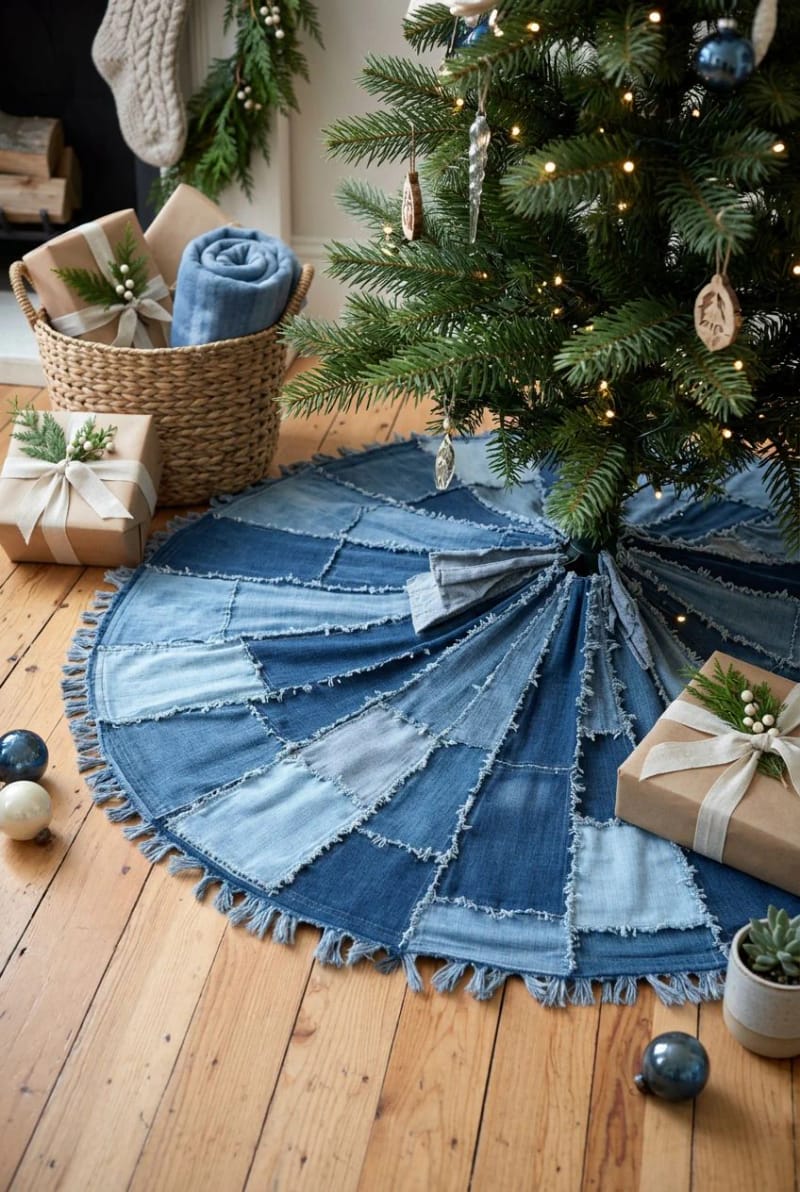
Rag-quilt squares of denim into a circle, sew the seams on the outside so they fray into raised ridges, and you have a skirt that gets softer every time it is washed. It is a lot of simple repeated squares rather than one hard task, so it suits a beginner willing to trade time for technique. Cut a center hole and an opening with two ties so it wraps around the trunk.
A pocket table runner

Piece denim rectangles into a long strip and keep a few back pockets intact along it to hold cutlery, name cards, or greenery. It is the same skills as the skirt in a shape that hides wobbles better, since a table runner is judged from above and at speed. Frayed long edges save you two hems.
Characters and gift-wrap extras
A denim gnome

Gnomes forgive everything, which is why they belong on a beginner list: a denim cone body, a fur or wool beard, a knit hat pulled down over a bead nose, and no face to get wrong. The hat can be a cut-off sock cuff, so the "hard" part is free. Weight the base with rice or a stone so it stands.
A no-sew denim snowman
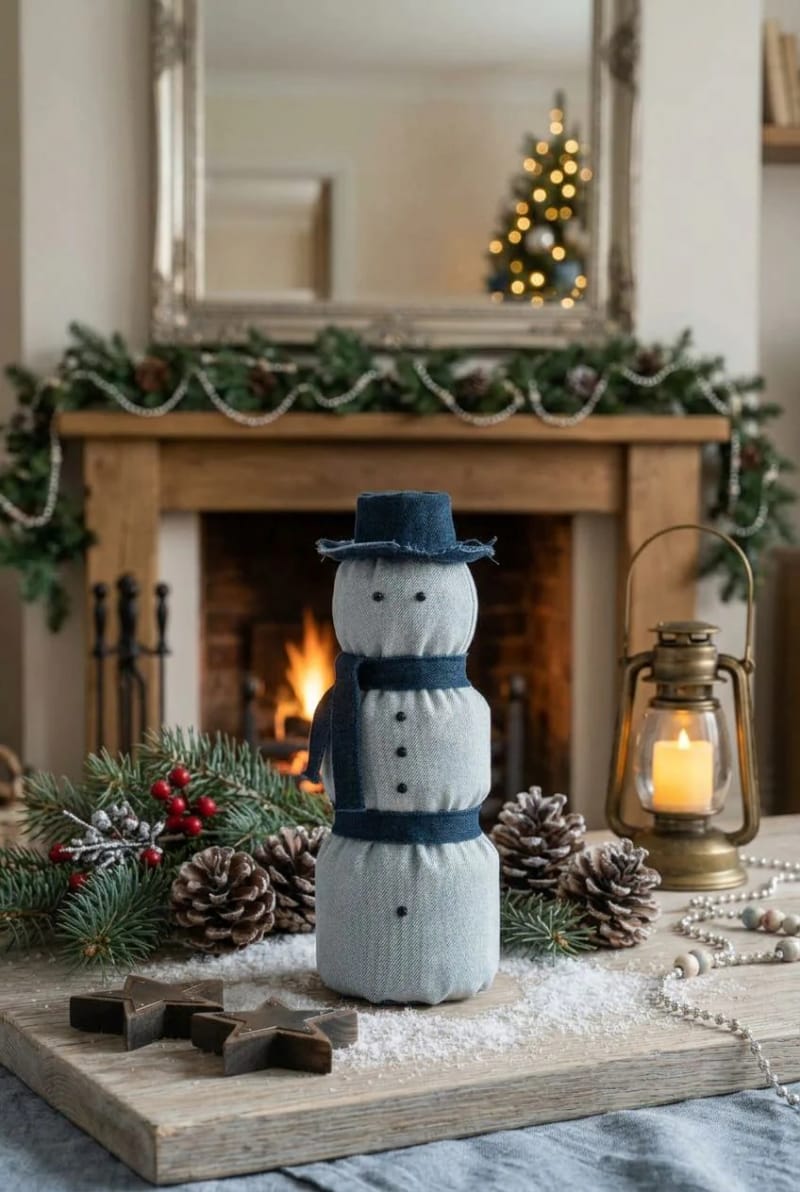
Wrap a cardboard tube or paper-towel roll in pale denim, add a dark denim scarf and a button front, and you have a standing snowman with no needle involved. It is the project to hand a kid alongside you, since every part is glue and wrapping. Pale stonewash denim sells the snow better than dark indigo.
Denim gift bags
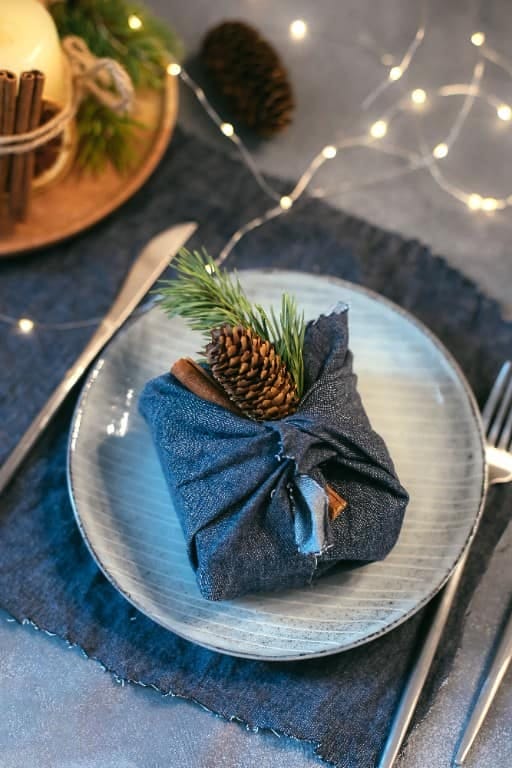
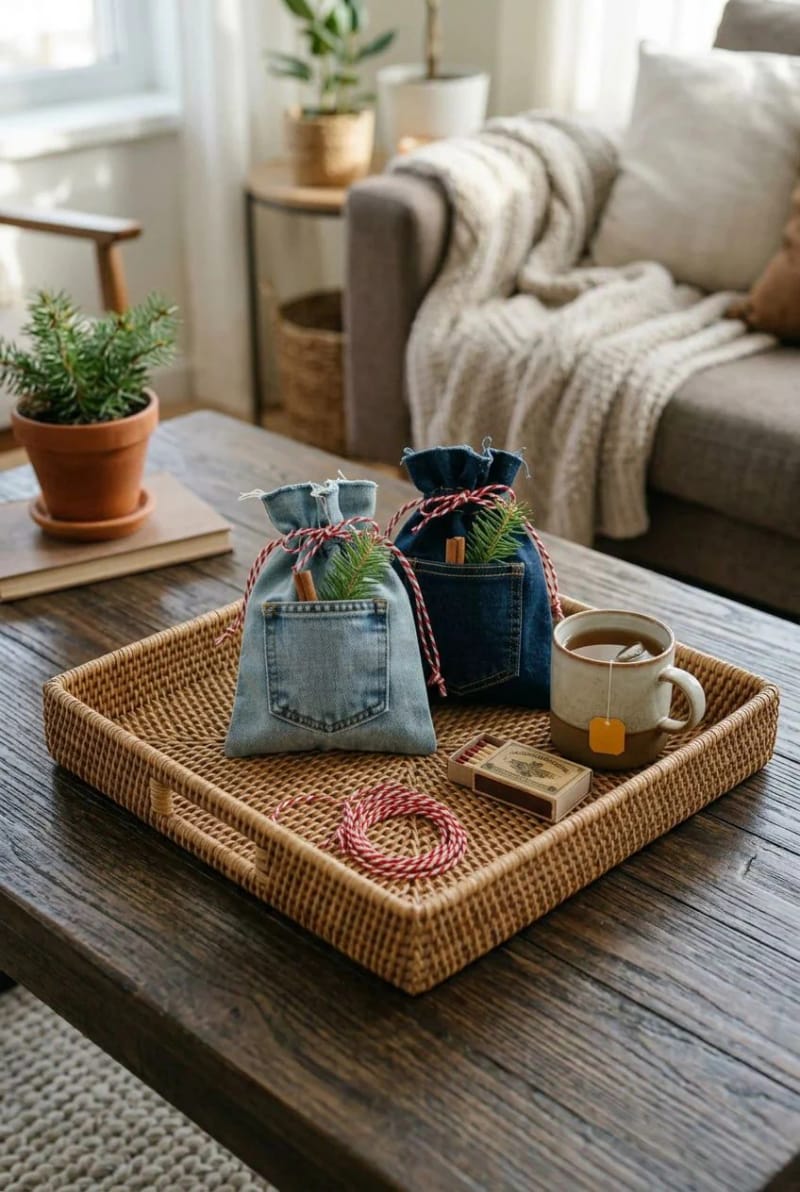
A jean leg sewn shut at one end, gathered with twine at the other, becomes a reusable gift bag that outlasts the gift, and a kept pocket on the front is a place to slot a gift tag or a sprig of pine. This is the one to make in a batch the week before you wrap, since they double as decoration under the tree. Every warning that denim is too hard for beginners was written by someone who tried to hem a waistband on their first day; a drawstring bag is where you prove it wrong.
Conclusion
If you are picking a starting order, make the no-sew stars and hearts first to get a feel for how much fray you like, then attempt the pocket angels once your hands trust the fabric, and save the cone tree and the jean-leg stocking for the evening you have real time.
The one specific I would hold onto across all twelve: buy a small bottle of Fray Check or keep clear fabric glue nearby, because a dab on a cut edge lets you decide exactly where the fraying stops instead of watching a heel unravel into the toe.
And when you run out of tree space, the wall tree and the gift bags are the two that keep earning their keep past the ornaments, one on a door, the others stacked under the branches waiting to be handed over.