
The problem with most "small apartment Christmas tree" advice is that it still assumes you own a floor you're willing to surrender. A four-foot pencil tree in a 400-square-foot studio is still a tree-shaped pylon you edge around for six weeks. Every idea below moves the whole thing off the floor, and in a couple of cases off the wall too, so you keep your one walking lane and still get the holiday.
Two of these go up with adhesive strips that are rated for real weight; one hangs from the ceiling and touches nothing you could lose a deposit over; the cheapest is a wall of photos and cards that costs about as much as a roll of washi tape. Not one of them needs a drill.
If you've got a cat that treats a low ornament as live prey, I've marked which versions survive that and which ones become a floor of broken glass. Start with the wall garland tree if you want the most tree-like result, and jump to the bookshelf or photo versions if you're renting somewhere with walls you are genuinely afraid to touch.

The wall garland tree is the closest thing to a real one

Build the silhouette out of pine garland pinned to the wall in a tall triangle, weave a warm-white light strand through it, and you have something that reads as a tree from the doorway while taking up two inches of depth. The whole rig is light, so you don’t need anything dramatic to hold it: a few small adhesive hooks carry pine garland and a light strand without complaint. The reason renters trust this one is weight headroom. A full set of four large Command picture-hanging strips holds up to around 16 pounds on a clean, smooth surface, and a garland tree weighs a fraction of that, so you’re never near the limit.
The catch is the wall itself, not the adhesive. Textured “orange peel” walls and wallpaper are where these fail, and freshly painted walls need about a week to cure before anything sticks reliably. I’ve hung a version of this in three different rentals and the only time a strip let go, it was because I’d skipped wiping the wall and a film of kitchen dust was doing the holding instead of the glue. A small box of Command Large Utility Hooks (5 lb, damage-free) covers the whole tree and the rest of your decor with strips to spare.
Do this
- Press each strip hard for 30 seconds, then walk away for an hour before you hang a thing. Most failures are just impatience.
- Wipe the wall with rubbing alcohol first; plain dust is what gives out, not the adhesive.
Avoid
- Wallpaper, textured walls, and anything you painted in the last week.
- Yanking the removal tab sideways or upward. Pull it slowly, straight down the wall, or you’ll take a chip of paint with it.
Hang the Christmas tree from the ceiling and keep your floor
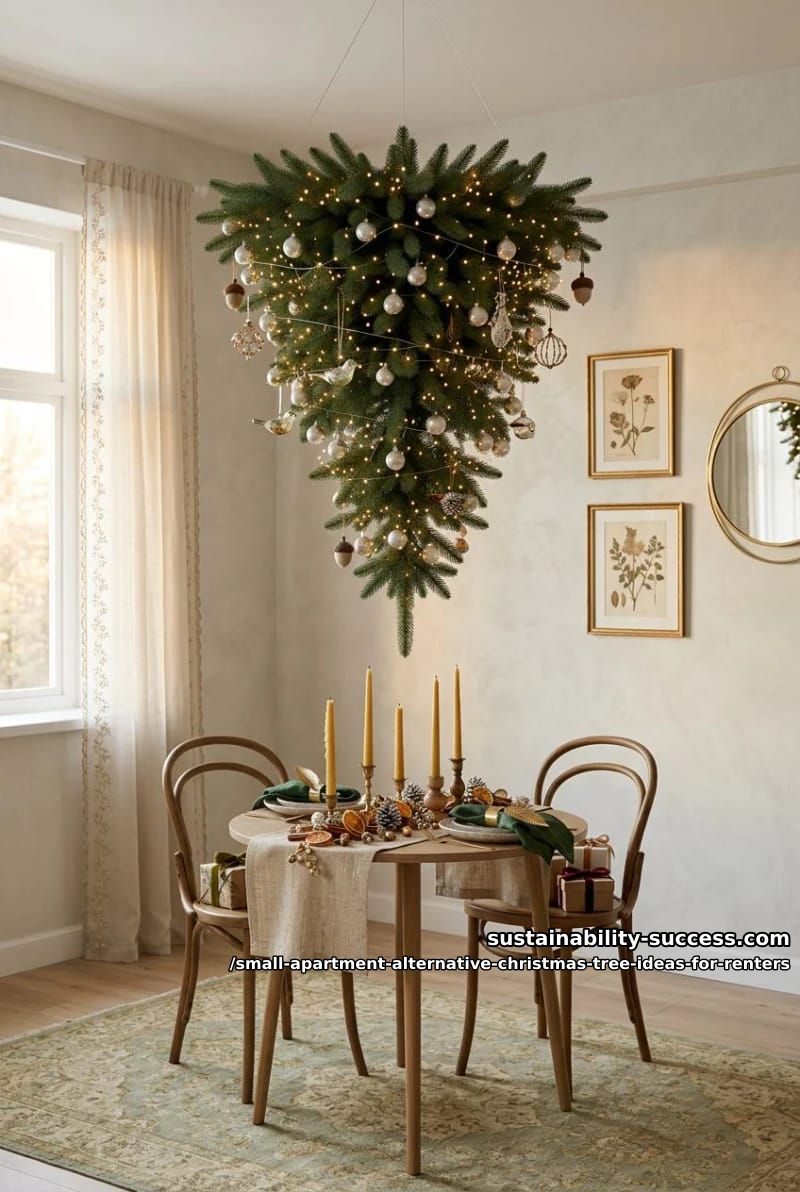
Suspend a small tree, point-down, from the ceiling over a table and you've used the one square of the apartment that was doing nothing. Clear Command hooks are rated for smooth ceilings, and fishing line makes the support disappear, so the tree looks like it's floating over your dinner. This is the move that gets the most "wait, how" reactions, partly because nobody expects to look up.
Keep it genuinely small and light; gravity is less forgiving on a ceiling than a wall, and you want margin. One placement rule from the manufacturer that people ignore: don't hang adhesive hooks directly over a bed, where a fall lands on a sleeping person. Over a dining nook or a reading corner, you're fine.
A branch-and-vase tree beats another mini fake tree

A vase of bare sculptural branches, lit and lightly ornamented, looks deliberate in a way a small artificial tree never manages. The $20 tabletop fake looks like a $20 tabletop fake from across the room, and your guests can tell. Manzanita branches are the ones that hold a shape worth looking at, usually $15 to $40 for a bundle large enough to fill a tall vessel; birch twigs are cheaper and stiffer, and if you've got a park nearby, fallen branches are free and look more honest than either.
The styling is where renters either nail this or end up with a coat-rack of dead sticks. Stick to warm-white lights only (the multicolor strand turns it into a craft project), and hold the ornaments to two finishes, something like clear glass plus brushed brass, hung sparsely so the branch shape stays legible. Weight the vase properly with sand or stones, both because a top-heavy branch arrangement tips at a touch and because a thin glass vase reads cheap next to a substantial one.
A branch tree at cat height is a cat’s idea of a present. Weight the vessel until it genuinely resists a shove, keep glass ornaments above the line a paw can reach, and know that if you use real cut evergreen branches, some foliage and the water preservative are mildly toxic to cats and dogs. A vase of water tipped onto a laminate floor is also precisely the sort of thing a landlord notices at move-out.
Let string lights do the tree shape on a bare wall

Pin a warm-white light strand into a tall triangle outline on an empty wall and the shape alone says "tree" with nothing else added. Buy warm white, not cool white, unless you want your bedroom to look like a parking garage; the color temperature you want sits around 2700K. A single 100-LED set, usually 30-something feet, outlines a five to six foot wall tree with strand to spare, and clear mini hooks or even a few loops of clear tape hold the wire.
I used to tell people to just tape the strand up in a loose zigzag and call it a tree. It looked like a strand of lights taped to a wall, which is what it was. The triangle outline, with a small wire or paper star at the apex, is the entire difference between "decoration" and "wiring."
The photo-and-card tree costs about as much as the tape
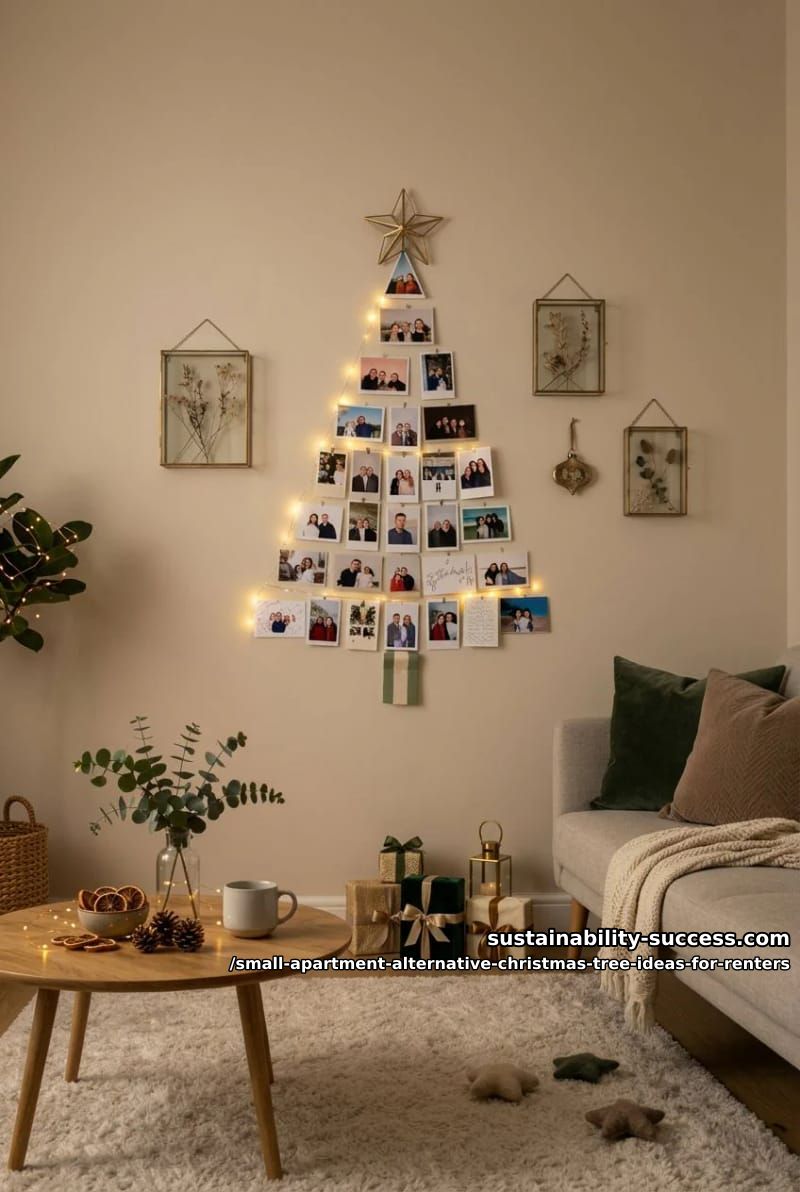
Arrange photos and the holiday cards you're already getting into a tapering triangle on the wall with washi tape, and you've made a tree out of things you own for the price of the tape. Washi peels off clean even from painted drywall, which is why it's the renter's adhesive of choice for anything paper. There's nothing to knock over, so this is the one I send to people with a destructive cat and a strict landlord.
Lean a flat wooden tree in the corner, no drilling

A flat wooden tree that leans into a corner gives you a real sculptural silhouette while occupying almost no floor and needing nothing screwed into the wall. The leaning ones rest on the baseboard; the lighter wall-hung versions ride on a single adhesive hook by their twine cord. These tend to run $25 to $60 depending on size and how rustic the wood is, and the slat style with visible bark edges reads warmer than the painted-MDF ones, which look like a hardware-store offcut.
At 31 inches and half an inch deep, it hangs on its own twine cord from one hook and stores flat behind a dresser the other eleven months; reviewers in studios and offices keep mentioning it as the cat-proof option.

Stack a tabletop tree on books to fake some height

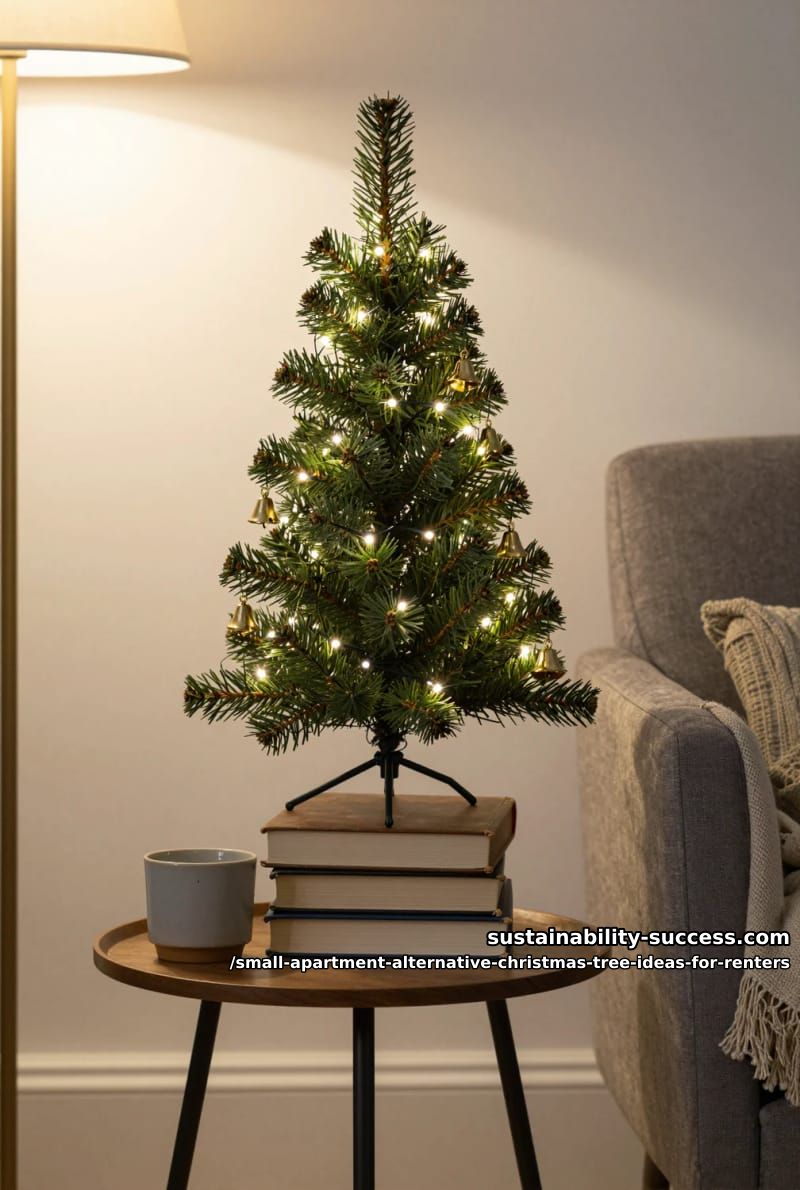

If you do want an actual little tree, lift it onto a stack of hardbacks or an overturned crate so it sits at eye level instead of sulking near the floor (a two-foot tree alone on the floor looks like it's waiting for the rest of itself). The height is the entire trick; a small tree on a surface reads as a chosen object, while the same tree on the ground reads as the runt of the lot. Keep the books and tree in roughly one color family so the base looks intentional.
Turn a doorway into a garland archway instead of a tree
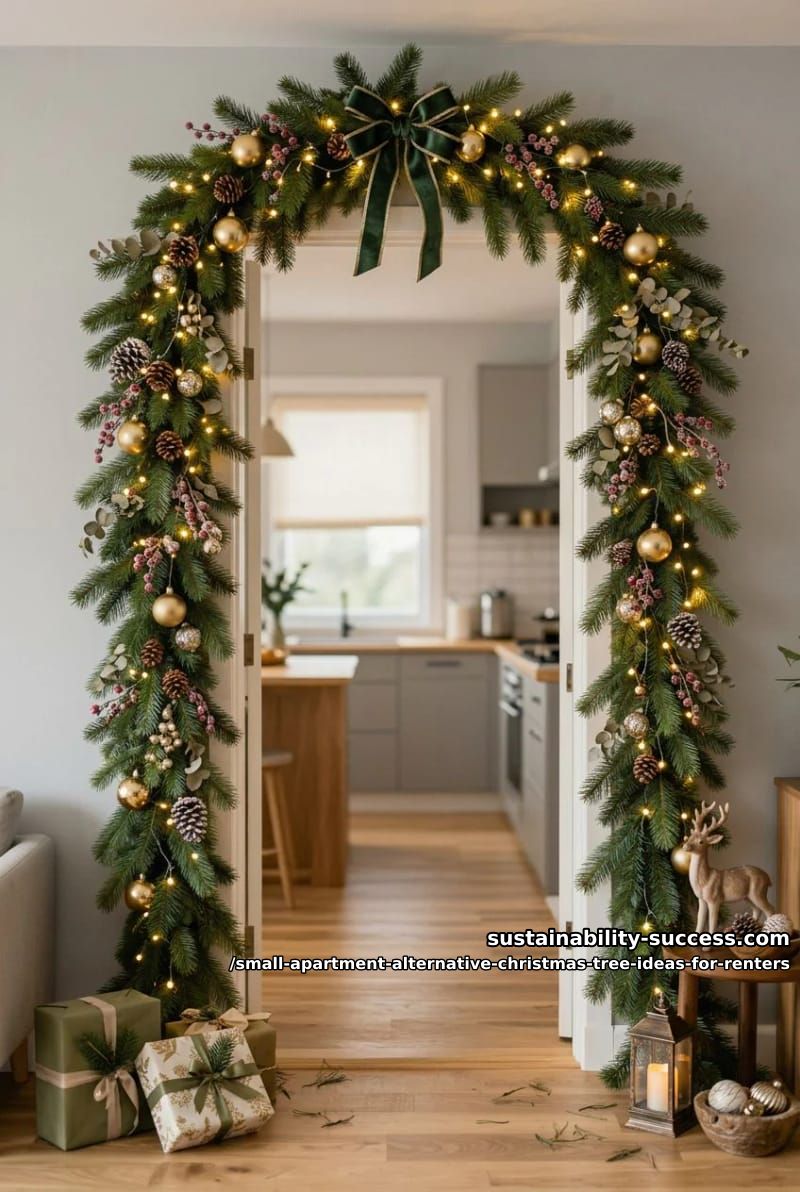
Frame a doorway with lit garland and you get the highest impact for the least effort of anything here, using exactly zero floor. Two small hooks at the top corners carry the weight, and the threshold is something everyone walks through, so the decoration is unavoidable in the right way. It also happens to be the move that performs hardest on Pinterest right now, if that tells you anything about how well it photographs.
Build the tree into the bookshelf you already own

Style your existing bookcase so the books and decor taper into a triangle, widest at the bottom and narrowing to a star object on the top shelf, then thread lights down the front edges. You've added a tree's worth of holiday with no new footprint and nothing to take down except the lights. It's the one on this list that costs nothing and survives a move because there's nothing to move.

Conclusion
If you only do one, do the wall garland tree. It's the nearest thing to a real tree on this list, and it comes down in about ten minutes without leaving a mark.
If you've got pets, or a deposit you're nervous about, the photo-and-card tree and the bookshelf version are the two that touch almost nothing and break even less. Save the branch-and-vase idea for when you actually have a weighted vessel and a surface a cat can't reach.
One thing nobody mentions: the wall and ceiling versions tend to photograph better than a real tree in a cramped room, because the camera finally has somewhere to stand back to. Take the picture before the cat finds the lowest ornament.