
A fresh evergreen wreath from a florist runs $40 to $80, and most of what goes into it is growing in your yard, or your neighbor's, right now. The thing standing between you and a free version is not skill or a craft-store haul. It is knowing which clippings actually hold up, and how to wrap a bundle so it does not slide loose by the second week of December.
That second part is what the prettiest tutorials skip. Not every green lasts: cut the wrong shrub and your wreath is shedding onto the doormat before you have finished the holiday cards. So a real share of this project is just reading your own yard with a clear eye.
This is a one-evening build on a reusable wire frame, maybe an hour start to finish once your greens are prepped. I will walk through what to cut, the wiring motion that genuinely holds, and the care schedule that buys you three to six weeks of green instead of one sad one.

What you'll need
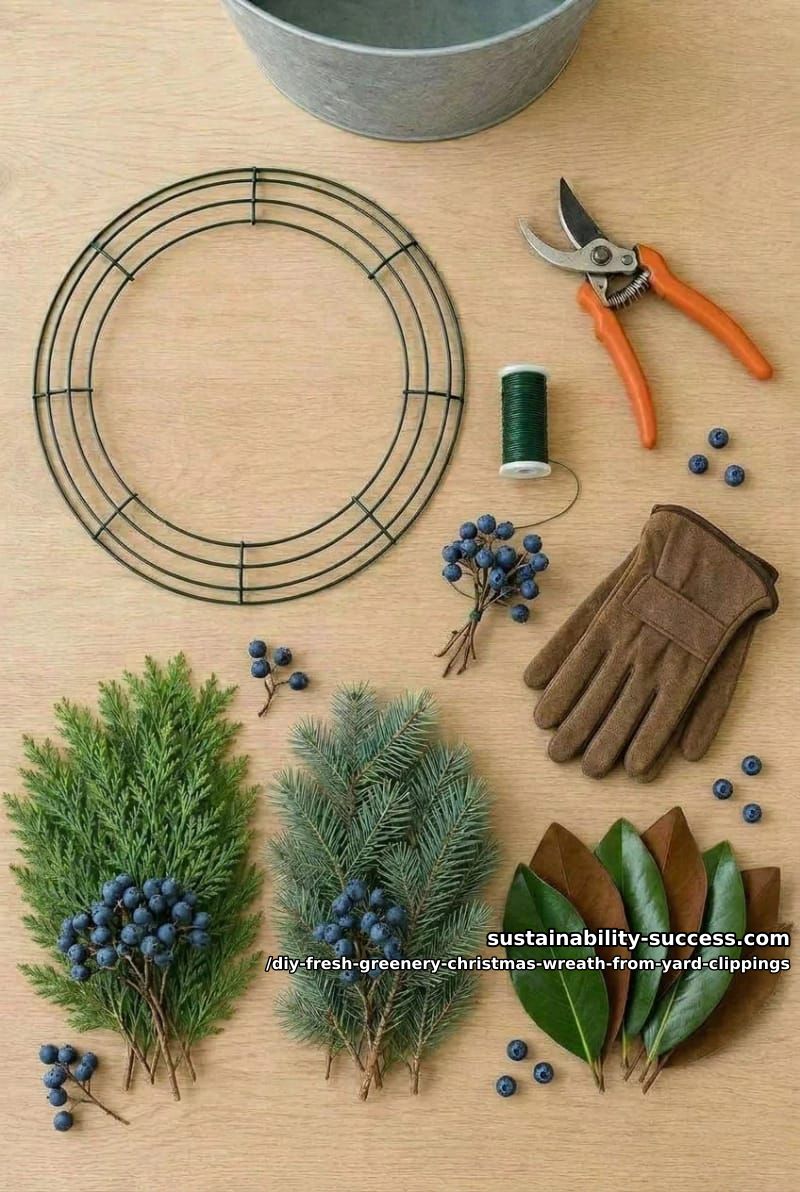
The supply list is short, and if you already own pruners you are most of the way there. There are really two purchases: a wire frame and a roll of paddle wire, and a single starter kit covers both for about what the ribbon costs on a store-bought wreath.
Tools (reusable, they live in the drawer):
- A box-style wire wreath frame, 14 to 16 inches across. Smaller than 12 inches and the greenery swallows the center hole. A multipack frame kit that bundles a roll of 22-gauge paddle wire runs roughly $10 to $20. 12-inch wire wreath frame multipack with 22-gauge paddle wire
- Bypass pruners or sturdy garden snips for clipping live stems cleanly, about $12 to $30. Fiskars bypass pruning shears, 5/8-inch cut capacity
- Wire cutters, only if your pruners have no wire notch. Free if they do.
- Garden gloves. Holly spines and pine pitch make the difference between a fun evening and sticky hands for two days. Around $6 to $15.
Materials (the things that get used up):
- Paddle wire, 22 to 24 gauge. Included in the frame kit above; a standalone roll on its own is about $4 to $8.
- Fresh greenery from the yard, an armful, ideally four or more kinds for texture. Free.
- Optional accents: pinecones, berry sprigs, a length of ribbon. Free if foraged, up to about $12 for ribbon.
- Optional anti-desiccant spray such as Wilt-Pruf, mostly for wreaths that hang indoors. Roughly $12 to $20 a bottle.
If you already own pruners and gloves, your real outlay is the frame-and-wire kit, call it $10 to $20. Starting from nothing with everything bought new lands somewhere around $30 to $60, still under one delivered florist wreath, and the frame and pruners carry over every December after this one.
Which greenery to cut, and which to skip
The single decision that determines whether your wreath lasts three weeks or three days is what you put on it. Needled evergreens that hold moisture, cut from trees that have gone dormant for winter, last two to three weeks indoors and considerably longer outside in the cold. Cedar, the firs (Fraser, Douglas, balsam, noble), and pines are your backbone: they dry slowly and keep their needles even at warm interior temperatures. Broadleaf cuttings earn their place as contrast, glossy Southern magnolia with its coppery felt undersides holds up about two weeks indoors, holly's waxy leaves and berries last well, and a variegated boxwood reads elegant against all the needles.
Mixing is the whole trick to a full wreath. Fir and cedar lie flat and give you coverage; pine fluffs and fills; juniper brings those small blue berries; a little eucalyptus throws in silver. Cut an armful of at least four kinds and you will not have to fuss with bare patches later.
Good to cut:
- Cedar and the firs for the base layer, since they fan flat and keep their needles the longest.
- Pine for fullness, juniper for berries, eucalyptus for a silver note.
- Magnolia or holly when you want broadleaf shine against the needles.
Leave these alone:
- Norway spruce. The prettiest needle-dropper in the yard, and bald by the second week. Lovely tree, wrong wreath.
- Yew. It sheds within a day and is toxic to people and pets, so it has no business on a door kids walk past.
- Common green American boxwood. Many strains smell like cat urine once they warm up indoors; reach for a variegated variety instead.
- Ground pine or princess pine (Lycopodium). It is a slow-growing native that local patches never recover from after harvesting, so let it stay wild.
Granted, cedar and juniper are an exception to their own success: glorious on an outdoor wreath, but indoor heat turns them brittle quickly, so save those for the porch and lean on fir and magnolia for anything that hangs inside. And ignore the styled shots built entirely from olive branches; olive curls and dries within a few days, which photographs beautifully and decorates poorly.
Step 1: Cut and prep your greens
Most of your wreath's staying power is decided here, before a single bundle goes on the frame, and the work is mostly waiting. Clip in the cool of the morning if you can, and cut every stem at a 45-degree angle so it can keep drinking.
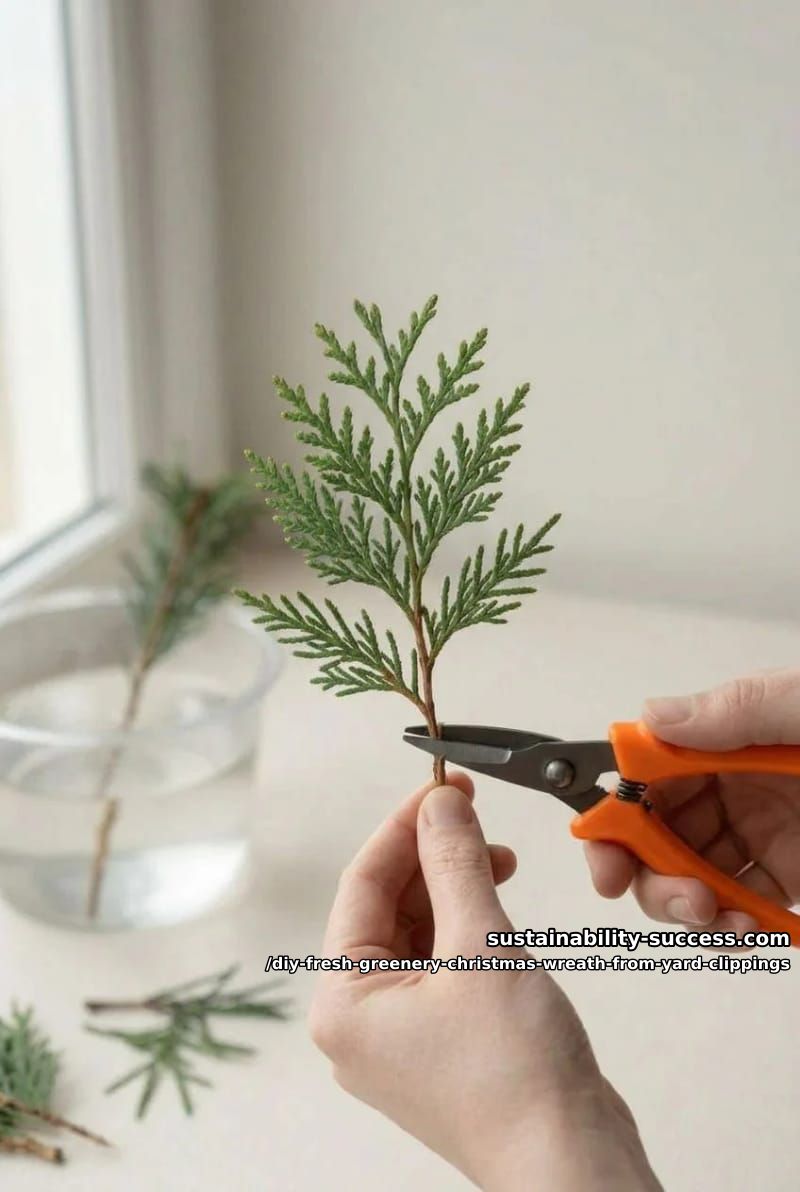
- Cut generously. Take more than looks reasonable; an armful collapses into about half a wreath once it is bundled.
- Strip the ends. Pull the bottom inch or two of needles off each stem so the wire grips bare wood, not foliage.
- Soak overnight. Stand the cut ends in a bucket of water in a cold garage or on the porch, ideally overnight, a few hours at the very least.
- Trim to length and sort. Cut everything to 6 to 8 inch pieces and sort by type into piles so building goes fast.
- Pre-bundle. Gather three to five stems per bundle, mixing one flat green with one fluffy one and an accent, and keep the bundles a consistent size.
I used to soak for an hour, decide that was plenty, and move on; the tips would brown by week two every single time. An overnight drink in a cold space did more for longevity than any spray I have tried since.
Step 2: Wire the bundles onto the frame
This is the entire craft, and it is one small motion repeated maybe forty times. The rule that makes it work: you do not cut the paddle wire until the very end. It stays attached to its spool and travels around the whole frame as one continuous strand.
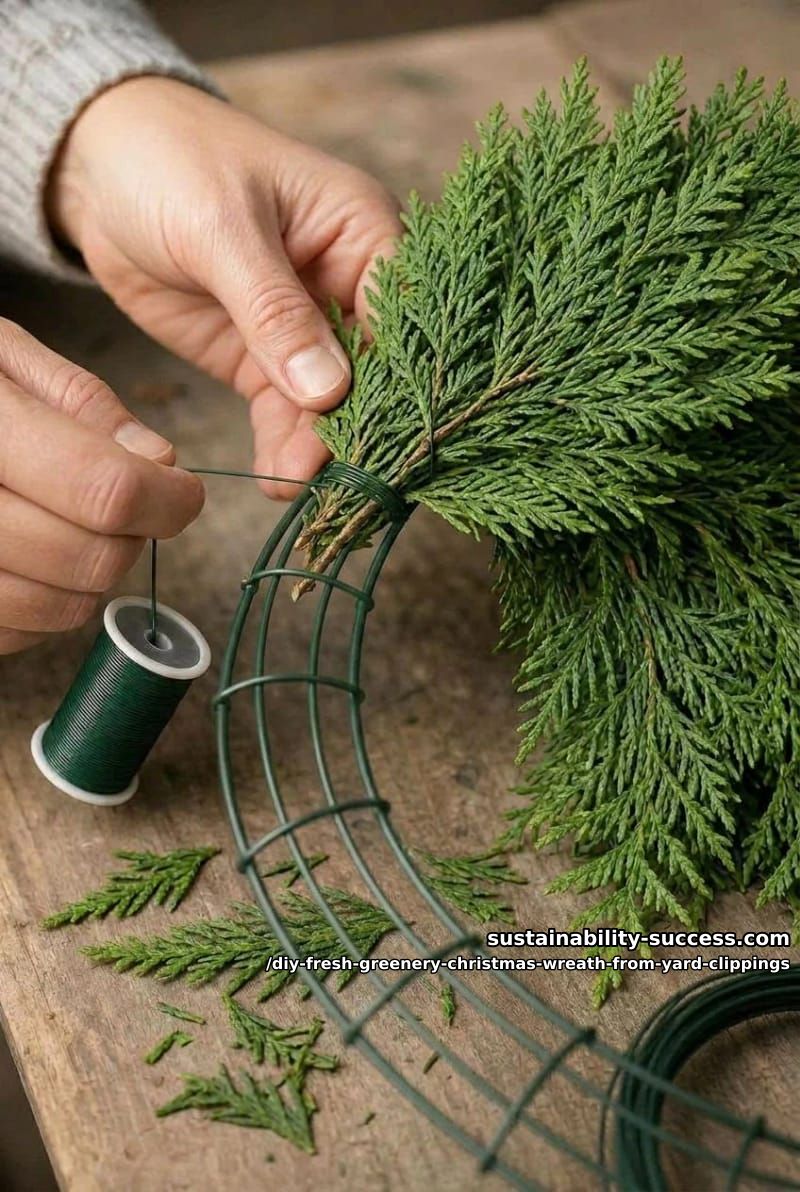
- Anchor the wire. Wrap the loose end around the frame three or four times, give it a twist, and let the spool hang to the outside.
- Place the first bundle on the frame at a slight diagonal, tips pointing out toward the rim and bare stems toward the center.
- Wrap the base tight, three or four firm pulls around both the stems and the frame. Pull harder than feels polite. The greens shrink as they dry, and a wrap that felt snug tonight becomes a sagging gap by the weekend.
- Overlap the next one. Lay each new bundle so its tips cover the stems of the last, then wrap. Alternate inner edge, outer edge, center as you circle so the wreath looks full from every angle.
- Keep going one direction all the way around, never cutting the wire.
- Close the loop. At the end, lift the very first bundle’s tips and tuck the final stems underneath so the circle reads continuous. Wrap a few extra times, cut the wire, and thread the tail through the back to form a hanging loop.
I leave mine undecorated nine years out of ten. A tight wreath of mixed greens looks intentional without a bow, and bows are the first thing to go limp in a December rain.
Step 3: Add accents, or leave it bare
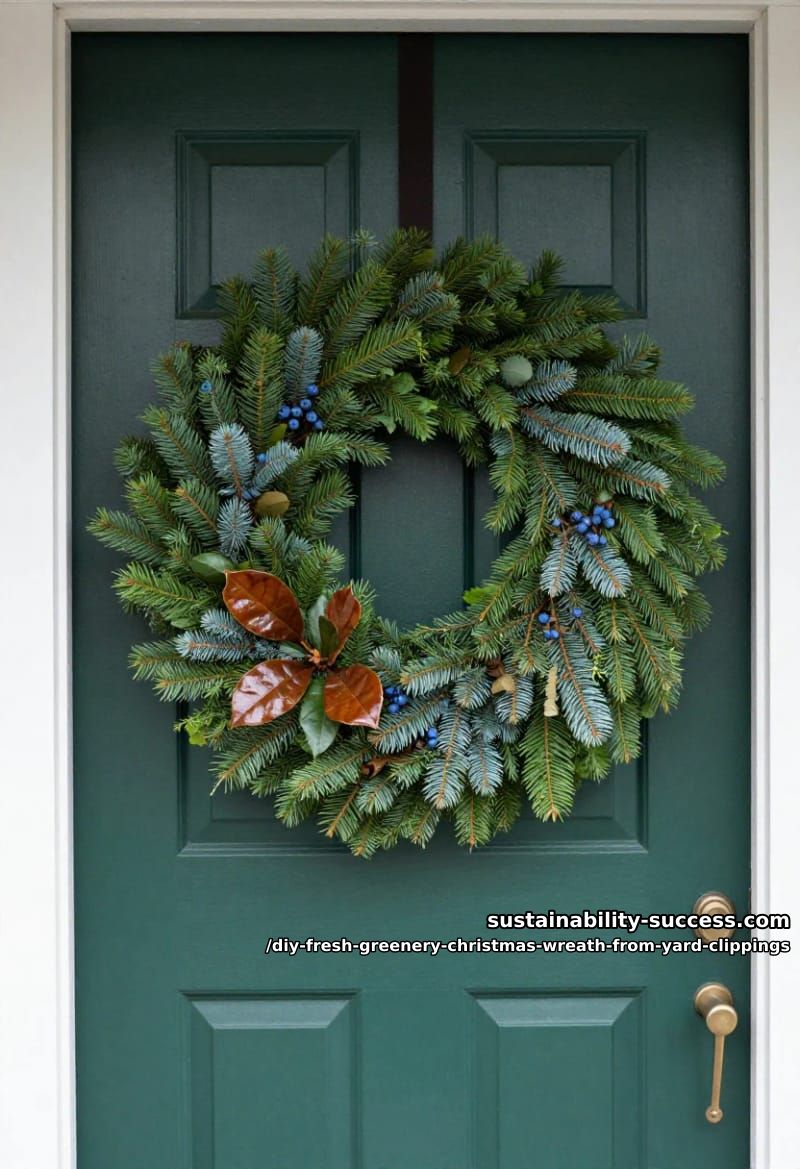
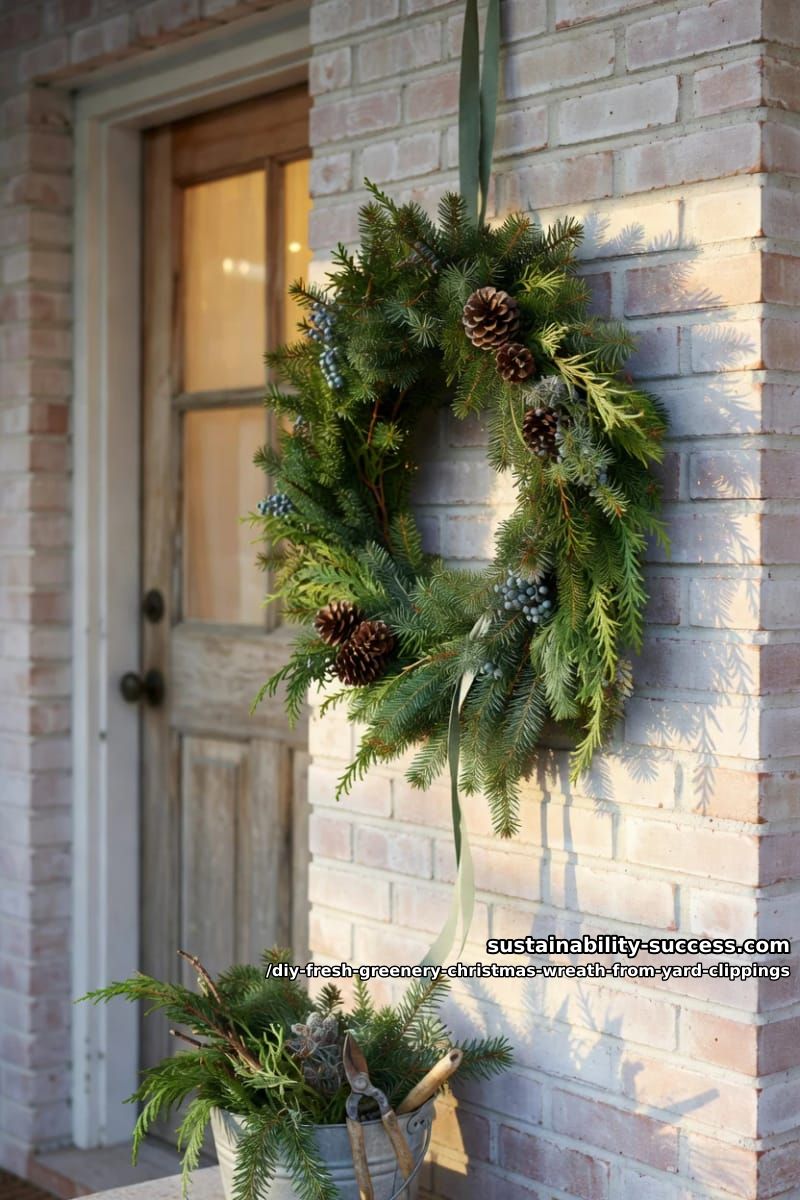
Accents are optional and the easiest thing to overdo. Wire pinecones and berry clusters on separately: twist a length of wire around the base of each, feed it through to the back of the frame, and twist it tight. Group them in odd numbers, three or five, clustered rather than dotted evenly around the ring, and put any ribbon on last so it sits on top of the greens instead of getting buried.

How long a fresh wreath lasts, and your make-day timeline
Indoors, plan on two to three weeks; on a cool, shaded door or porch out of the wind, four to six is realistic, and a whole season is possible in a cold climate. Cold and still air is the entire game. Wind strips moisture faster than anything, and a wreath baking in front of a sunny storm door or over a heat vent gives up early.
- Cut day, morning: clip and trim, every stem at a 45-degree angle.
- Cut day, evening: bundles standing in water overnight in a cold space.
- Build day: assemble in about an hour, then hang out of direct sun and away from any heat source.
- Weekly: mist with water (or take it down and rinse it under a cold shower), and pull out any sprigs that have started to brown.
- End of season: strip the greens for the compost, keep the frame and leftover wire for next year.
For an indoor wreath, an anti-desiccant like Wilt-Pruf earns its keep by sealing in moisture, more so than the daily misting you will inevitably forget to do. Outdoors in the cold, I honestly do not bother; the weather does the preserving for free.
Mistakes that ruin a fresh wreath
- Wrapping the wire too loosely. The greens shrink as they dry, so a wrap that felt secure on build day turns into a drooping gap days later. When in doubt, pull harder.
- Skipping the overnight soak. Dry-cut stems brown from the tips inward, and once they start there is no bringing them back.
- Building on a frame that is too small. Anything under 12 inches lets the greenery fill the center hole, and you end up with a bush rather than a wreath. Aim for 14 to 16.
- Hanging it over heat. Above a working fireplace or against a sun-struck glass door, the wreath cooks, and dried evergreen near an open flame is a genuine fire risk, not just a wilting one.
- Relying on a single type of green. One species lies flat and looks thin no matter how much you cram on. The fullness comes from pairing a flat base with a fluffy filler.
Conclusion
If you take only two things from all of this, take the ones the rest hangs on: cut a mix of needled evergreens that actually last (cedar and fir over spruce, every time), and pull that paddle wire tighter than feels reasonable. Soak the stems overnight, build on a 14 to 16 inch frame, and hang the thing somewhere cold and out of the wind.
What the tutorials undersell is how quickly it stops being fiddly. The first wreath takes an hour and the wiring feels clumsy; by the third you are eyeing the neighbor's overgrown juniper and the holly out by the mailbox, quietly doing the math on how many doors you can cover before the clippings run out.