
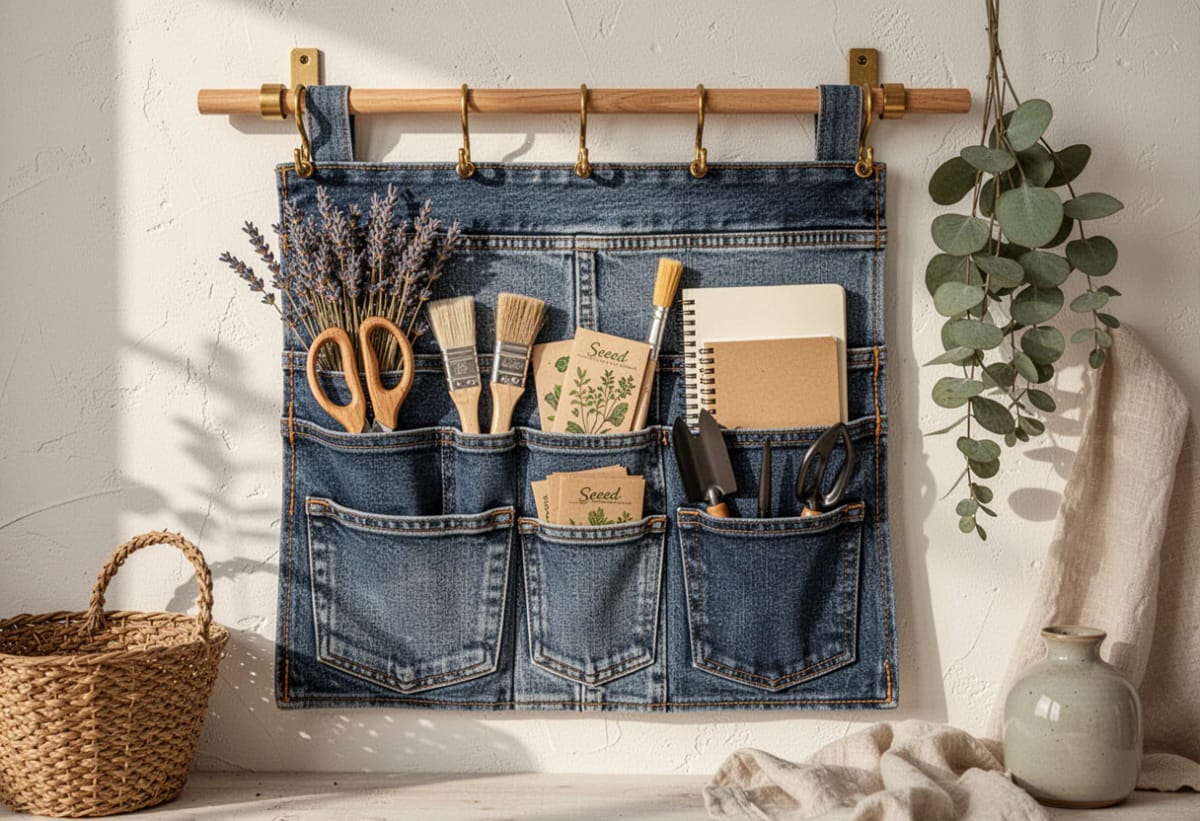
Thirteen ways to turn the pockets off a dead pair of jeans into something that hangs on a wall and holds mail, thread, hair ties, or a charging cable. They are sorted by the one decision that determines whether any of them work, which is what sits behind the pockets. Get that wrong and you own a limp blue rag with three sagging pouches on it, and that is what most of the versions circulating right now turn into by about week three.
The denim is free, so the cost here is hardware, glue and thread. What it is not is fast. Working out what a given pocket board is meant to carry, then picking a backing rigid enough to carry it, is twenty minutes of thinking you do before any cutting.
Cut wide, not clean: go about an inch outside the pocket’s stitch line on all four sides and cut straight through both the pocket and the seat panel underneath it. Unpicking a pocket off the jeans gives you a flat patch, not a pouch.
The seat panel is the pocket floor. Those two layers, held together at the edge, are the only reason the thing opens at all. Never separate them.
Leave the mouth alone. The folded, double-stitched top hem is the strongest finished edge on the garment and you cannot rebuild it. Every raw edge you create belongs on the other three sides.
Budget four usable pockets per adult pair: two back patch pockets and two front scoop pockets. The front ones come away with the pocket bag still attached and are considerably deeper than they look.

Start with the backing, because the pockets are the easy part
Four backings, in ascending order of what they will actually hold. One spec is worth knowing before you choose: most jeans are midweight denim, roughly 12 to 16 ounces per square yard, with anything under 12 counted as lightweight and anything from 16 up as heavyweight. A pocket cut from a heavy raw pair holds its own shape on a wall. One cut from a thin stretch pair collapses into a flat crease no matter what you hang it on, which is the same reason denim behaves so differently across our roundup of denim projects that do not read as denim crafts.
A jean-leg panel on a dowel, no machine involved
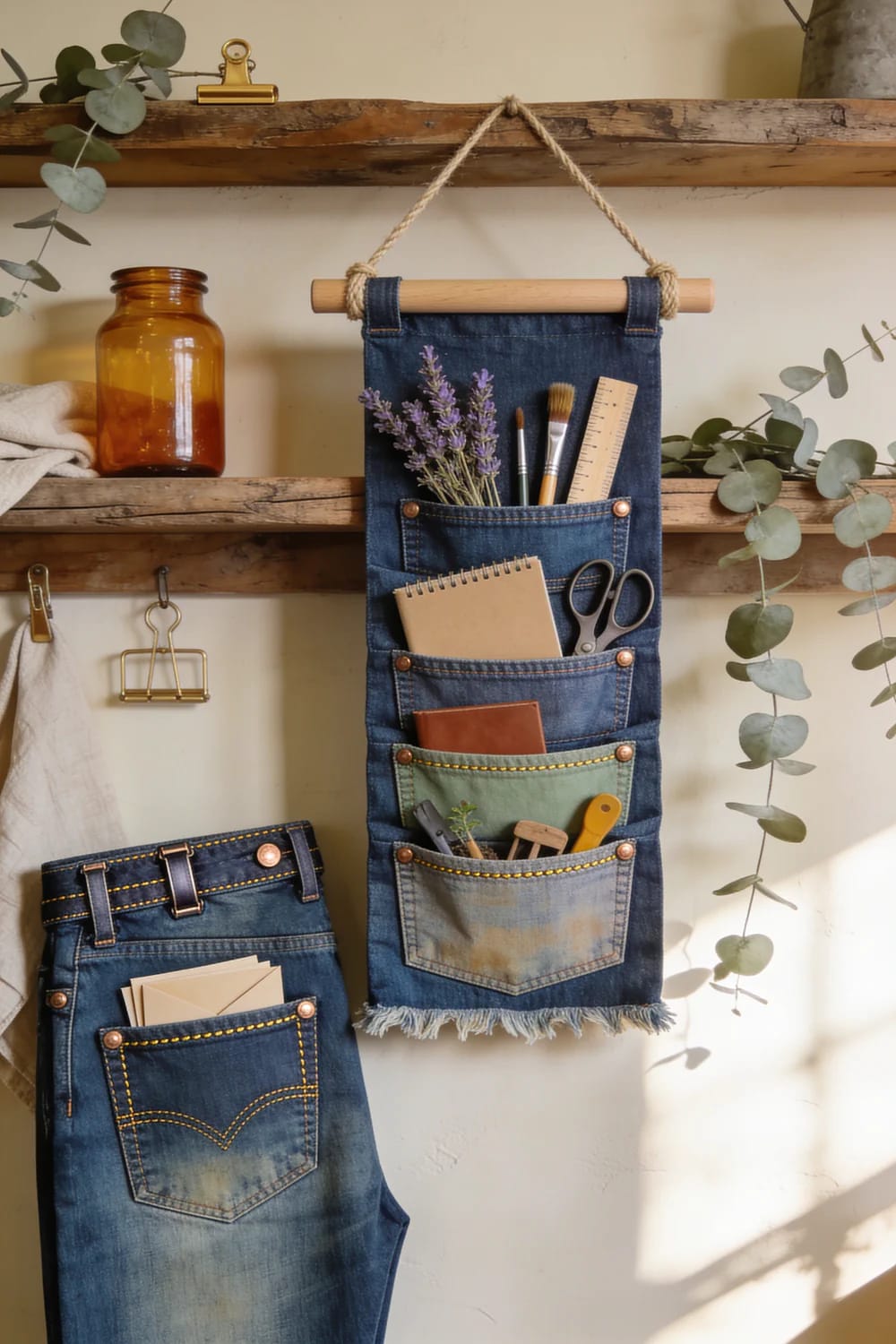
Build this one first even if it is not the one you want. Slit a leg open along the inseam, press it flat, and you have a panel roughly 20 by 22 inches with a finished hem already on the bottom. Fold the top over a dowel, glue, clamp for an hour. Two feet of jute through the dowel ends and it hangs off a single nail.
Glue-only construction has a ceiling, and it sits lower than the tutorials suggest. Fabric adhesive on a denim-to-denim bond is strong in shear and weak in peel, which is precisely the wrong way round for a pocket that gets yanked open twice a day. Glue the three closed sides, then run twenty hand backstitches across the two bottom corners. Five minutes, and the peeling stops being the failure mode.
Dries flexible rather than stiff, which matters on a pocket mouth that has to open; cut the tip narrow and lay a thin bead rather than flooding the seam.
Aleene’s Fabric Fusion permanent fabric adhesive, 4 ozA thrifted picture frame, which turns the pockets into wall art
Pull the glass and the backing board out of a 16 by 20 frame, staple a denim panel over the board, mount two or three pockets on it, and drop the board back in. The frame supplies the rigidity and the finish in one move, and thrift stores price that size somewhere between three and eight dollars. It is the cheapest way to make a pocket panel read as a deliberate object rather than a scrap of trousers on a nail.
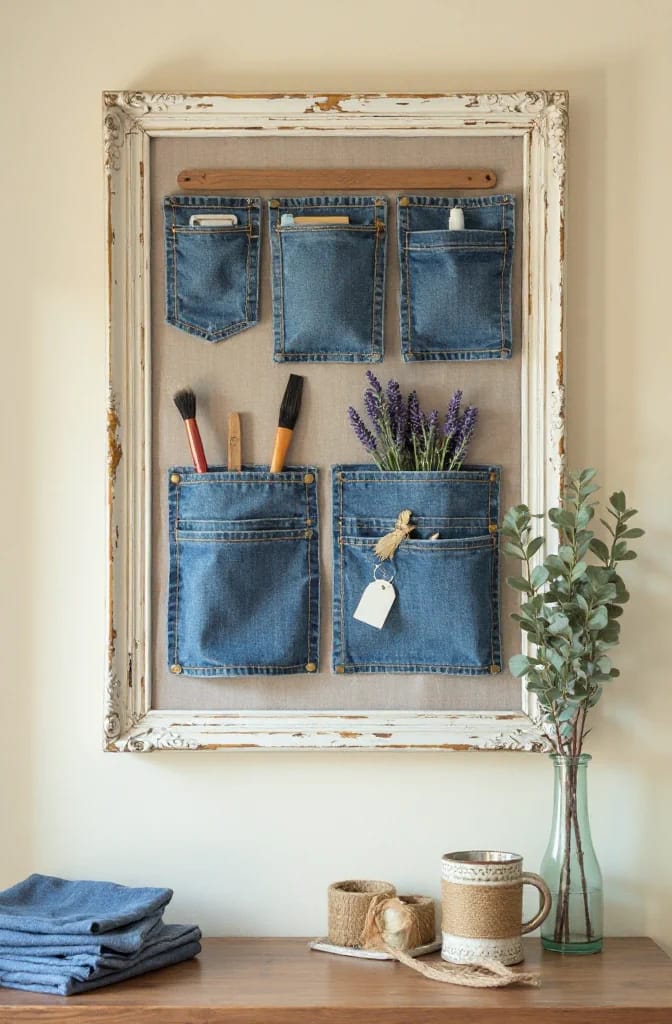
The thing that trips people is the rabbet, the lip the glass used to sit in. It is often only a quarter inch deep, and a loaded pocket bulges further than that, so the backing board will not seat and the frame rocks on the wall. Either buy a shadow box with a full inch of depth, or accept that the frame will stand off the wall and put felt pads at the bottom corners. (The versions of this with a felt flower glued in the corner are doing the exact opposite of what the frame was brought in to do.)
Do this
- Keep the gold topstitching visible and let it be the only warm color anywhere on the piece.
- Cut your pockets from one brand where you can. A Levi’s back pocket is a different shape from a Wrangler one, and mixing them looks accidental rather than pieced.
- Square the pocket mouths to the panel edge with a ruler. Half a degree of tilt is visible from across the room.
Avoid
- Fabric stiffener. It dries shiny, goes brittle, and cracks along every fold. Rigidity belongs in the backing, not in the cloth.
- Iron-on letters and painted labels.
Pockets riveted to a cedar plank, for the tools glue will not hold
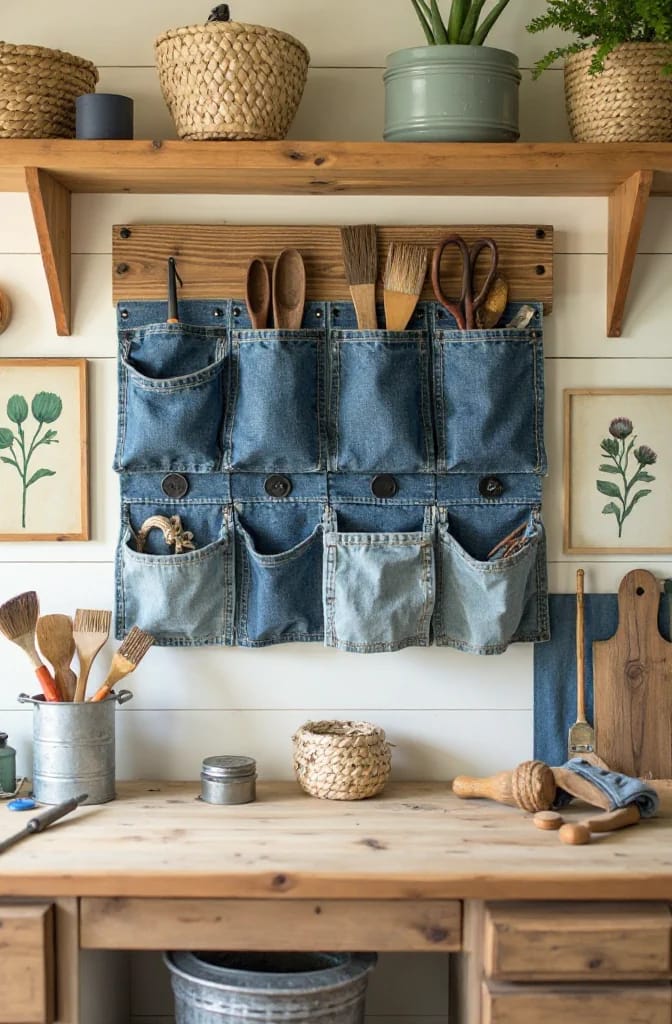
Hardware, not adhesive. One 1×6 cedar or pine board cut to 24 or 30 inches, pockets fixed through both denim layers with copper rivets or upholstery tacks, the board hung on a French cleat or two number 8 by two-and-a-half inch screws driven into studs. This is the only build on the list that will carry a cordless drill without sagging, and the rivets are load-bearing rather than decorative: one at each top corner of the pocket mouth takes most of the weight, and the rest are spacing.
Keep the rivets at least an inch in from the ends of the board. Cedar splits along the end grain with almost no warning, and you will find that out with the board already on the wall. What is left over after this build is two full legs of denim per pair, which is the raw material for a braided denim rag rug, the one project that eats an entire pile rather than one good pair.
A pieced panel in three washes, because one wash goes flat
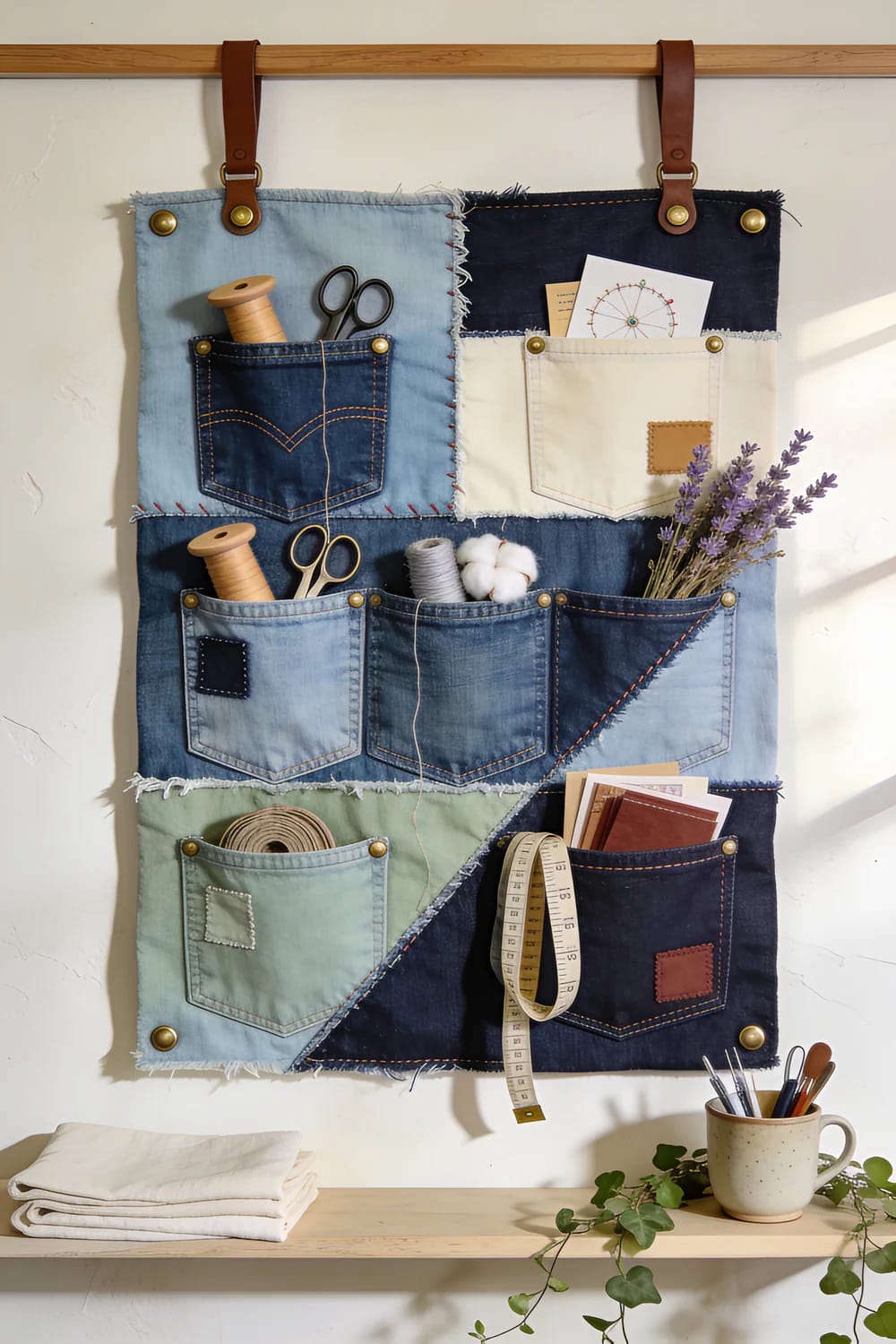
Cut the backing panel from three or four different pairs rather than one. Dark indigo on its own reads as a solid navy rectangle from across a room, and every detail people say they like about denim, the gold topstitching, the pale wear across the knee, the ridge of a felled seam, vanishes at that distance. Alternate a near-black, a mid indigo and a bleached pale in strips of uneven width, and the panel still has something to look at from six feet away.
Then quilt the finished panel to a layer of cotton batting or a cut-up bath towel. Unquilted patchwork ripples along its seam lines within a week of hanging, and a rippled backing makes every pocket mounted on it look crooked. Whatever pockets are left over after this are the right size for jean pocket angel ornaments, which use the pocket whole and need no backing at all.
| Backing | Realistic load | How it hangs | Where it fails |
|---|---|---|---|
| Jean panel on a dowel | Paper, envelopes, hair ties | One nail through a jute loop | Glued pocket corners peel |
| Board in a thrifted frame | Postcards, glasses, keys on a ring | Sawtooth hanger | Frame will not seat over the bulge |
| Cedar or pine plank | Hand tools, a cordless driver | French cleat or screws into studs | Splits if riveted near the end grain |
| Full-length door panel | Socks, cables, cleaning cloths | Over-door hook rack | Door will not latch if hooks are thick |
Built around one room's specific mess
Denim is cotton and cotton holds water. A pocket board on a bathroom wall takes on shower steam every day and mildews from the inside of the pocket, where nobody looks until it starts to smell. A garage or a shed is the same problem by a different route, since the daily temperature swing drives condensation straight into the fabric. Direct sun is the third one worth naming: indigo is a surface dye sitting on the outside of the yarn, and a south-facing wall will pull a near-black panel to a chalky mid-blue inside two summers.
The entryway board that ends the key-and-mail pile
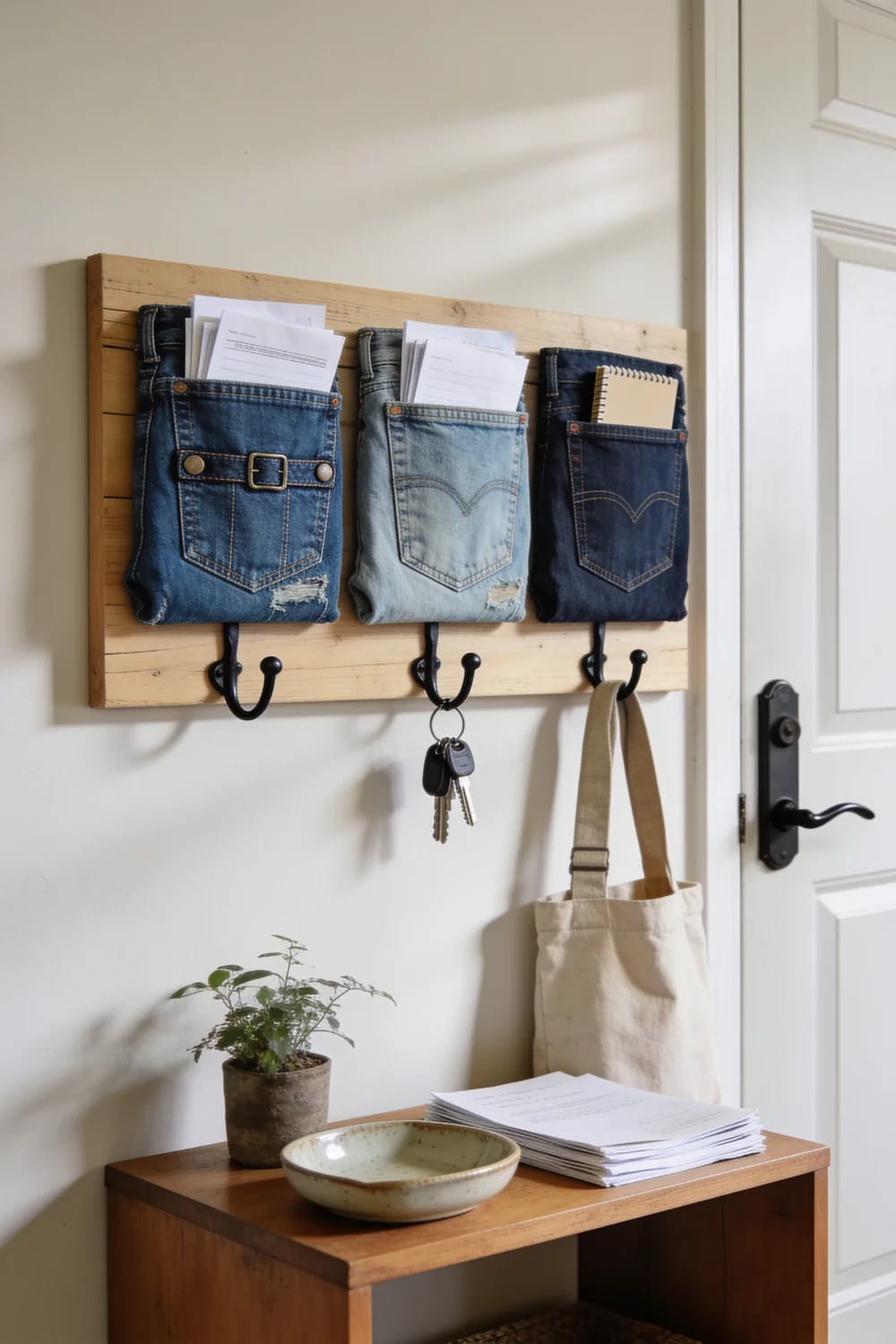
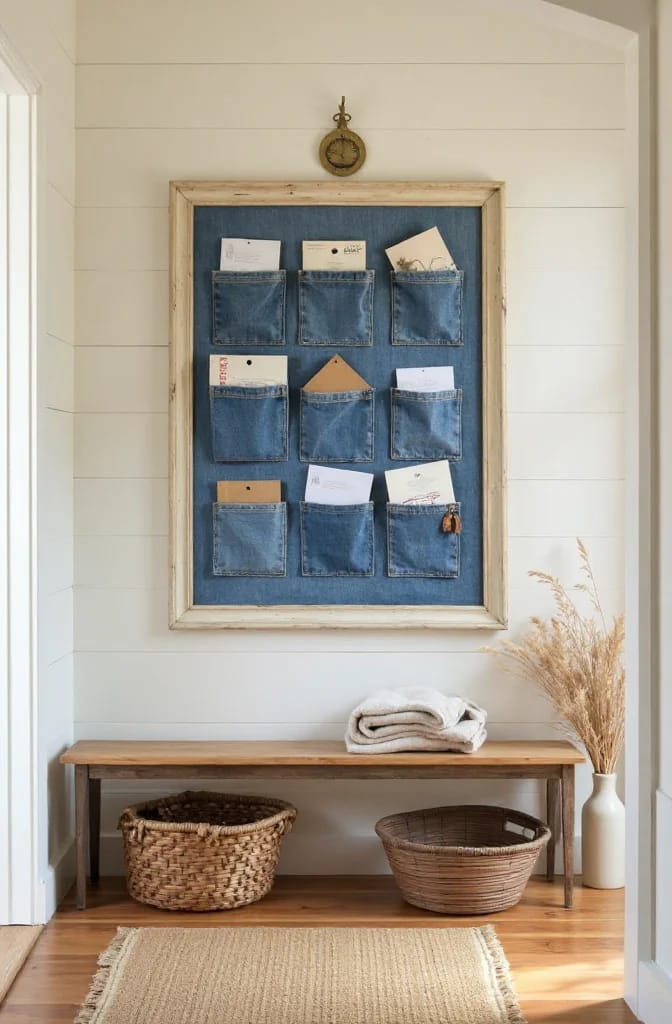
Three pockets in a row with two hooks screwed in underneath, and the division of labor is the entire point: mail goes in the pockets, keys go on the hooks. Keys dropped into a fabric pocket sink to the bottom corner and disappear under whatever landed on top of them, which is the pile you were trying to solve. Mount the pocket mouths at about 54 inches and the hooks at 44, so you are reaching rather than bending on the way out.
A sewing corner caddy with loops for the tools that walk off
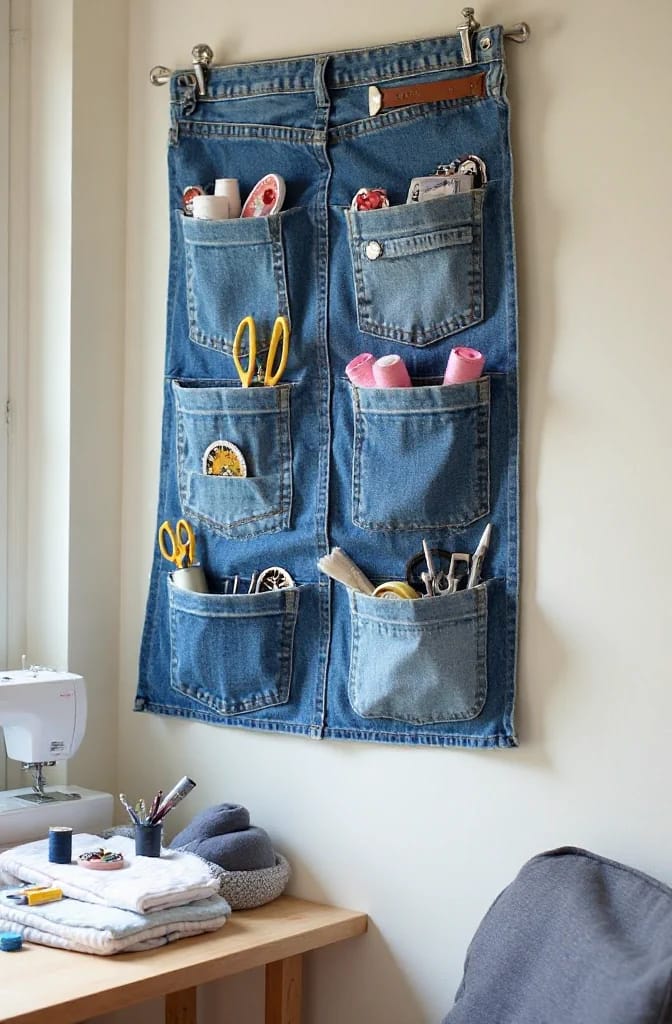
Size each pocket to one tool instead of making four identical ones, which is what turns a decorative panel into something you actually use. A four inch pouch takes the seam ripper. A strip of half inch elastic tacked down at both ends holds shears by the blade. One full-width slit pocket swallows the rulers that never fit in a drawer.
Stitching this is where machines fail, because a pocket mouth is four layers of heavy twill and a universal 80/12 needle will skip stitches and then snap. Use a Schmetz jean and denim needle in size 100/16, slow the machine right down, and lengthen the stitch to about 3.0. A short stitch in heavy denim perforates the fabric into a tear line, which shows up two months later as a pocket that rips off along a neat dotted edge.
A changing-table caddy that keeps wipes at arm height
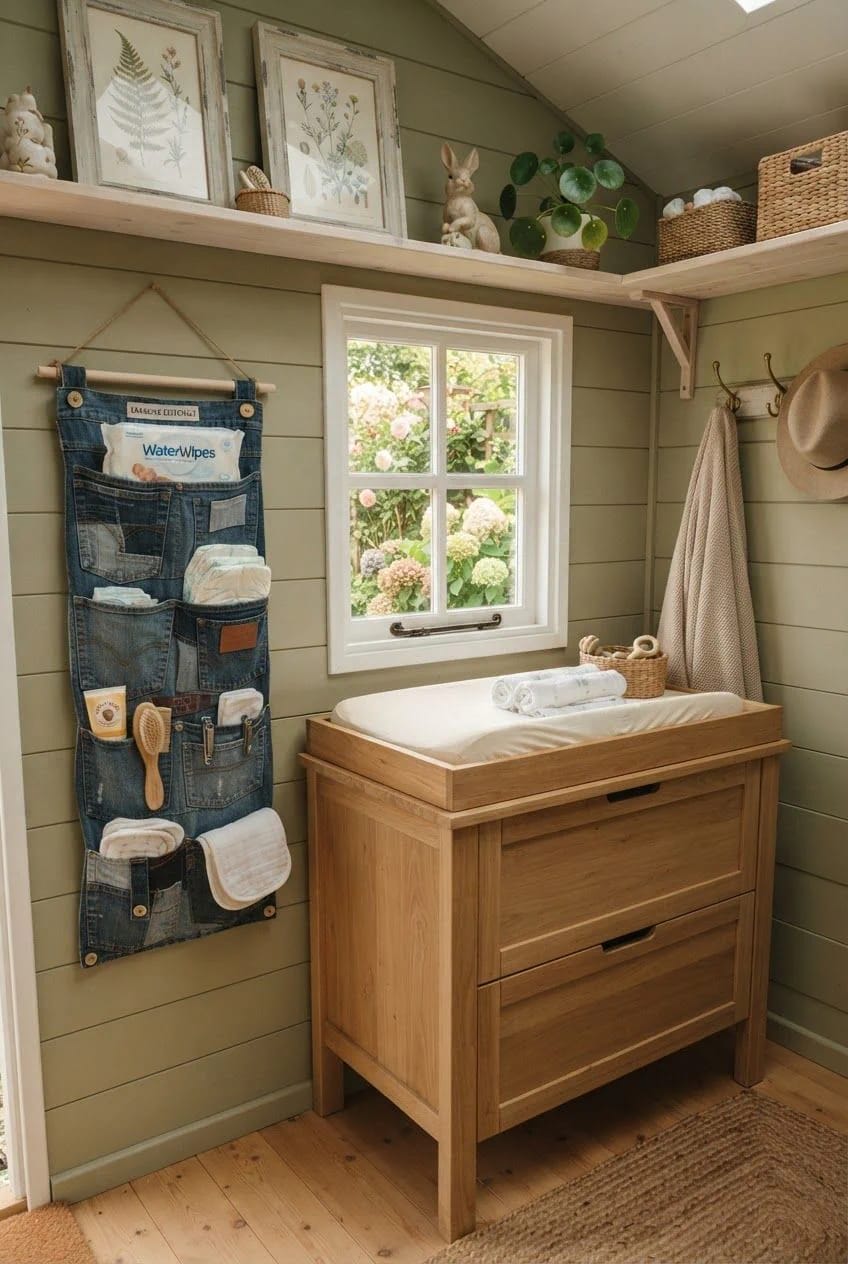
Wipes, cream and one spare onesie, at the height where you can reach them with one hand while the other stays where it needs to be. Mount it beside the changing table at shoulder height, and not above a crib. Anything with a hanging edge or a cord above a sleeping baby is a hazard, and no amount of convenience makes that trade worth taking.
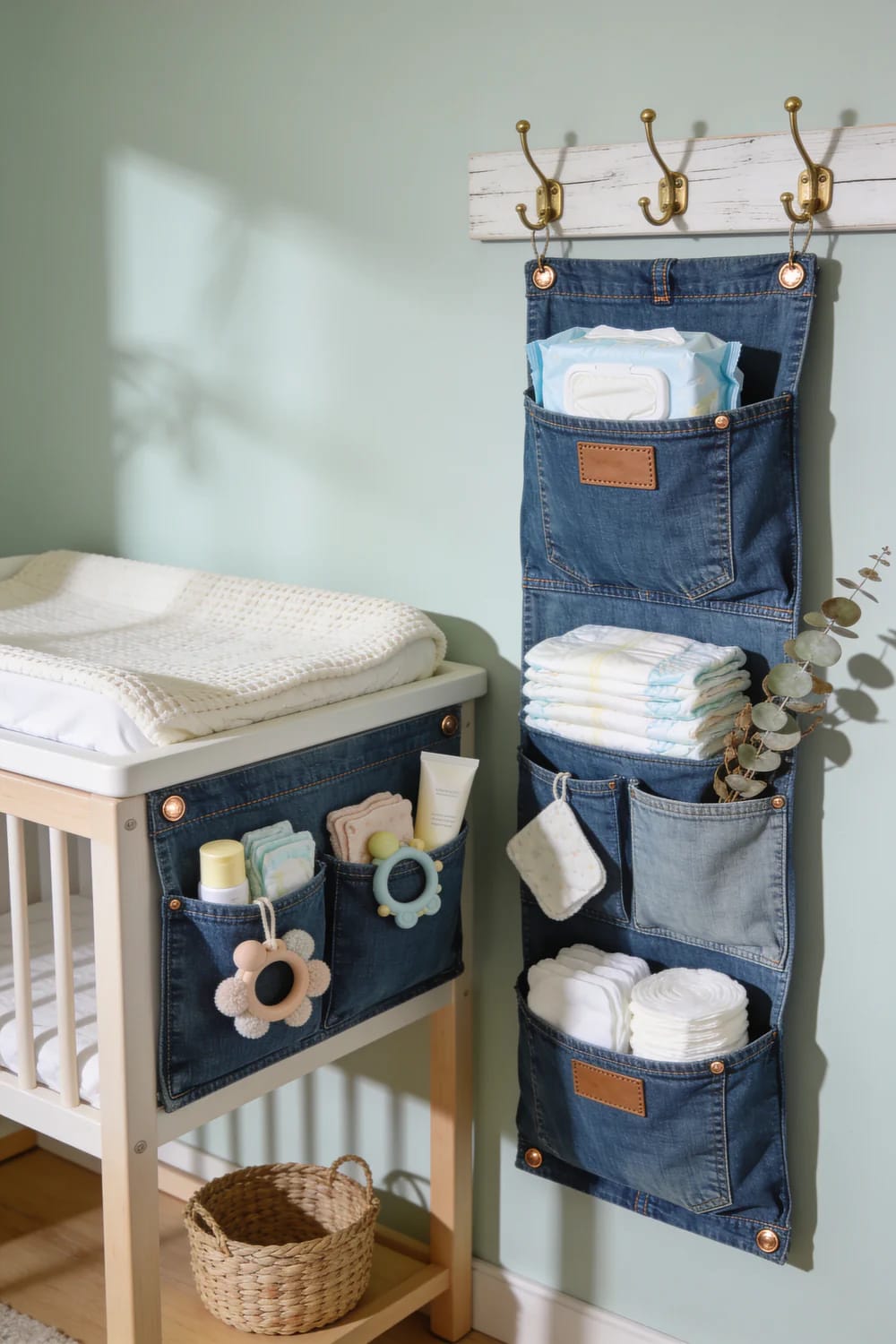
This is also the only build here that has to survive a wash, which rules out glue and rules out the dowel entirely. Sew it, use a fabric backing rather than board, and prewash the denim hot before cutting. A pair of jeans that has been through fifty cycles will still give up another half inch of shrink the first time a made-up panel goes in on hot, and it comes out of the machine as a parallelogram. If denim is going to repeat elsewhere in the room, our navy blue bedroom built from upcycled jeans covers how far you can push it before it reads as a theme.
Desk-side pockets with the charging cable coming out the bottom
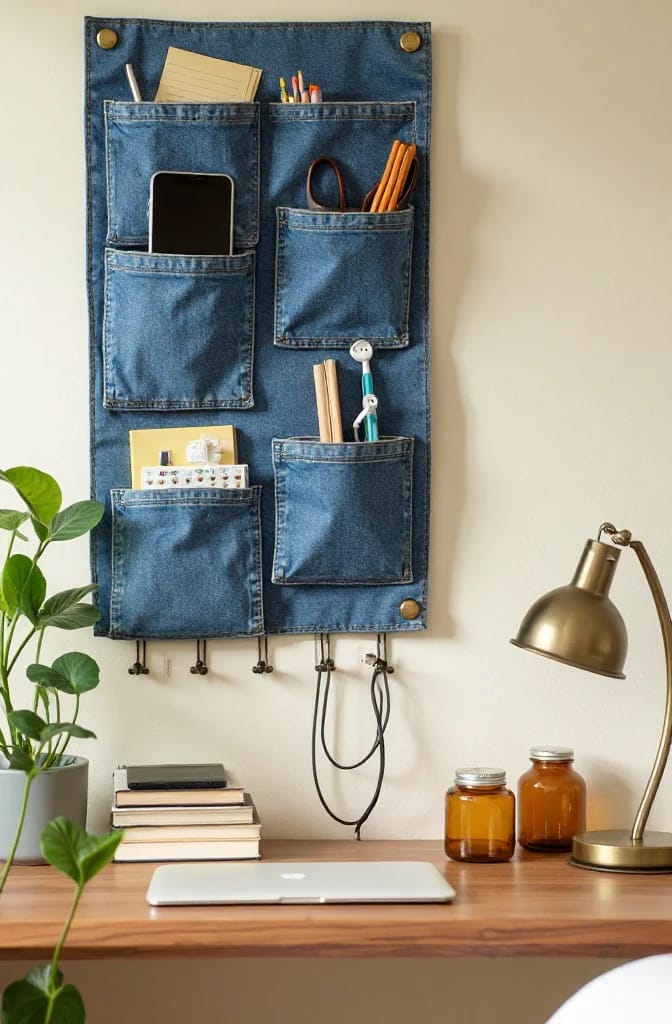
One pocket, mounted at desk height beside the monitor, with a slit in the bottom seam for the cable. The phone charges standing up, the cable runs down the wall to the outlet, and it stops getting dragged off the desk every time someone walks past. Cut the slit no wider than three quarters of an inch and finish it the same day, either with a hand buttonhole stitch or a bead of seam sealant, because denim is a twill and a raw slit will run along the weft under repeated load.
Granted, there is a limit to this one. Do not leave a phone charging in a closed fabric pocket flat against a wall for hours at a time; the pocket traps the heat the back of the phone is designed to shed. Fine for a top-up between meetings, not for overnight.
Shapes past the rectangle
A rectangle is the default because it is the easiest thing to cut out of a trouser leg, not because it is the right shape for the wall it ends up on. Three that are not rectangles.
A three-tier stepped caddy that beats a hanging shoe organizer
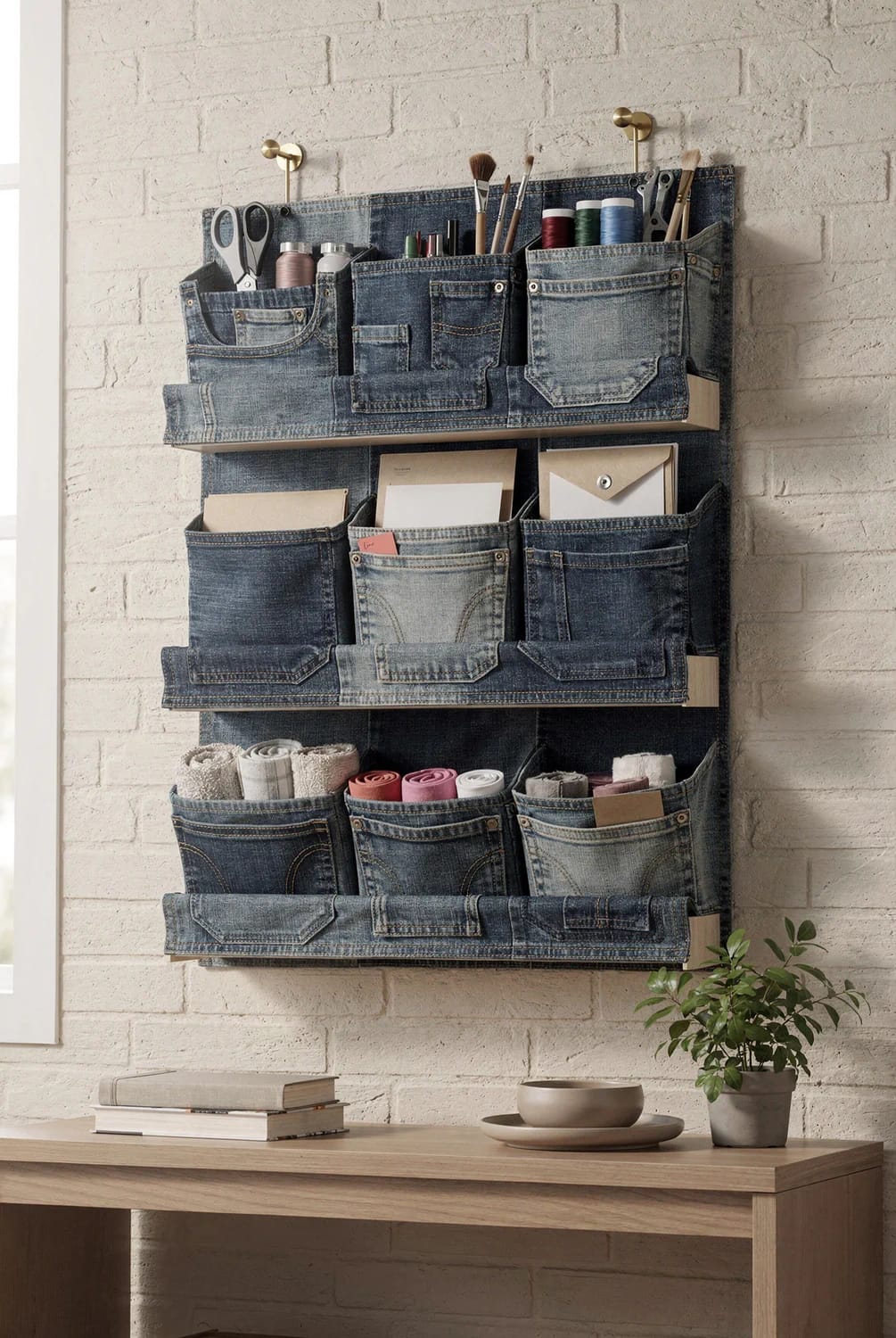
Three rows of pockets down one long panel, each row lapping over the stitch line of the row above it. On a 30 by 16 inch panel, rows at roughly nine inch pitch give you nine pockets, which is more storage than most walls need, and the overlap does two jobs at once: it hides every attachment seam and it lets a loaded pocket lean forward without exposing the raw edge behind it. If you are working through a whole pile rather than one pair, the wider run of upcycled jeans projects spreads the denim further than a single panel can.
Hang it from two points. A single center nail on a panel this long lets the loaded bottom row swing every time someone walks past, and the top corners start to curl within a month.
Embroidery hoop rounds, hung as a stagger of three
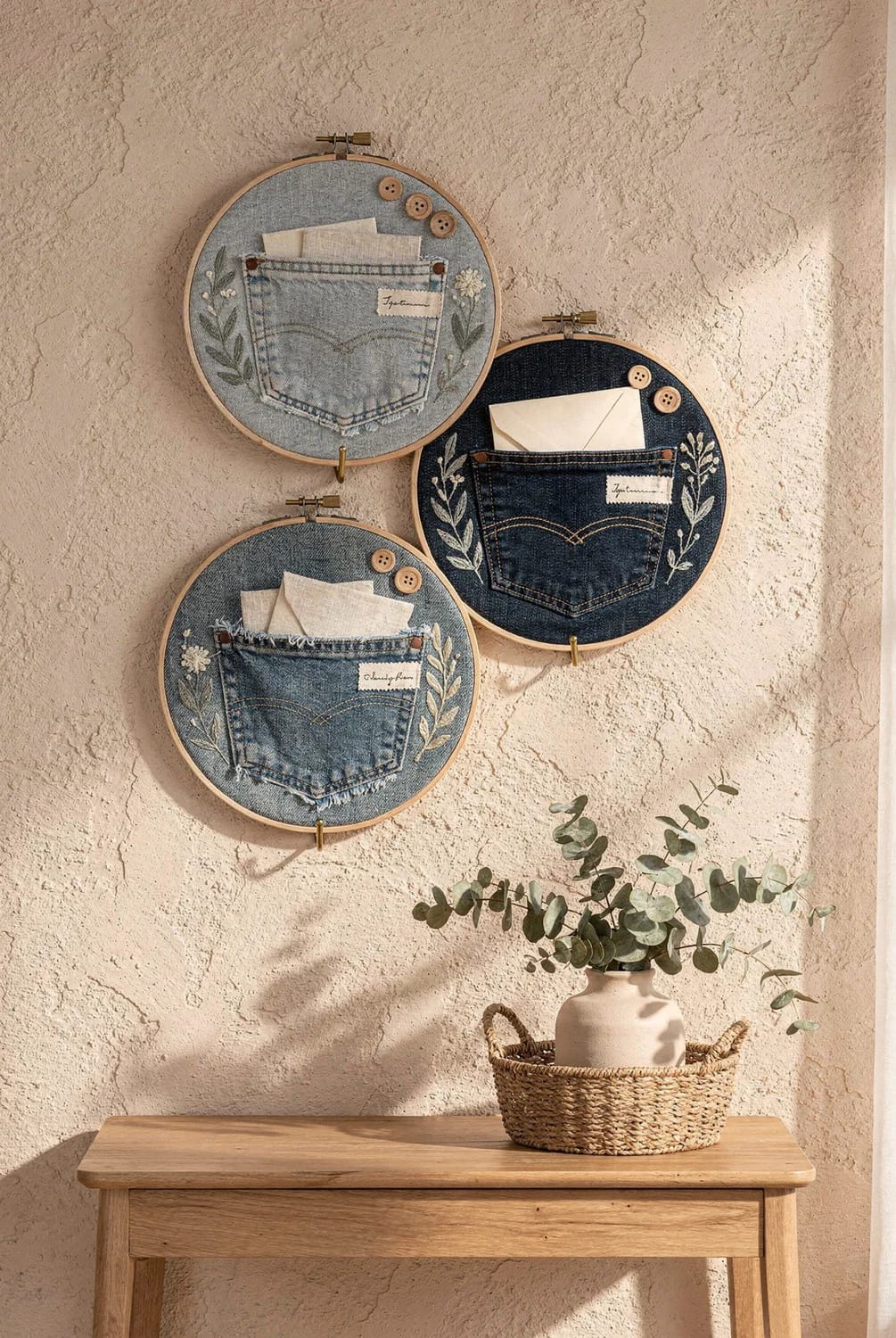
Stretch denim in a six, an eight and a ten inch hoop, stitch one pocket to each, and hang them at three different heights rather than in a line. The tension screw at the top of every hoop is already a hanger, so the hardware count for the whole cluster is three nails. These carry light things and only light things: hair elastics, earbuds, a pen, a folded note. Put a phone in one and the hoop tips forward off the nail.
A roll-up wrap that lives on one hook
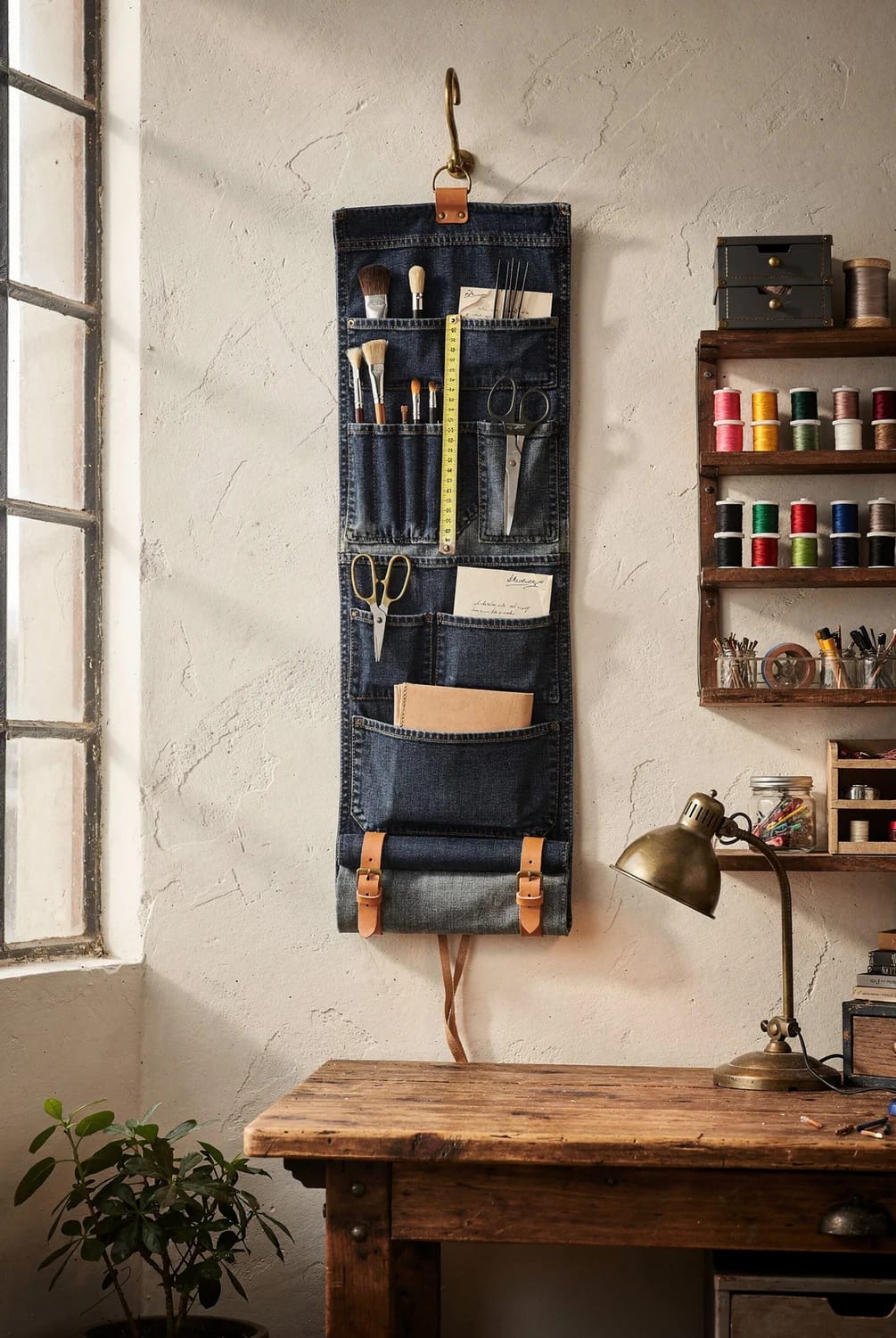
Pockets in a single row across one long strip, ties at the top corners, hung open from a nail and rolled shut when it travels. Make each pocket about two thirds the length of whatever goes in it so the handles stand clear and you can grab one without fishing. Knitting needles, paintbrushes, screwdrivers.

For walls you are not allowed to drill
An over-the-door caddy that uses the door's whole height
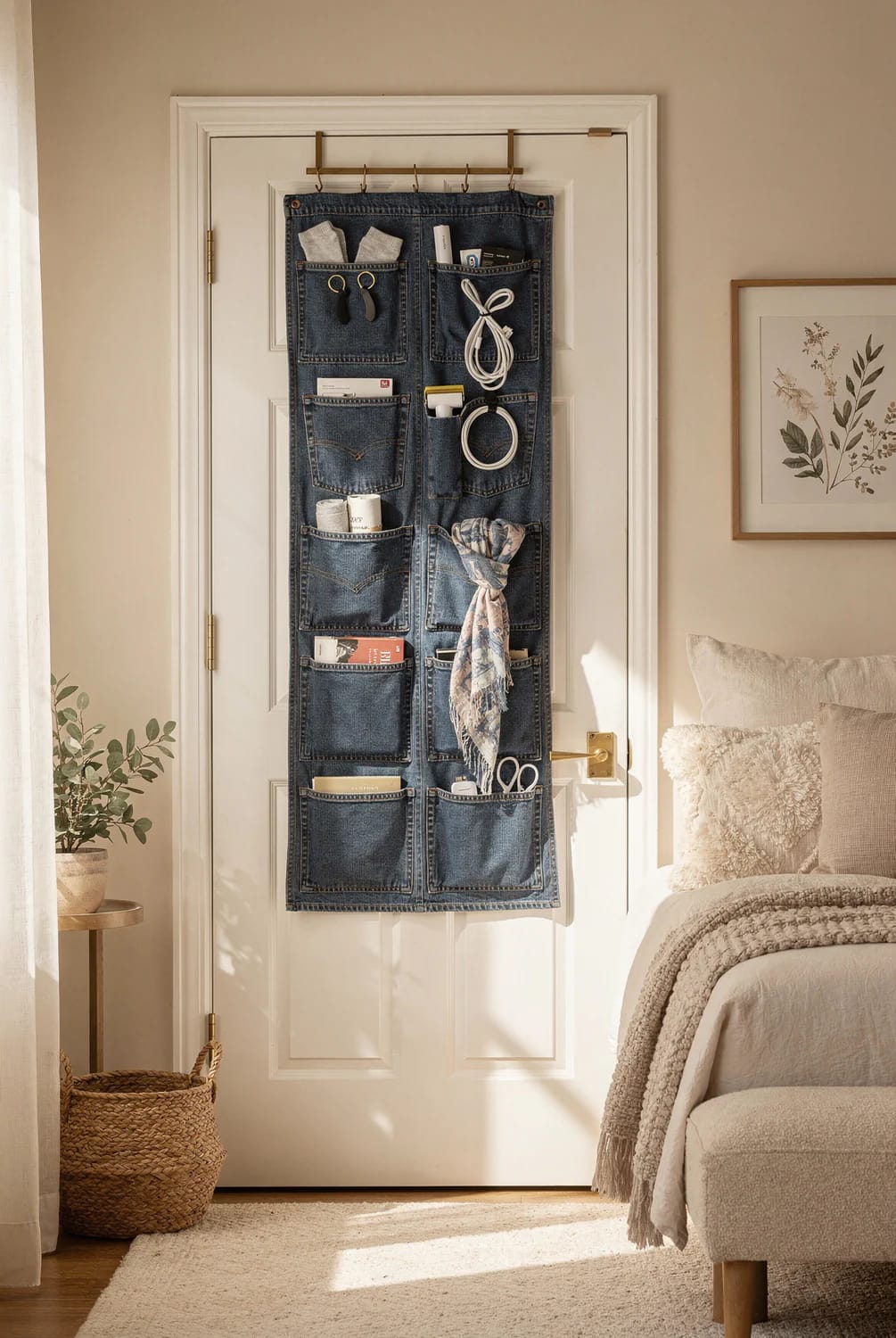
A door is five feet of unused vertical surface in a room where wall space has already run out. Five or six pockets down a full-length panel, hung on a standard iDesign York 5-hook over-the-door rack, and you have storage that comes down clean on moving day.
Check the hook thickness against your own door before you commit, though. Most over-door hardware clears an interior door up to about 1.75 inches, but a thick hook plus a loaded panel can stop the latch engaging, and a door that will not shut is a worse problem than the pile of socks was.
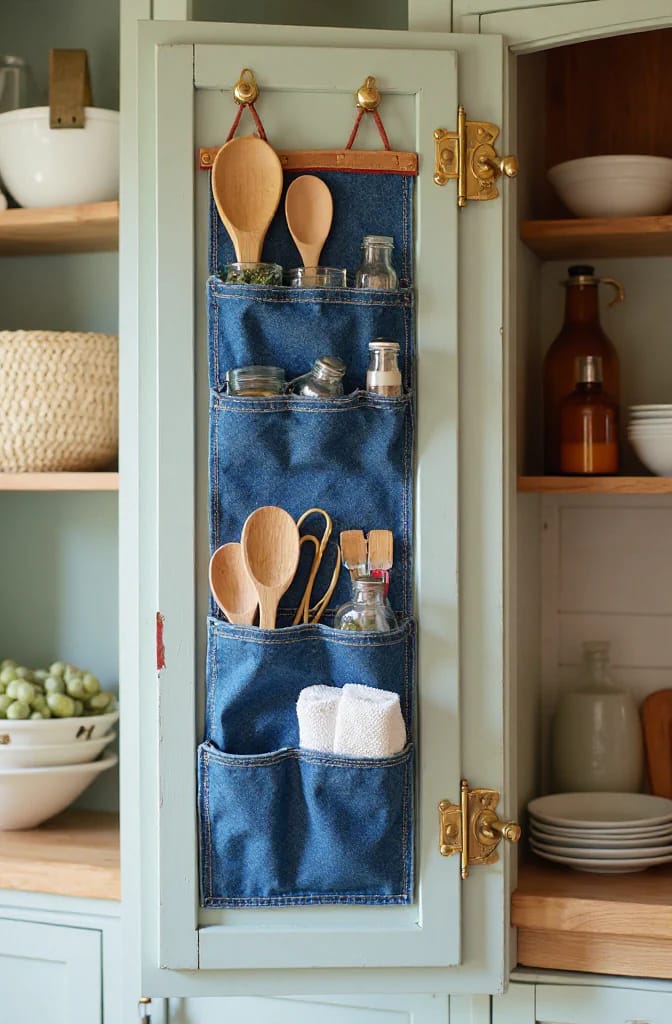
A pocket strip inside a cabinet door
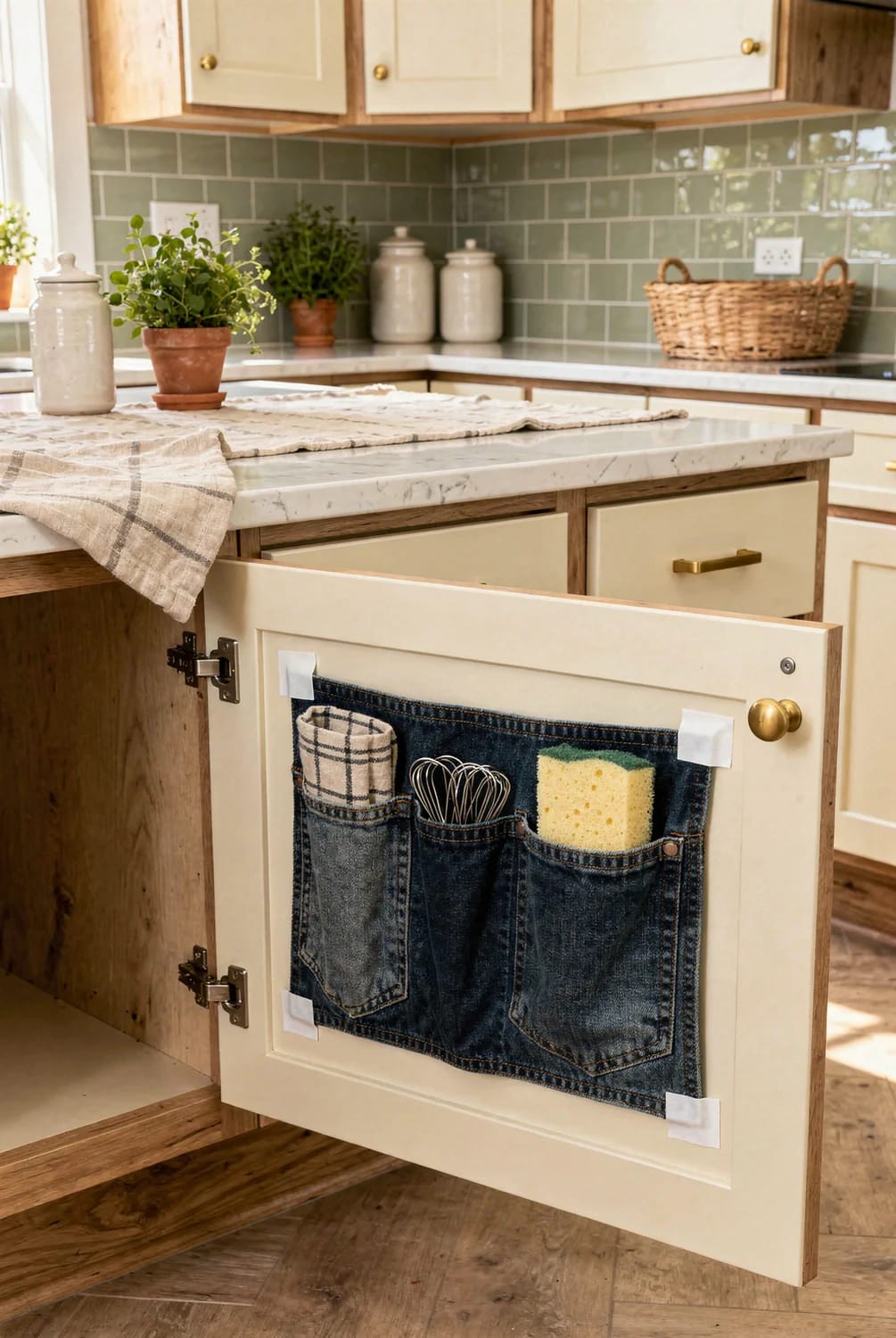
Three small pockets on a narrow strip, stuck to the inside of a vanity or kitchen cabinet door: sponges, twist ties, spare hair elastics, the objects that have never had a drawer and never will. Two things decide whether it is still there in a year. Wipe the door with isopropyl alcohol first rather than a household spray, because the surfactant film a cleaner leaves behind is exactly what makes adhesive strips release two weeks later. Then check the swing, since a loaded pocket has to clear the front edge of the shelf inside, which on most vanities puts the strip in the upper third of the door.
Four pairs are rated to 16 pounds, which is far more than a denim strip will ever hold, so the safety margin covers the fact that a cabinet door gets slammed.
Command Large Picture Hanging Strips, 14 pairs Upcycled Room and Apartment Decor for Renters Storage and decor that leans, stands, or peels off clean, for anyone whose deposit depends on an unmarked wall.
Where to start, and where I would stop
Build the dowel banner first even if the cedar plank is the one you actually want. It costs one trouser leg and an hour, and it answers the two questions you need settled before hardware goes into a wall: whether your glue holds on your denim, and whether you cut the pockets wide enough on the first attempt. Almost nobody does.
I could not find a straight answer anywhere on how many machine washes a glued pocket survives. The adhesive makers say washable, denim on denim is a good substrate, and no one publishes a cycle count. So if a piece is going in a machine, and the changing-table caddy is the obvious case, stitch it and treat the glue as a clamp that holds everything still while you sew.
And keep the front scoop pockets. Every version of this project builds from the back patch pockets because those are the ones with the topstitching people recognise, which means two perfectly good pockets per pair go in the bin. The front ones come off with the bag attached, they are roughly twice as deep, and they are where the tall things go.
Related Posts
- How to Make Angel Ornaments from Old Jean Pockets
- 15 Avant-Garde Wall Hanging Craft Ideas for a Stylish Space
- 15 Zesty Sewing Room Ideas to Jazz Up Your Space!
- Navy Blue Bedroom: 19 Decor Ideas Made with Upcycled Jeans
- Personality-Packed Cubicle and Office Decor That Comes Down Clean
- Minimalist Wall-Mounted Christmas Tree Alternatives for Small Spaces