
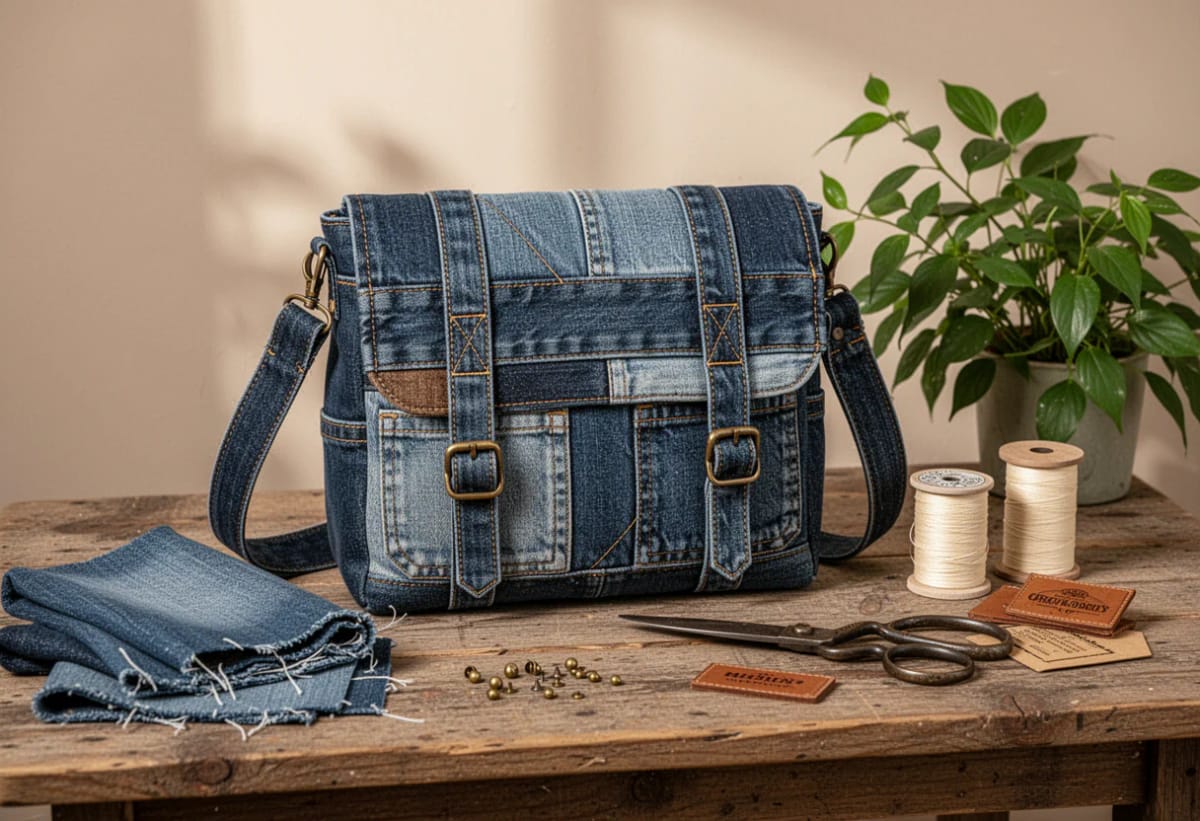
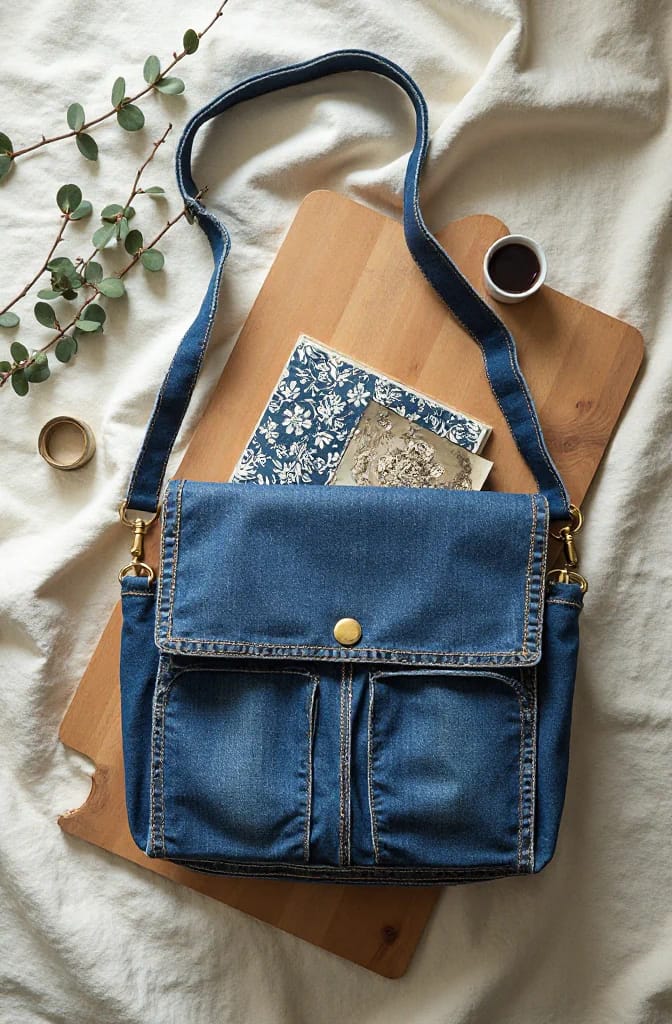
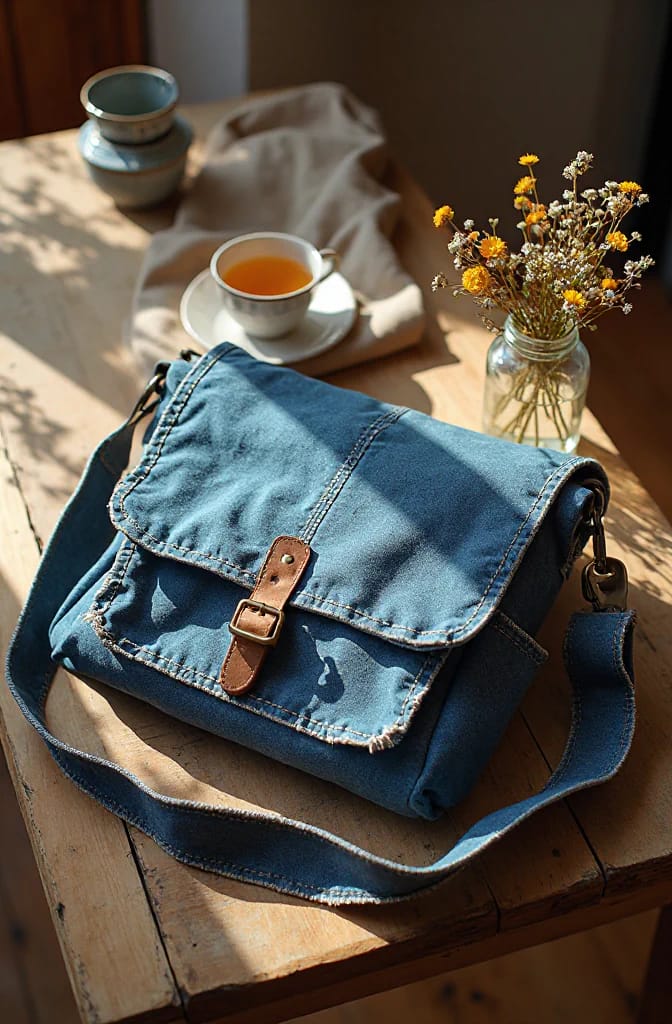
Most denim bag tutorials tell you to print a pattern and buy new hardware before you cut anything. Skip both. A messenger bag is a rectangle with a flap, and an old pair of jeans already holds the finished hem for that flap, two working pockets, and a waistband that does most of a strap’s work for free. The bag below costs almost nothing because it starts from the pair you were about to throw out.
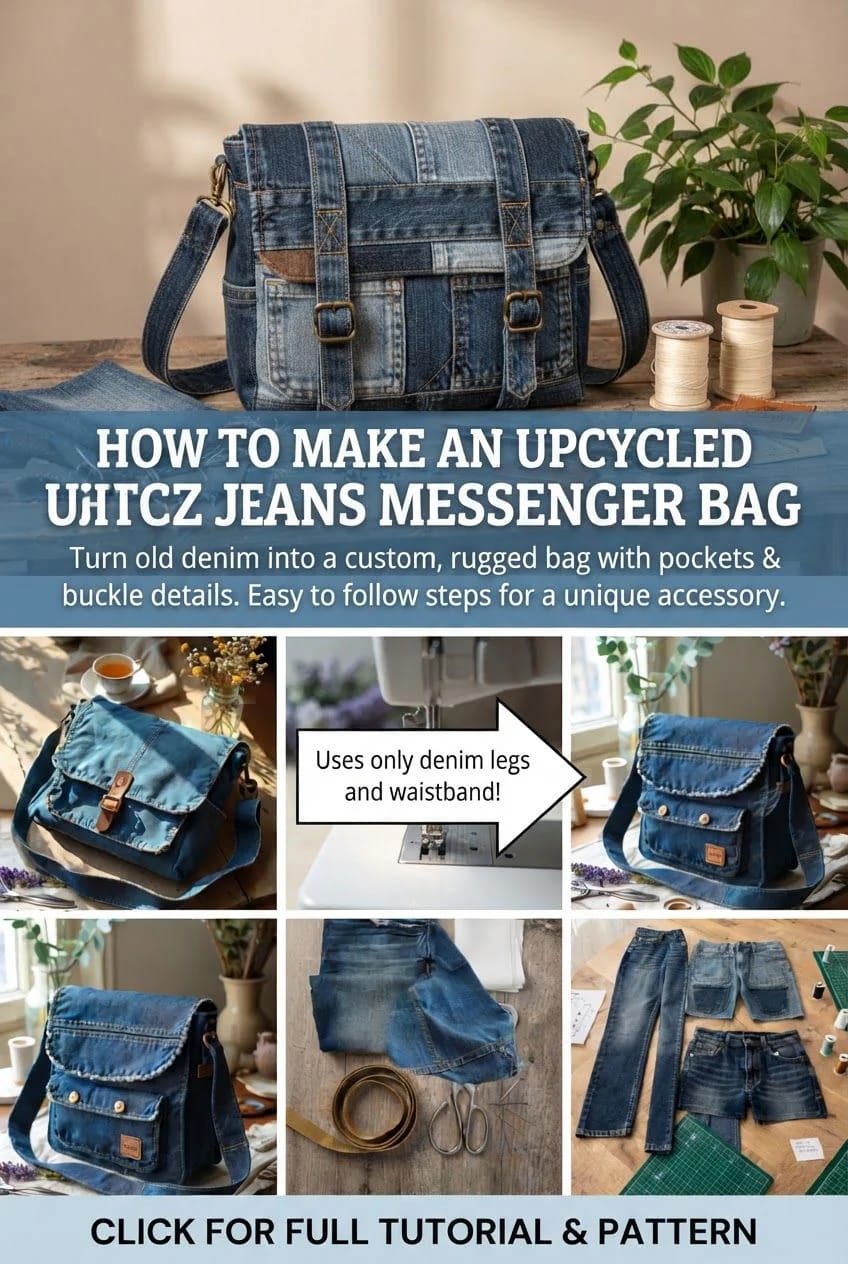
The finished bag runs about 15 inches wide by 11 inches tall by 3 inches deep, room enough for a tablet, a paperback, and a water bottle. It sews up in one afternoon on a machine, or over two evenings by hand. The one thing you should not skip is a jeans needle. The denim is not what fights you; the eight layers at the corners are.
Three decisions that shape the bag
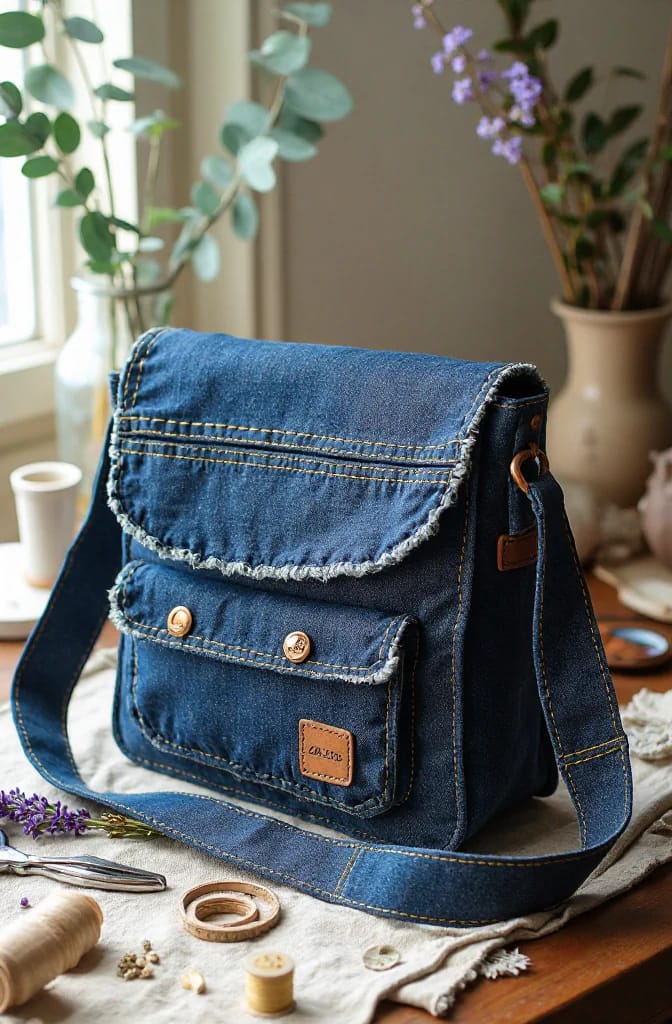
Before any cutting, decide the three things that give a messenger bag its shape, because the jeans already do part of each one. The flap comes from a leg, cut so the original hem becomes its finished bottom edge, which saves you a hem and keeps the topstitching where it belongs. The base is a flat 3-inch bottom made by boxing the corners, so you never cut a separate gusset. The strap is either 1.5-inch webbing run through a slider, or the waistband and belt loops sewn end to end, which is free but lands too short for crossbody wear on most adults.
Two washes of denim beat one if you want contrast, a dark panel for the body and a faded one for the flap, and hand stitching in place of the machine is a legitimate finish rather than a downgrade. If you have a whole pile of jeans rather than one good pair, the wider set of upcycled jeans ideas is a better place to pick a project than trying to force this one to use everything.
What you need
Everything below splits into what gets used up and what goes back in the drawer. The only things you may need to buy are a needle and a few small supplies; the jeans, the iron, and the scissors you already own.
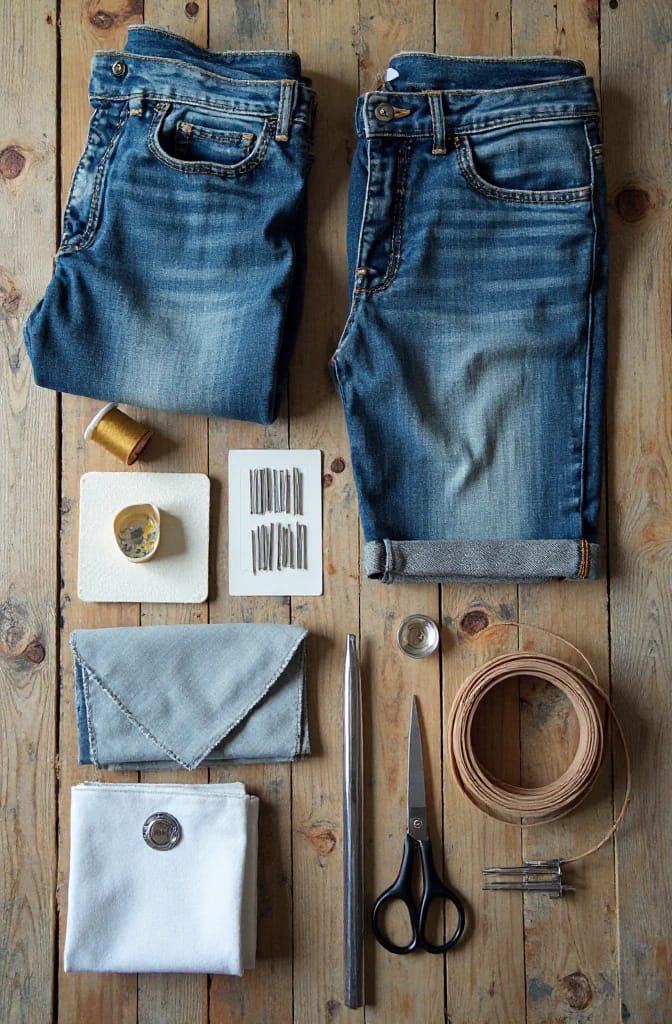
Materials
| Qty | Item | Spec | Price |
|---|---|---|---|
| 2 | Old jeans | adult size, any wash; straight legs give the longest panels | $0 (own) |
| 1 | Coats & Clark Dual Duty XP Heavy Thread | 125 yd spool, gold or black | $5 to $7 |
| 1 | Pellon SF101 Shape-Flex Fusible Interfacing | medium weight, about 1/2 yd | $5 to $9 |
| 1 | 18mm magnetic snaps | sew-on, 18 mm | $4 to $8 |
| 1 | 5-inch nylon webbing strap | 5 in wide, 3 yd, black or tan | $7 to $12 |
| 1 | Lining cotton (optional) | quilting cotton, from your stash | $0 to $6 |
| Materials subtotal | $21 to $42 | ||
Prices are approximate ranges as of September 2026; verify before purchase.
Tools
| Qty | Item | Spec | Price |
|---|---|---|---|
| 1 | Sewing machine | any home machine | $0 (own) |
| 1 | Schmetz jeans needle, size 90/14 | 90/14, or 100/16 for very thick seams | $4 to $6 |
| 1 | Fabric shears | sharp, 8 to 9 in | $0 (own) |
| 1 | Seam ripper | $0 (own) | |
| 1 | Iron and board | for fusing and pressing | $0 (own) |
| 1 | Pins or clips | $0 (own) | |
| 1 | Chalk or fabric marker | $0 (own) | |
| Tools subtotal | $4 to $6 | ||
Combined total
| Everything from scratch, including the needle | $25 to $48 |
Step 1: Cut the jeans into four flat panels
Turn the legs into rectangles first, and only then cut shapes. Wash and dry the jeans so the denim is preshrunk, cut the legs off just below the crotch, and slit each leg open along the inseam so it lies flat as one wide panel. Keep the felled outseam intact; that double-stitched edge is a finished edge you can use as a strap or flap later. Cut the back pockets out with a half-inch seam allowance and set the waistband and belt loops aside.
The parts worth saving are the parts that make denim read as denim, the felled seams, the gold topstitching, the faded knees. The full argument for cutting this way, rather than treating jeans as plain blue fabric, is laid out in the upcycled jeans decor guide.

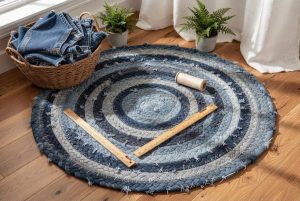 How to Make a Braided Denim Rag Rug From Old Jeans The project that uses up every leg and scrap this bag leaves behind.
Step 2: Cut the pieces and fuse the interfacing
Cut the body and flap now, and fuse interfacing to every denim piece before you sew anything, because a bag without it collapses like a grocery sack. Cut two body pieces 16 by 12 inches and one flap 16 by 9 inches. If you kept the leg hem, make it the flap's bottom edge and trim the other three sides square. Cut the same two body pieces from lining only if you want one; I would skip the lining on a first bag, since the wrong side of denim is part of the look and you can always add it later.
Fuse the interfacing to the wrong side of each denim piece with a dry iron, adhesive side down, holding for 8 to 15 seconds per area, and let it cool before moving the piece. Then switch to the jeans needle. A universal size 80/12 will snap on the first thick seam; the jeans needle's reinforced blade is what gets you through the corners.
Step 3: Sew the flap and the front pocket
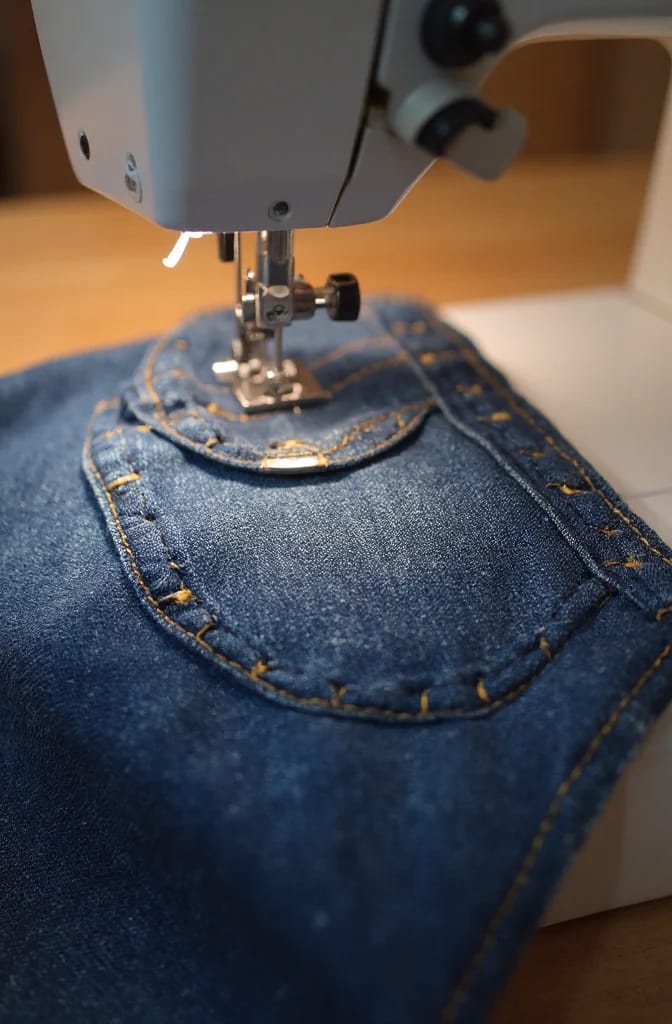
Build the flap and the pocket before the body, because both are easier to sew while they are still flat. Put the flap's denim and lining right sides together, sew around three sides, turn, press the edge crisp, and topstitch with the gold thread. Then stitch one saved back pocket onto the front body piece along its original stitch lines, leaving the top open so it still works as a pocket.
Do this
- Keep the hemmed leg edge as the flap’s bottom, so it needs no hemming.
- Gold thread for the topstitching, matched to the jeans’ existing stitching.
- Sew the pocket down by following its original stitch lines.
Avoid
- A pocket cut off flush, which leaves raw edges to fray.
- Skipping the press after turning the flap, which leaves a rounded, puffy edge.
If you want the flap to read as mended rather than plain, this is the step where it happens. A few rows of running stitch across the flap, or a patch pinned over a worn knee and stitched around its edge, turns a scrap of denim into the kind of visible mending that shows up on jeans people keep wearing.
Step 4: Sew the body and box the corners
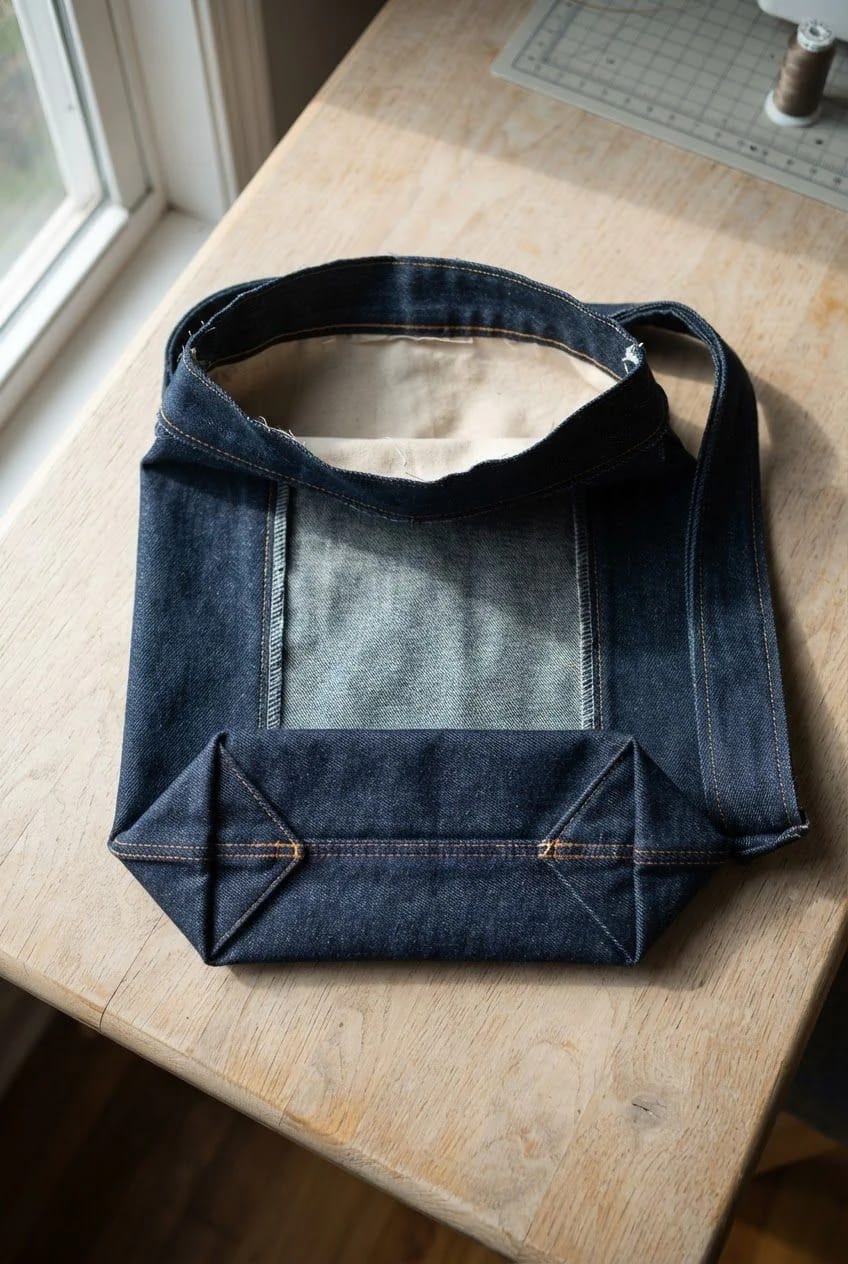
Sew the two body pieces together, then box the bottom corners to give the bag a flat base. Put the pieces right sides together and sew the sides and bottom with a half-inch seam, leaving the top open. At each bottom corner, pinch the seam so the side seam and bottom seam meet, mark a line 1.5 inches from the point across the triangle, and sew across it. That single seam turns a flat corner into a 3-inch-deep base. Trim the excess triangle and finish the raw edges with a zigzag or pinking shears.
Where the felled outseam crosses a side seam, the seam allowance stacks into a ridge your needle has to climb. Go slow, hand-crank the machine over the thickest inch, and never force the foot. A snapped needle here is the most common way this project ends early, and the fix is patience, not a bigger machine.
Step 5: Strap, closure, and the afternoon total
Attach the strap and the magnetic snap last, once the body is a bag you can hold. Fold each strap end under and topstitch a rectangle with an X through it at each side seam, running the strap across the back panel. Set the magnetic snap on the flap's underside and the bag's front, backed by a small square of denim so the prongs do not pull through. If you cut a lining, sew it in now, turning the bag through a gap left in the lining's bottom seam and closing the gap by hand.
I have never seen a printed strap length that fits a real body, so run the webbing over your shoulder first and mark the drop before you cut anything. From the first cut to a wearable bag is about 3 to 5 hours on a machine. By hand, budget two evenings, one to cut and assemble, one to topstitch and set the strap. Fusing the interfacing adds about 20 minutes, not a separate session.
A messenger bag hangs from two stitched rectangles. Sew the strap through the bag body and the seam allowance together, not just the outer layer, or the first heavy load tears the strap free and takes a corner of the bag with it.
Where the rest of the jeans go
You will finish this bag with two legs’ worth of offcuts left over, and the waste is only waste if it hits the bin. The longer strips braid or weave into something, and the small scraps too short to sew are exactly what the denim Christmas ornaments piece turns into a whole tree of decorations. The one part nobody has found a good reuse for is the crotch seam itself; its curved double thickness fights every pattern, so cut it apart and sort the pieces with the rest.
Related Posts
- How to Make a Braided Denim Rag Rug From Old Jeans
- 57 Innovative Upcycled Jeans Ideas: Transform Your Old Denim into Chic Fashion and Home Decor
- Upcycled Denim Christmas Ornaments From Old Jeans
- 11 Upcycled Jeans Decor Ideas for the Pile You Can’t Toss
- 13 DIY Denim Christmas Stockings From Old Jeans
- 25 Creative Christmas Crafts Using Upcycled Jeans For Unique DIY Decorations