
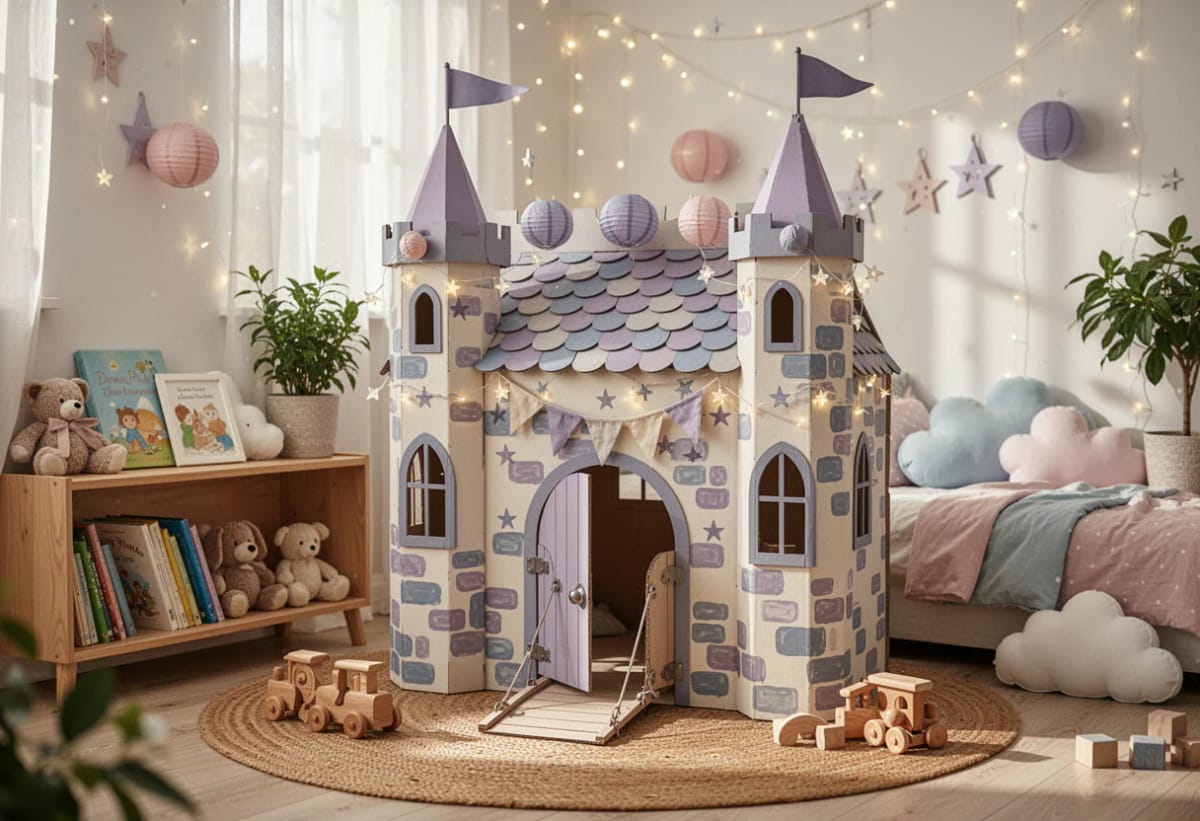
Most cardboard castles fail for one dull reason: they are built like furniture when the job called for scenery. A fortress that runs floor to ceiling looks tremendous on the afternoon you finish it, then spends three weeks blocking the door, and the tape holding the towers on gives out the second time somebody sits on a wall. The thirteen builds below are sized for a real bedroom, which means they fold flat, come apart, mount on a wall, or live under a bed, and none of them needs more than boxes, a blade, and something to join edges with. The sizer halfway down will tell you how many boxes your room and your child’s height actually require before you cut anything.
Castles you can build from the boxes already in the garage
1. Two boxes, one corner: the keep that costs nothing
Split two medium boxes open and tape them at a right angle and you have a keep, because the corner is doing the structural work: two walls meeting at ninety degrees brace each other, so that joint needs tape rather than timber. Keep the flaps on the inner box folded back as a lip where wall meets floor, and cut the top of each wall at your child's shoulder height so they can lean over it without tipping the whole thing.
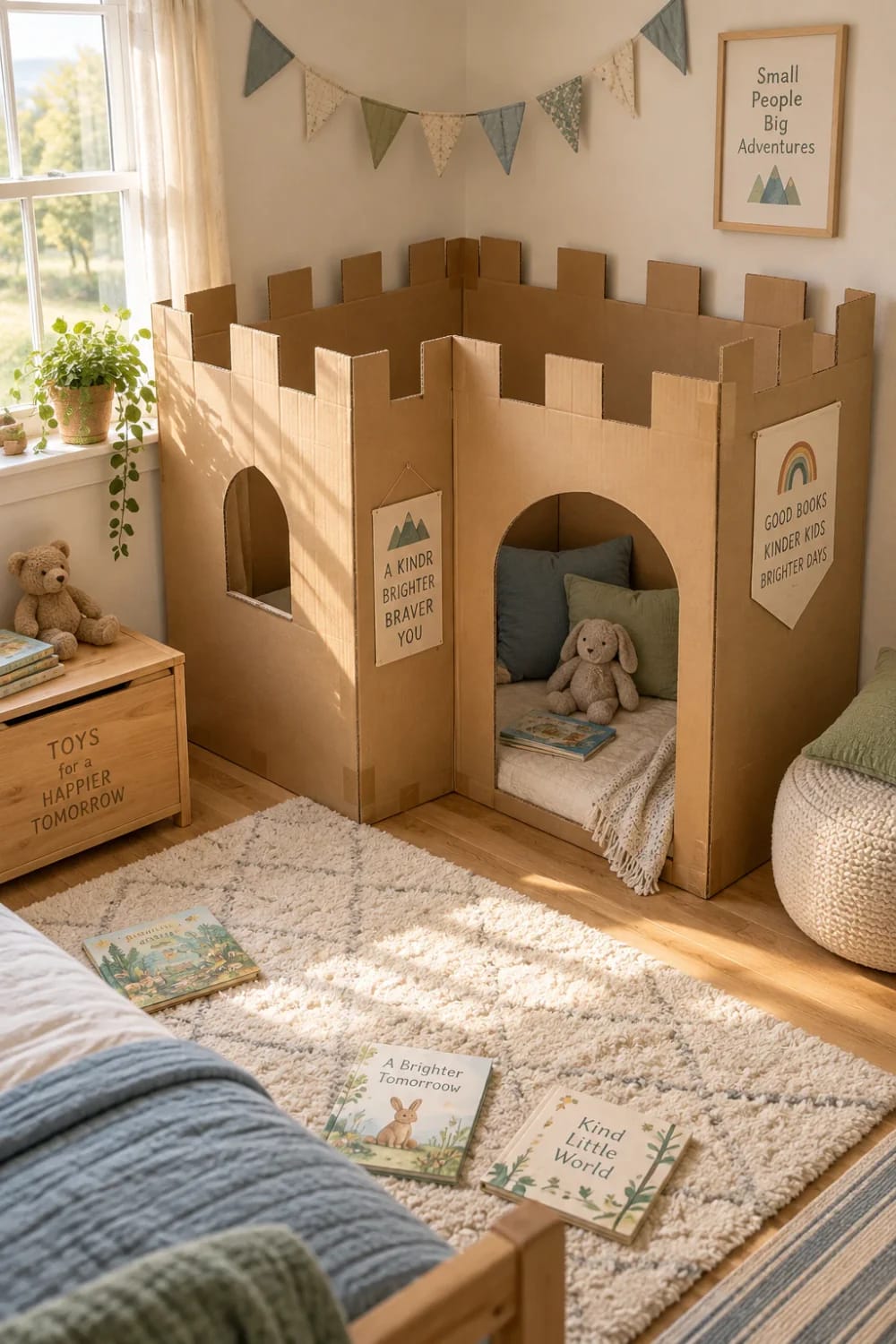
The most common mistake is starting with the biggest box in the house. A 24 inch cube is a better castle wall than a refrigerator box, since a small child can see over it, climb in without help, and the panels are short enough that the corrugation does not bow under its own weight. Flattened boxes make decent ramparts once the keep is standing, and if you want the rest of the household scrap to earn its place, there are thirty-odd upcycled projects that start from the same pile of cardboard.
2. One wardrobe box, one door that actually closes
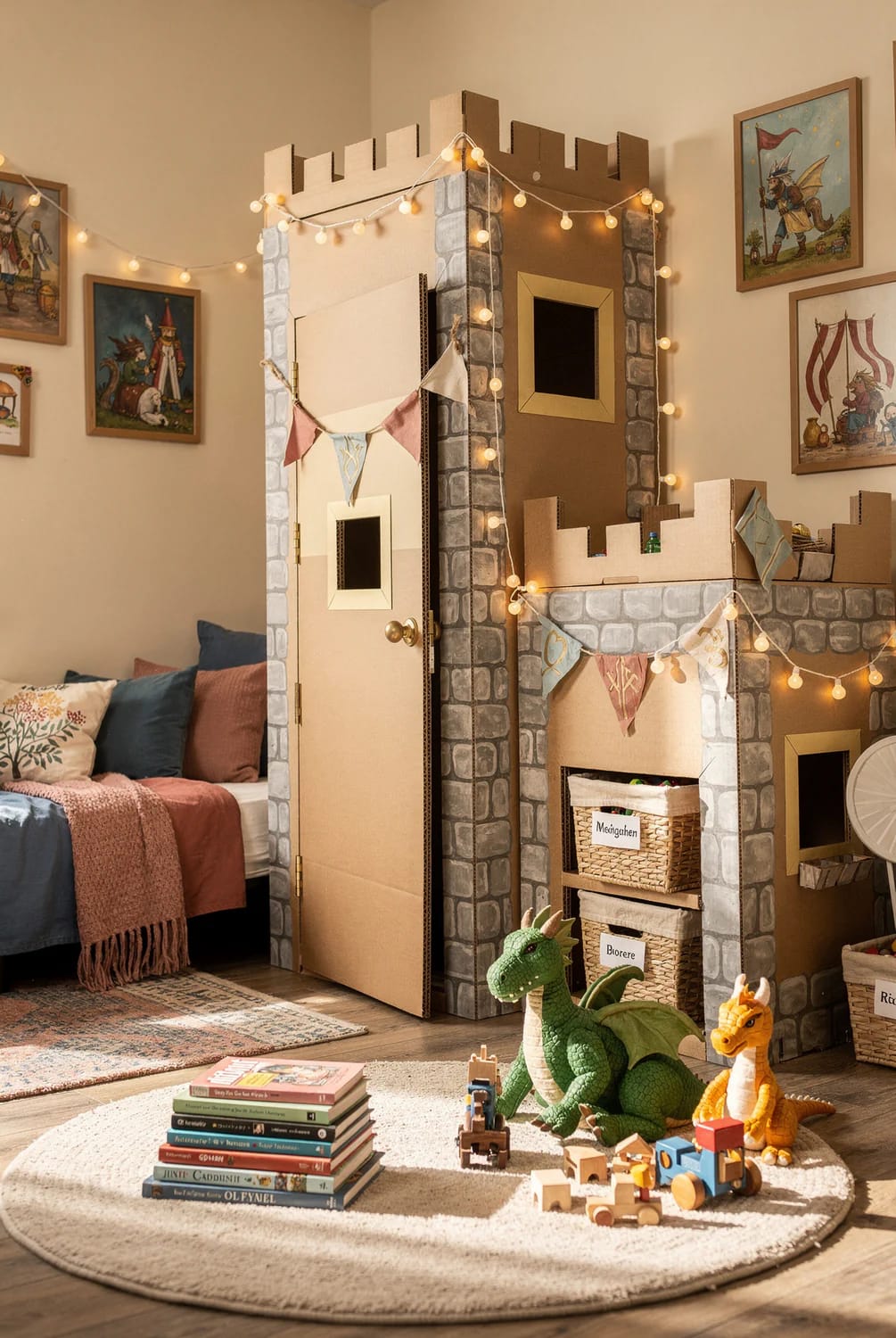
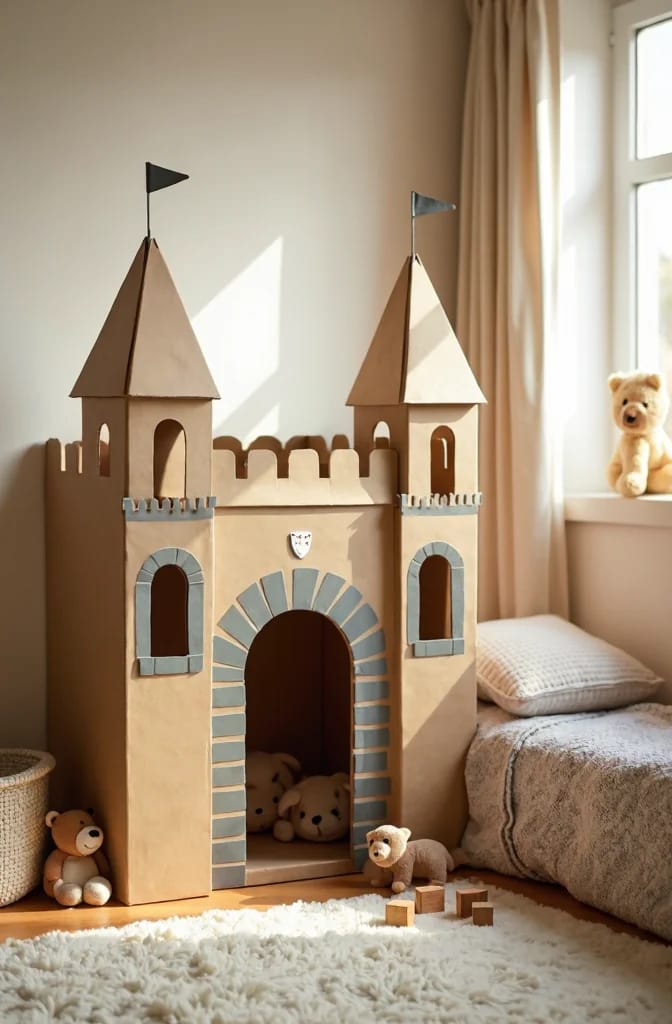
A single wardrobe box becomes a tower with a real door if you cut that door as a flap hinged on one side and reinforce the fold on both faces with cloth tape. Cut the doorway four inches shorter than your child, put the window at their eye level, and leave the roof off so daylight gets in.
Cardboard hinges fail in one direction only. Tape the inside face and the outside face of the same fold and the door swings all winter. Tape only the outside and the second or third open pulls the liner paper off the flutes, and the flap tears along the fold from there.
3. Score the folds and the castle flattens against the wall
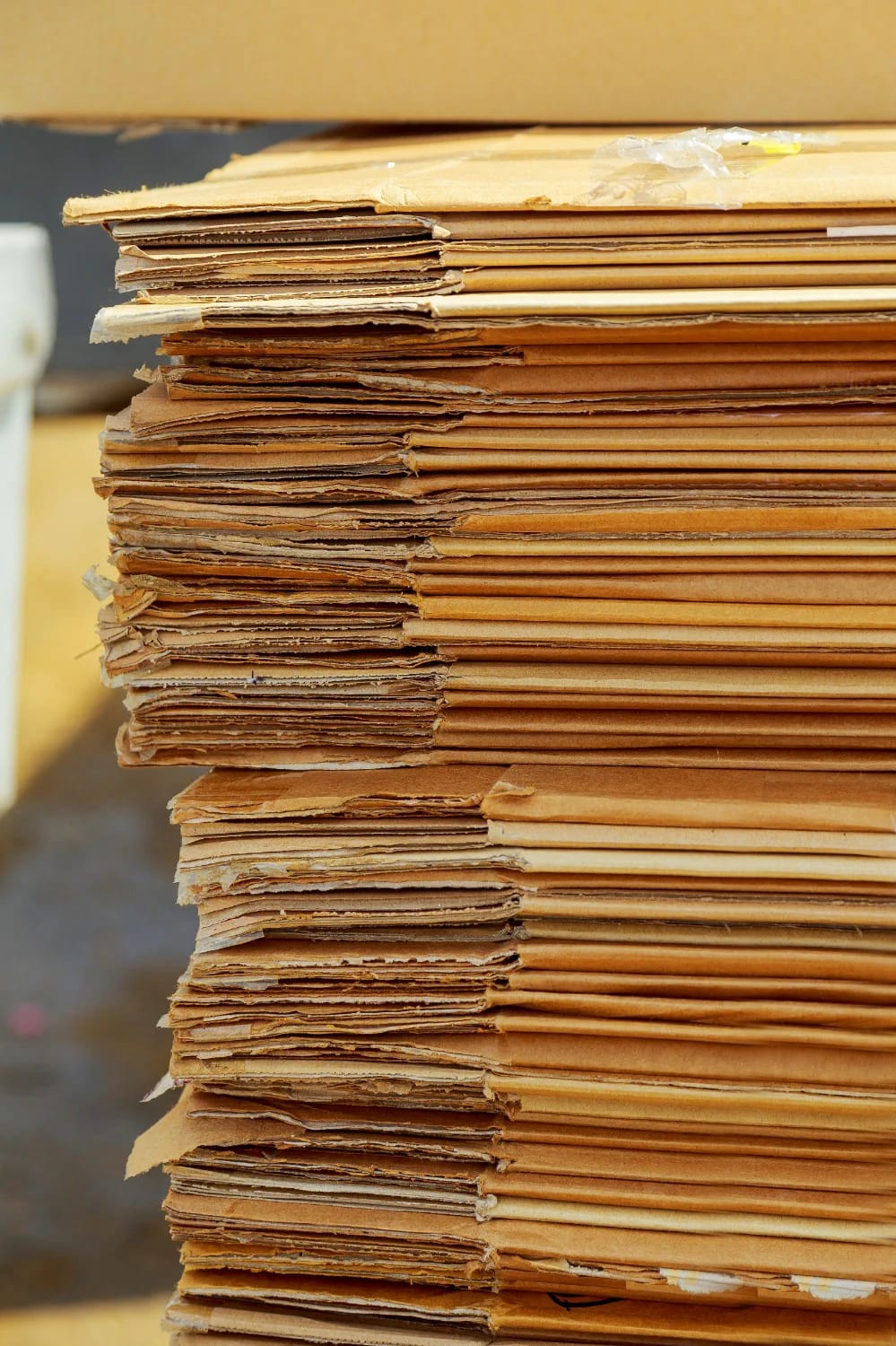
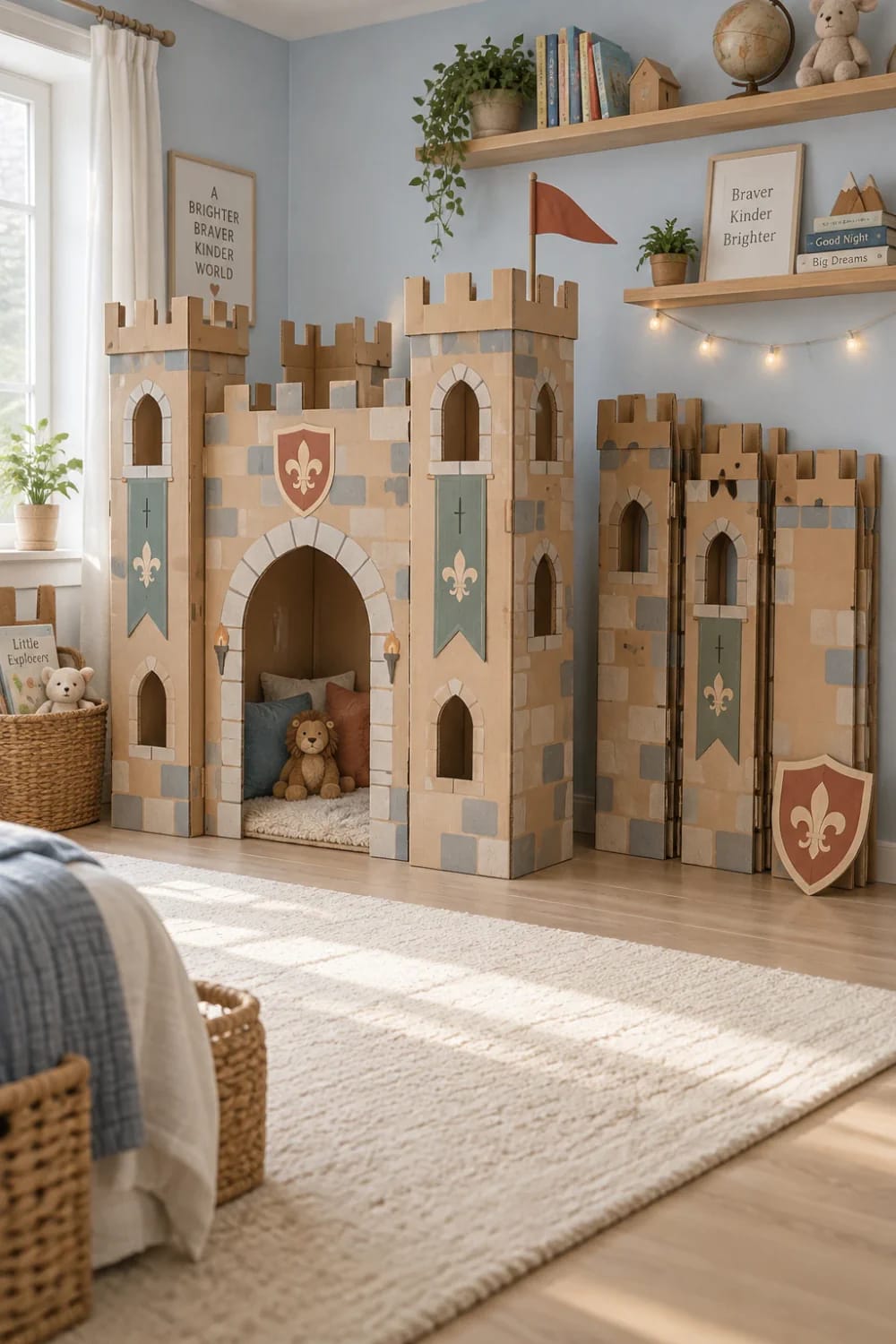
Score the folds instead of guessing at them. Run a utility knife along a straightedge just deep enough to cut the top liner, then fold the panel away from the cut, so it turns on a clean line while the flute layer underneath stays intact and keeps its strength. Three panels scored at their corners and hinged with cloth tape on both faces fold down into a stack about four inches thick, which stands behind a wardrobe between visits. Wardrobe boxes run about $20 to $30 each new, and a furniture store loading dock will usually hand you flattened ones for nothing if you ask.
Cloth gaffer tape is the right hinge material and duct tape is not. Gaffer is a matte cloth that tears by hand, grips kraft paper, and peels off a painted wall without lifting the paint, while duct tape leaves a gum line that collects carpet fibre and dust until the whole edge looks grubby. A two inch roll goes a long way:
Gaffer Power 2 inch matte cloth gaffer tape, 30 yards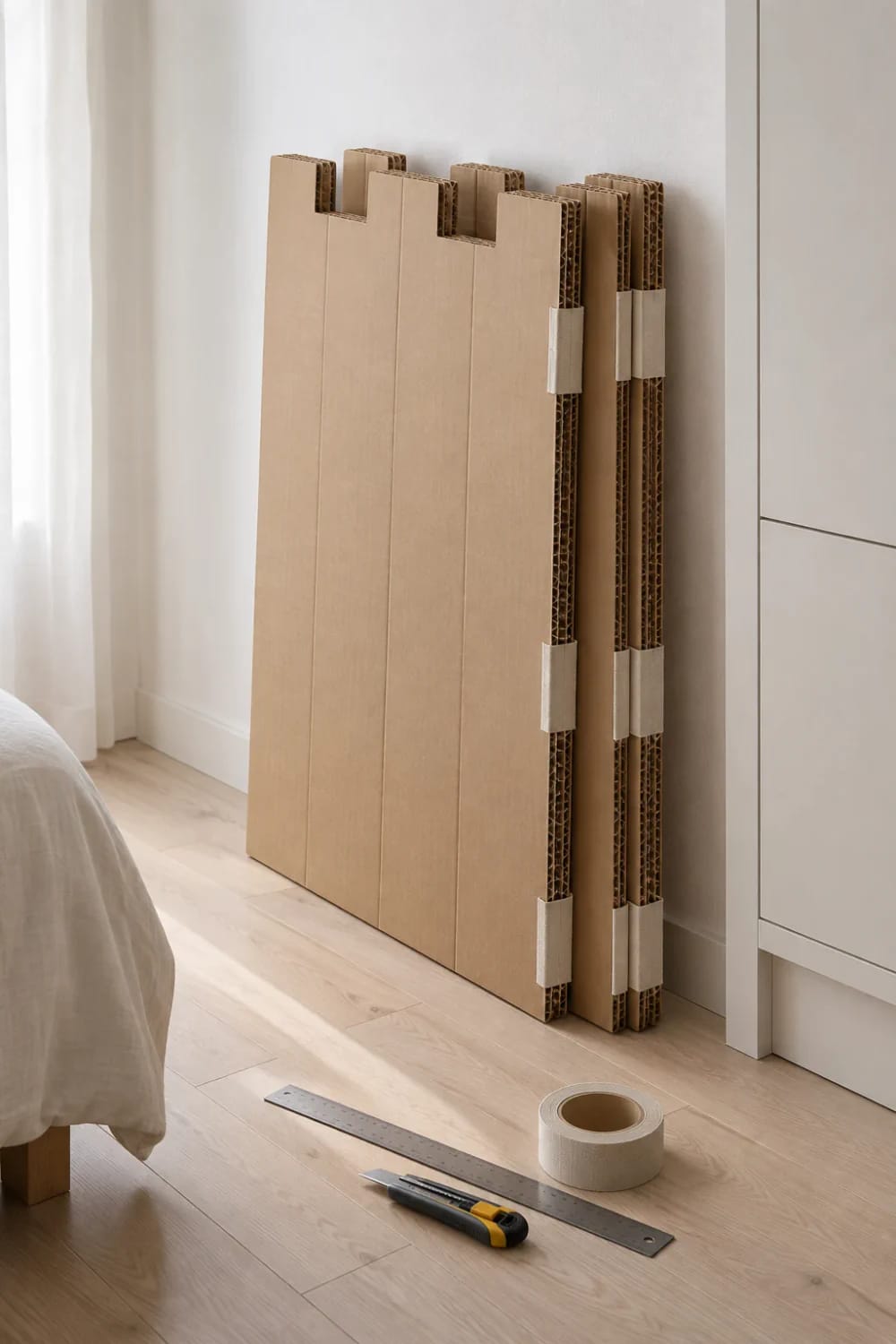
Castles that take up almost no floor space
4. Screwed, not glued: a castle that comes apart again
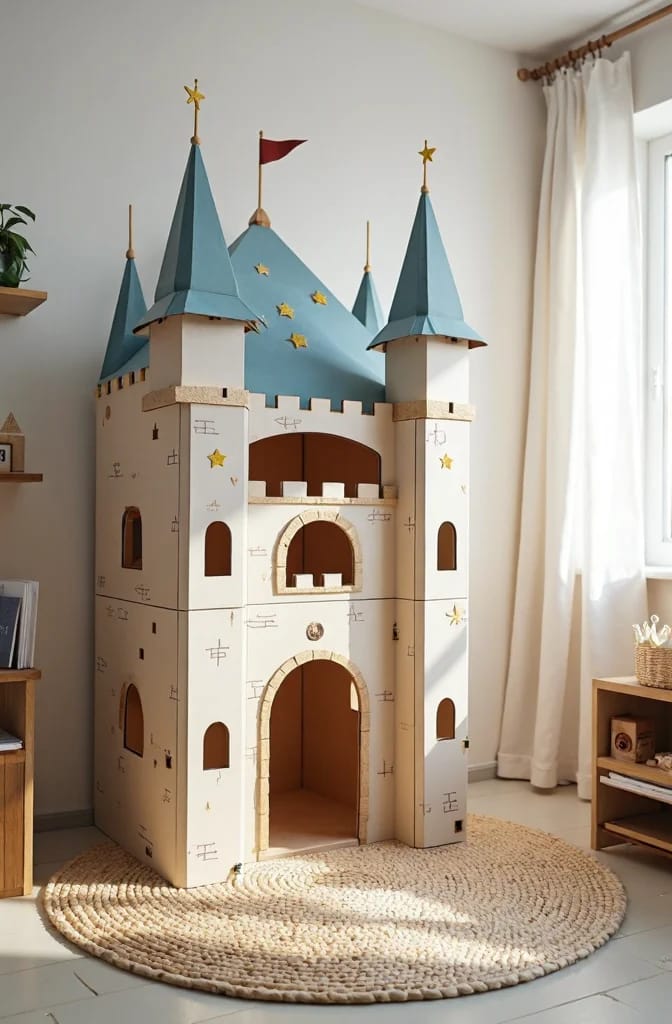
Screws beat glue for anything you might want to rebuild, and that is most of it. A glued joint is rigid, permanent, and single use: it tears the liner when you finally pull it apart, which is how a lot of promising castles end up at the kerb three weeks later. I would not glue a single joint on a castle a child will actually use. Plastic cardboard screws pierce two layers of corrugated, hold hard enough to carry a roof span, and back out with the same tool, so the fort becomes a ship next month without new material.
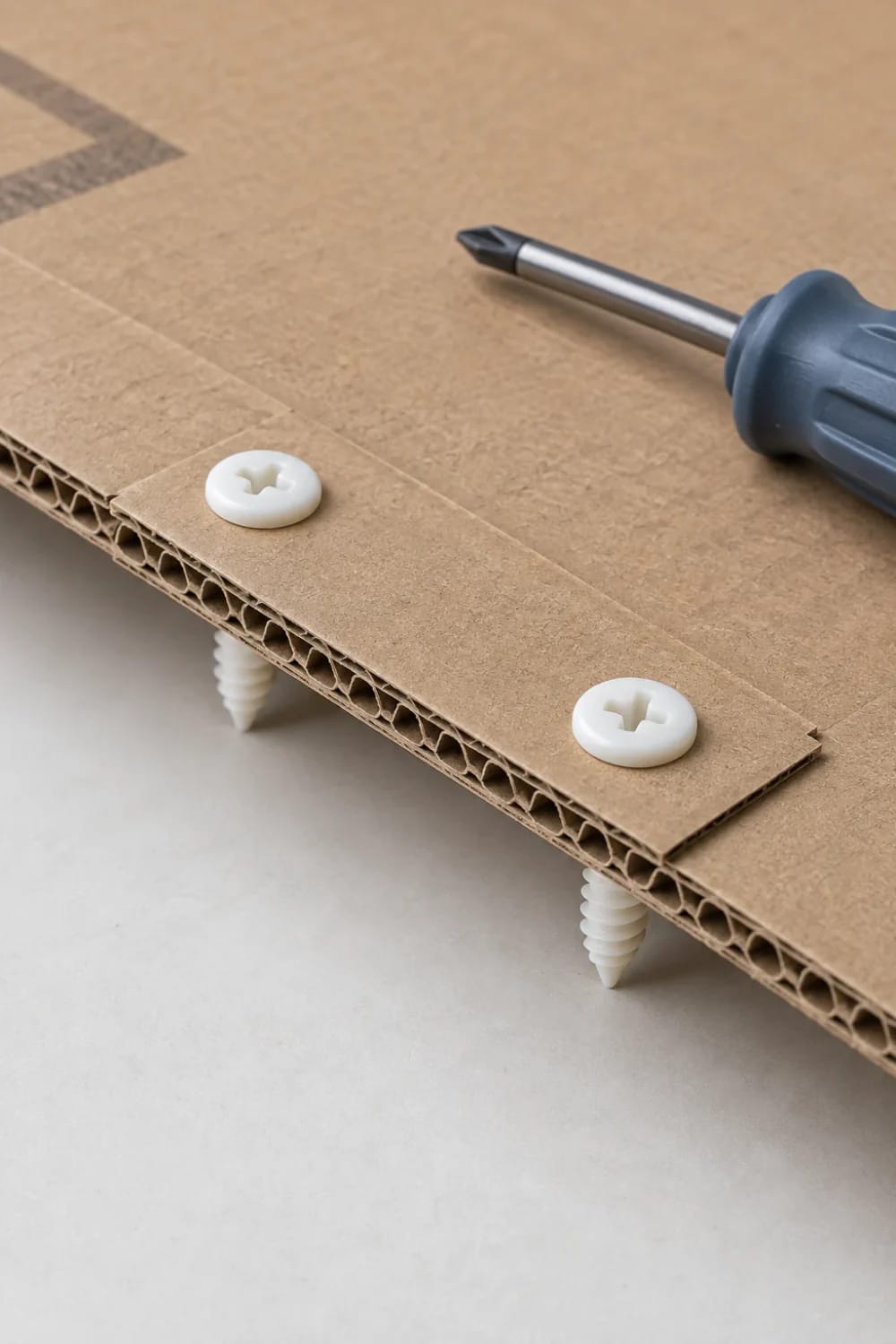
The 50 piece set carries the screwdriver tool and 36 reusable screws, which is enough for a keep and a tower, and every screw comes back out with the same tool so the board can be rebuilt.
Makedo Explore JNR cardboard construction toolbox, 50 piecesTwo boards screwed at an overlap make a hinge that swings. Two boards screwed flat make a rigid panel. The screws live in a jar on a shelf when the castle comes down, which means the next build starts with a box of parts rather than a trip to the shops.
5. A half castle mounted on the wall
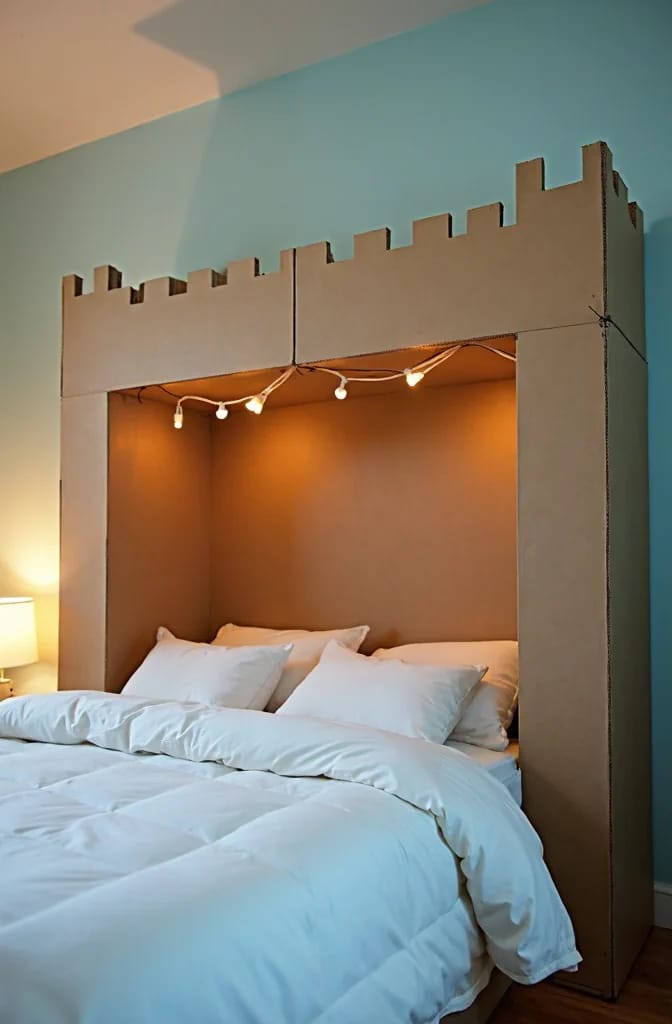
Mount the castle on the wall and you give up nothing on the floor. A ring of panels around the head of the bed, standing 12 to 18 inches proud of the wall, puts the bed inside the castle and leaves the rest of the room exactly as it was. A crenellated silhouette cut from a single wardrobe box does the same job at almost zero depth, and removable adhesive strips hold a light panel without touching the paint.
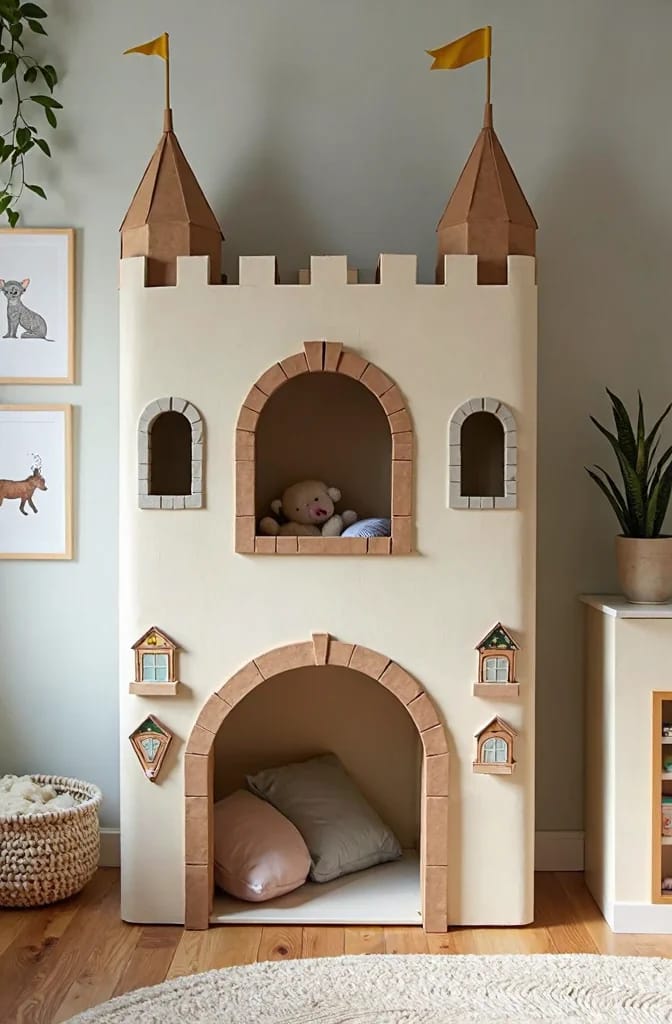
Paint the wall behind it rather than the cardboard. Flat kraft board casts real shadows against a painted surface, and the wall can be the sky, a forest, or a colour the child picked themselves. Some of the painted wall treatments worth copying go up in an afternoon with a roll of masking tape and a tester pot.
6. Turn the under-bunk gap into the castle footprint
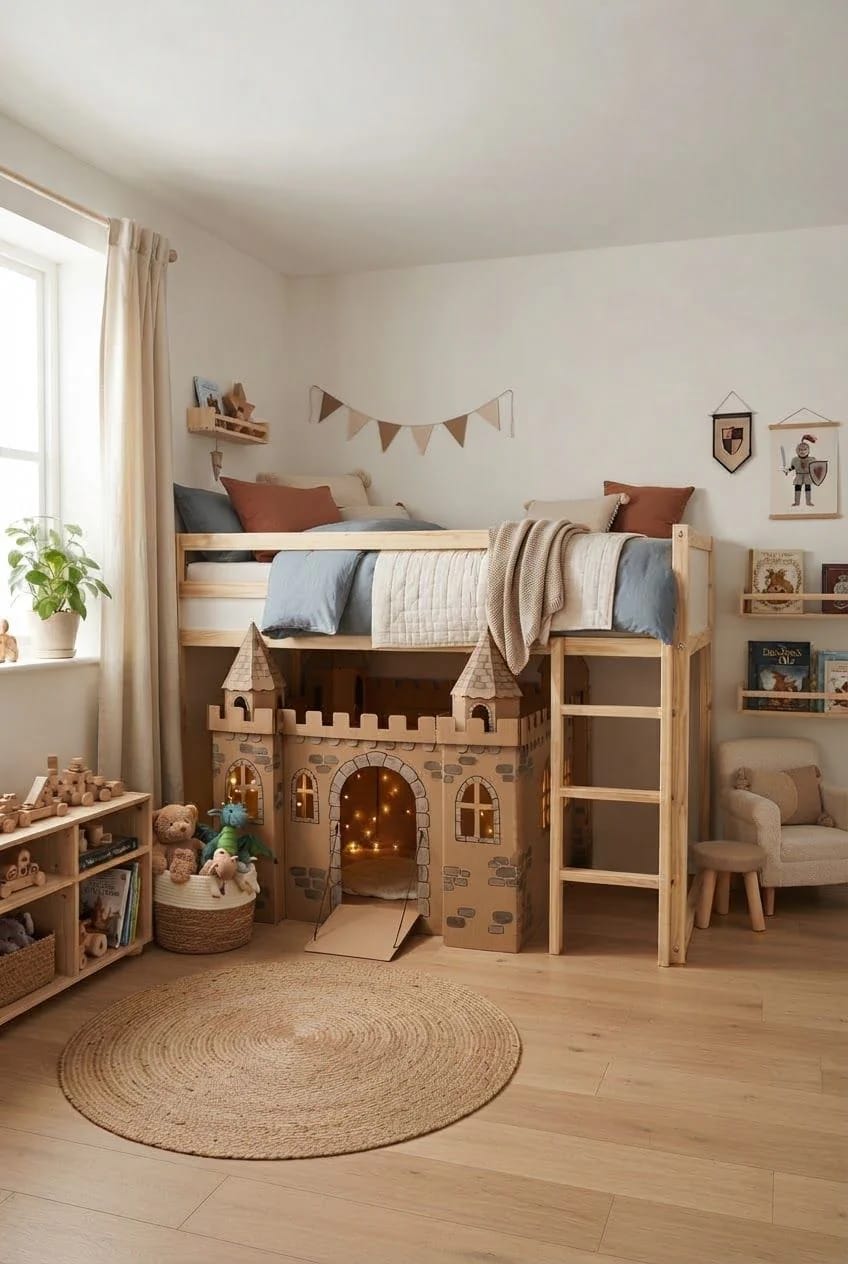
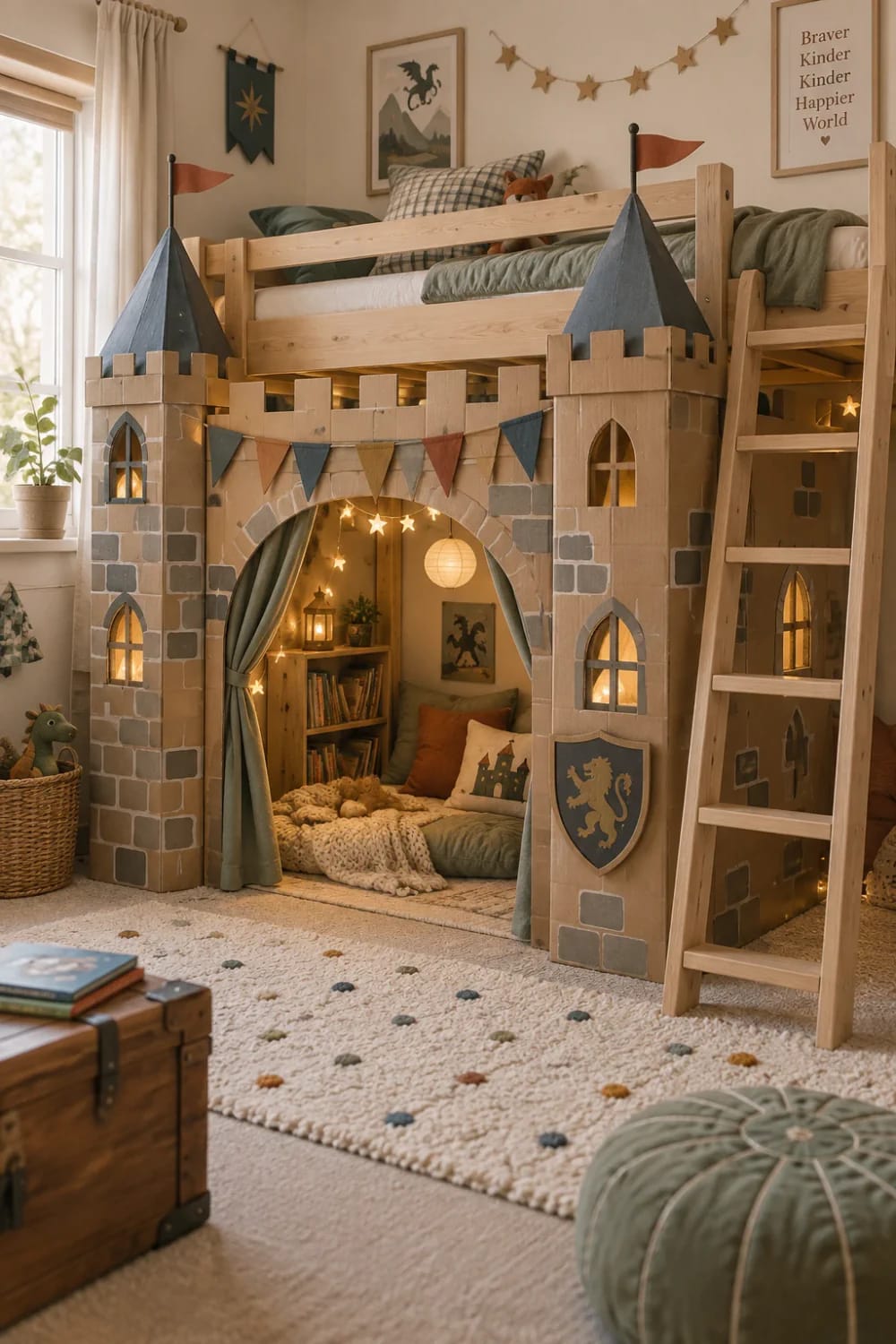
A mid-sleeper bunk hands you roughly 30 inches of height nobody uses and a footprint you already pay for, and that gap is the best castle site in the house. Measure the clearance from the floor to the underside of the bed frame before you cut anything, keep the ladder approach clear, and build the walls to that number exactly; a castle wedged under the frame needs no roof at all, because the bed base is the roof.
Leave the mattress support alone, and fix the light to the underside of the frame rather than inside the walls, where it will be knocked loose. The same thinking applies to the rest of the room, and the space-saving moves that work in a small bedroom are worth a look before you buy another storage box to sit inside the castle.
Size it before you cut: the numbers your room gives you
Wall height follows your child rather than a plan, and the panel you need follows the wall. Set the three numbers below and the arithmetic does itself.
Cardboard castle sizer
Set your child’s height, the wall you have, and the boxes in the garage.
Cut the walls to
Towers want
Panel you need
Boxes that means
Floor it claims
Estimates only, rounded. Assumes one medium moving box gives up about 16 square feet of usable panel, walls cut from a single layer, and both walls the same length. Add one spare box for the tower and for mistakes.
The details that make cardboard read as stone
7. Battlements that survive being leaned on
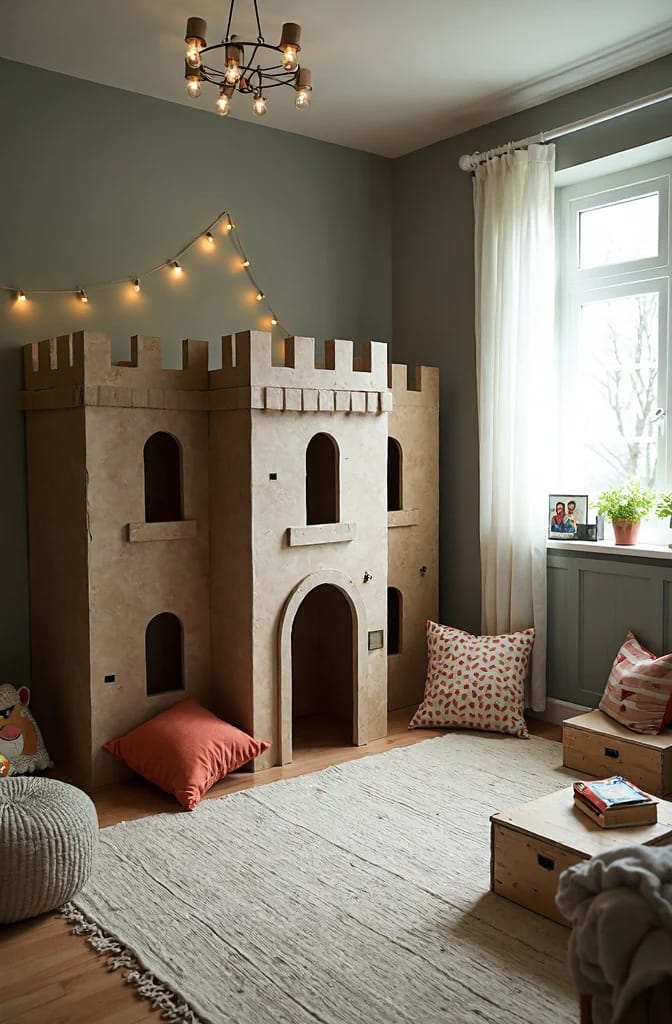
Cut your merlons four inches wide with four-inch gaps, and leave a solid band two inches deep under the notches. That band is what stops the battlements tearing off the first time a child hangs on the top edge. Line the flutes up so they run vertically as well: corrugation is a stack of tiny arches, and arches standing on end carry a lean while the same board laid sideways folds, which is why every box you have ever received was built with its flutes running up the sides.
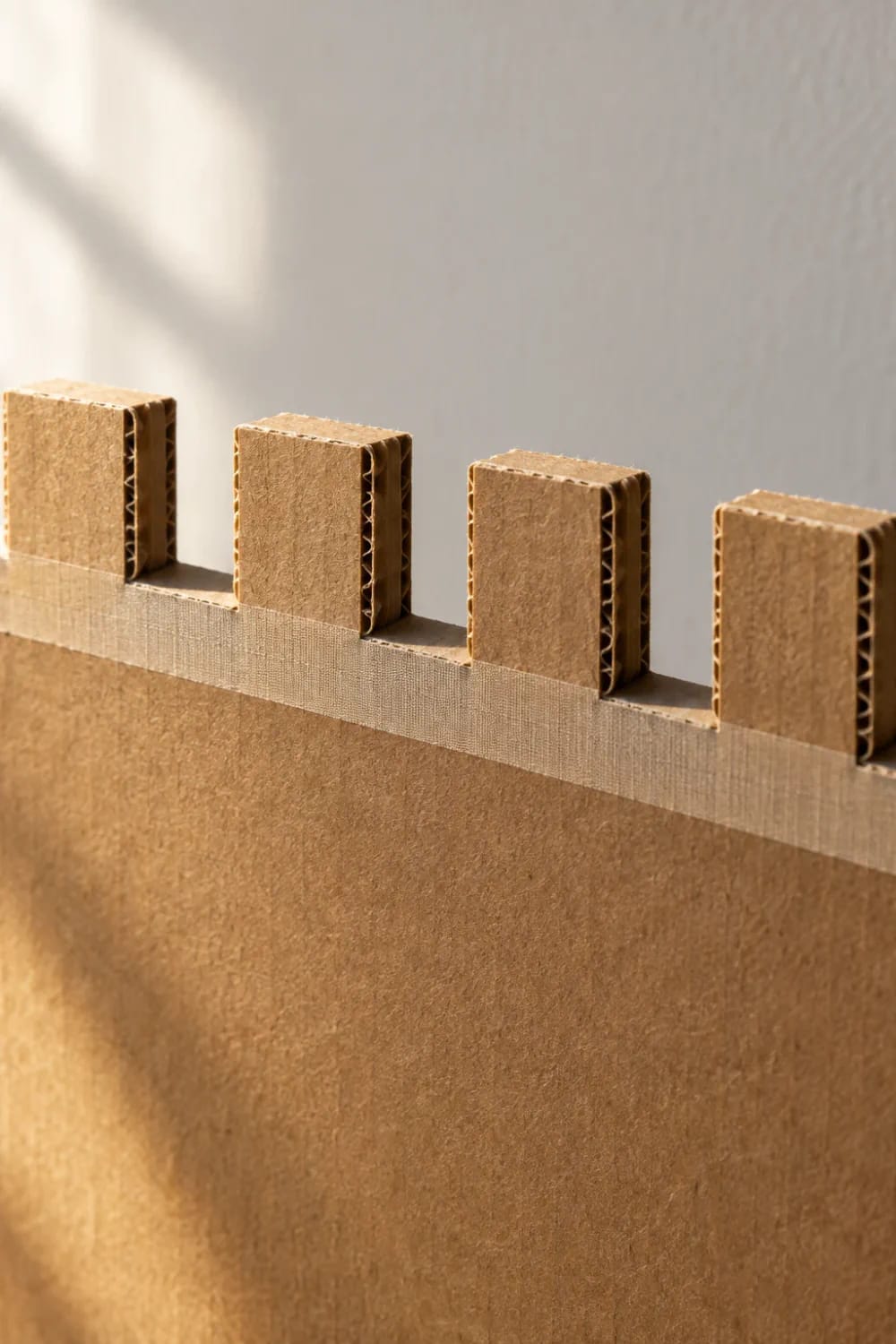
Where a notch cuts across the flutes, back the inside face with a strip of tape or a length of dowel fixed under the top edge. A dull blade crushes the flutes and starts a tear that grows every time the castle gets moved; a fresh blade and a straightedge make a cut nobody notices.
8. Torn masking tape is the whole stonework trick
Torn masking tape looks wrong right up until the paint goes on. Tear the tape into strips of uneven length, lay them across the wall at odd angles with the torn edges showing, press them down hard, then paint the lot with a thin grey coat and drag a nearly dry brush over the surface so paint only catches the raised edges. The torn ridge lines read as mortar joints, and the flutes of the corrugation give you a second set of lines for free.
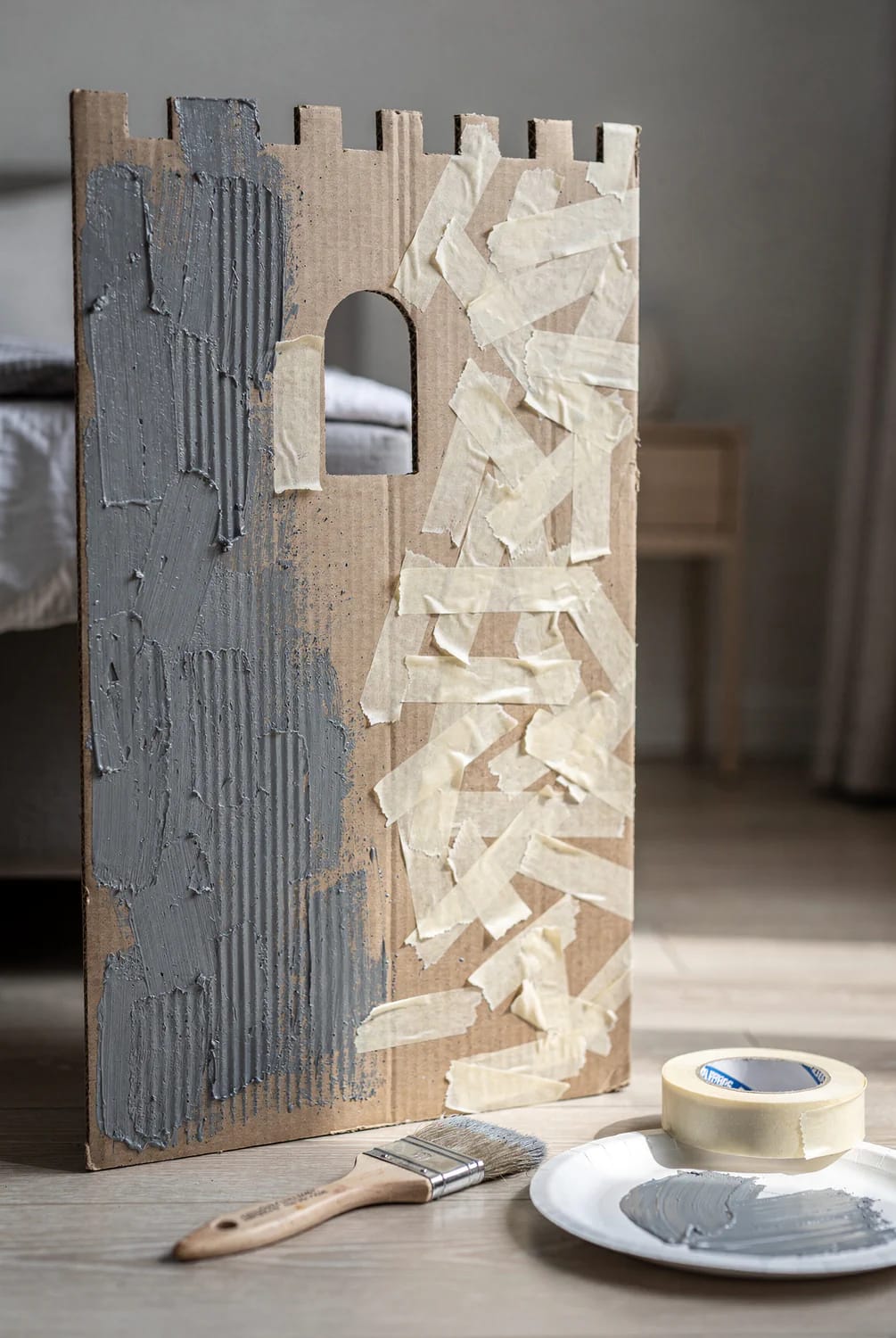
The catch is that smooth tape edges look like tape. Every strip has to be torn, none of them parallel, and the overlaps staggered so no two joints line up across a wall. Children can do the taping and the dry brushing; it is close to impossible to get wrong, and a six year old's version is nearly always better than an adult's because they stop sooner.
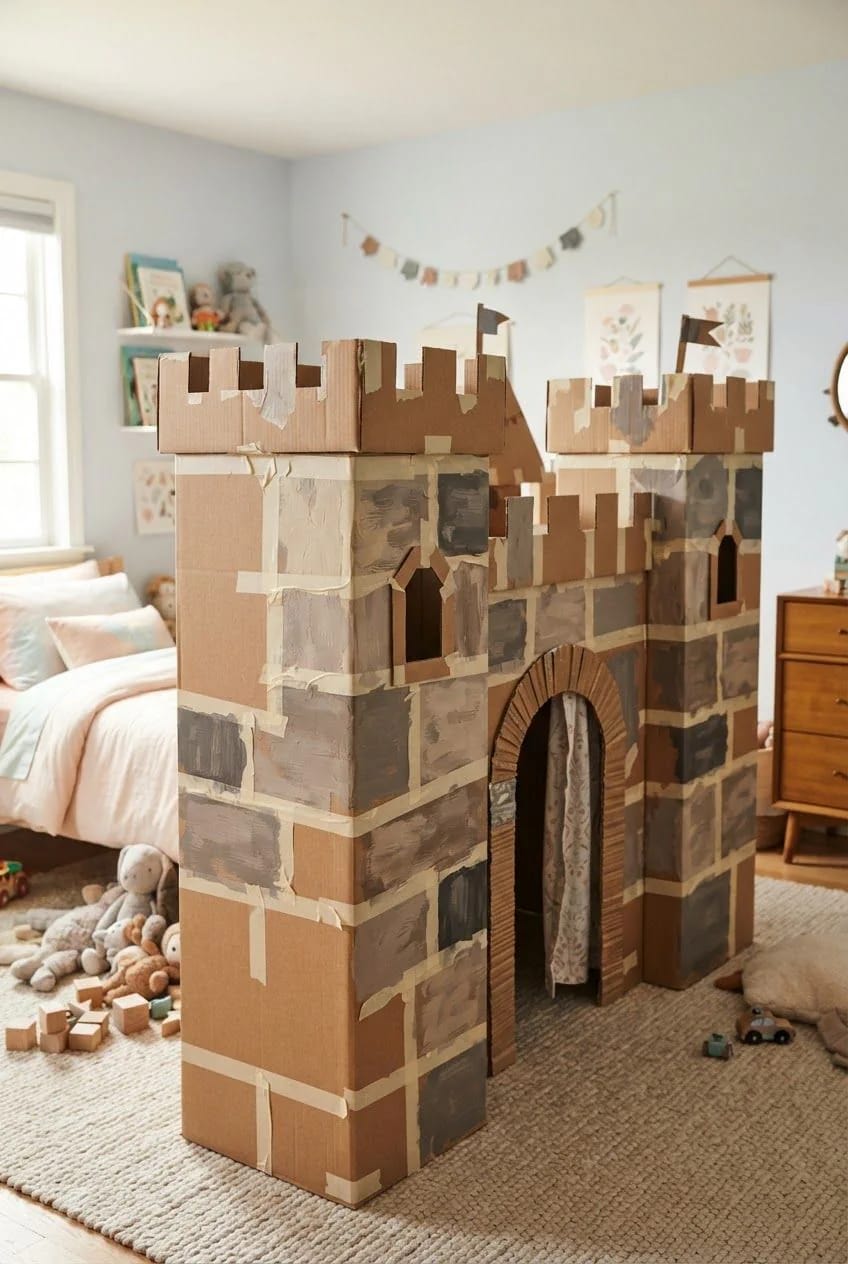
Hand over the colour once the base coat is dry. Solid tempera paint sticks let a child add banners, moss, and a door number with no brush, no water, and no drying rack:
Kwik Stix solid tempera paint sticks, 12 classic colours 12 Recycled Crafts for Kids That Earn a Real “Whoa” on Earth Day A dozen more box-and-junk builds sorted for the adult running the table, including the ones that need exactly one careful grown-up step.
9. A drawbridge on string and a portcullis that slides
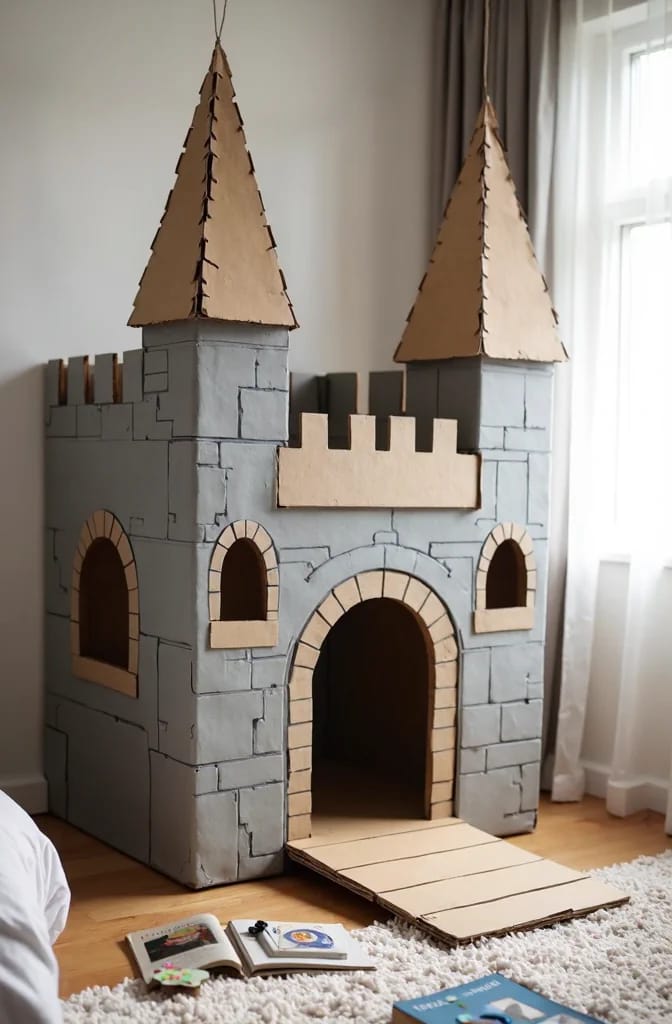
A drawbridge needs a hinge along its bottom edge and something to pull it up. Everything else is decoration. Cloth tape makes a passable hinge for a light flap, but a door a child will sit on wants a real hinge or a strip of leather, because a tape hinge on a heavy flap sags and never closes flat again.
Hinge: cloth tape on both faces for a flap under about a pound and a half, or a piano hinge fixed to a thin wood batten for anything heavier.
Run: one brass eye hook at each upper corner of the doorway, with waxed cord threaded through both, so the cord pulls the door up instead of sideways.
Lock: a dowel through two holes above the door as a windlass, pinned with a nail, so the bridge stays up without a knot a child cannot reach.
The portcullis is easier than it looks because it never has to hinge. Two vertical strips taped three quarters of an inch apart make a groove down each side of the doorway, a grid of cardboard slats slides between them, and a dowel across the top three slats gives small hands something to grip.
10. Light the tower from inside, not above
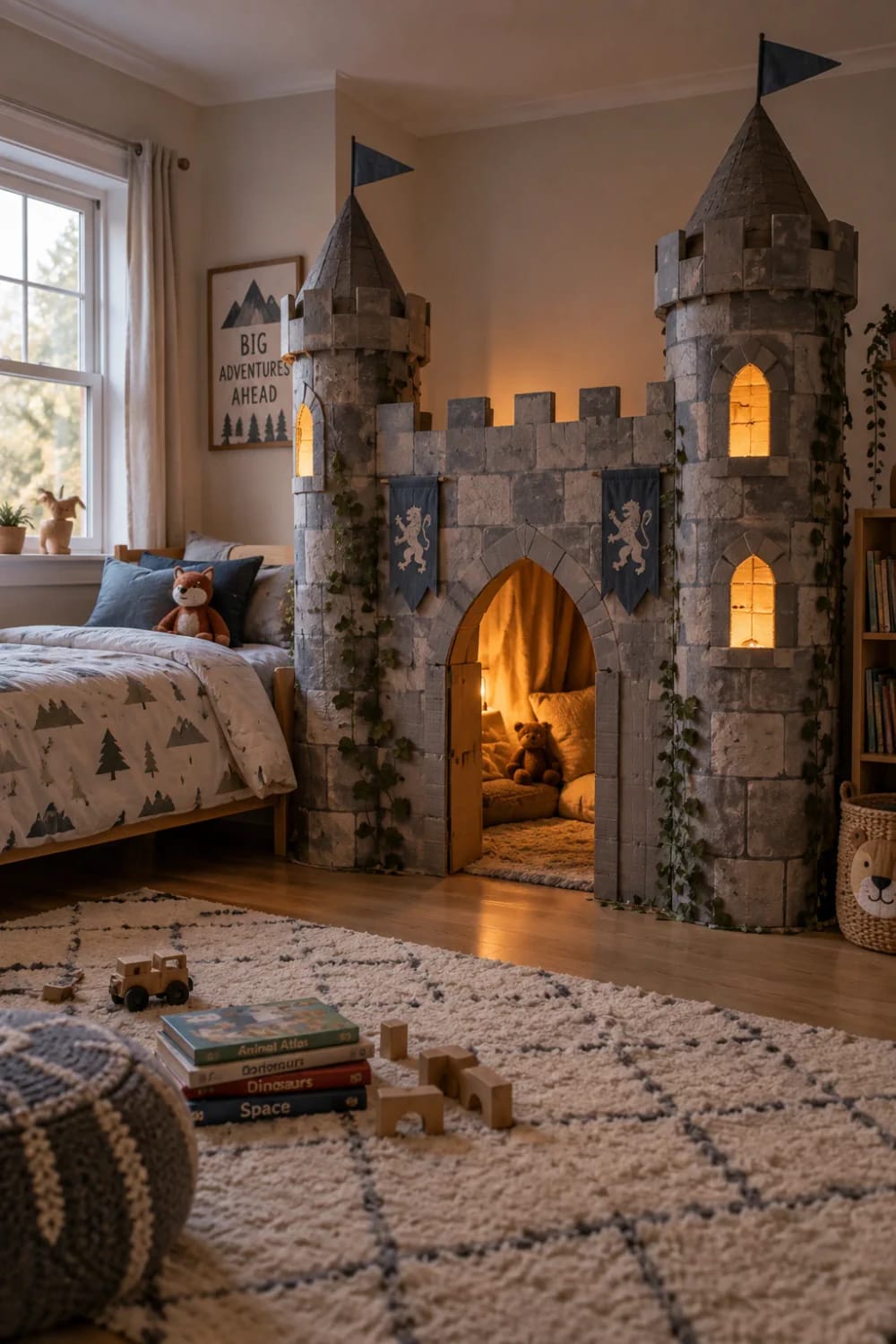
Put the light inside the turret and let it spill out of a window rather than lighting the room from above. A short string of battery LEDs taped under the top inside edge reads as firelight through arrow loops, and the battery pack belongs outside the wall, clipped where you can reach it without crawling in.
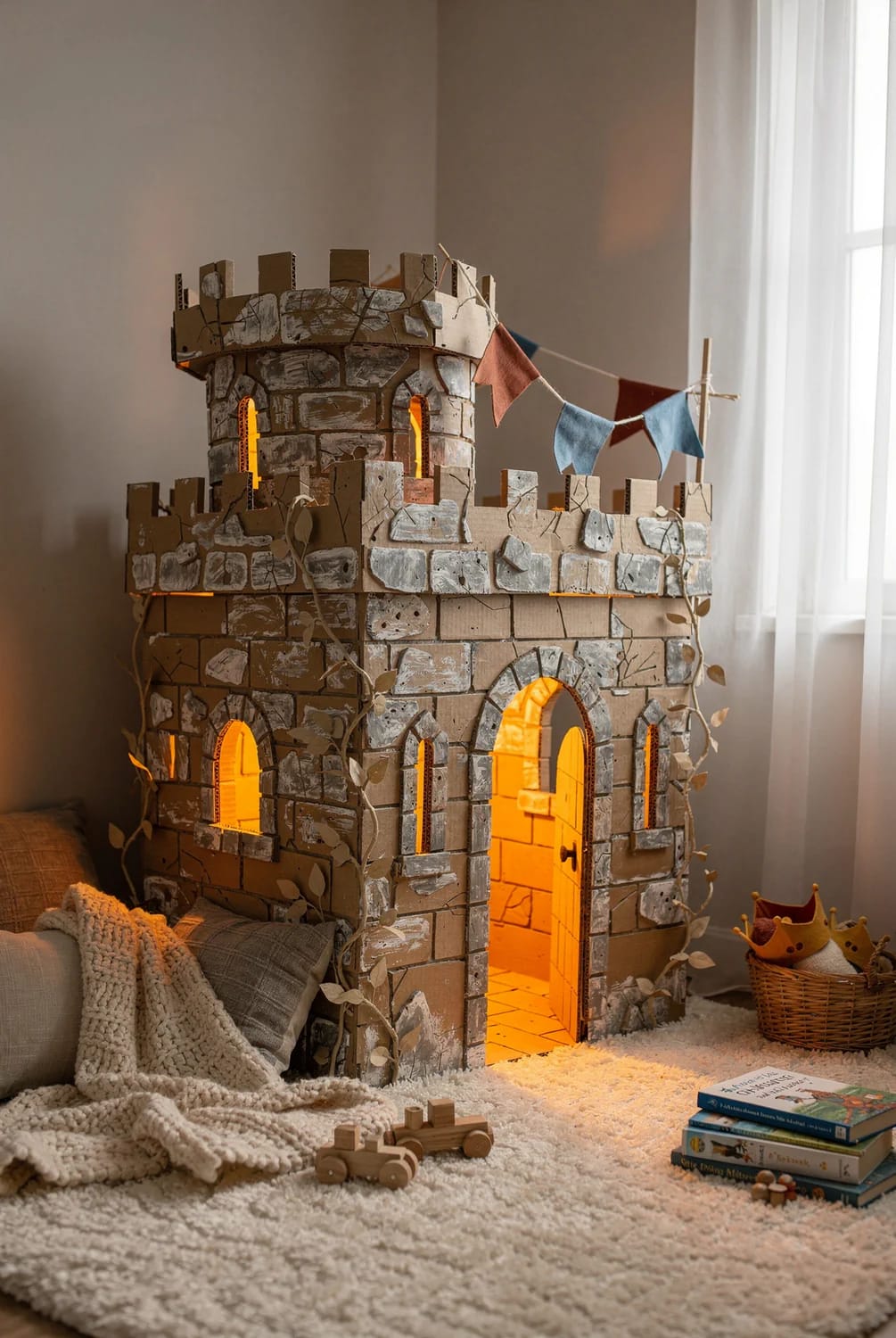
Low voltage LEDs run cool and are the only light that belongs inside a cardboard castle. Keep the structure clear of radiators, space heaters, and bedside lamps with hot shades, and never run a mains cable inside a wall panel. Battery packs go outside the wall and never under bedding, so the castle can be switched off from the room.
Warm white rather than multicolour, and one string per tower is plenty. I would rather see two arrow loops glowing than a whole facade lit evenly, which just makes the castle look like a shop display.
A 12 pack of coin-cell strings covers a tower, a doorway, and the gap under a bed, and the pack said roughly 70 hours of light per string, which is a few weeks of bedtime use.
Brightown 12 pack battery LED fairy lights, warm white silver wireCastles that survive a shared bedroom and a moving van
11. A castle whose dungeon bins the toys
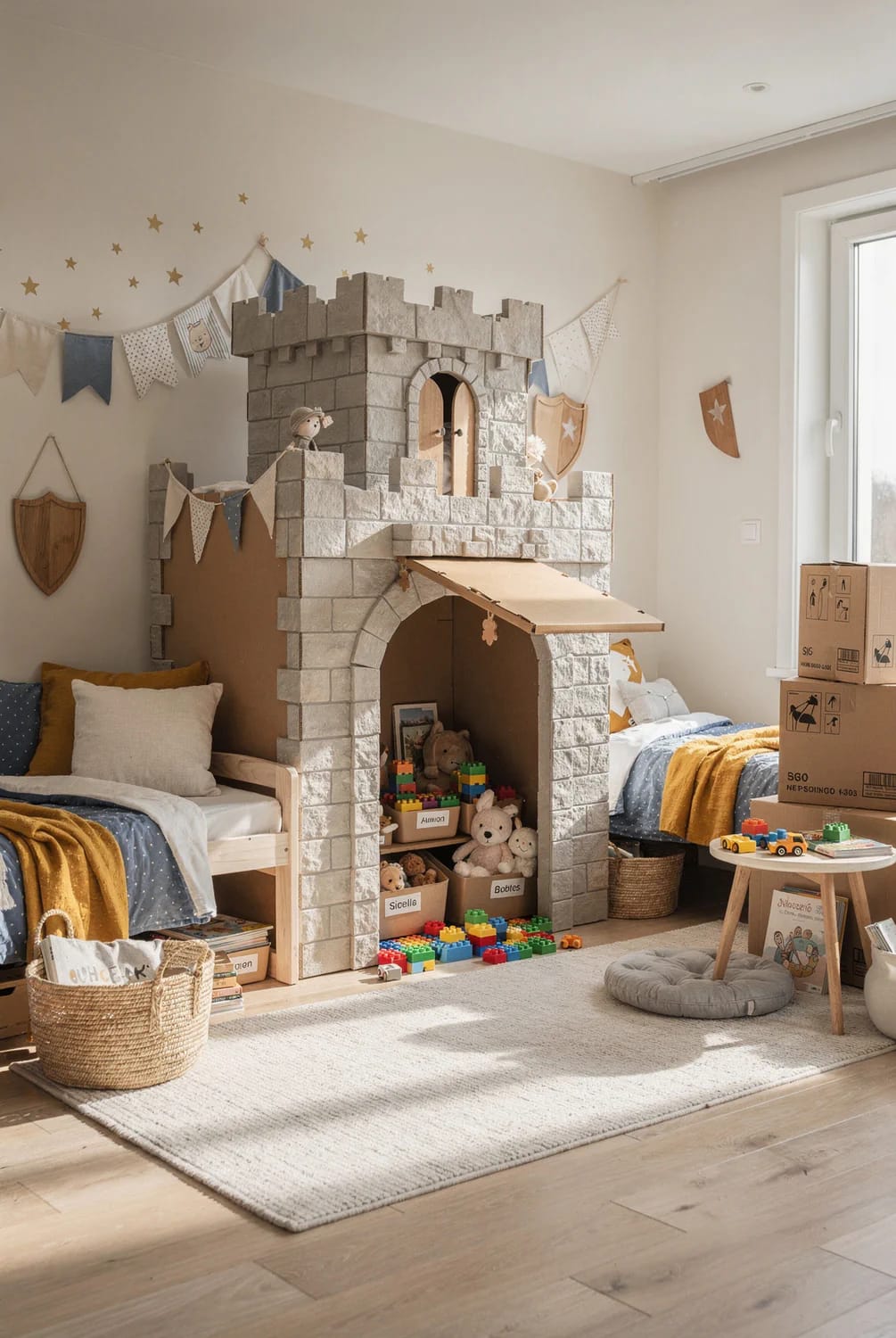
Build the bottom course as storage and the castle pays rent on the floor it occupies. The two lower walls become open bins with a low hatch cut at floor level so toys get pushed in rather than carried in, and the top course stays light: paper, dress-up fabric, soft animals. Keep anything heavy below shoulder height, because stacked boxes lose their shape fast once a bin is full of wooden blocks.
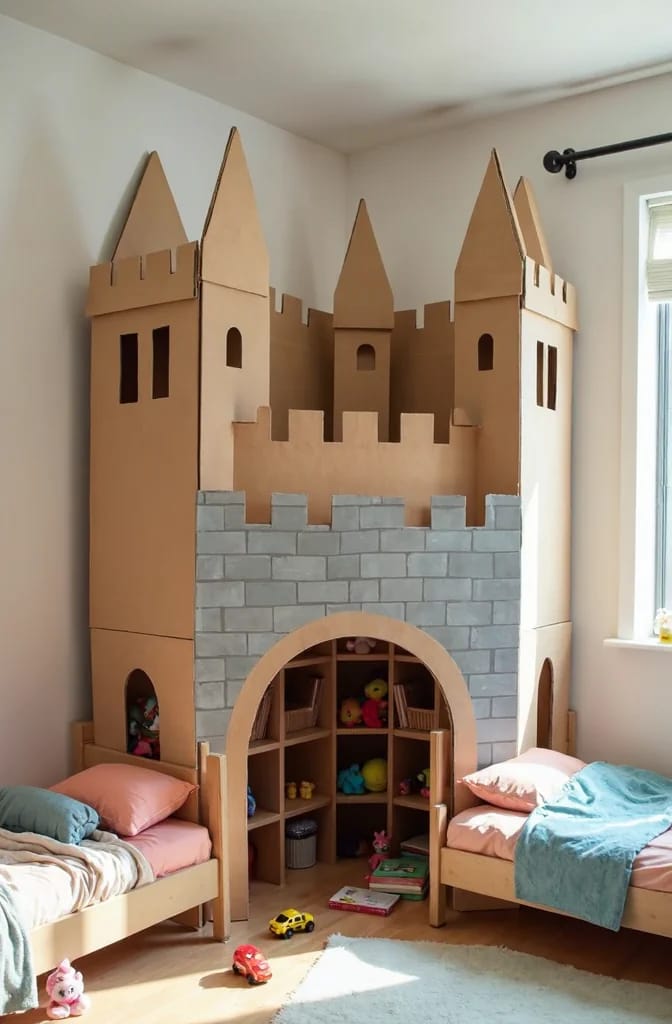
Granted, this only works if the bins stay shallow. A 12 inch hatch is a bin; anything much deeper becomes a place where things disappear, and a castle whose back wall is a hoarding zone gets emptied by a parent twice a year.
12. Two half-keeps for two children in one bedroom
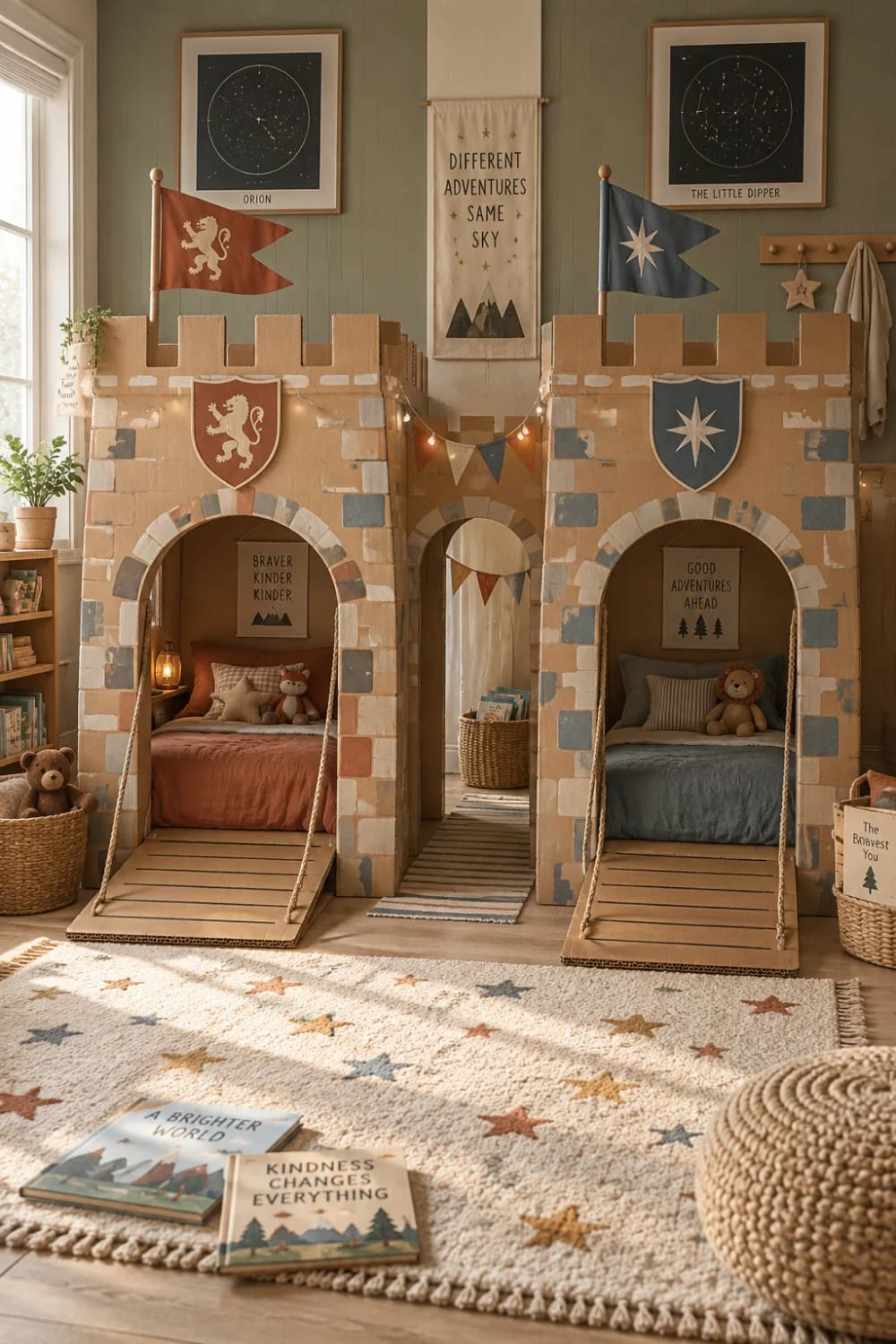
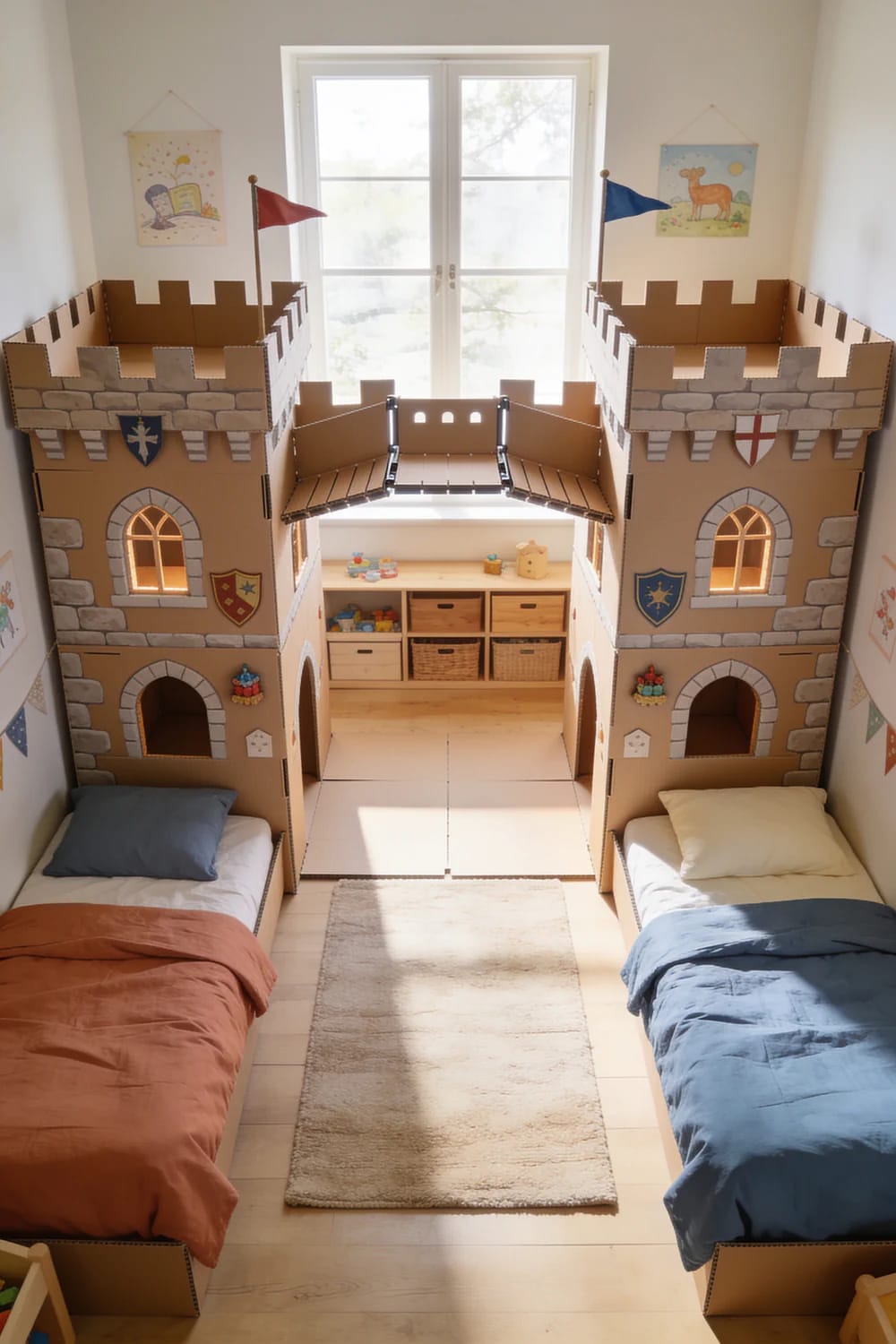
Two children, two castles: split the boxes into two half-keeps and face the gate walls toward each other across a gap, so the drawbridge at the boundary belongs to both. Put the shared wall on the room's midline and hinge a gate on each side of it, and the negotiation usually sorts itself out in a fortnight.
Uneven boxes are an advantage here. The child with the tall tower gets the small footprint, and the child with the wide wall gets the window and the shelf.
13. The no-build route: printed patterns and pop-up playhouses
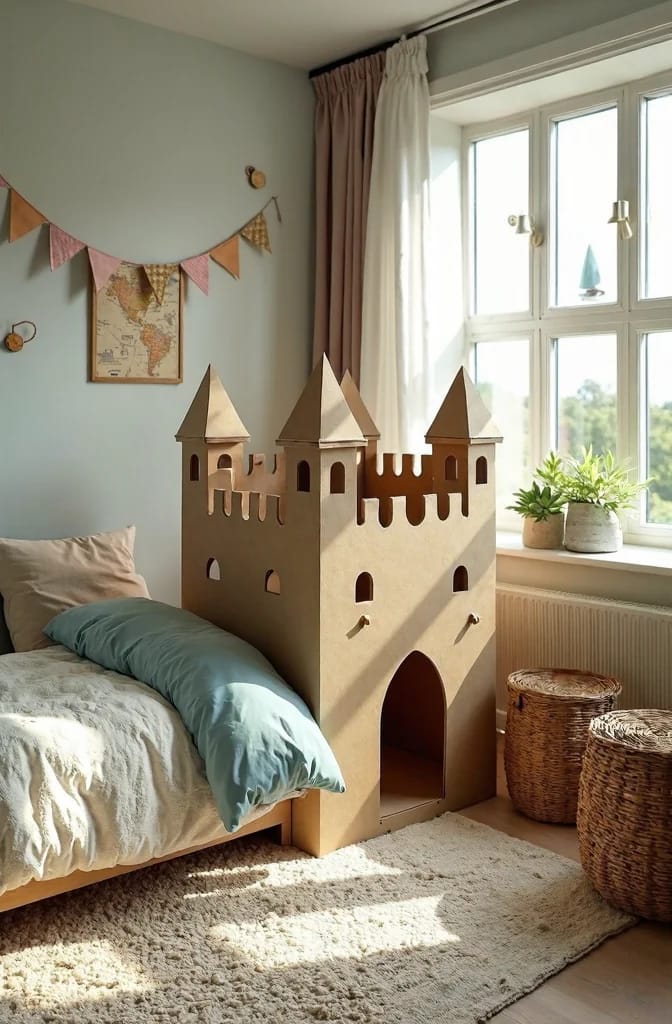
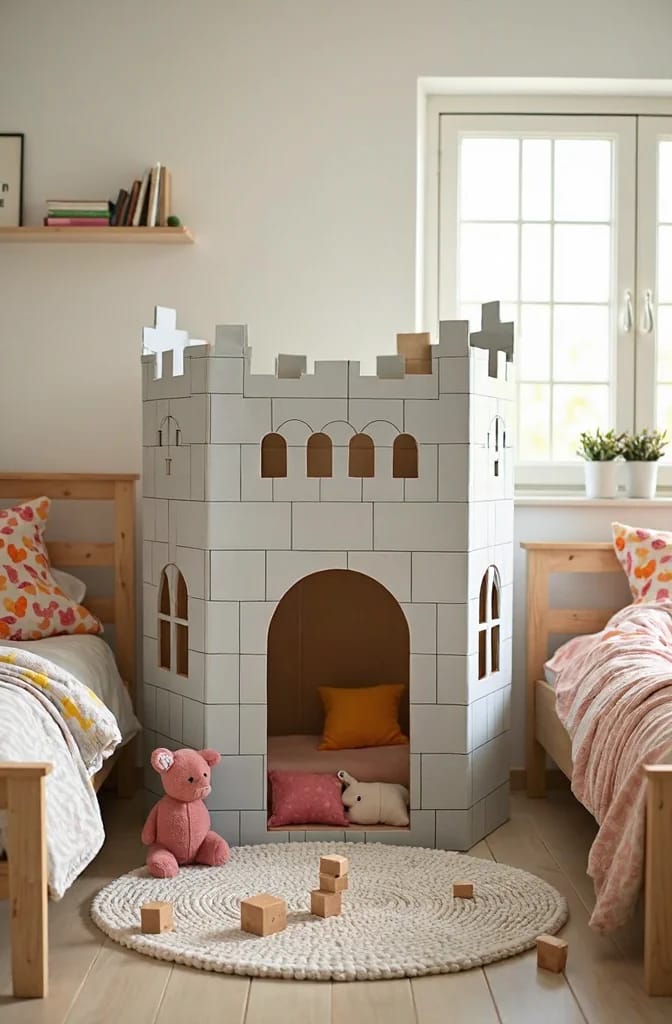
There is no shame in starting from somebody else's pattern. Printable castle plans sold as PDFs come with cut lists and fold lines, flat-pack corrugated playhouses arrive folded and stand up in ten minutes, and a fabric castle canopy over the bed does the whole job for a child who wants the look rather than the build. The route you pick should follow the child, not your own patience.
If you already like working from a pattern at small scale, the popsicle stick cottage build is the same idea in miniature, and its finishing technique transfers directly to a full size cardboard tower.
| Route | What it costs | Time | Floor space | What it survives |
|---|---|---|---|---|
| Boxes you already have | $10 to $25 in tape and a blade | An afternoon | The corner it stands in | Being rebuilt, if you screw rather than glue |
| Printed pattern or flat-pack playhouse | $40 to $120 | 30 to 90 minutes | The footprint of the panel set | Folding away and coming back out |
| Fabric canopy over the bed | $60 to $200 | 20 minutes | None | Washing, siblings, and a house move |
 Cardboard recycling for cash (and making MONEY in 2023) What actually happens to bales of cardboard once they leave the kerb, and when a stack of it is worth a trip to a buyer instead.
Plan the day it comes apart
Whatever you build, join it so it can be undone: screws rather than glue, cloth tape rather than construction adhesive, and the eye hooks, cord, and dowel from the drawbridge pulled off before the panels go out. A folded castle takes up about four inches behind a wardrobe and comes back out when interest returns, which for most children it does. The hardware goes in a jar with the screws, because it will be the only part worth keeping for the next one.
Related Posts
- 14 Super Cute Tiny Farmhouse Ideas
- 23 Creative Garden Art DIY Ideas for a Unique Outdoor Decor
- 33 Colorful DIY Wall Murals for a Playful Home Makeover
- 15 Wooden DIY Wedding Decor Ideas for a Unique Celebration
- 15 Inspiring Upcycled Garden Decor for Small Backyards
- 15 Inspiring Craft Room Ideas to Elevate Your Creative Space