
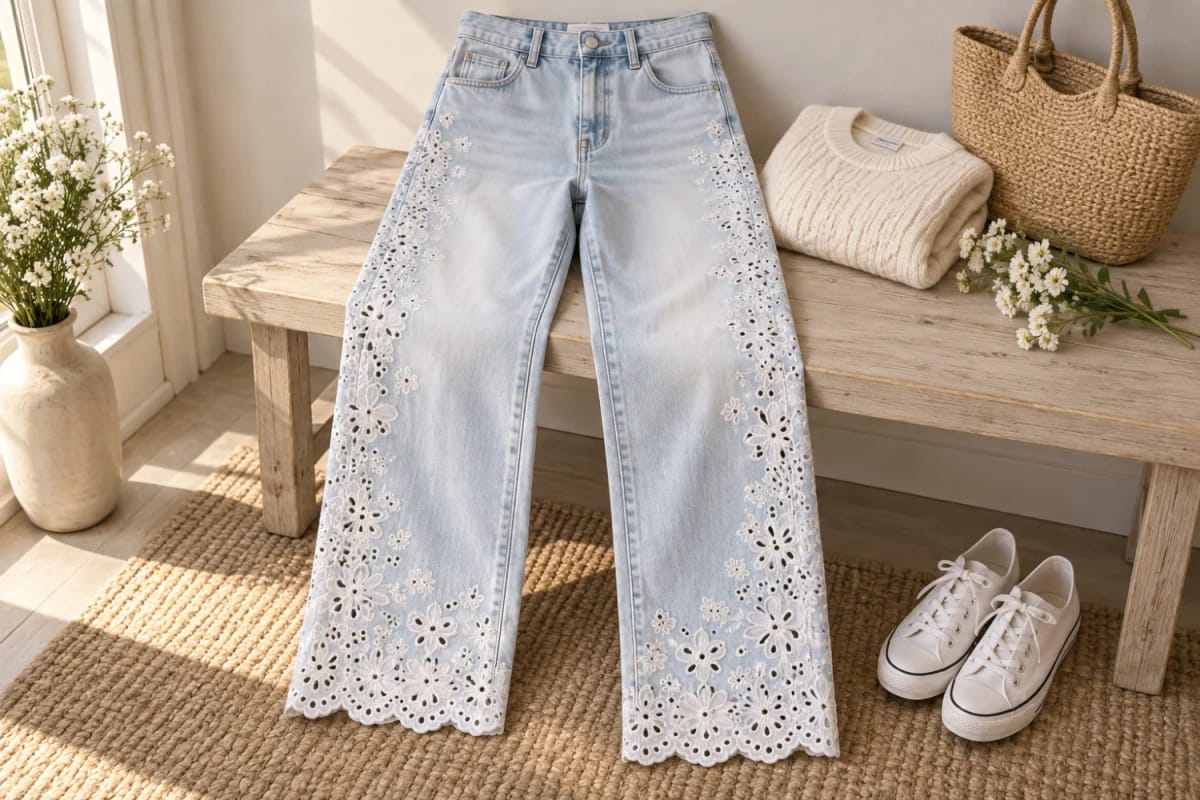
Denim is the wrong fabric for broderie anglaise. Real eyelet work belongs on cotton lawn, a fine plain weave that turns under a needle and holds a rolled edge the width of a thread, while a pair of jeans is 11 to 14 oz twill with tension running through every seam, which is why a cut hole in a thigh grows a little every time you sit down. So most of the eleven ideas below do not embroider the denim at all: they set real broderie anglaise cotton into it at seams, hems and pocket edges that are already reinforced. Two of them do put worked holes straight into the twill, in the places on a jean that barely move, and one of those uses no blade at all.

Panels Set Into the Seams
These two work because a seam is already carrying the load, so the eyelet cotton is infill and the denim keeps doing the job it was woven for.
1. An Outseam Insertion Strip That Buys Two Inches of Room
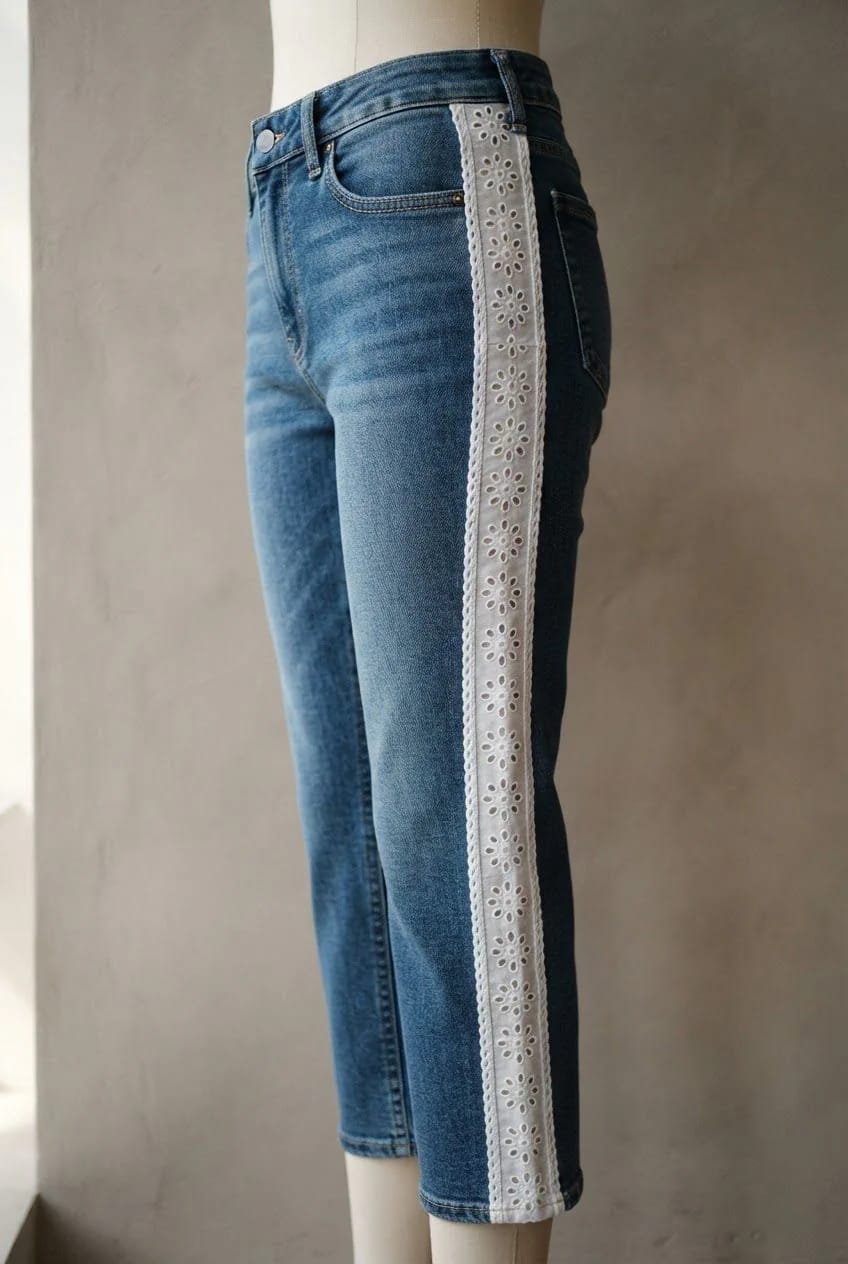
Open the side seam from hem to hip and set a strip of eyelet cotton into the gap. A strip that finishes two inches wide adds two inches to the circumference of that leg, which is the whole difference between a straight leg you can sit down in and one that has been folded at the back of a drawer since last spring. Cut it at 2 3/4 inches to allow 3/8 inch seams. Check which seam you are opening first, though: the one doubled over with two rows of gold topstitching is flat-felled and structural, and on most five-pocket jeans that is the inseam. The outseam is usually the plain overlocked one, and that is the one to cut.
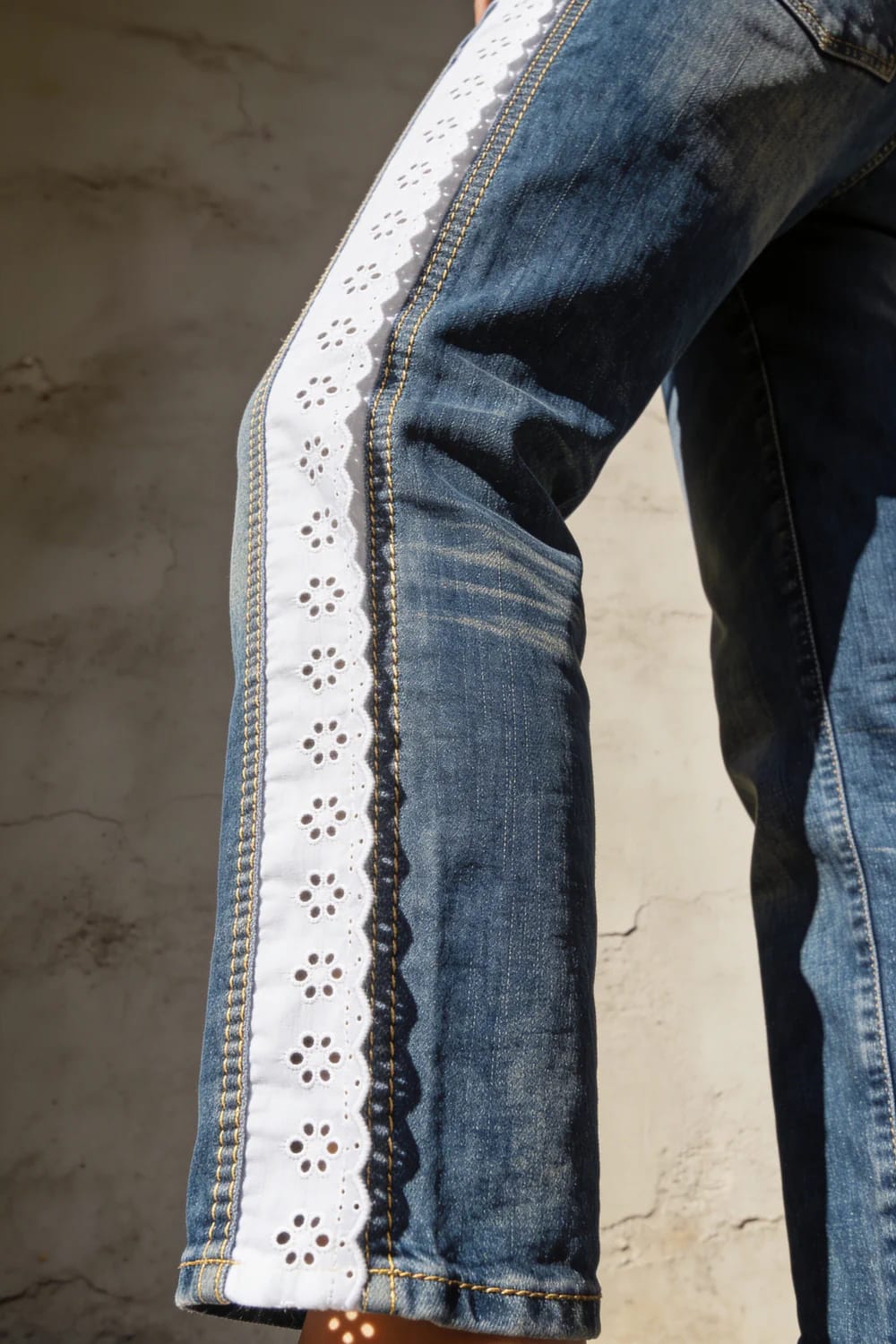
Here is the part that gets skipped. Press both denim allowances toward the denim and topstitch them down flat, so the seam still holds and the eyelet panel carries nothing. Cotton lawn at roughly 3 oz against 12 oz twill loses that argument every single time. A yard of white broderie anglaise cotton eyelet fabric, about 52 inches wide does both legs with enough left for the pocket facings further down.
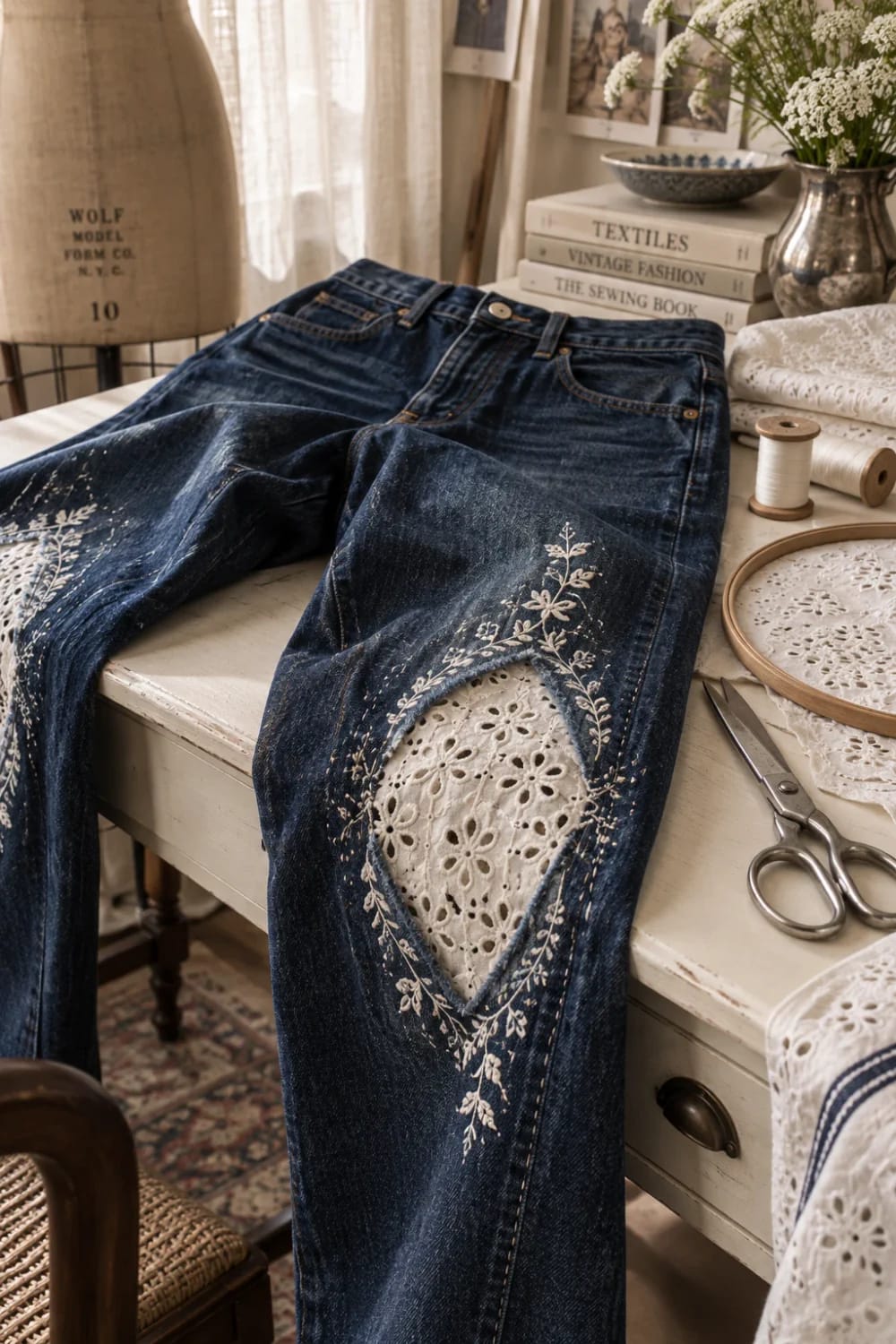
2. A Reverse-Appliqué Window Over a Knee That Has Gone Thin
Put the eyelet behind the denim and cut the denim away, not the other way round. A thinning knee is the one spot on a jean where you want a second layer anyway, so back the whole area with a patch of eyelet cotton on the inside, stitch your motif outline twice from the right side, then cut only the top layer of twill inside the stitching with curved embroidery scissors, leaving an eighth of an inch inside the line.
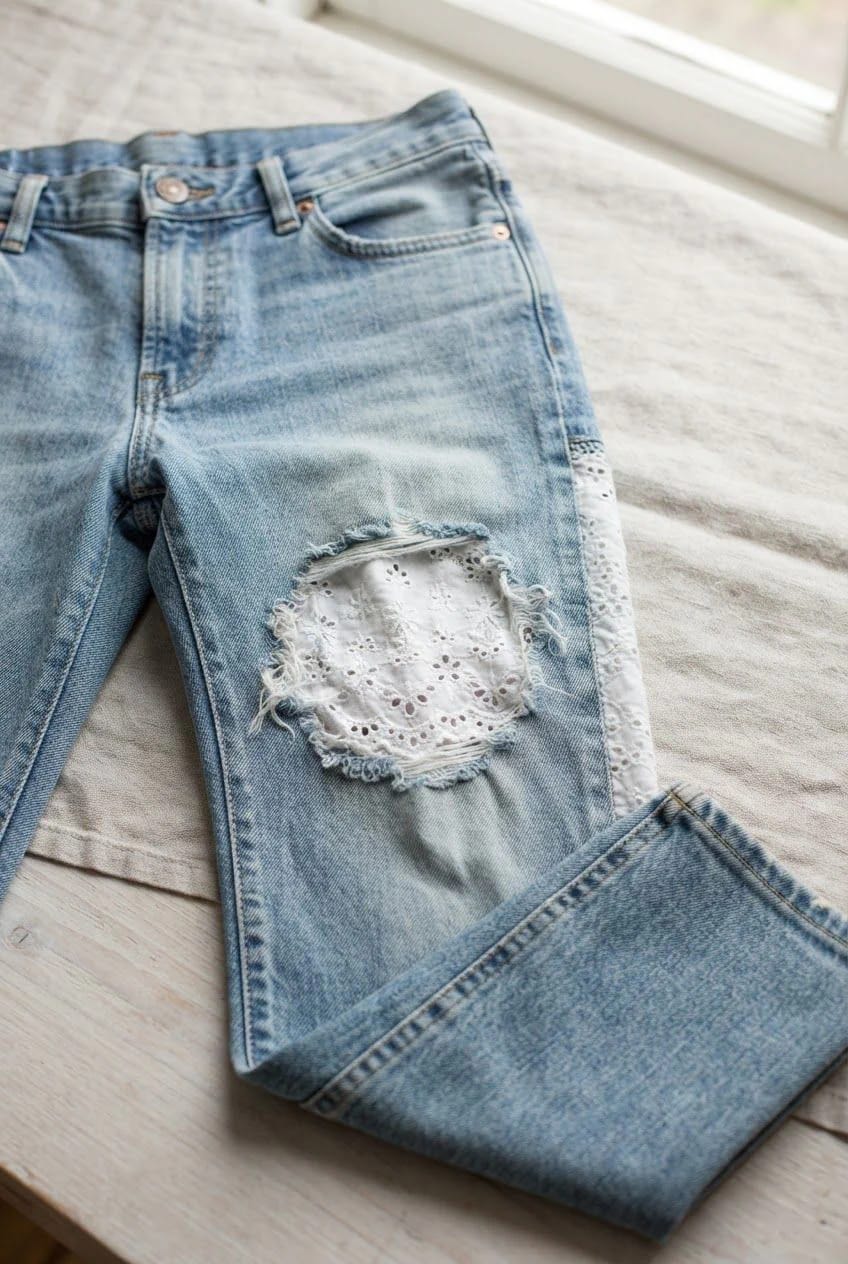
What you end up with is a knee stronger than it was, showing white cotton through the windows instead of skin. A purist will tell you this is not broderie anglaise, since nothing has been pierced and overcast by hand, and they are right; it will also outlast the honest version by years. If the knee has already split, this is not your fix, because those cut edges need an eighth of an inch of sound twill to sit in and a frayed hole does not have it. Patch it from behind first and put the windows higher up the thigh, or go the other route entirely with a boro patch that stacks remnants over the same worn knee and cuts nothing at all.
 Butterfly Embroidery Jeans: Ideas Worth Stitching Onto Denim You Already Own Eleven motif placements that follow the pocket edges, outseams and hems a pair of jeans already has.
Pockets, Yokes and the Flat Parts of a Jean
Small, flat, and fenced in by seams that already exist: that is the test for where cutwork can go. North America sells the fabric as eyelet and Europe calls it broderie anglaise, and both names describe holes punched through cotton with their edges overcast. The technique grew up on lightweight cloth because that is what it needs, and a pocket does not change the physics. A pocket just does not pull.
3. A Scalloped Overlay on the Back Pockets, Original Topstitching Left Showing
Lay the trim over the pocket instead of replacing the pocket. Cut a length of scalloped eyelet to the pocket's width, align the scalloped edge with the V at the bottom, and run your stitching directly on top of the pocket's existing side seams so the new line hides inside the old one. Leave the double arc of gold topstitching along the pocket's top edge completely uncovered, and stop short of the bar tacks at the corners.
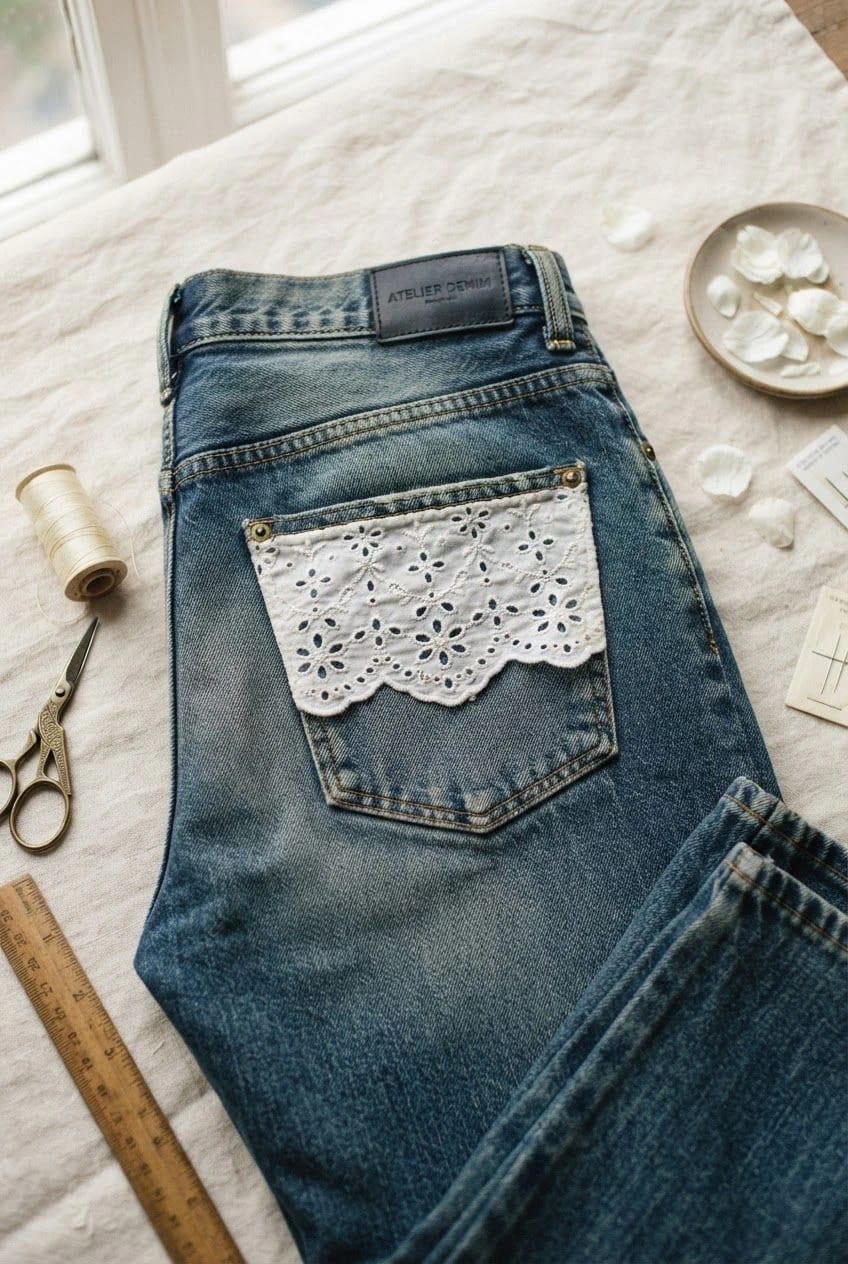
Accept what this costs you: the pocket is now decorative. Anything you push into it catches the eyelet from behind, and a snagged buttonhole stitch unzips along the row.
4. Eyelet Pocket Facings That Show When the Front Pocket Gapes
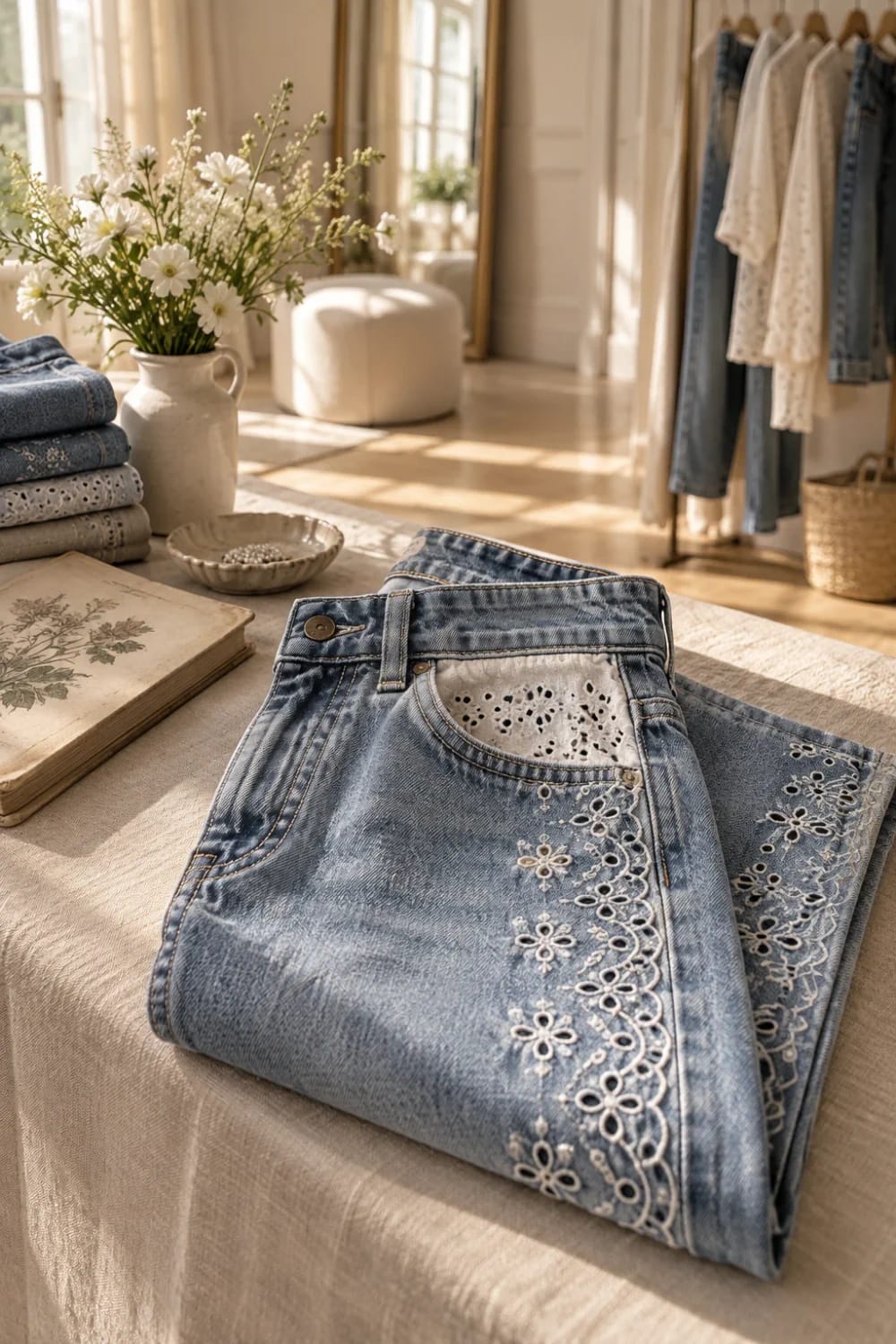
Replace the top three inches of the pocket bag, not the whole bag. Eyelet cotton makes a genuinely bad pocket: it is light, the holes catch keys, and one snagged thread takes a row of scallops with it. So cut the pocketing three inches down, seam the eyelet in across the mouth, and what shows when the pocket gapes is broderie anglaise while what holds your phone is still pocketing twill. It is the same instinct behind treating the pockets and gold topstitching as the parts of a dead pair worth designing around, rather than treating denim as blue fabric.
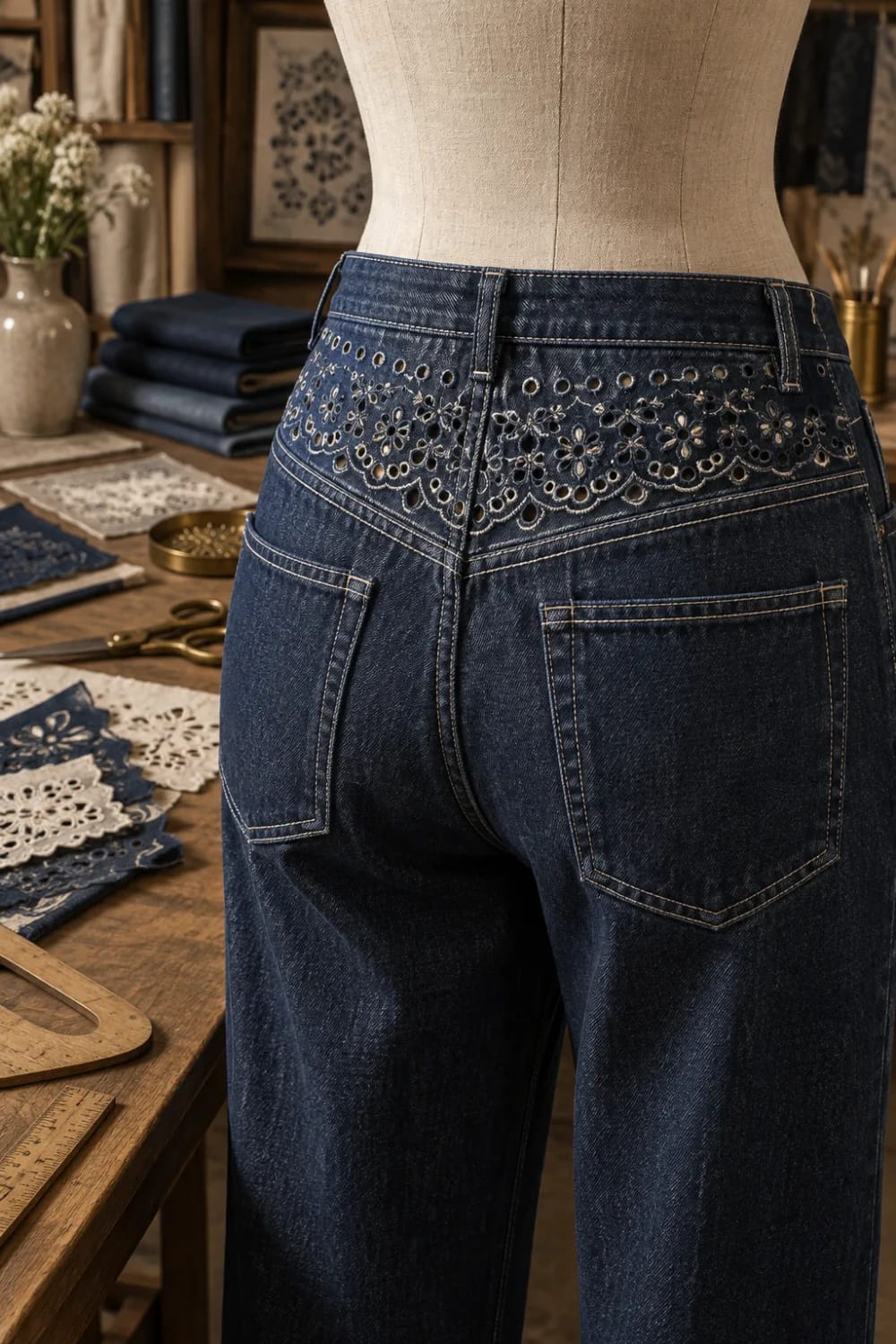
5. Worked Eyelets on the Back Yoke, the One Panel That Barely Moves
If you want real cut-and-overcast holes in denim, the yoke is where they go. It is the shaped panel between the waistband and the back legs, a short span fenced top and bottom by flat-felled seams, and it flexes less than anything else back there. Keep the whole motif inside a band about an inch and a half deep, size the holes at a quarter inch, and work them in DMC pearl cotton, size 8, in white rather than stranded floss, which goes fuzzy against twill. Five or seven eyelets in a line along the yoke seam read as a trim. A cluster reads as damage.
Hems, Cuffs and Cut-Offs
Every ready-to-wear version of this lives at an edge, and an edge is already two layers of denim plus a fold, so it takes stitching a single layer cannot. Worth noticing what the shops are actually selling, too: the broderie anglaise trousers that filled the summer roundups are cotton poplin cut like trousers, pitched as an alternative to jeans rather than a version of them, and GANNI's broderie anglaise denim piece is a top. Free People's embroidered denim shelf is embroidery on denim, not cutwork in it. I have not found anyone manufacturing eyelet-perforated 12 oz twill, which tells you something about how it would wear.
6. Drop the Hem and Set Scalloped Trim Underneath It
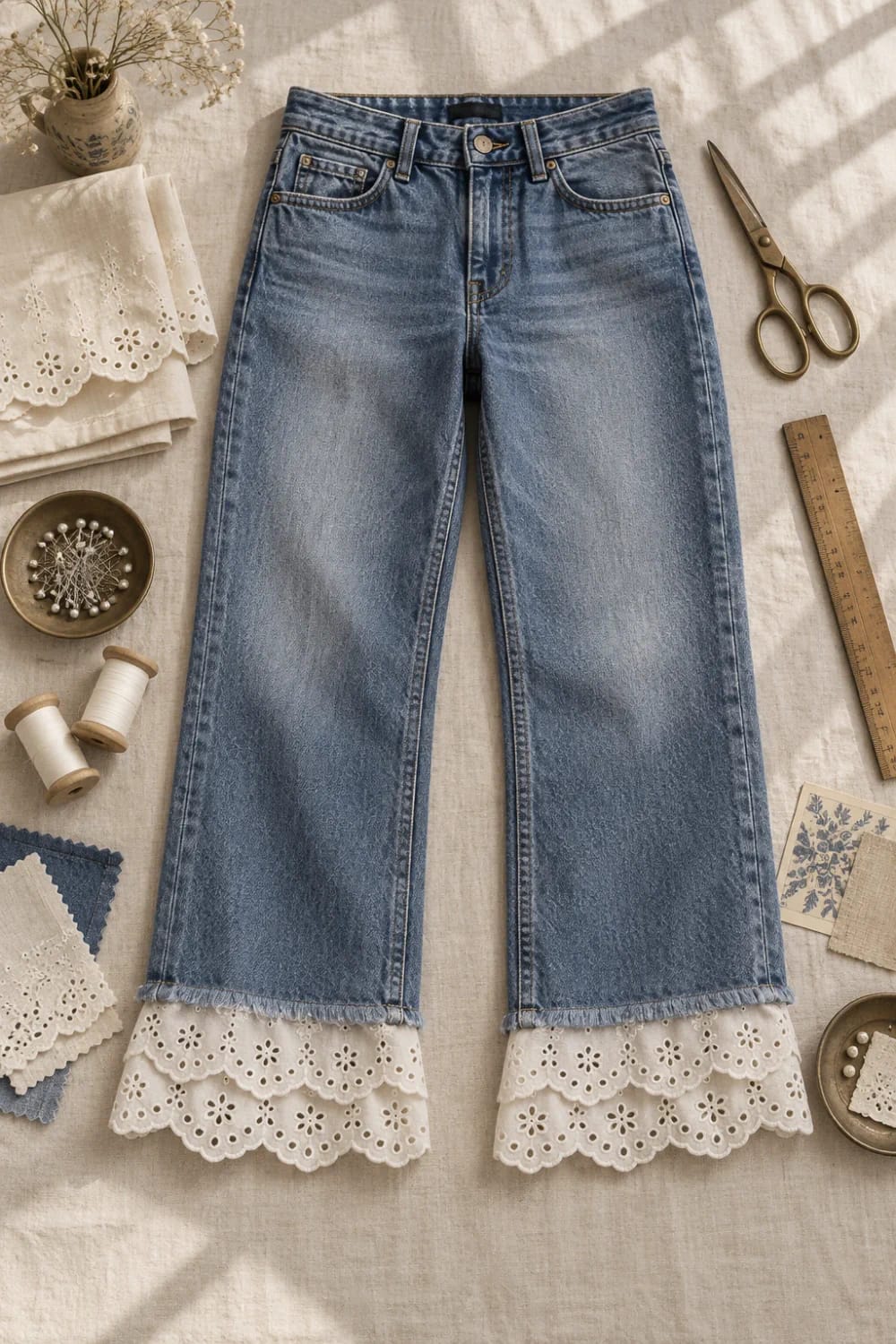
Unpick the original hem, press it flat, and stitch a band of scalloped eyelet behind the raw edge so roughly an inch of white shows below the denim. You gain an inch of length in the process, which is the argument if the pair shrank, and the trim's own scalloped edge means there is nothing left to hem.
The catch is the old crease. On dark denim it never presses out, so you get a pale line an inch above the new edge, and the fix is to put your new stitching directly on that line so it reads as a design decision instead of an accident.
At 2.4 inches deep it sits below the hem crease on most jeans, and 14 yards is enough for three or four pairs plus mistakes.
14 yards of 2.4 inch scalloped cotton eyelet trim in white7. A Cuff Faced in Eyelet, So the Pattern Only Shows Rolled
Face the inside of the last three and a half inches of each leg with eyelet cotton. Rolled once, the pattern shows; unrolled, it is a plain jean again. This is the only idea here that reverses in a single motion, which matters more than it sounds, because eyelet on denim is a trend with a clock running on it.
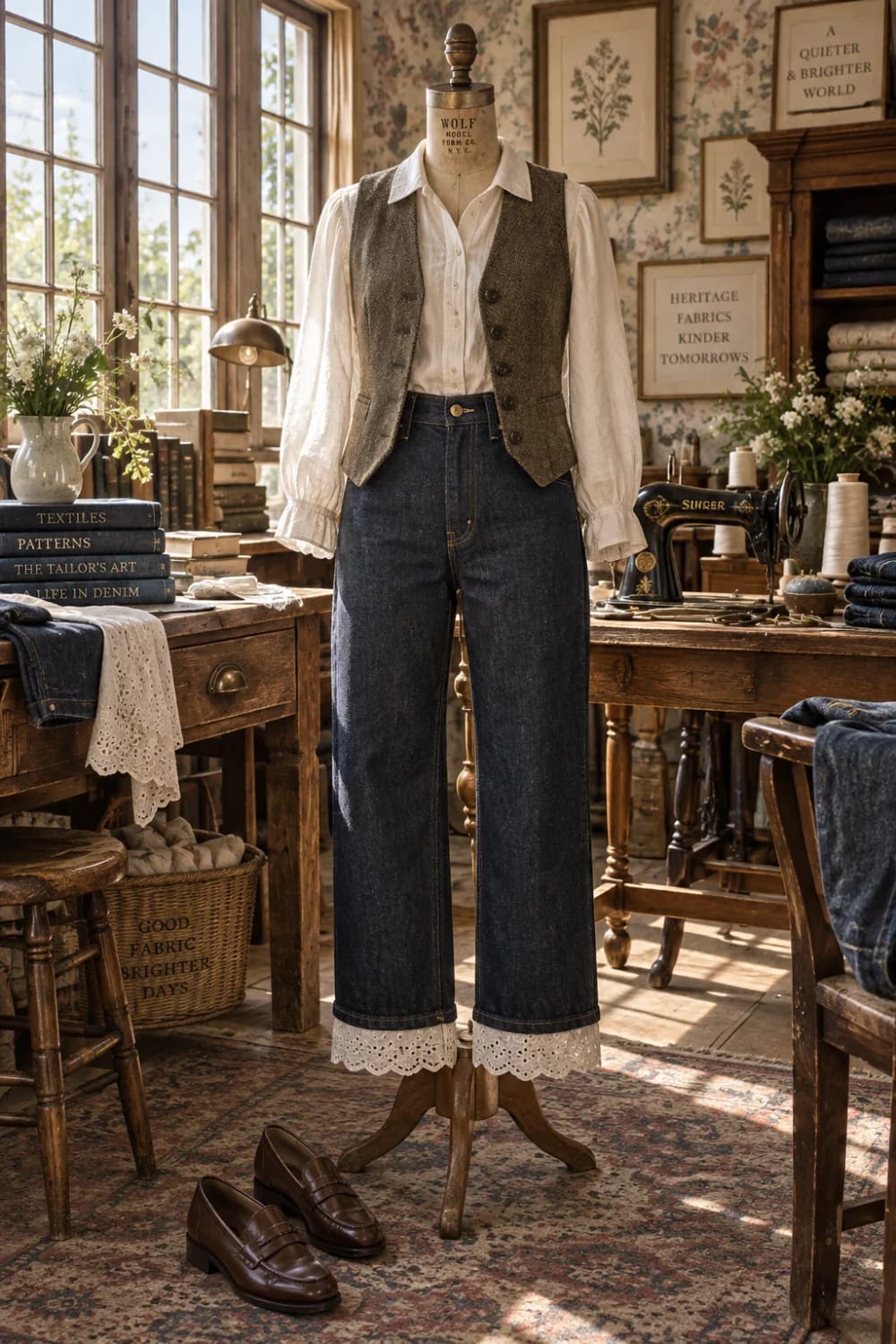
One roll, not two. A double roll buries the facing and leaves you with a cuff the thickness of a paperback.
8. Cut-Offs With a Gathered Eyelet Ruffle Instead of a Frayed Edge

The frayed cut-off has been the default for fifteen years and it is exhausted. A gathered eyelet ruffle does the same job, hiding a raw edge, and looks like a decision: gather at 1.5 to 1 for a flat frill, 2 to 1 if you want it standing away from the leg, and let the trim's scalloped edge be the bottom so there is nothing to finish.

Those two amputated legs are the most useful denim in the house, by the way. Four flat panels, each with a finished hem already on it, which is most of the reason a denim messenger bag needs almost no new material.
 How to Make a Braided Denim Rag Rug From Old Jeans The one denim project that eats a whole pile of dead jeans rather than one good pair.
Technique and Color, Which Is Where Most of These Fail
Construction is the easy half. What sinks a finished pair is a hole that frays open by August, or a white so clean it reads as a nightgown showing under the denim.
9. Pierce the Eyelets With an Awl, Never Cut Them
A stiletto or an awl pushes the warp and weft apart instead of severing them, which is how small eyelets were made long before anyone owned a machine, and it is the only version that holds in denim. Nothing is cut, so nothing frays, and if the overcasting gives out the hole closes back on itself rather than running. The ceiling is about a quarter inch across. Past that the twill will not spread that far and you are back to a blade, which is why the yoke row in idea five stays small.
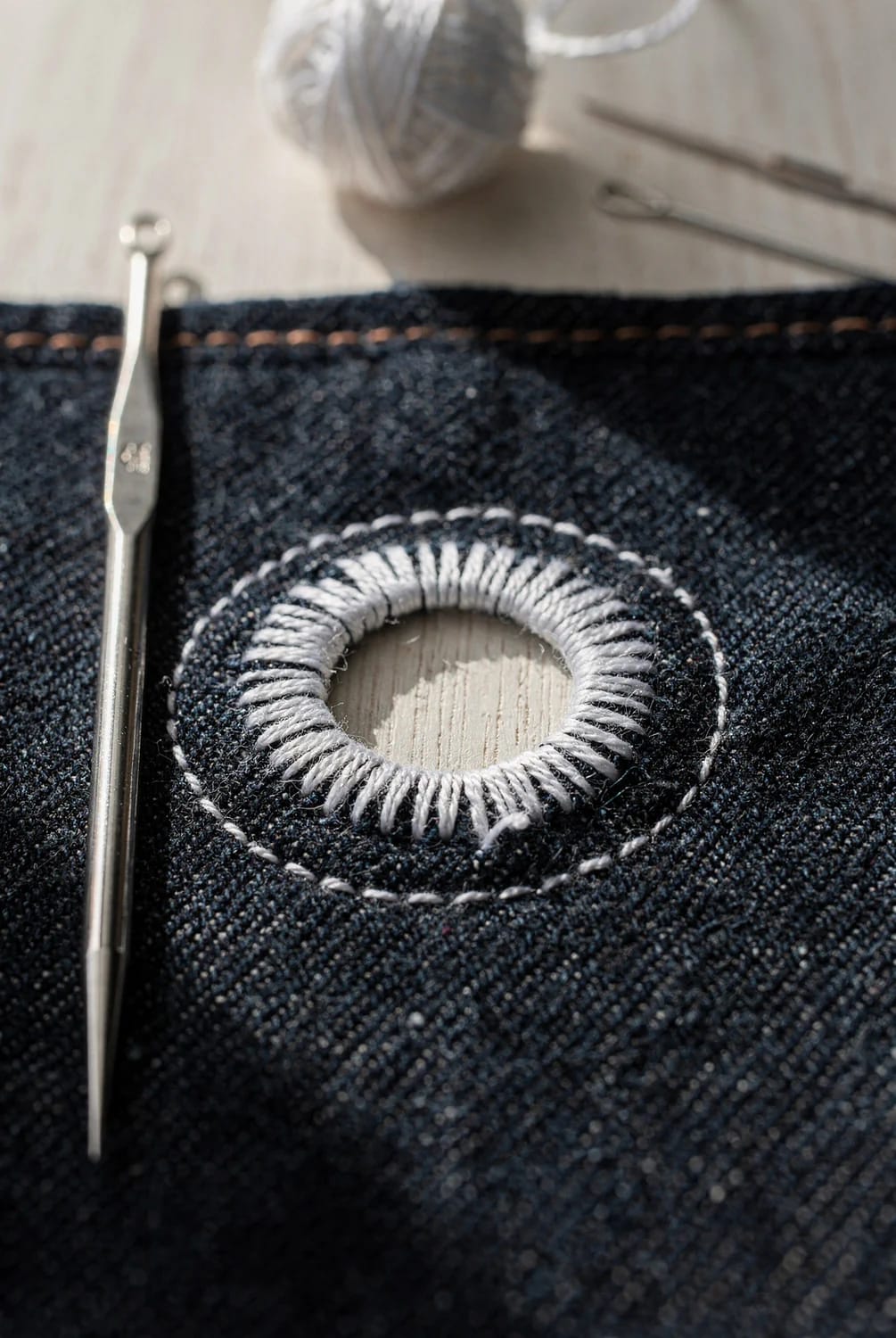
Mark the ring on the right side, on the line the finished edge will sit on.
Run small running stitches all the way round that ring first, before anything opens.
Push the awl through the center and work it outward until the hole stops at the running stitches.
Overcast into the ring, roughly twenty stitches, pulling each one snug so they stand the hole open.
Marking is the other half of the problem, because chalk on indigo is nearly invisible and a water-erasable pen bleeds into a dark ground. Sulky Sticky Fabri-Solvy, the printable wash-away stabilizer takes a drawn or printed line, sticks where you put it, holds the denim steady while you work, and rinses out warm. A crewel needle in size 5 or 7 gets pearl cotton through 12 oz twill without a thimble fight.
Never below the knee, never on the seat, never across a thigh. Those are the three places denim stretches under load, and an eyelet there elongates into a slot and then a tear. Skip stretch denim entirely: the elastane core in the yarn recovers after you pierce it, so the hole will not stay round, and the filament eventually snaps at the stitch line. Check your care label for elastane before you pick up the awl.
10. Tonal Indigo on Indigo, Read by Shadow Instead of Contrast
Navy eyelet on dark denim is the version I would actually wear out of the house. At three feet it registers as texture; up close it resolves into holes; in photographs it does almost nothing, which is presumably why nobody pins it. Three pairings hold up:
- Navy eyelet on raw or one-wash indigo, where the trim is a half shade lighter and reads as shadow.
- Black cotton eyelet on black denim. The one version that passes unremarked in a room full of adults.
- Ecru on mid-wash blue, which is the softest of the three and the only one that also works on a light wash.
One reason to go tonal has nothing to do with taste. Indigo is a surface dye sitting on the outside of the yarn, which is why jeans fade at the creases and why anything pale stitched to them picks up a blue shadow along the seam line. Wash the jeans twice before you put white cotton anywhere near them, and expect a little transfer regardless. Navy and black sidestep the whole argument.
Cotton, not polyester, so it fades on roughly the same curve as the jeans instead of staying suspiciously new.
navy broderie anglaise cotton eyelet fabric by the yard11. Tea-Stain the Eyelet Before It Goes Anywhere Near the Denim
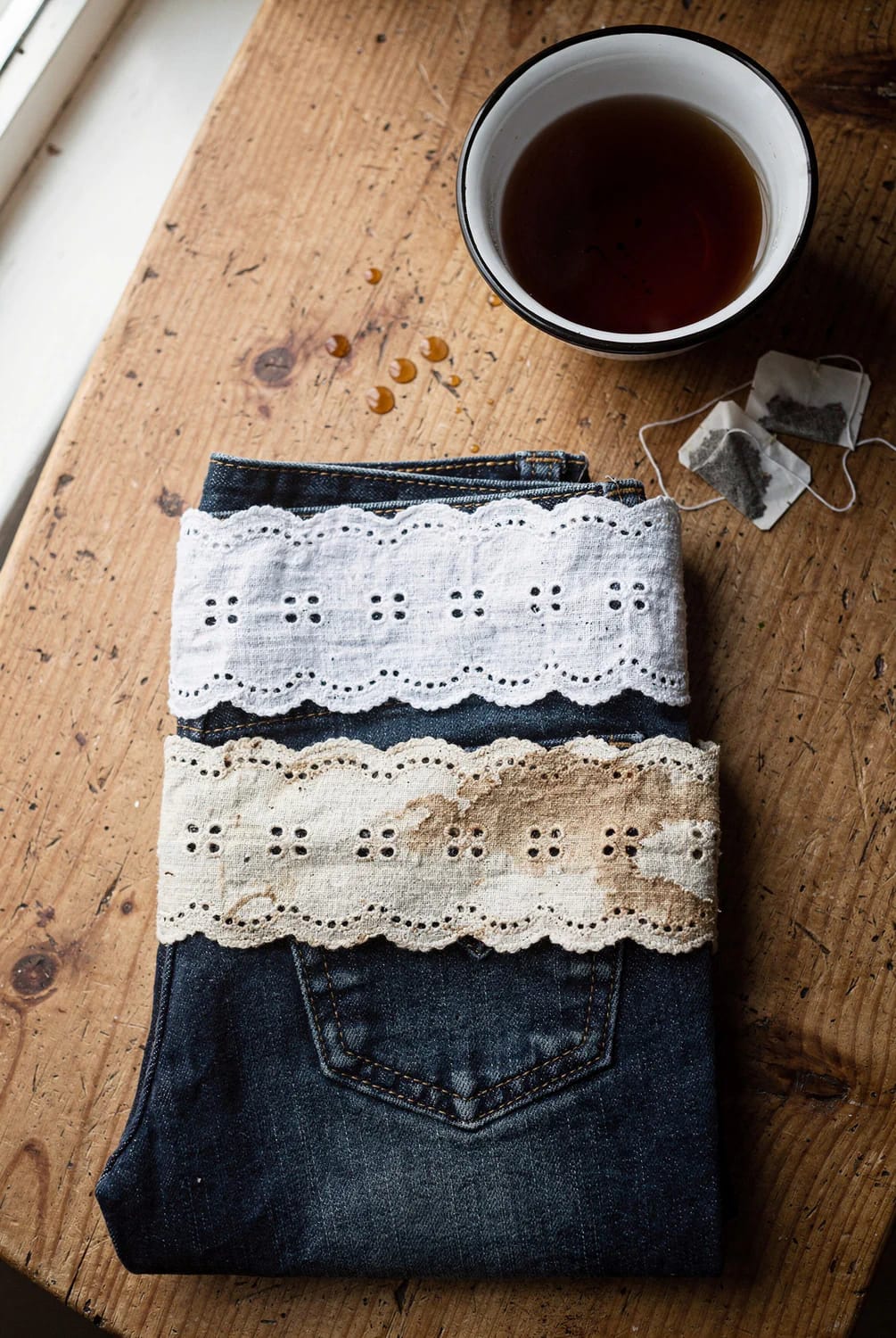
Optical white is what makes this look like underwear showing. Drop the trim in strong black tea, four bags to a quart, cooled to hand-warm, for twenty to forty minutes, and it lands at ecru with a slight unevenness that is the point. Test six inches first, since it dries two shades lighter than it looks wet. Granted, tannin is not lightfast and the color will drift over a few years, which on a hand-finished pair of jeans is not a problem worth losing sleep over. If you would rather not boil a kettle, buy the trim in ecru and skip the whole step.
Wash the finished pair inside out and cold, and keep softener off the eyelet: it coats cotton and takes the crispness out of the scallops, which is the only reason the pattern reads from across a room. If you cannot give it up, at least use something that does not leave a film on cotton.
Start With the Hem, Not the Holes
If you are only doing one of these, do the dropped hem in idea six. It costs an hour, one length of trim, and nothing you cannot unpick, and it tells you how white cotton behaves against your particular indigo after two wash cycles before you commit to opening an outseam. Leave the worked eyelets on the yoke until last, and practise them on a dead pair, because I could not find anyone who has actually tested hand-overcast eyelets in 12 oz twill across a year of wear. The sewing books assume lawn, the denim people assume nobody would try it, and the gap between those two assumptions is where your first pair is going to live.
Related Posts
- Butterfly Embroidery Jeans: Ideas Worth Stitching Onto Denim You Already Own
- 11 Upcycled Jeans Decor Ideas for the Pile You Can’t Toss
- 13 DIY Denim Christmas Stockings From Old Jeans
- 57 Innovative Upcycled Jeans Ideas: Transform Your Old Denim into Chic Fashion and Home Decor
- 15 Unique Upcycled Jeans Winter Tablescape Ideas
- Navy Blue Bedroom: 19 Decor Ideas Made with Upcycled Jeans