
Red and green is the easy button, and it is why most mantels look interchangeable from Thanksgiving to New Year's. Pull those two colors out and a winter mantel has to earn its warmth some other way — through texture, wood, metal, and the temperature of its light — which is harder to fake and much harder to get sick of by mid-January. What follows is how to build one that reads deliberate instead of undecorated, and that you can leave up long after the tree is at the curb.

1. Build the neutral base before you buy a single stem
The failure mode of a no-red-no-green mantel is not that it looks wrong; it is that it looks like nothing. A shelf of cream objects on a cream wall reads as unfinished rather than restrained. The fix is to treat "neutral" as five distinct tone families and make sure a mantel touches at least three of them, because contrast between warm white, wood, and metal is what your eye registers as intentional.
Start with three whites, not one
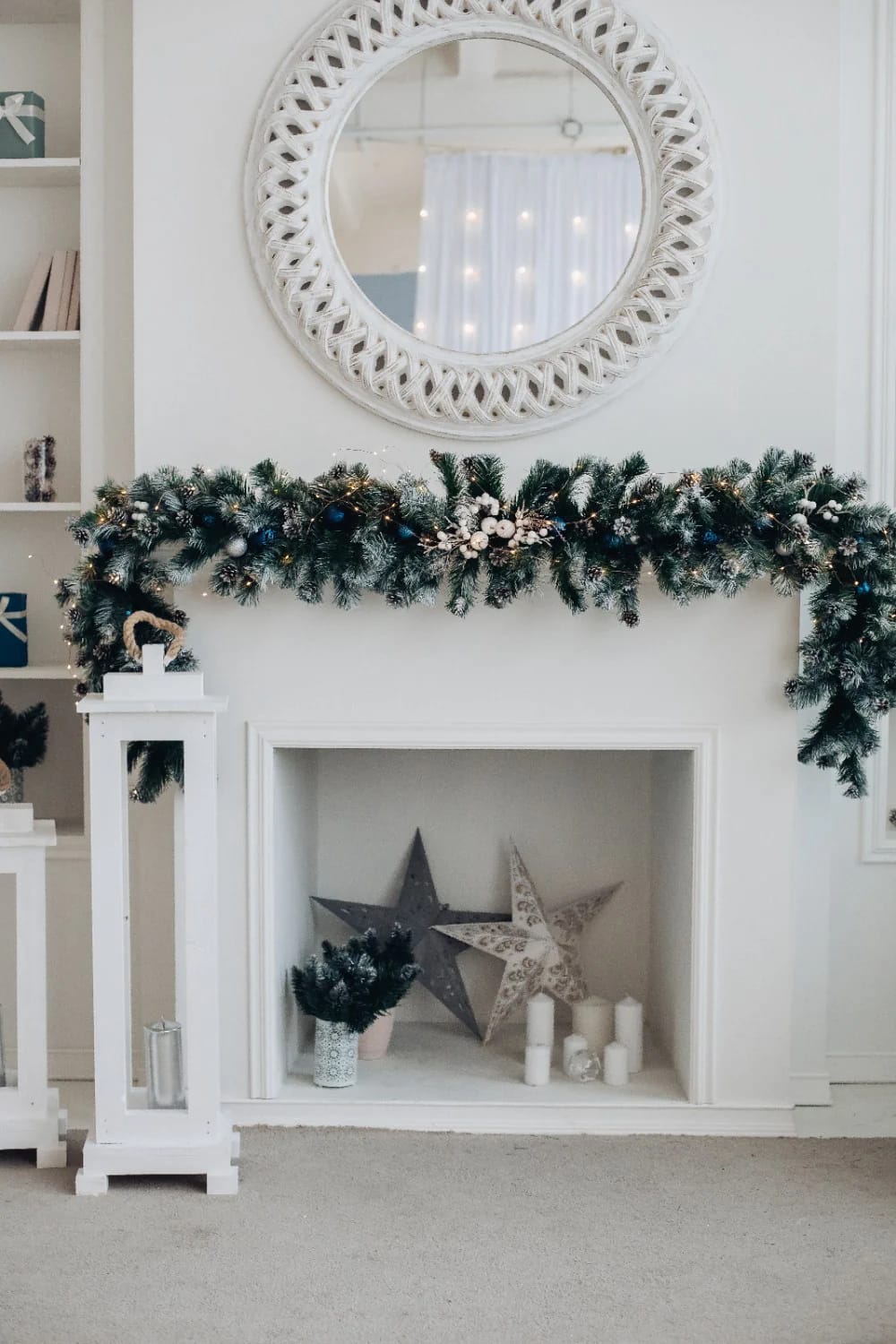
There is no such thing as a single neutral. Ivory, oatmeal, and a cooler chalk white sitting near each other create the subtle stepping your eye needs; a mantel styled in one flat beige is the thing people mean when they call neutral decor boring. If you want the same restraint applied to the whole room rather than just the mantel, a wider neutral holiday palette worth planning before you shop will keep the mantel from floating alone.
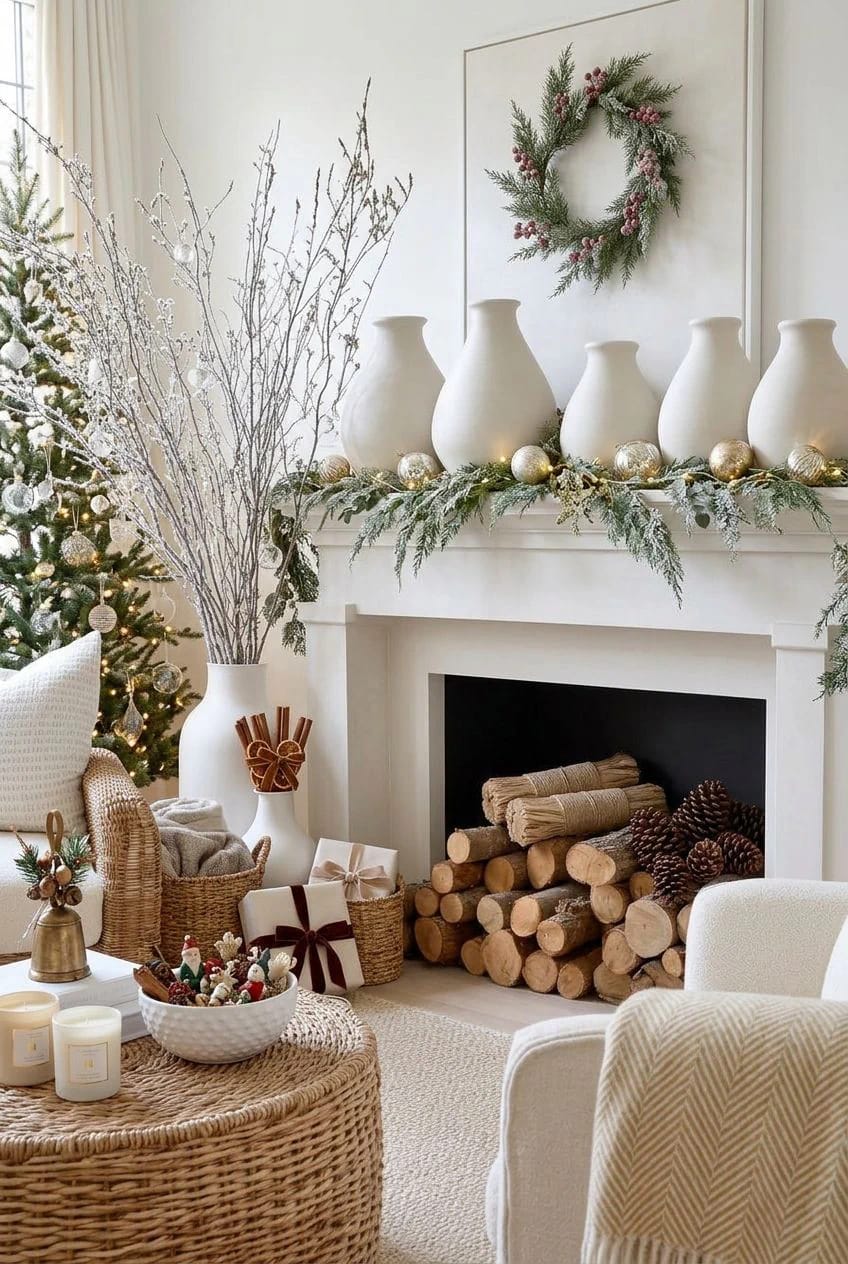
The one dark thing that saves it
Add a single near-black object and the whole arrangement snaps into focus. A matte black lantern, an aged-iron candle holder, a charcoal stoneware vase — one anchor of real depth stops the mantel from dissolving into a pale smudge. Most neutral mantels fail for want of that one dark note, not for want of another cream candle.
| Tone family | What it does on the mantel | Watch out for |
|---|---|---|
| Warm whites (ivory, oat, chalk) | The base layer; carries the “winter” read | All one shade goes flat fast |
| Greige & putty | Bridges white to wood so nothing looks stark | Too much and it reads gray and cold |
| Wood (birch, oak, walnut) | Grain and warmth without any color | Orange-toned pine can look dated |
| Warm metal (brass, bronze) | The glint that stands in for ornament shine | Chrome and nickel read too cold here |
| One dark anchor (black, charcoal) | Gives the eye something to land on | Skip it and the mantel looks unfinished |
2. Let texture do the job color used to do
Once color is off the table, texture is your only remaining volume knob, so turn it up. The difference between a nubby wool bouclé, a loose chunky knit, a slubby linen, and a smooth ceramic is exactly the variety that a red bow and a green sprig used to provide. Layer at least three of those weaves within arm's reach on the mantel and hearth and the arrangement stops looking spare.
Matching everything to the same soft beige is the single most common neutral-decor mistake. A cream knit next to a cream candle next to a cream vase, all the same value and all the same matte finish, photographs like fog. You need contrast in finish even when you have none in color: pair matte against a little sheen, chunky against smooth, so the light has something to break on.
Matte beats glossy for almost everything here — the exception is one restrained shine, usually the metal. Skip glitter and sequins entirely; they are the fastest way to drag a neutral mantel back toward generic holiday. And a run of felted wool garlands and mini-mitten strands does more for the texture story than another string of beads ever will.
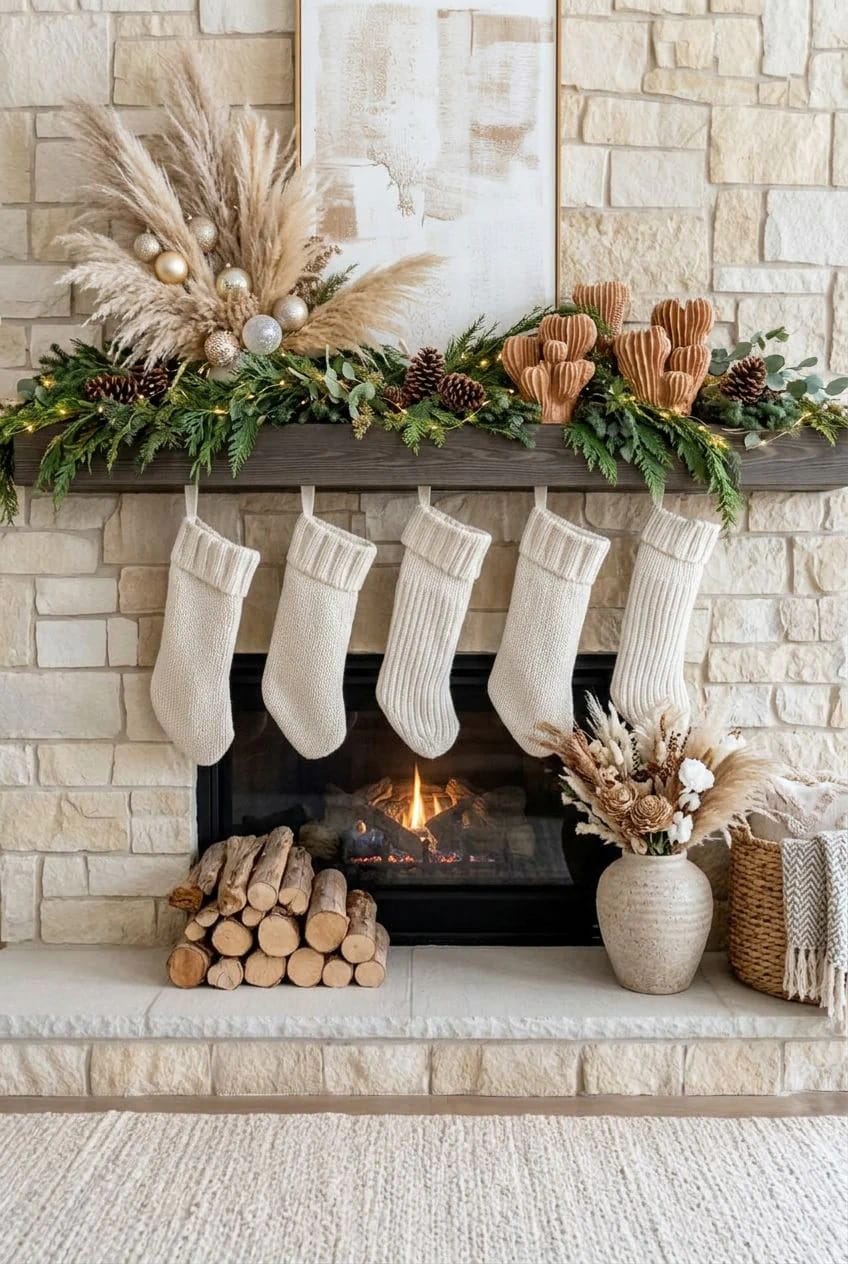
3. Make bare branches the centerpiece, not an afterthought
A tall spray of bare or dried branches is the highest-impact, lowest-cost move on this whole list, and it is the piece that most clearly says "winter" rather than "Christmas." Birch, curly willow, magnolia with its brown suede leaf-backs, dried hydrangea, cotton stems: these give you height and sculpture with zero saturated color. Most of them you can cut from your own yard in December for nothing, which beats the $18-a-stem faux magnolia that places like Afloral and Pottery Barn will happily sell you.
Arranging so it doesn't read as dead sticks
The line between "sculptural" and "somebody forgot to throw out the yard trimmings" is asymmetry and restraint. Group an odd number of stems, let them lean off to one side rather than standing in a stiff bouquet, and vary the heights hard — a couple of tall branches with shorter frosted eucalyptus filling the base. Anchor it all in something with weight, a footed stone urn or a heavy stoneware vessel, so the proportions look chosen.
 15 Natural Centerpieces for Your Winter Table The same foraged branches and pinecones, arranged for the dining table instead of the mantel.
4. Rethink greenery so it reads winter, not Christmas
Here is the part people get wrong: "without red and green" does not mean without greenery. It means without the specific glossy, saturated fir-green that your brain has been trained to file under Christmas the instant it appears. Swap that note for muted, dusty, cool-toned foliage — bleached or dried eucalyptus, gray-green olive, pale cedar, sage — and the same garland shape suddenly reads as January instead of December 25th.
Reads winter
- Bleached, dried, or lightly frosted eucalyptus
- Gray-green olive branches and pale cedar
- Sparse and foraged, with gaps that let the mantel show
- A little flocking or faux snow on the tips
Reads Christmas
- Glossy true-green pine as the dominant note
- Anything with red berries tucked in
- Dense wall-to-wall coverage that hides the mantel
- Plastic garland straight out of the box, unfluffed
Sage green reads English-cottage and Scandinavian; saturated pine paired with red reads mall food court. That is the whole distinction, and it is why the greenery you already own may be fine once you strip the berry picks out of it. And if you decide you actually miss the color, leaning all the way into green as the deliberate accent instead of red is a cleaner answer than a nervous half-measure.
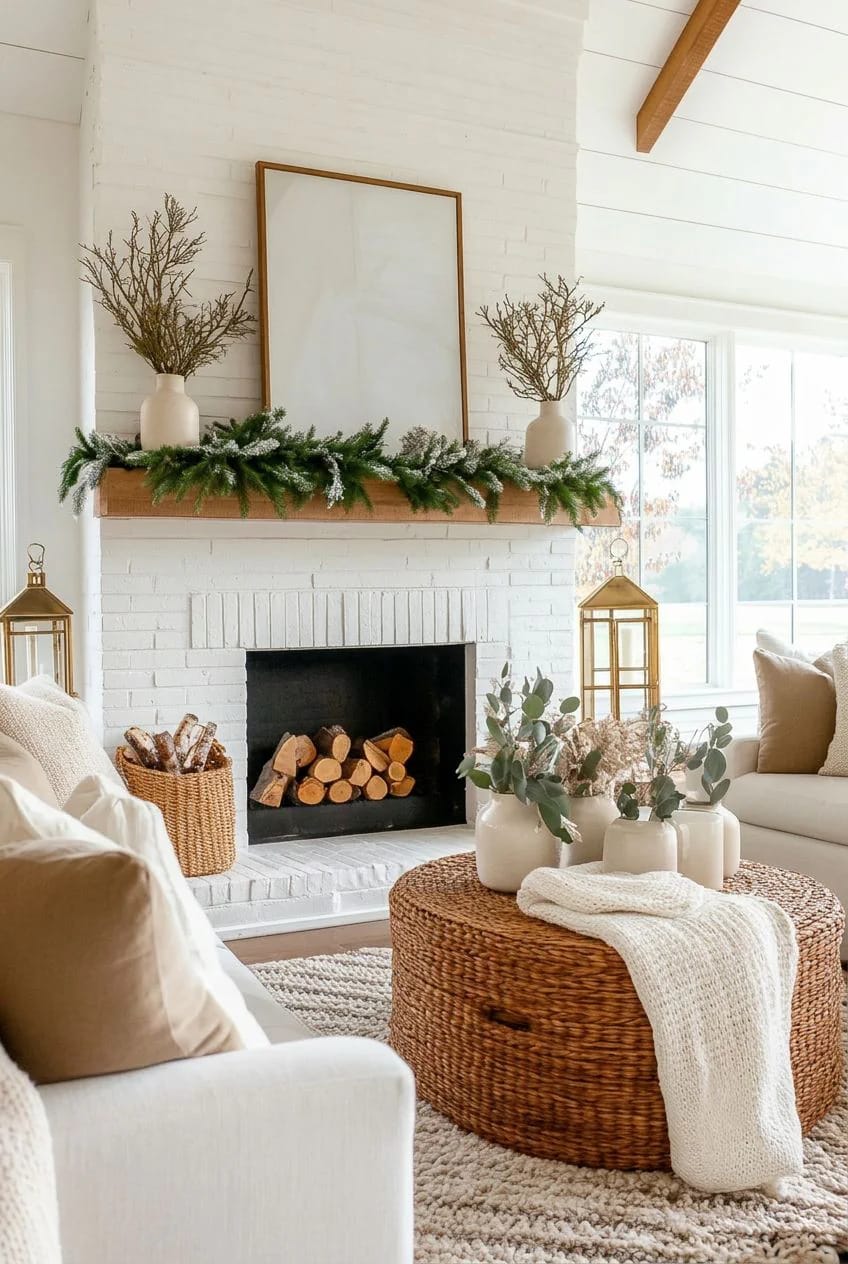
 How to Make a Eucalyptus and Pine Christmas Garland for a Natural Mantel A step-by-step for a foraged-looking eucalyptus garland at roughly a quarter of the designer price.
5. Get the light temperature right, because it makes or breaks the whole thing
You can nail every object on this list and still ruin it with the wrong bulbs. Cool-white and blue-tinted LED string lights turn ivory to gray and cotton to concrete; they are the reason a lot of neutral mantels photograph cold and clinical. The entire warmth of a red-and-green-free scheme is carried by light color, so this is not a detail to leave to whatever came in the box.
Candlelight, ~1800K: the amber baseline. Real or LED pillar candles are the safest light on a neutral mantel.
Warm white, 2200 to 2700K: the range to buy string lights and lanterns in. Still reads gold, not white.
“Soft white,” 3000K: borderline. It starts to flatten cream toward gray; fine in small doses.
Cool white or daylight, 4000K and up: the mistake. It turns ivory blue and kills the warmth you built.
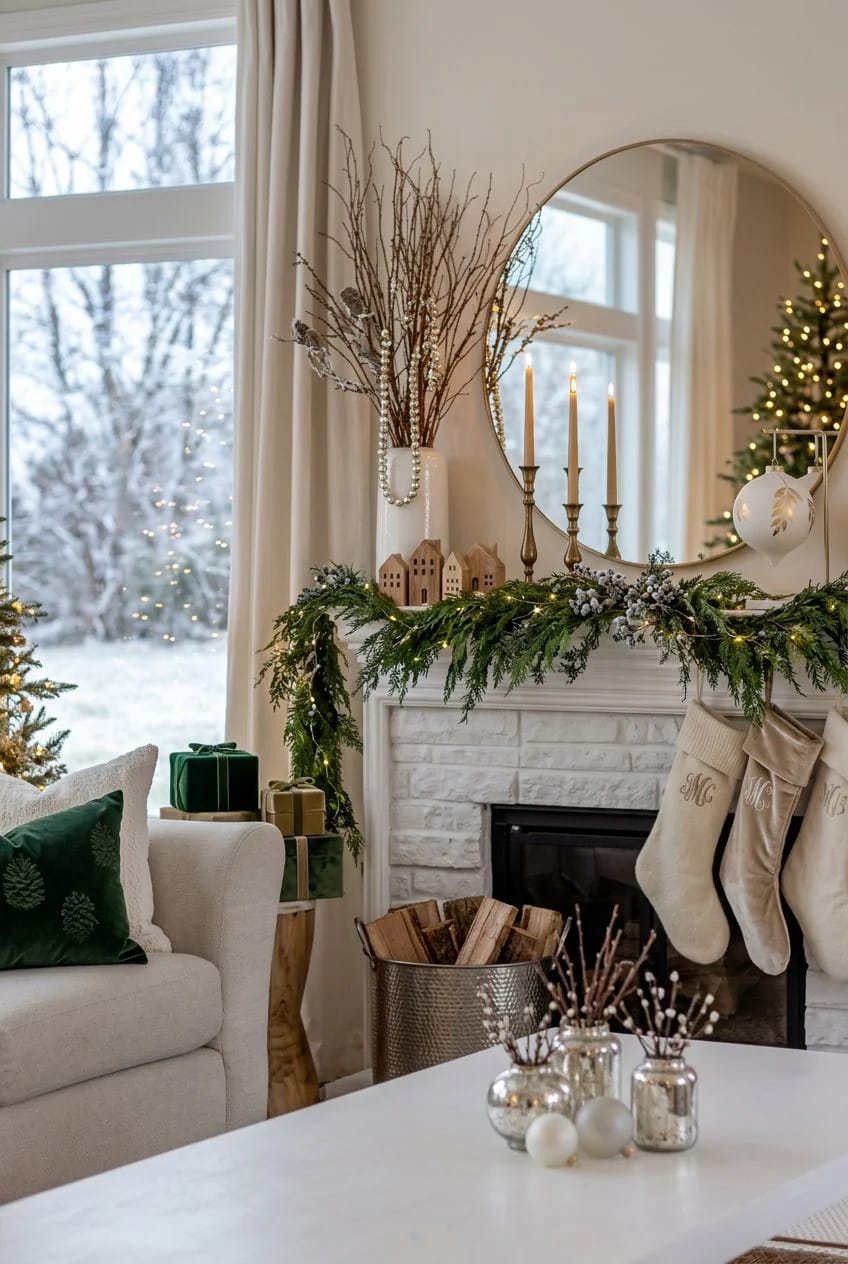
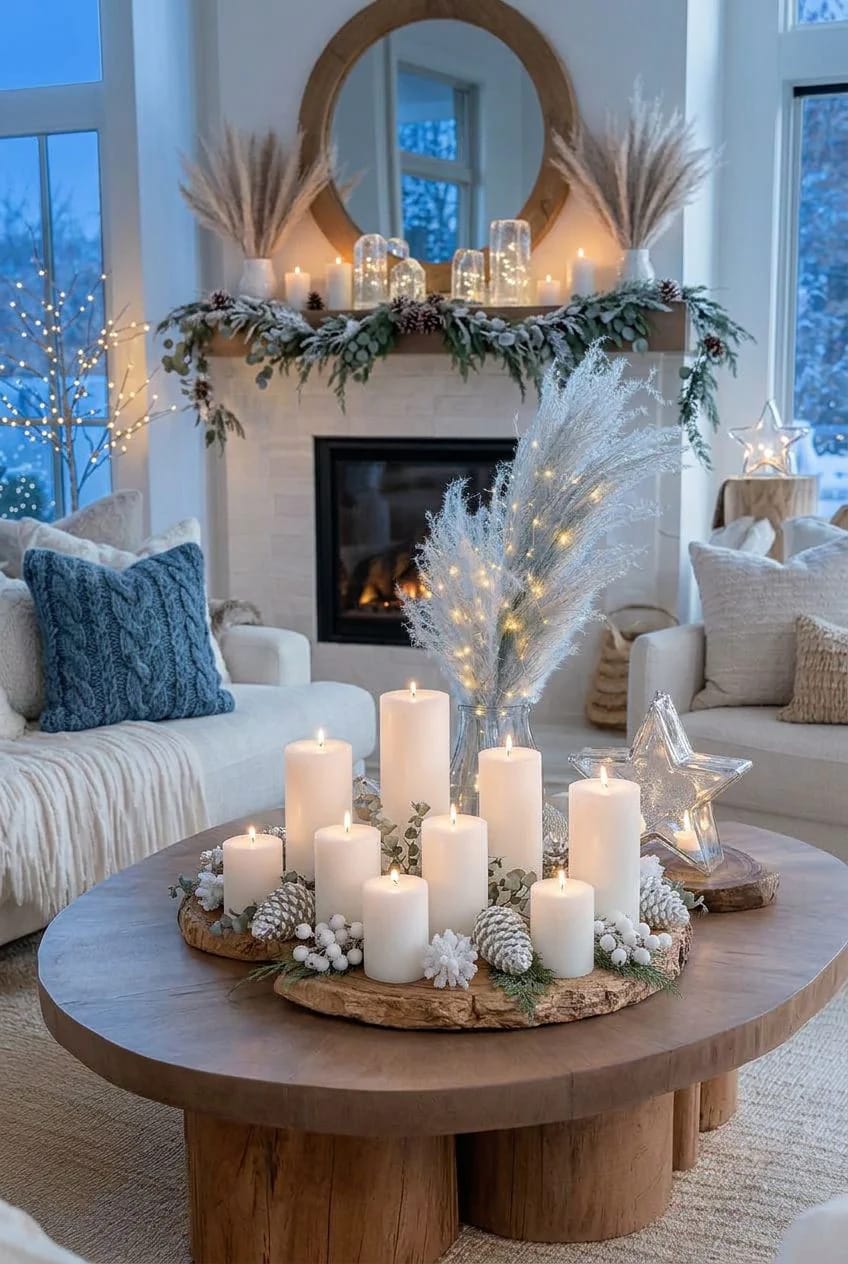
Group your candles in odd numbers at staggered heights rather than lining them up like a fence, add one brass lantern for a warmer point source, and stick to a single strand of genuinely warm fairy lights buried in the greenery so you see glow, not wire. The same warm-white-only discipline that makes a minimalist light-based tree alternative work is exactly what a neutral mantel needs.
6. Style the stockings and skip the garland if you want
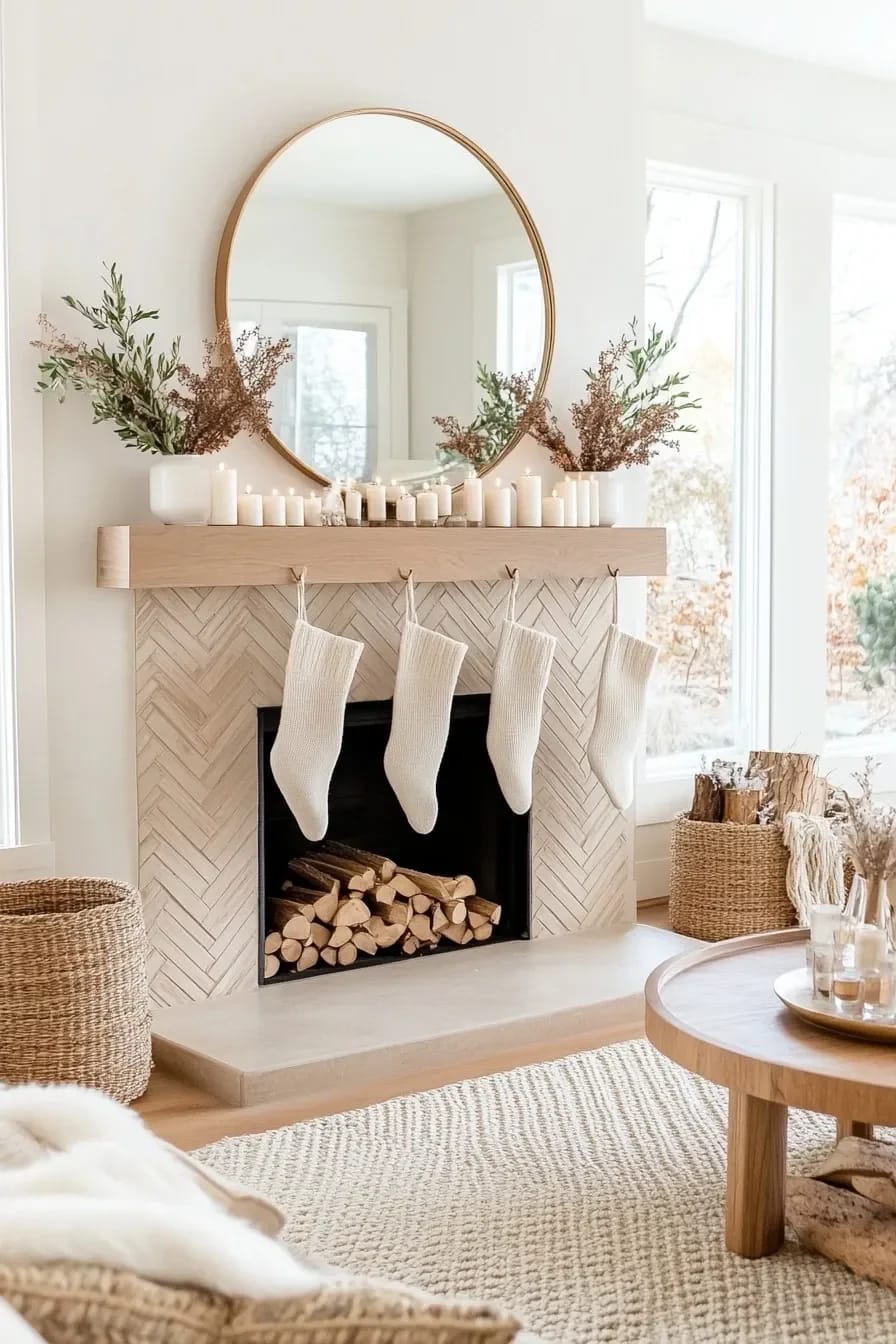
Stockings are where neutral mantels quietly fall apart, because the default store options are all red felt and green cuffs. Go for texture and tonal variety instead: one cable-knit cream, one ticking-stripe linen, one flat oatmeal wool with a little leather hanging tab. Hung from matte black or aged-brass holders spaced unevenly, three mismatched neutral stockings look collected rather than bought as a set.
The no-garland mantel
You are allowed to skip the garland entirely, and it is often the stronger choice. A bare mantel holding just a large leaning arched mirror in a thin brass frame, a squat vase of pale grasses, and the stockings below reads calmer and more architectural than anything draped. A garland-free mantel is one of the most-searched neutral looks for a reason: it is the fastest route to something that does not shout "holiday" — and it is a great use for an upcycled sweater sleeve turned into a stocking if you would rather make than buy.
7. Choose pieces that survive past December 26
The word “winter” is doing real work in this topic, and it is what separates this mantel from a Christmas one you have to tear down the day after. If most of what you put up is seasonless — bare branches, dried grasses, wool, stone, brass, candles — then removing three or four holiday-specific things on the 26th leaves a mantel that carries you clear through February. Swapping in a few natural winter pieces that have nothing to do with the holidays is the difference between decor you enjoy and decor you resent taking down.
A mantel you leave up until February
One 5-foot mantel, built to shed its holiday layer cleanly
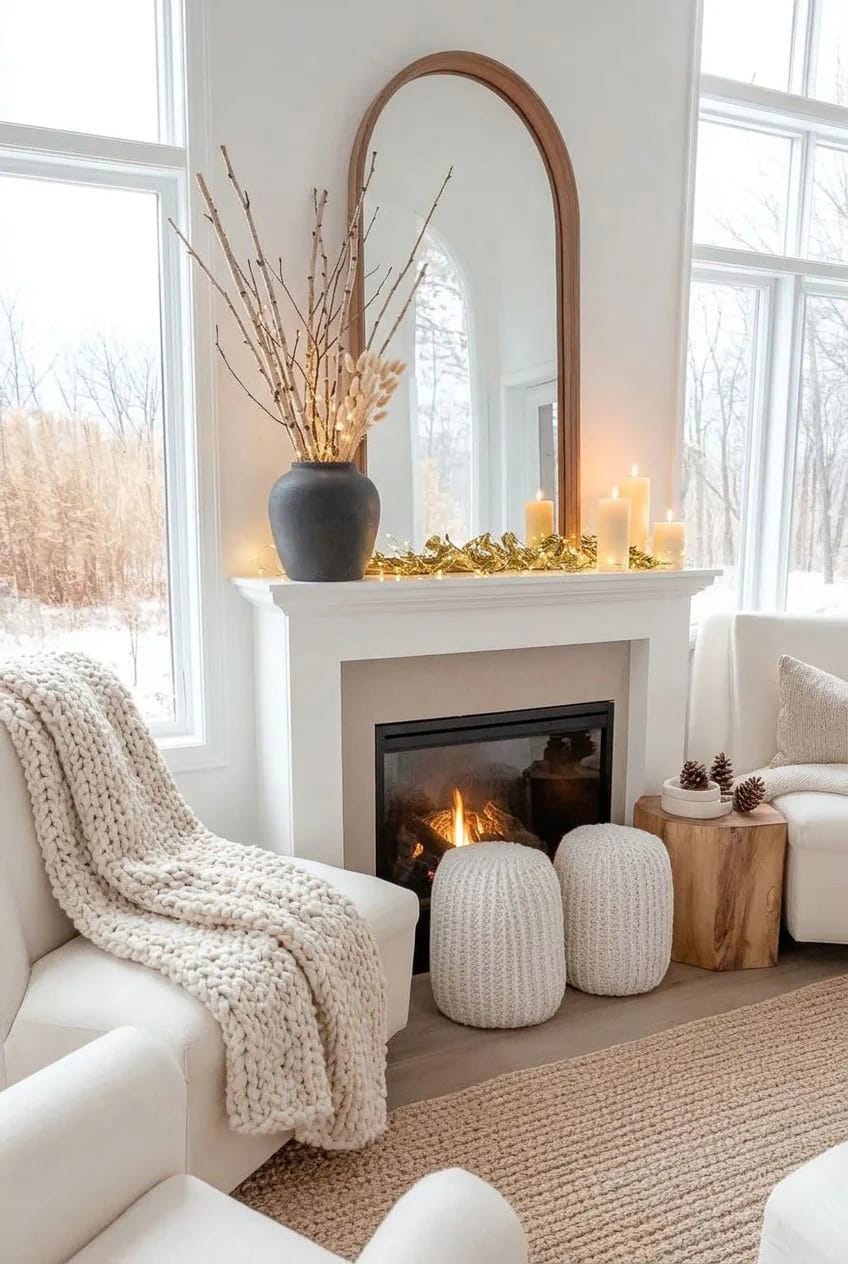
Build it in two layers. The permanent layer is birch branches in a stoneware vase, a stack of linen-bound books under a speckled bowl, a wool bouclé throw on the hearth, and warm candles. The holiday layer is only the stockings, one small brass ornament cluster, and the fairy lights. On December 26 you pull the three holiday items, and what is left still reads as a finished winter mantel rather than an empty shelf.
The permanent layer
| Qty | Item | Spec | Price |
|---|---|---|---|
| 1 | Bare birch branch bundle | Foraged free, or tall dried | $0 to $30 |
| 1 | Dried bunny-tail grasses | Pale, one small bunch | $8 to $18 |
| 1 | Stoneware or stone vase | Matte, heavy, off-white or charcoal | $20 to $50 |
| 3 | Ivory pillar candles | Real or warm-white LED, staggered heights | $15 to $35 |
| 1 | Warm-white fairy lights | 2200 to 2700K, single strand | $8 to $15 |
| 1 | Wool or bouclé throw | Undyed cream, chunky weave | $30 to $80 |
| Total | about $90 to $230 | ||
Prices are approximate ranges as of December 2025; verify before purchase.
Build It in This Order
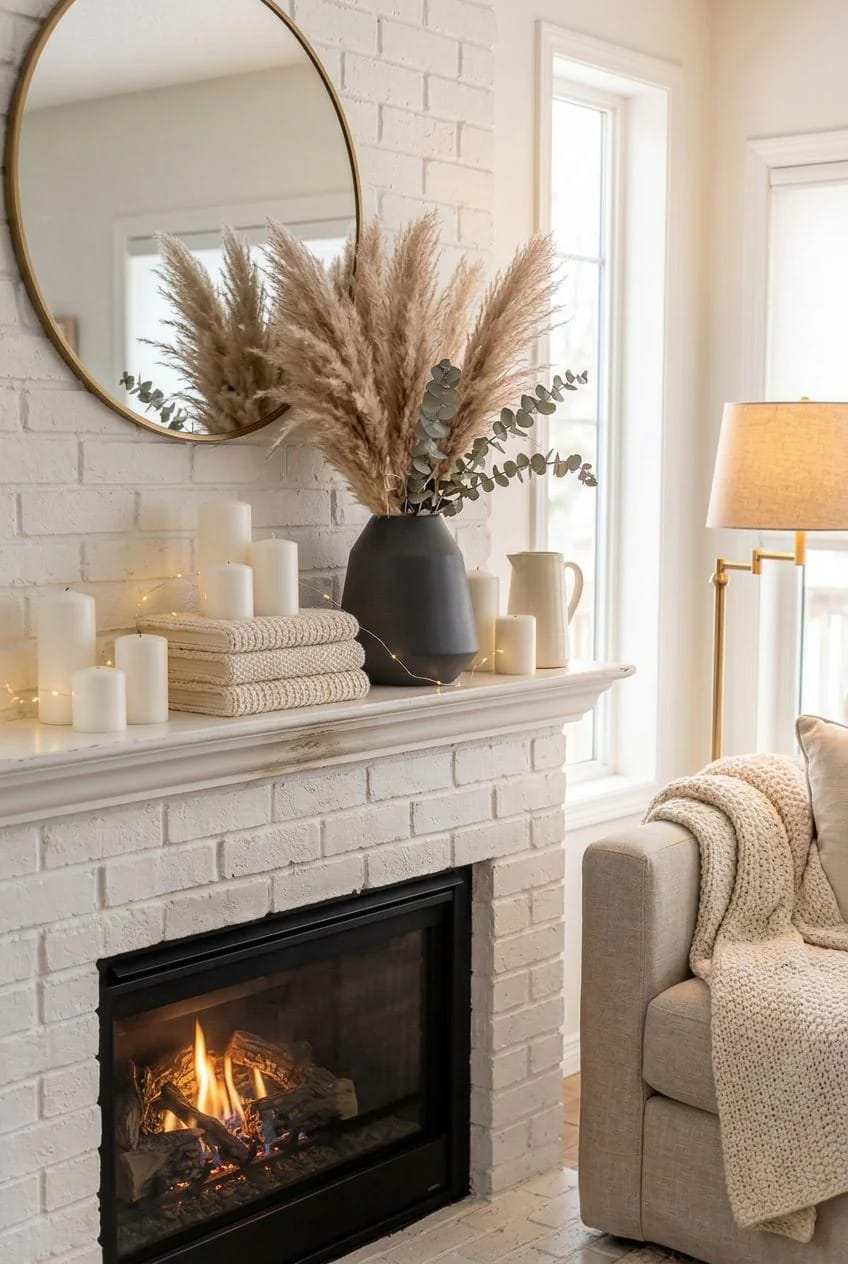
If you do nothing else, fix the light temperature first, because warm bulbs rescue a mediocre arrangement and cool ones sink a beautiful one; then get your three whites and one dark anchor onto the mantel, then layer texture, and add the branches and muted greenery last once you can see where the gaps are. Everything on this list is reversible and most of it is cheap, so the real luxury of dropping red and green is that you stop decorating for one week in December and start decorating for the whole cold half of the year.
Related Posts
- 29 Trendy Neutral Christmas Decor Ideas for a Relaxing Holiday Season
- 25 Green Christmas Fireplace Decor Ideas for a Fresh and Festive Mantel
- 23 Cozy Eco-Friendly Christmas Living Room Ideas for a Warm, Sustainable Holiday
- 9 Foraged Winter Greenery Centerpiece Ideas for the Table
- 15 Natural Centerpieces for Your Winter Table
- 15 Cozy Natural Winter Decor Ideas to Warm Up Your Home