
A driftwood Christmas tree is one of the few holiday builds that looks better the more weathered and mismatched your wood is, which makes it almost unfair for a cabin. The pale, salt-stripped grey of driftwood reads as warm and deliberate against dark log walls in a way a flocked store tree never manages, and most of these cost close to nothing if you live near water or know where to buy a bundle. Below are seven distinct builds, not seven photos of the same stacked tree: a six-foot floor cone for a great room, a flat wall version that uses no floor space at all, a lit single branch, and the sourcing and lighting calls that decide whether yours looks like art or like a heap of sticks leaned in a corner.

The stacked-ladder driftwood tree
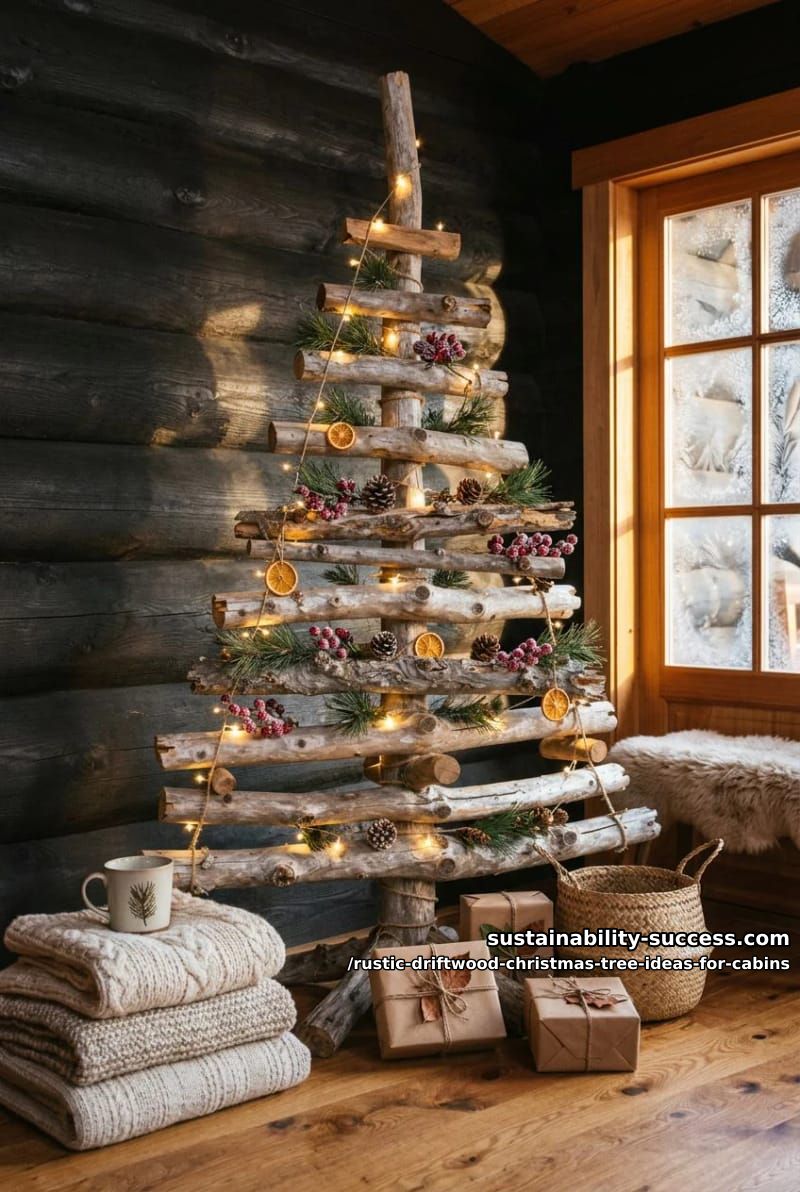
This is the one everyone pictures, and it is still the one most worth building: graded driftwood pieces stacked horizontally, widest at the floor, narrowing to a twig at the top. The whole effect lives or dies on two decisions, and neither is the wood itself.
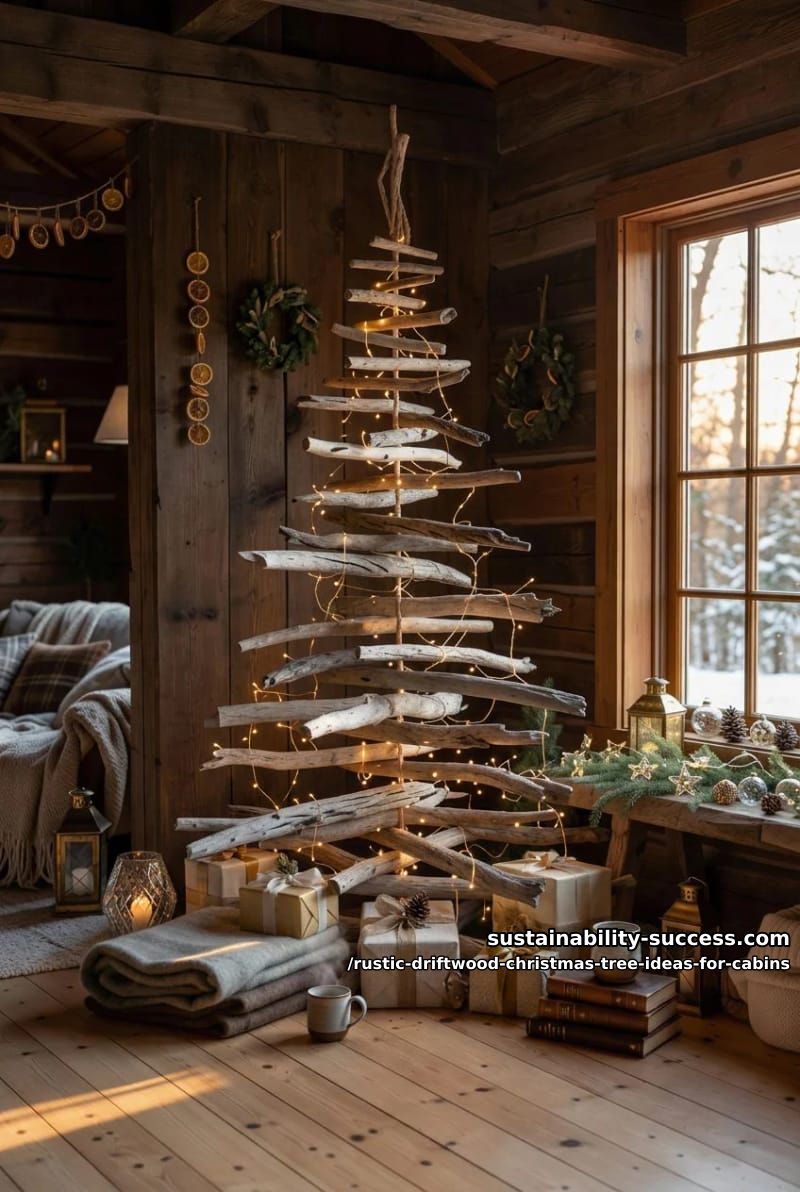
Grading the pieces so the taper reads as a tree
Lay every piece out on the floor and sort by length before you attach anything. A clean taper is what your eye reads as "tree"; an even stack of similar sticks reads as a louvered shutter someone stood on end. Aim for a base around 24 to 30 inches for a freestanding floor tree, less for a tabletop, and step down from there.
- Widest piece at the bottom, then drop roughly two inches per tier.
- Mix thicknesses on purpose. A row of identical-diameter sticks looks manufactured.
- Top three tiers: keep them short and slightly crooked. Perfect symmetry up there is what makes the cheap pre-made ones look like a wall calendar.
What holds it up: dowel, rope, or a length of copper pipe
Three real options. A wooden dowel run vertically through drilled center holes is the sturdiest and the most work; jute or hemp rope strung through the holes lets the tiers shift and swing a little, which I actually prefer because it stops the thing looking machined; a length of half-inch copper pipe does both, holds weight and adds a warm metal line down the spine. Drill the holes slightly oversized so a hot, dry cabin doesn’t swell the wood and crack a piece. As for the driftwood, a craft bundle of graded one-to-twelve-inch pieces runs somewhere around $25 to $50 online if you can’t beachcomb, and if you do collect your own, check the rules first: California caps state-park collection at one piece or fifty pounds a day, national parks ban it outright, and private beaches mean asking the owner.
A full-height driftwood cone for the great room
If you have the ceiling for it, skip the stack and build a cone. A five or six-foot teepee of thin driftwood branches lashed into a tapering tower is the version that stops people in the doorway, and it suits a cabin great room far better than a delicate tabletop piece that disappears under a vaulted roof.

Lashing beats gluing, and it is faster
I used to glue these at the joints. Then one lived in a wood-heated cabin for a winter, the glue let go in the dry heat, and the whole side sagged like a wet tent. Now I lash everything with jute twine, the way you'd build an actual teepee, around a hidden central pole or as a free tripod of three thicker branches that the rest lean into. Lashing is quicker, it survives the heat, and the visible twine wraps look right on driftwood in a way a glob of hot glue never will.
Weighting the base against a cabin draft
A tall cone is top-light and bottom-empty, so a door swinging open in a drafty cabin can walk it over. Stand the center pole in a galvanized bucket and fill it with sand, or pour a few inches of quick-set concrete around it and hide the rim with a burlap wrap or a low pile of pinecones. Wind the lights vertically from base to tip rather than ringing them around; vertical runs make the cone read taller and stop the lights pooling in one bright band.
Whitewashed driftwood for a paler cabin
Not every cabin is dark log, and this is where I'll annoy people: if your walls are already pale pine or painted white, do not whitewash your driftwood. A bleached tree against a bleached wall vanishes. Whitewash is for the cabins with charcoal log or knotty dark-stained walls, where a chalky pale tree pops the way fresh snow does against bark.
Lime-washing without burying the grain
The mistake is painting it solid white, which turns weathered driftwood into a craft-store dowel. Thin your white paint or limewash heavily, brush it on, then drag most of it back off with a dry rag while it is still wet so the grey grain shows through and the ends stay bare natural wood. Leaving roughly a third of each piece unpainted keeps it reading as driftwood, not as something from a discount homewares aisle.

A single forked branch as a tabletop driftwood tree
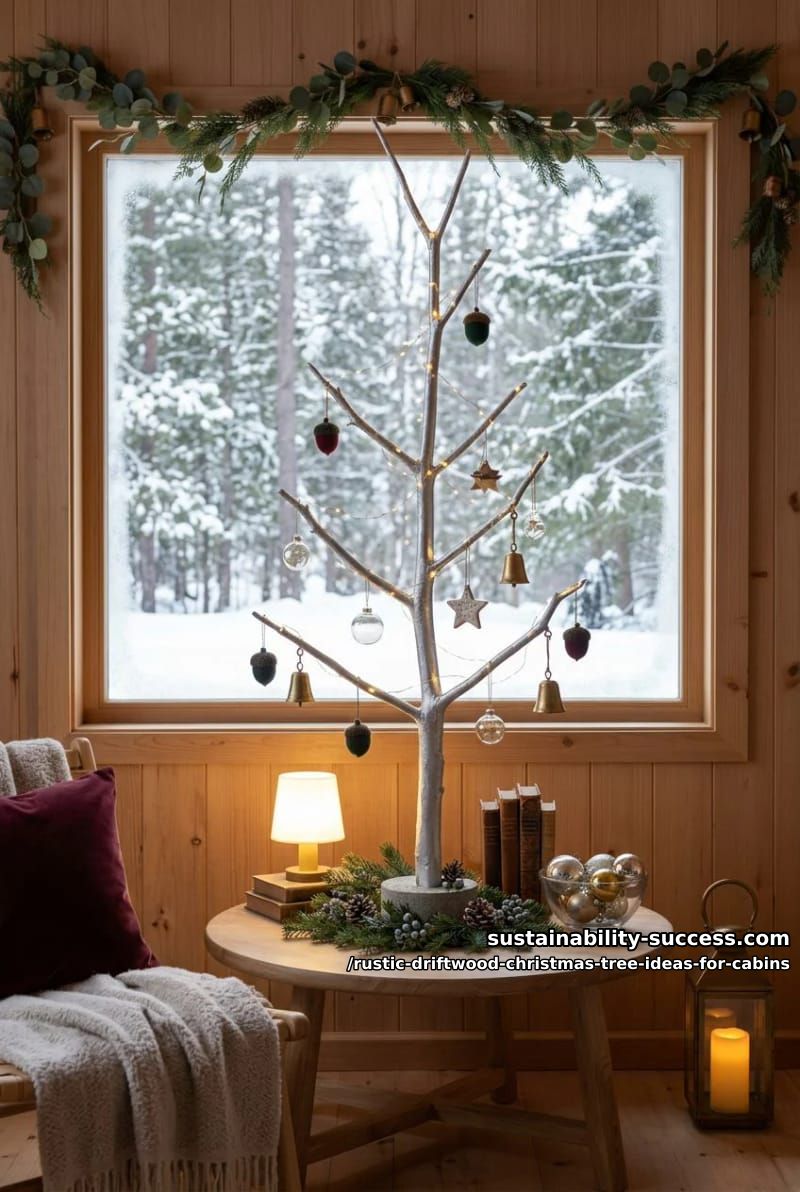
The cheapest, fastest tree here is one good forked branch stood upright in a base. Find a branch that already forks into a rough triangle, anchor the bottom in a drilled log round, a concrete cylinder, or a jar of sand, and hang two or three small ornaments. That is the whole project. It earns its slot because a tiny cabin or a mantel has no room for a floor build, and a single sculptural branch with three brass bells on it has more presence than a crowded two-foot tabletop tree.
The flat wall-hung driftwood tree, no floor space needed
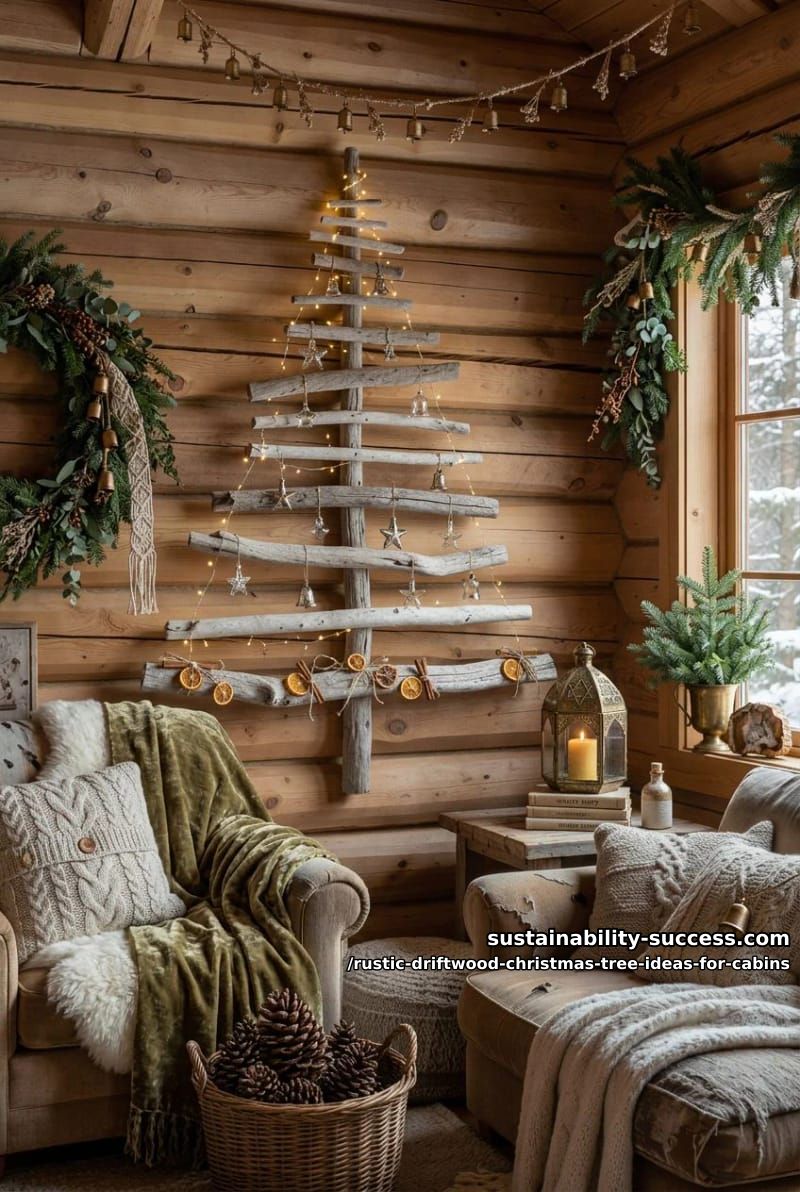
For the tightest cabins and for renters who can't drill much, hang the tree flat against the wall. Seven or so horizontal sticks arranged in a triangle, longest at the bottom, with one vertical stick behind them as the trunk line, gives you the full shape with almost no depth and zero floor footprint.
Hanging it without wrecking a log wall
Wire or hot-glue the sticks to a vertical jute cord first, so the whole tree hangs from a single point instead of needing a fastener per stick. On a log wall, one nail into a chinking line or a stud holds it; renters can use a heavy-duty adhesive picture hook rated well above the tree's weight, since dry driftwood weighs almost nothing. Space the sticks a hand-width apart and let the gaps stay slightly uneven, because a perfectly even ladder reads as a shelf rack, not a tree.
A suspended driftwood tree hung from a beam
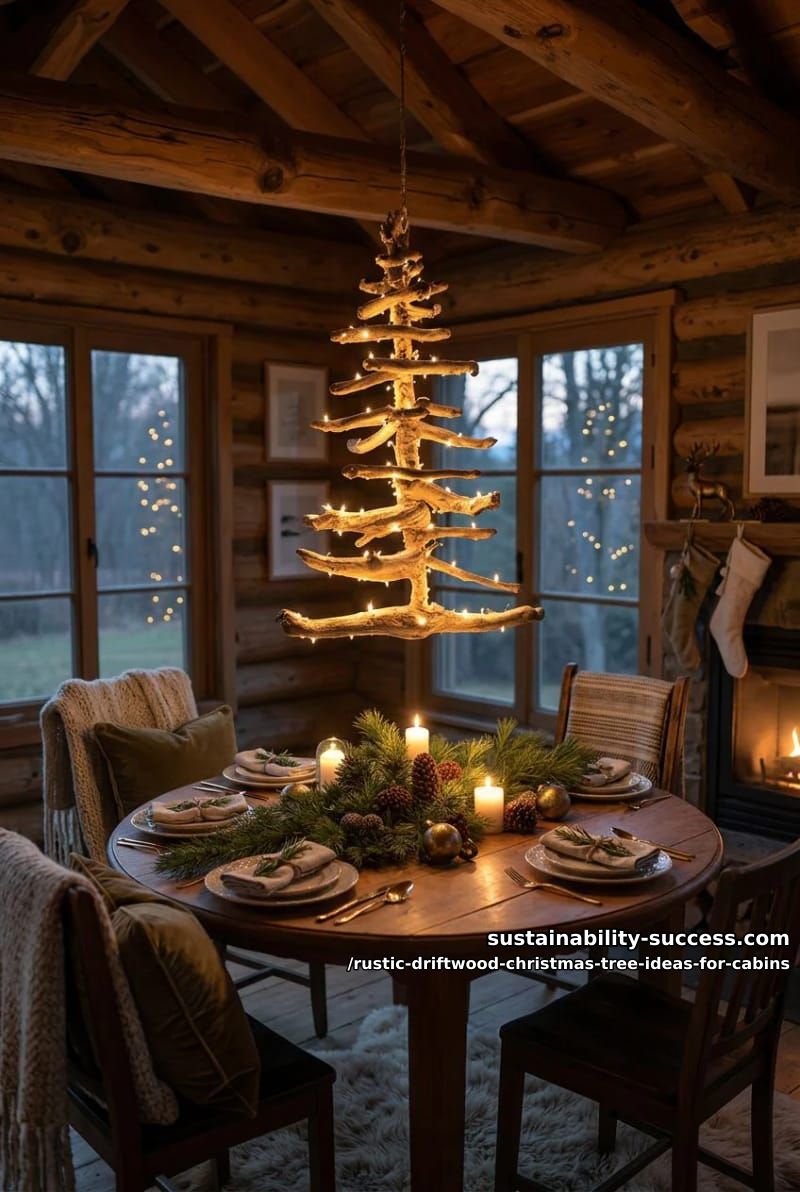
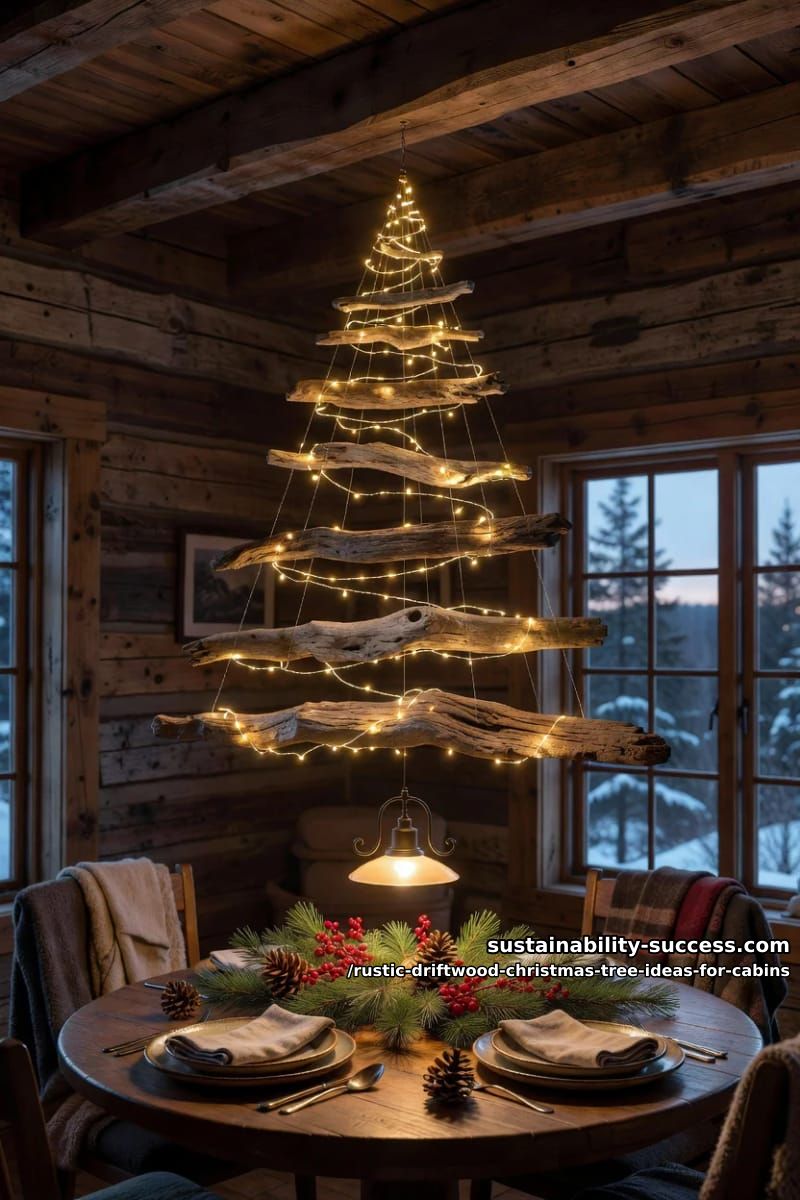
Hang the stacked version from a beam on clear line and you get a floating tree that turns slowly in the room's air. It is the same graded-horizontal idea as the first build, just suspended over a dining table or in a window instead of standing on the floor, which frees the floor entirely and gives a cabin with exposed beams something to do with them. Cabins with the beams already up there get this nearly for free.
A lit driftwood branch in a split-log base
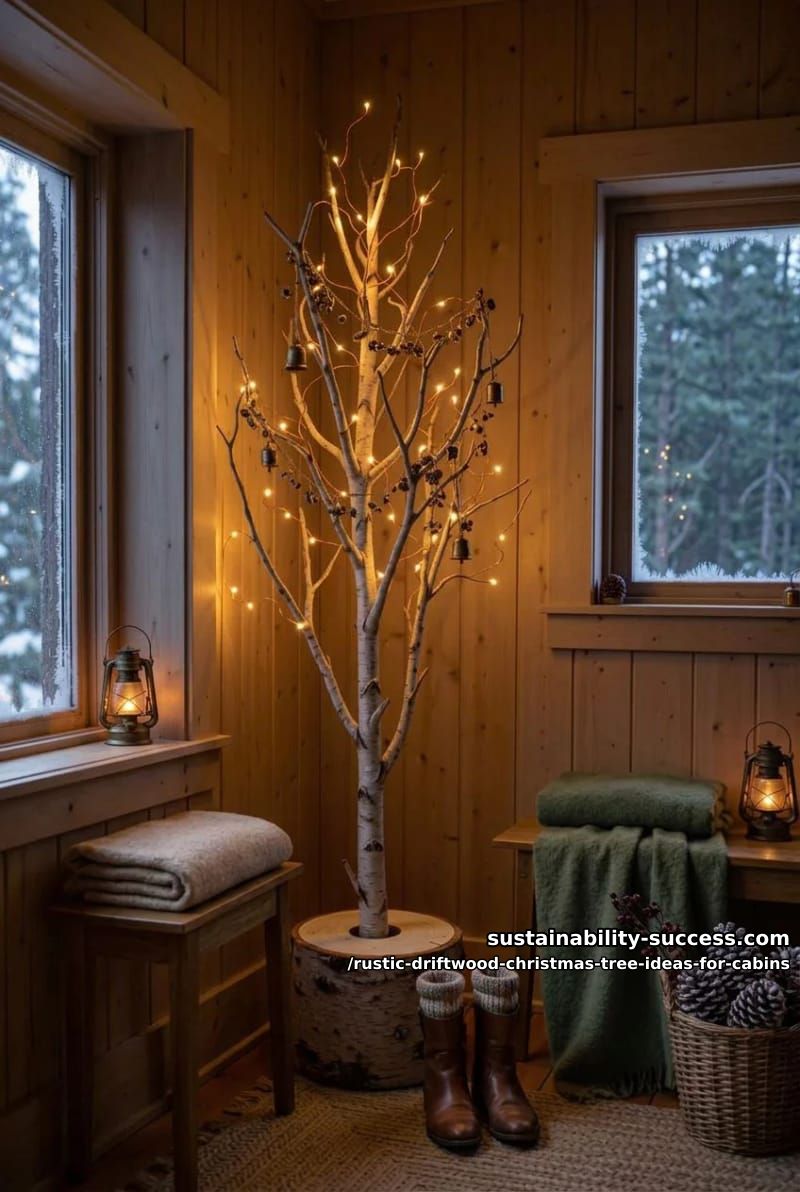
The most sculptural option is a single tall branch lit from top to bottom, set in a halved log. Where the forked tabletop branch is small and bare, this one is four feet of upturned driftwood limbs glowing in a corner, and it leans on its lighting more than any other build here, so the light choice is the whole job.
Drilling the base so the branch stands plumb
Halve a log round, drill a hole into the flat face slightly wider than the branch butt, and seat the branch with a wood shim or a dab of construction adhesive so it stands true. A branch leaning two degrees off vertical looks like a mistake; spend the extra minute with a level. Birch or pale log rounds suit the driftwood; a dark walnut round fights it.
Bare bulbs or micro-fairy on open branches
On an open branch with lots of negative space, fat cafe bulbs draw the eye to the bulbs and away from the wood. Use warm white micro-LEDs on bare copper wire instead, around 2700 kelvin, wrapped close to the limbs so the wire vanishes and the wood appears to glow on its own. Skip cool-white and anything labeled "bright white," which turns weathered driftwood a dead blue-grey.
Conclusion
If you are deciding where to start, match the build to your space before your taste: a tight or rented cabin wants the flat wall tree or the forked-branch tabletop, while a great room with a vaulted ceiling is wasted on anything under five feet, so build the lashed cone. The whitewash is a styling layer you add only if your walls are dark enough to carry it.
One honest caveat that none of the pretty photos mention: driftwood sheds. Sand, the odd bug, a fine grey dust on the floor for the first week. Bake your pieces at a low oven temperature or leave them in the sun for a few days to dry and evict anything living before you bring them inside, especially the bigger floor builds.
And resist over-decorating any of these. The reason a bare grey tree works against log walls is the contrast, so a few brass bells or jute stars is plenty; load it with baubles and you have just made an ordinary Christmas tree out of unusually difficult materials.