
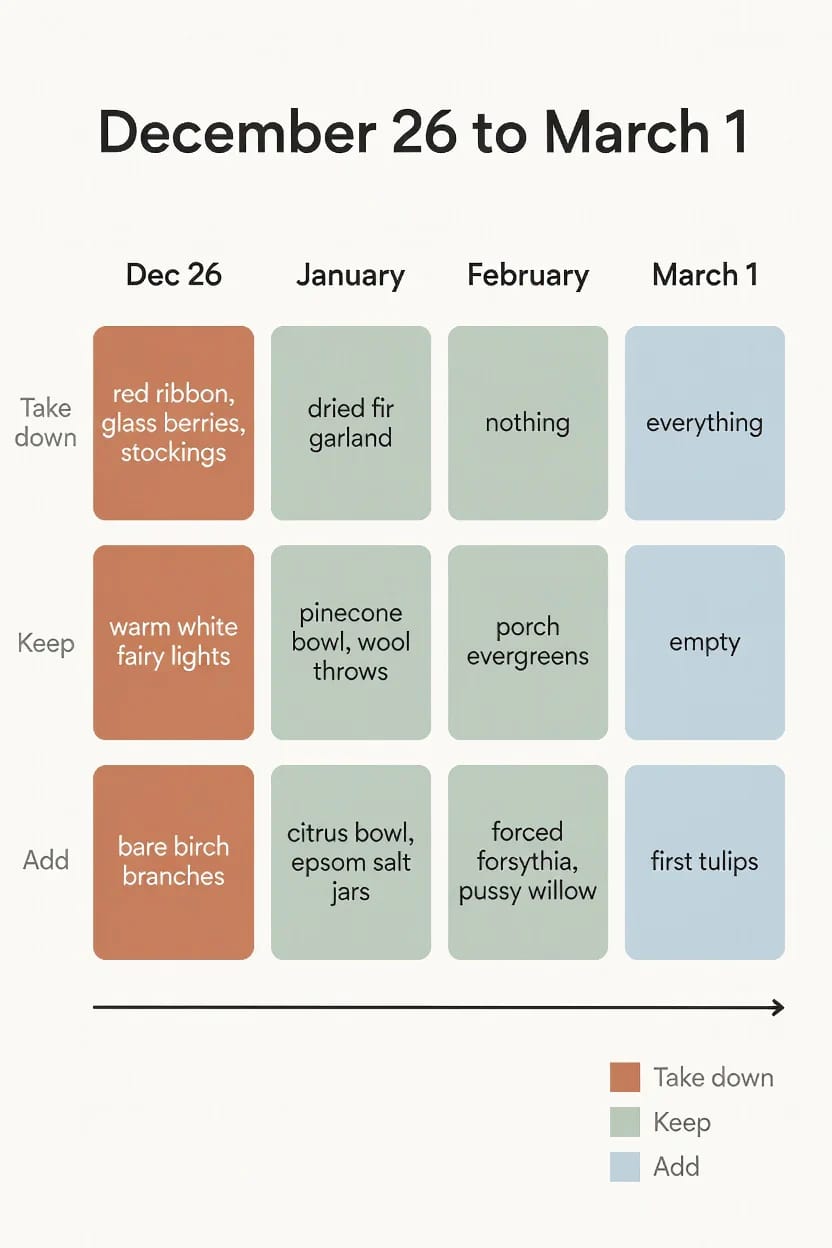
The tree comes down and the room looks robbed. That gap between December 26 and the first warm week of March is the longest stretch of the year your house has nothing to say, which is why so many living rooms either keep a tired tree up until February or get stripped back to a beige box with a candle on it. The thirteen ideas below are sorted the way the damage actually shows: first what you keep from the holiday layer, then the surfaces that go bare, then the texture and light that carry January, then the door and the yard. Specifics included, from the exact bulb temperature to the week forsythia will start forcing.

Edit the Christmas layer instead of evicting it
1. Put lit birch branches where the tree stood
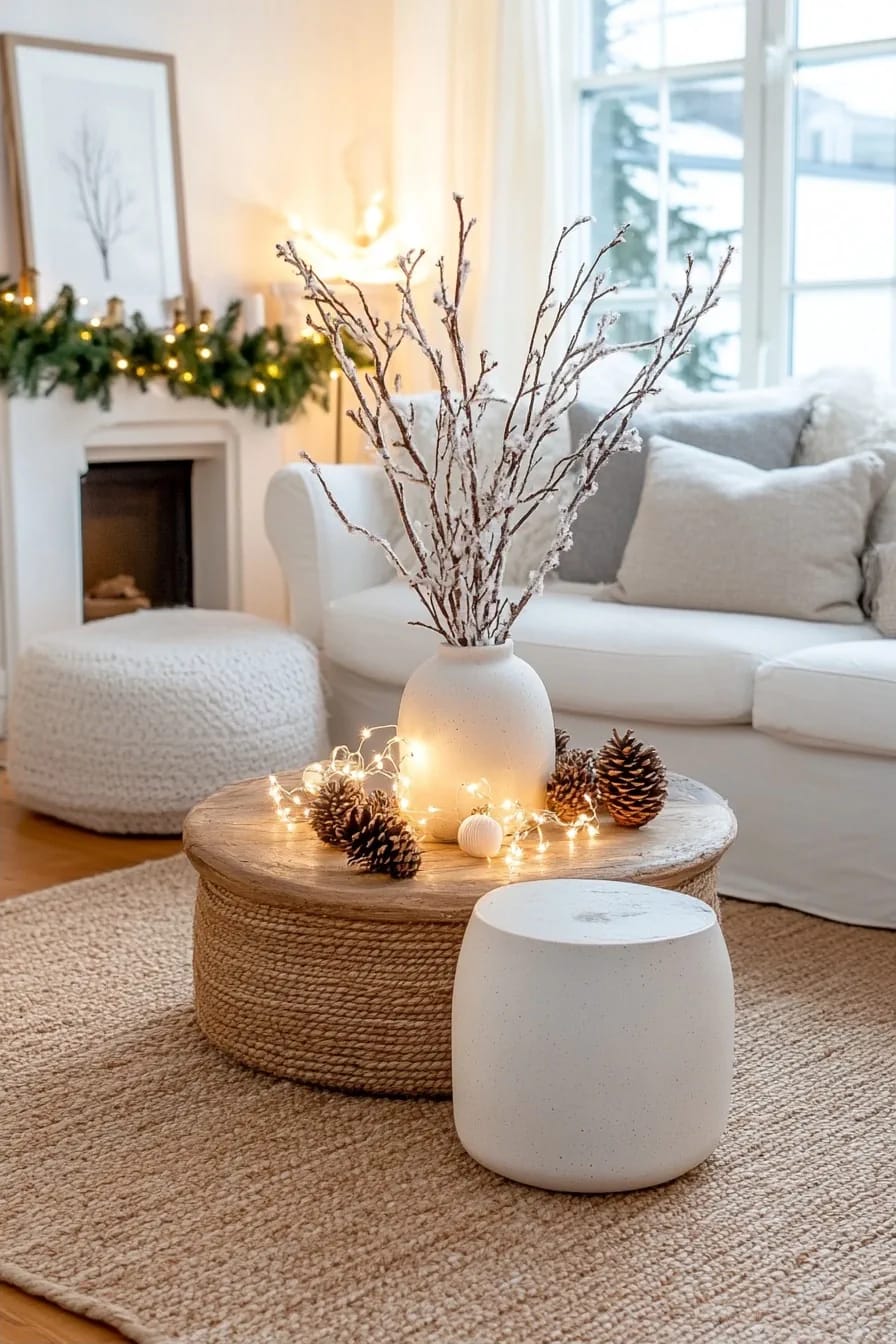
Fill the tree's footprint with bare branches in a heavy floor vase, wrapped with the warm white lights you already own. Birch and manzanita are the two that read as sculpture instead of yard waste, and both are sold at florists' suppliers by the bundle for around $15 to $30, though a neighbor's pruning pile is free and usually better shaped. Weight matters more than the branches do: a vase that tips is a vase you will move to the garage in a week, so put a brick or a bag of gravel in the bottom before you add anything else.
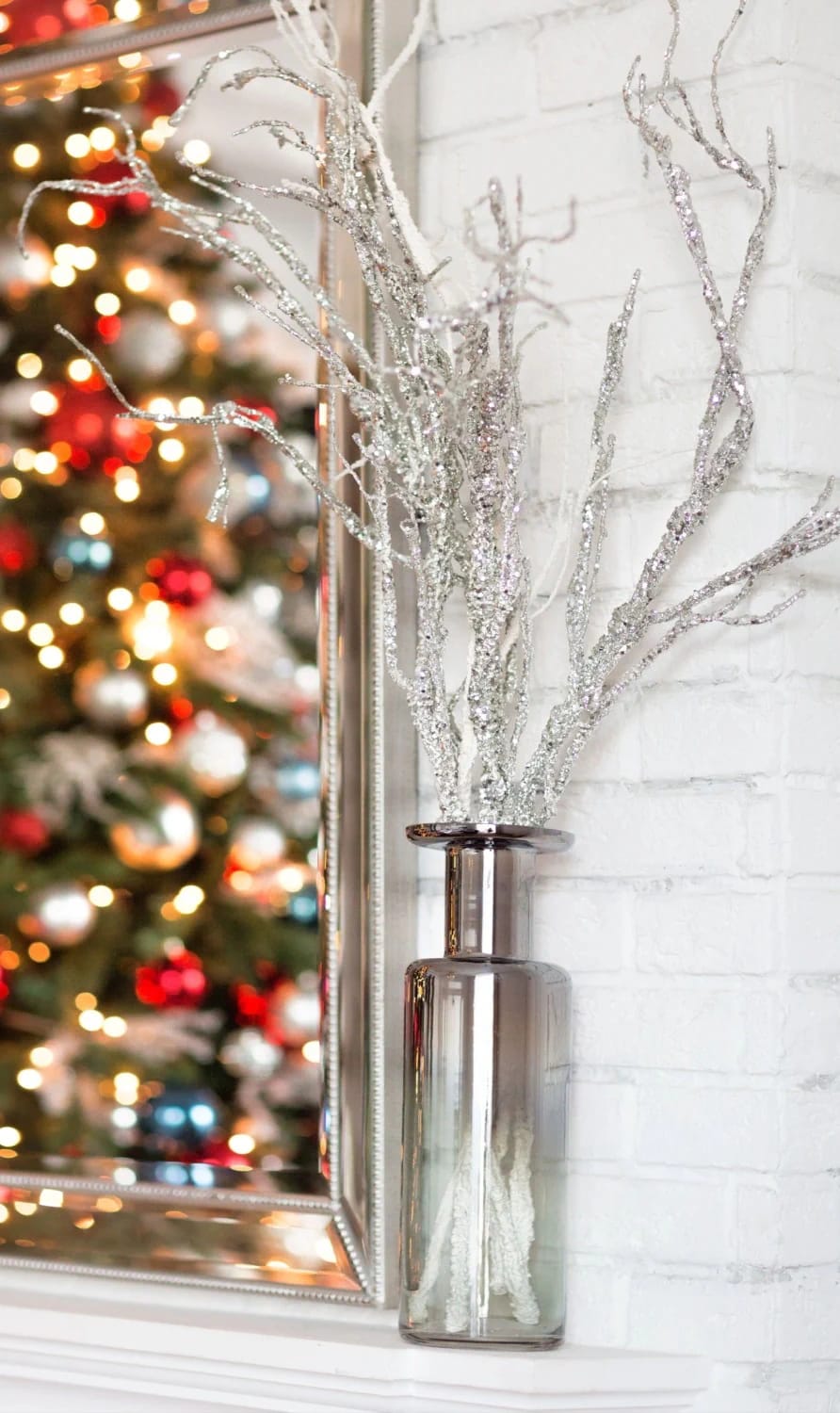
Granted, this only works if the branches are tall enough to read from across the room. Under about four feet they look like a failed centerpiece that wandered onto the floor. If your ceiling is low or your square footage is measured in a single room, the tighter versions of this idea, including where a branch arrangement can actually go when the floor is already spoken for, are worth reading before you buy a vase.
2. Strip the red out of the mantel garland and keep the green

Pull the red ribbon, the glass berries, and the pine cones with glitter on the tips, and the same garland becomes winter greenery. This is a fifteen minute job and it is the single highest return move on this list. What is left should be eucalyptus, olive, cedar, or fir, plus something dry and pale (wheat, bunny tail grass, seeded eucalyptus) so the green has a partner. If you are building a base garland from scratch rather than rescuing one, the eucalyptus and pine method gets you there for about a quarter of the florist price.

3. Leave the fairy lights up until March (warm white only)
Keep the lights and take down almost everything else. The instinct in January is to strip the house of anything that twinkles, and it is the wrong instinct: at 4:30pm in February you have three hours of dark to fill and no daylight to fill it with. What makes lights read as Christmas is not the light, it is the red and green plastic they are stapled to.
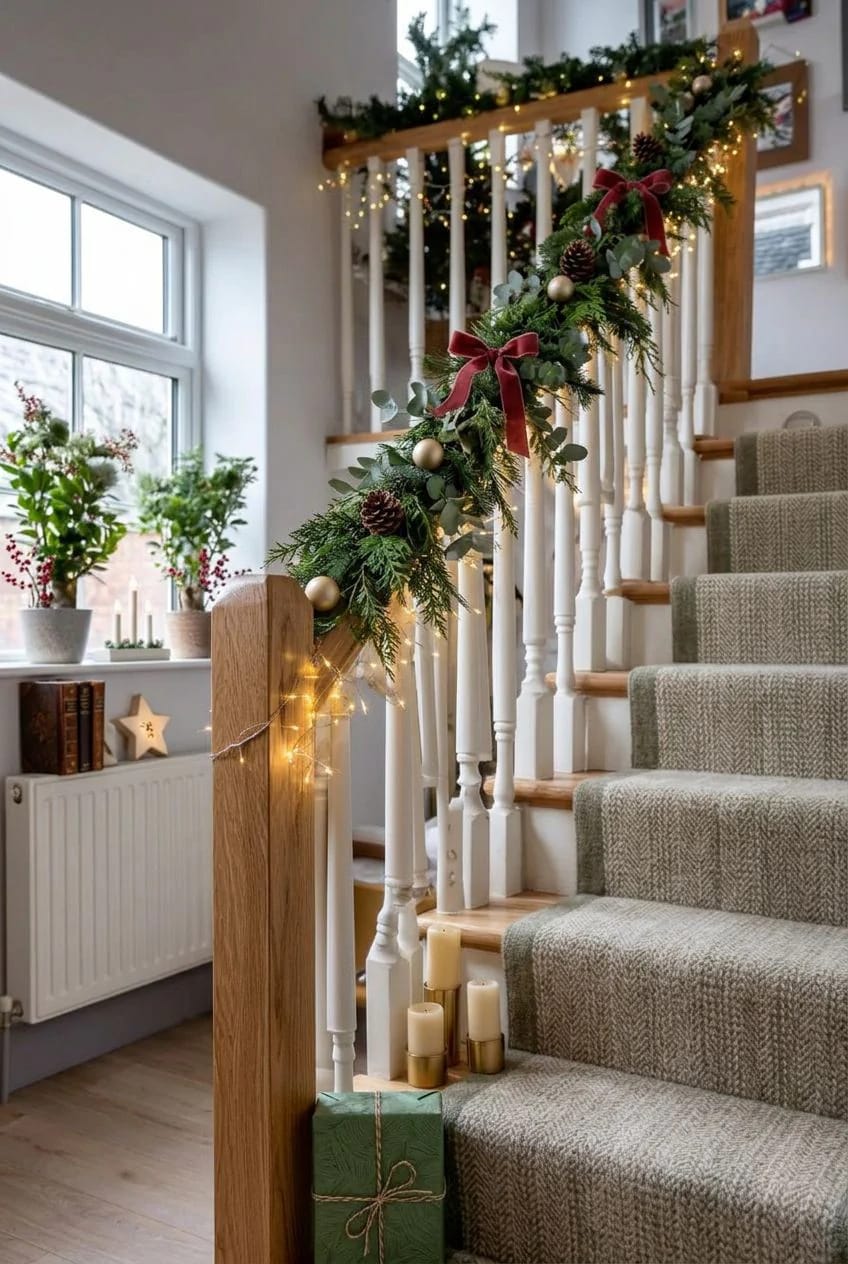
So: warm white strands only, on copper wire rather than green cord, and put them somewhere structural rather than draped on a shrub of tinsel. A banister, a bookshelf's back edge, the frame of a large mirror, the inside of a glass demijohn. Multicolor strands and anything labeled "twinkle" go back in the box.

Put the whole thing on a $12 smart plug set to come on at dusk and off at 11pm. True, that is a small expense for something you could flip with your hand, but the reason people take lights down in January is not taste, it is the nightly chore of switching them off, and removing the chore is what buys you February.
The surfaces that go bare on December 26
4. A bowl of winter citrus beats a bowl of ornaments

January is peak citrus, which is the one seasonal fact the winter decorating internet keeps ignoring in favor of dried orange slices from November. Moro blood oranges run roughly January through March, Cara Caras from January into April, and Meyer lemons hold through winter into early spring. Pile them whole in a shallow wooden bowl or a footed compote, leaves on where you can find them, and you have a centerpiece that costs $6, smells like something, and gets eaten before it can rot.
Skip the dried slices. They were beautiful in December and by mid January they are dust magnets with curled edges. If you want the table to hold longer without fruit, the natural centerpiece formats that survive weeks on a warm table are the better route.
5. Pinecones in a wooden bowl, no glitter, no glue
Bare pinecones in a dough bowl with two or three beeswax pillars is the version of this that does not look like a school craft table. The gold spray paint, the fake snow tips, the cinnamon scenting: all of it dates the arrangement to December 24 and none of it survives contact with January light.
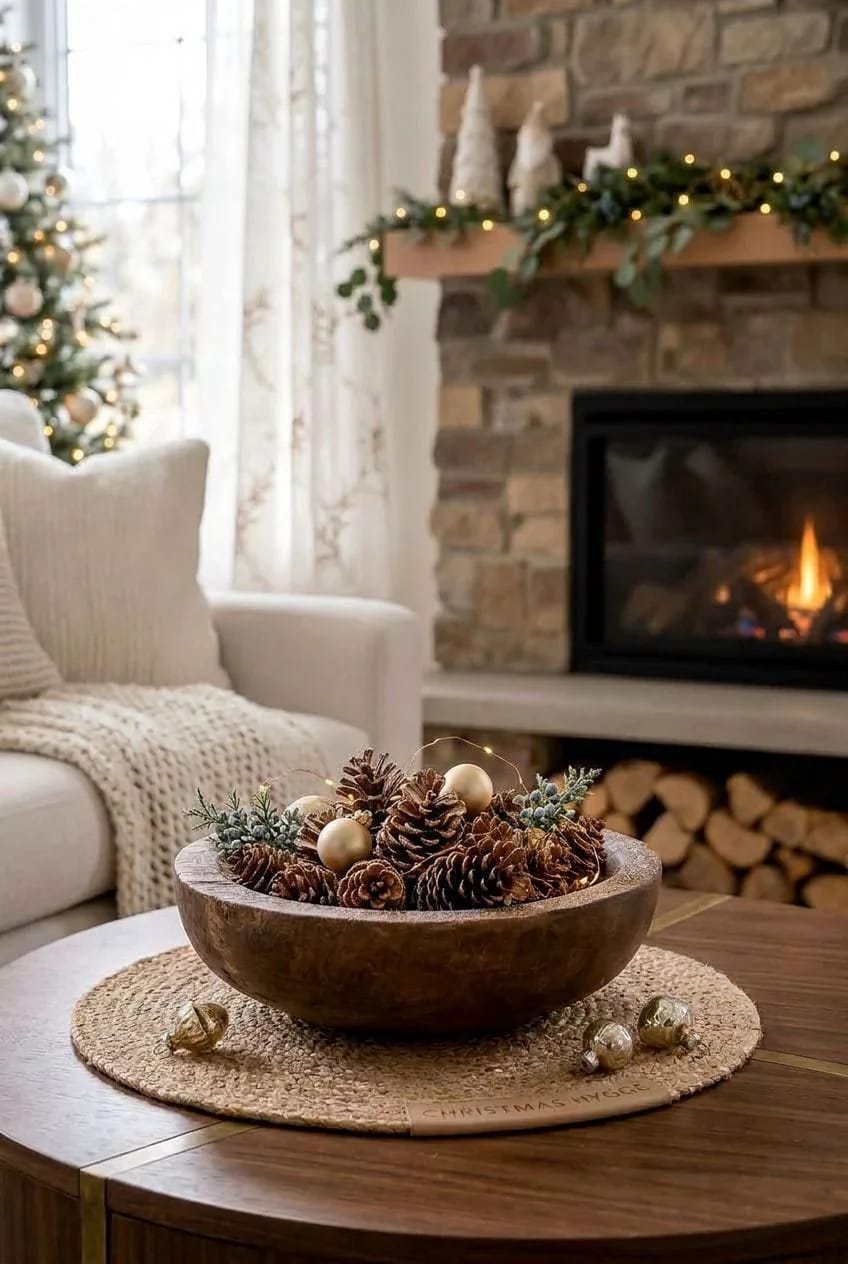
Bake foraged cones at 200F for half an hour on foil first. It kills whatever is living in them and opens the scales, and if you have never done it, the smell of warm resin is the good part of the job.
 25 Pinecone Christmas Decorations You’ll Want to Keep Up All Winter Twenty five ways to use the cones beyond a bowl, most of which hold up long past December.
6. Epsom salt jars are the one snow effect worth doing

Epsom salt over a thin coat of glue gives you a frosted jar that looks like frost. Glitter gives you a jar that looks like a craft store exploded, and glitter is a microplastic besides, so the version worth making is the plain one: brush the outside of a jar with white school glue, roll it in Epsom salt on a plate, let it dry for an hour, drop in a battery tea light. Total cost is a jar you were recycling anyway and about 40 cents of salt.
Use whatever glass you already have, since the squat sauce jars and yogurt pots throw better light than the mason jars everyone tells you to buy.
7. Force forsythia in February so the table has something alive

Cut branches in late January or February and the house gets flowers three to six weeks before the yard does. The mechanism is simple: spring bloomers set their buds the previous summer and need roughly six weeks below about 40F before they will open, so once your cold has been banked (mid January in most of the country) any mild day above freezing is a cutting day. Forsythia is the reliable one, usually blooming indoors in one to three weeks. Pussy willow is faster and flowerless, quince is slower and worth the wait, and crabapple and magnolia can take four to five weeks.
Cut stems 18 to 36 inches long from branches you would prune out anyway, take them at an angle just above a side bud, and stand them in warm water in a cool bright room out of direct sun. Change the water every two or three days. Once the buds crack, move them where you actually sit. Expect the open flowers to hold about a week, which means a second cut in mid February keeps the table going into March.
The caveat nobody mentions: cut too early, before the chill requirement is met, and the buds swell, stall, brown, and drop. That is not a technique failure, it is a calendar failure.
Warmth is a texture, light and scent problem
8. Set the palette with pillow covers: cream, bark, one cold blue
Buy covers, not cushions. A set of four covers in wool, boucle, or heavy linen runs about $12 to $25 each and stores flat in a drawer; four new cushions cost triple and live in your closet forever. The palette that reads January rather than leftover December is cream plus a real wood brown (bark, chestnut, unbleached jute) plus exactly one cold accent, a slate blue or a grey green, used once or twice and no more.
Texture does the work that color used to do in December, so vary the weave rather than the hue: one flat linen, one ribbed knit, one long pile, one smooth. Four cushions in the same oatmeal boucle is a sofa wearing a uniform. If you want the whole room to lean natural rather than seasonal, the natural-material version of winter decorating is the same idea taken further.

9. Turn off the overhead light and run three lamps at 2700K

The ceiling fixture is what makes a January room feel like a waiting area. Kill it and put three lamps at different heights around the room instead: a floor lamp behind a chair, a table lamp at sitting height, something low on a shelf or a sideboard. Standardize the bulbs at 2700K, the color of an old incandescent, which is the warm end of "warm white" and the one used in living rooms and hospitality spaces for exactly this reason. 3000K is not wrong, it is just cleaner and more task-like, and mixing the two in one room is what makes a space feel unresolved.
Dimmable, 800 lumens, and the right color temperature for the whole room in one four-pack, so your lamps stop disagreeing with each other.

10. Change the scent from cinnamon to fir, beeswax and grapefruit

Cinnamon and clove are Christmas in a bottle, and burning them in February is why your house still smells like December. Swap to fir, cedar, beeswax, vetiver, or citrus. Two beeswax pillars burning does most of the job for free, and a pan of water with grapefruit peel, rosemary, and a handful of fir tips off the discarded tree, held at a bare simmer, will scent a floor of the house for the cost of the water.
The door, the porch and the birds
11. Rebuild the Christmas wreath into a January wreath
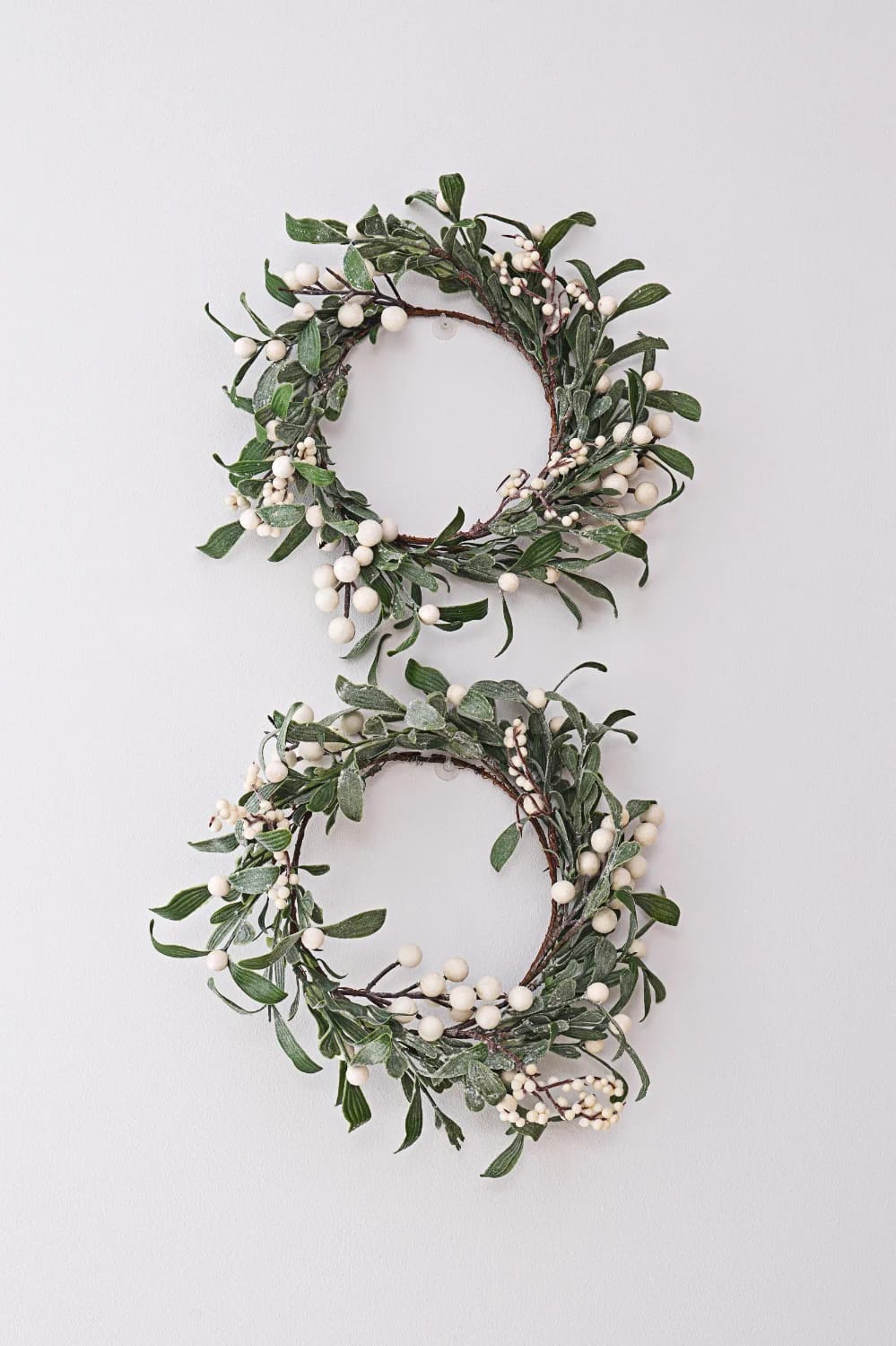
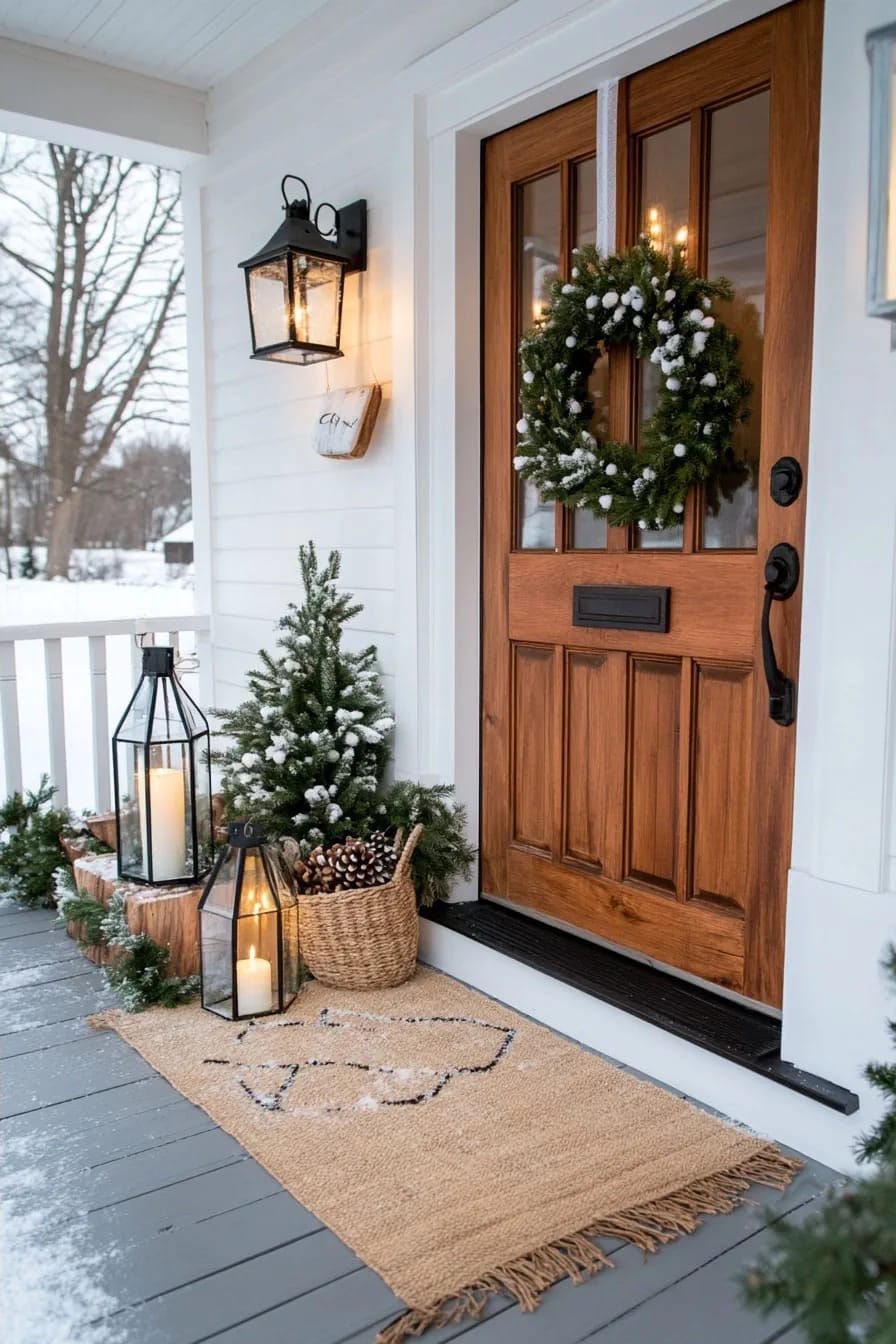
Take the wreath down, cut off everything that says December, and wire in something dry. A fir wreath hung in the shade on a cold porch will hold four to six weeks and often longer, so the one on your door right now is probably still fine; it is the trim that has expired. Replace the red velvet with a magnolia leaf or two, a fan of dried grasses, a few olive branches, or nothing at all. A plain grapevine ring with three eucalyptus stems wired at seven o'clock is the version that will still look deliberate in March.
Do this
- Strip the ribbon, berries and bells before you decide the wreath is dead. Usually it is not.
- Wire, do not glue. You will want to change this again in six weeks.
- Hang it out of direct sun. A shaded north-facing door is why some wreaths make it to spring.
Avoid
- Canned spray snow.
- An oversized burlap bow, which is just the red bow wearing a costume.
- Leaving a wreath up once the needles go dull grey-green and snap instead of bending.

 15 Natural Front Door Winter Wreaths for an Inviting Entryway Fifteen builds that start from foraged greens rather than a craft store base.
12. Refill the porch urns with birch poles and curly willow
The pots either side of your door are the loudest thing on the house from the street, and in January they are usually holding a dead poinsettia. Rebuild them with height instead of color: three birch poles cut to about five feet, a fan of curly willow or red twig dogwood behind them, and evergreen boughs pushed into the soil around the base. Outdoors in the cold, cut greens hold four to six weeks and in a cold climate they routinely run to March, which is the entire argument for putting them outside rather than on your mantel.

Water the soil in the pots until it freezes solid. That is the whole maintenance program, and it is the difference between a display that browns by mid January and one you take apart in March because you want to, not because you have to. For the pieces around the pots, the porch projects that add no plastic to the yard are the right companions here.

Cut evergreens indoors last about two to three weeks in a heated room, not the whole winter. Once the needles are dull grey-green and snap rather than bend, they are dry enough to be a fire load, and that is the moment people are hanging string lights on them. Take dried greenery down, keep any greens you do keep away from vents and candles, and use LED strands only, which do not run hot. Cold and damp is what preserves this stuff, which is why the porch and the door hold it and the mantel does not.
13. Hang a feeder where you can see it and let the birds be the decor
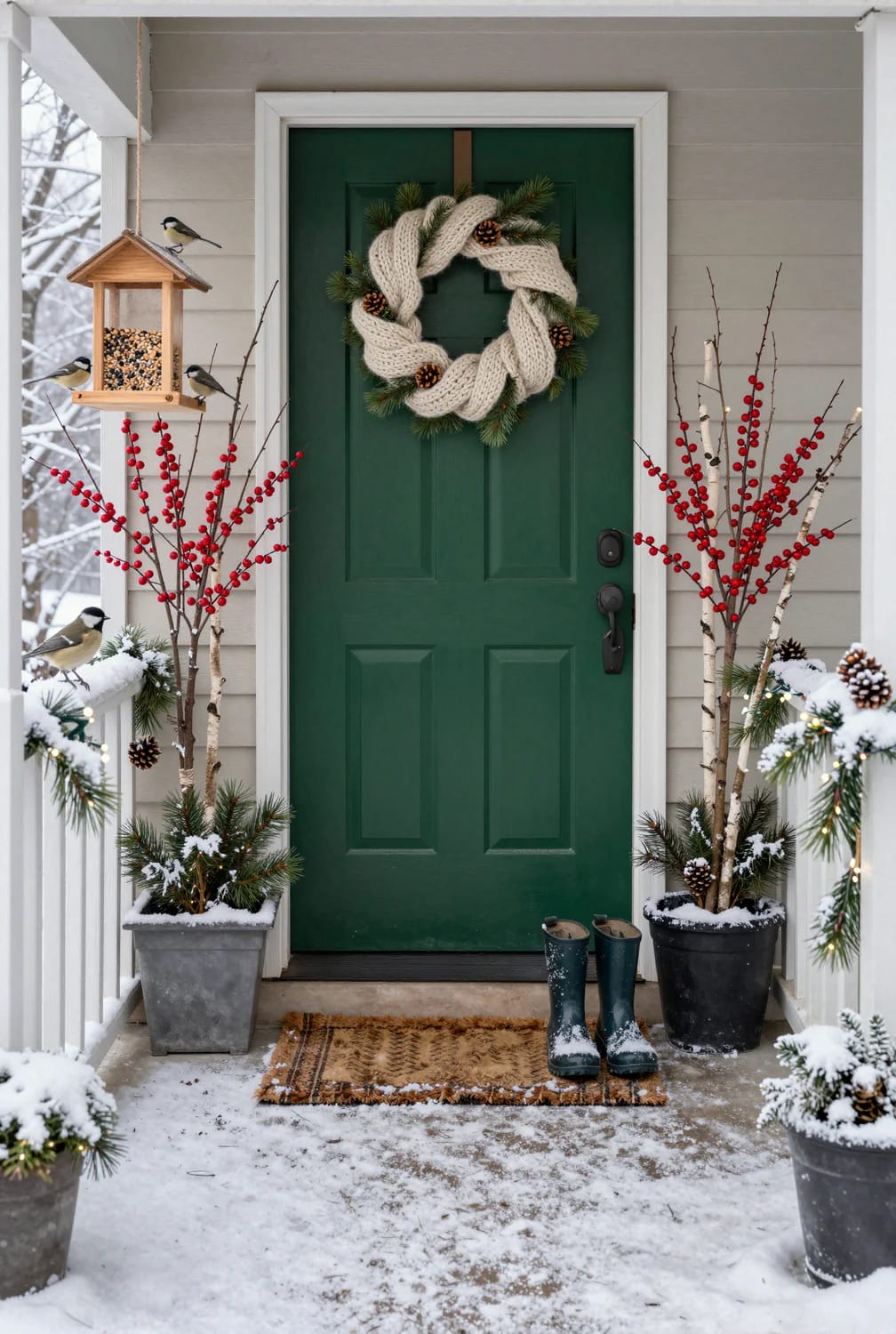
The most alive thing in a January window is not a decoration, it is a chickadee. Hang a suet cage and a tube of black oil sunflower where you can see them from the chair you actually sit in, and the view does more for the room than another candle would. Suet is close to pure fat and black oil sunflower is around 40 percent fat with a thin shell, which is why the Cornell Lab calls the latter the most important seed of the winter feeder.
Two placement rules, both non-negotiable: put feeders either within about three feet of the glass or more than thirty feet away, since the deadly zone is the middle distance where birds build up speed before they hit the window, and skip bread entirely, which fills a small bird up and feeds it nothing.
Do it in three passes, not one afternoon
Pass one, the day the tree goes: strip the red from the mantel garland and the wreath, pull the ornaments, leave the fairy lights and the greenery. That is twenty minutes and it removes ninety percent of what makes a room look like a party that ended.
Pass two, the first week of January: swap the pillow covers, standardize the lamp bulbs, put a bowl of citrus where the ornaments were, and rebuild the porch urns while the boughs from your tree are still fresh enough to use. Pass three is February, and it is one job, cutting forsythia.
The one thing I would plan for now rather than later is that chill requirement. Branches cut before roughly six weeks of cold will swell and stall and then quietly brown on your table, so mark a date after mid January and cut on the first mild day above freezing. Everything else on this list forgives bad timing. That one does not.
Related Posts
- 23 Elegant Christmas Decor Ideas You’ve Never Seen Before
- 25 Pinecone Christmas Decorations You’ll Want to Keep Up All Winter
- 25 Trendy Christmas Winter Decor Styles to Inspire
- 31 Creative Upcycled DIY Christmas Decorations for a Cozy Holiday
- 23 Super Cozy Christmas Fireplace Decor Ideas to Try
- 7 Free Christmas Decorations You Can Make From Evergreen Branches