
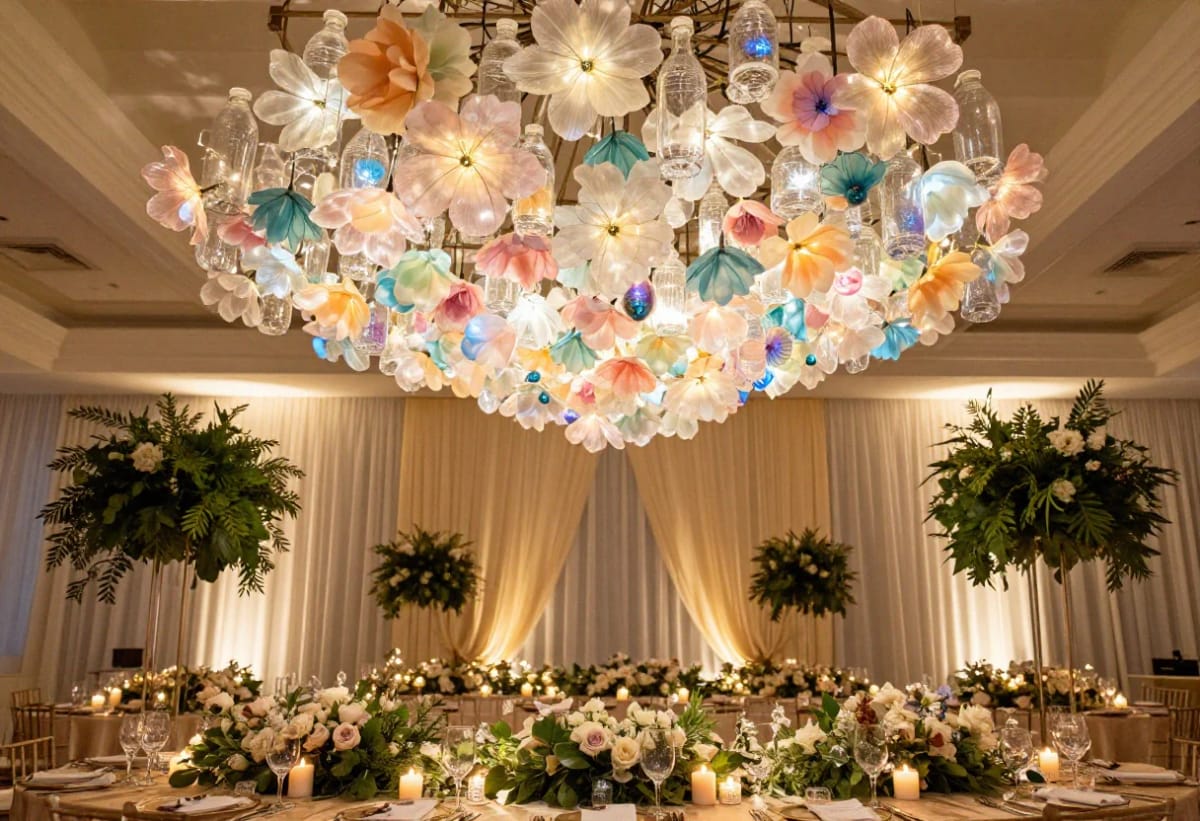
Most plastic bottle flower chandeliers fail for a reason that has nothing to do with the bottles: the maker paints them. Spray paint turns a translucent 2-liter into an opaque shell, and an opaque shell hanging over a party ceiling reads as exactly what it is, a bag of bottles with a light behind it. The Chihuly effect everyone is chasing comes from light moving through the plastic, and paint is the fastest way to stop that happening.
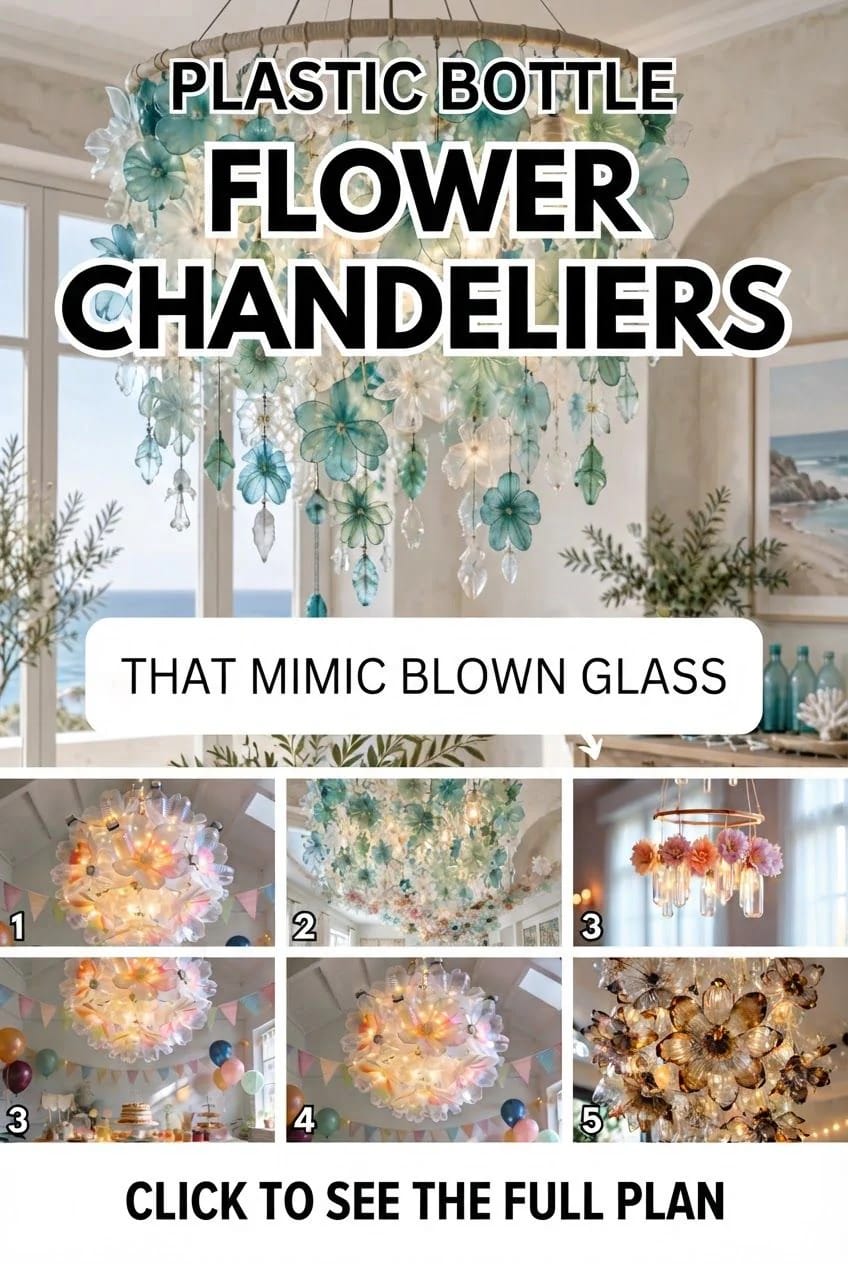
What follows runs the whole chain: cutting and heating petals so they curl the way glass does, tinting and frosting them so they still pass light, the armature that keeps the whole illusion hanging square, and the part most guides skip entirely, which is scaling one chandelier into a ceiling.
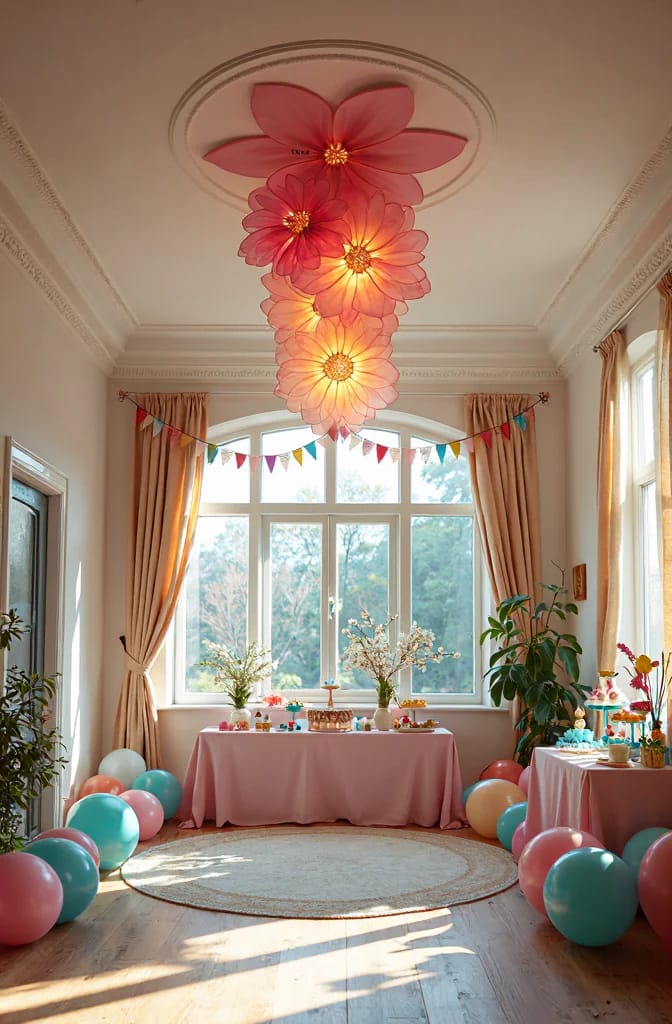
One thing up front. This is a plastic installation and from a foot away it looks like one, seams, edges, the ghost of a label. From across a room, with a single warm light under it, it is a different object altogether. Everything below aims at that second view.
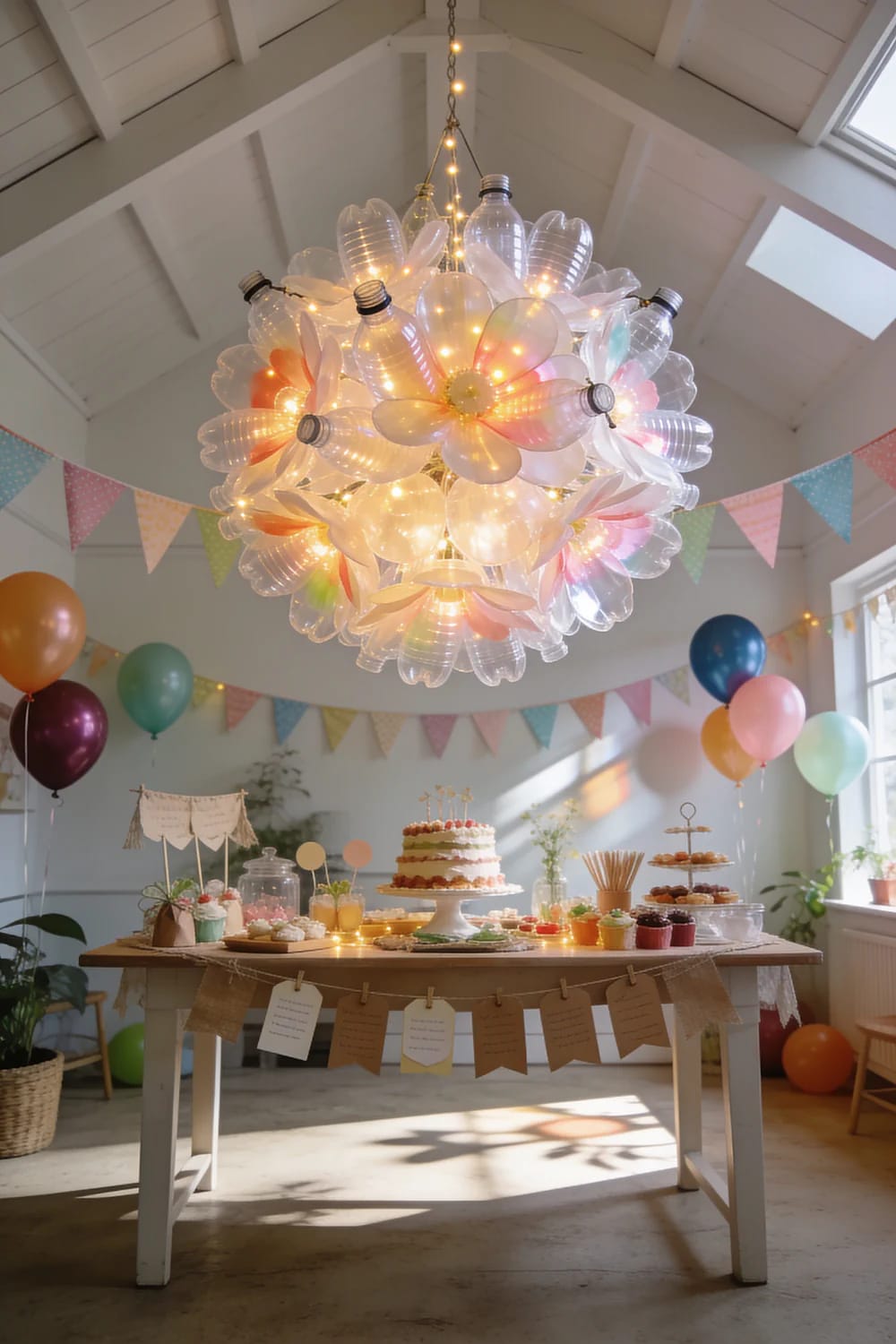
Party venues are the constraint nobody plans for, and the rules are stricter than most people expect. Some allow only adhesive hooks and decorator clips. Some prohibit ceiling attachment outright in certain rooms. Several cap hanging weight at around 5 lb per attachment point and bill you for anything they did not approve beforehand. A single 3-foot bottle chandelier is light, roughly 2 to 4 lb with its armature, but a full canopy of stranded flowers adds up faster than it feels like it should while you are standing on a ladder. Get the decoration policy in writing before you cut a bottle, and never attach anything to a sprinkler head, a light fixture, a ceiling track, or an air duct.
Shaping the Blooms
Every flower below starts as the same object, and the differences come from how you cut it and what you do to the cut edge. Judge each one on a single question: does the finished petal catch and pass light the way glass does? Two bottle types do most of the work.
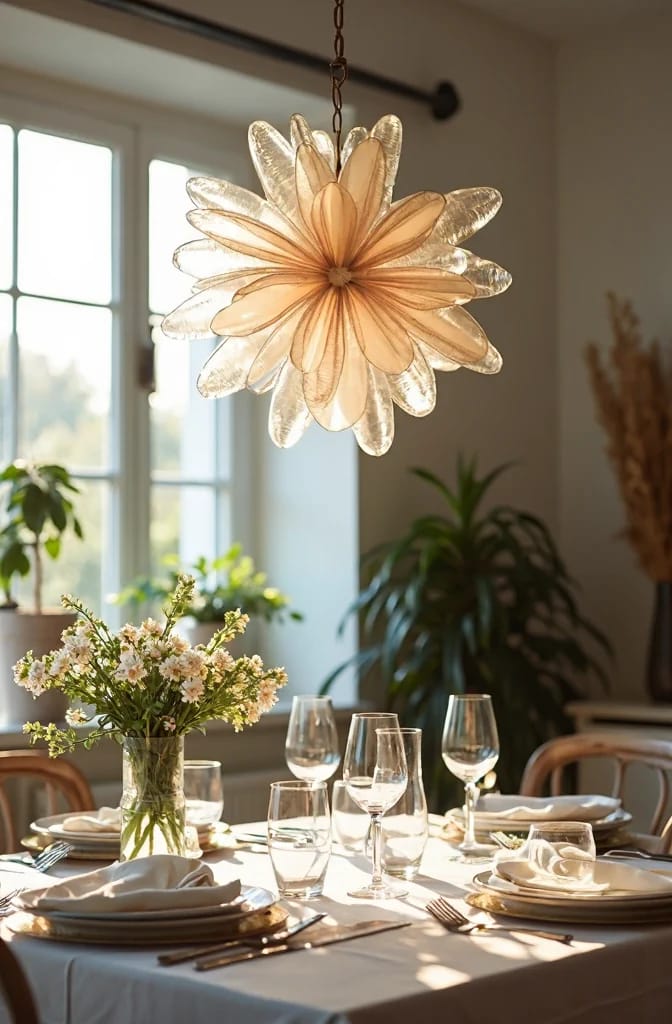
Heat-gun 2-liter petals, the shape worth copying first
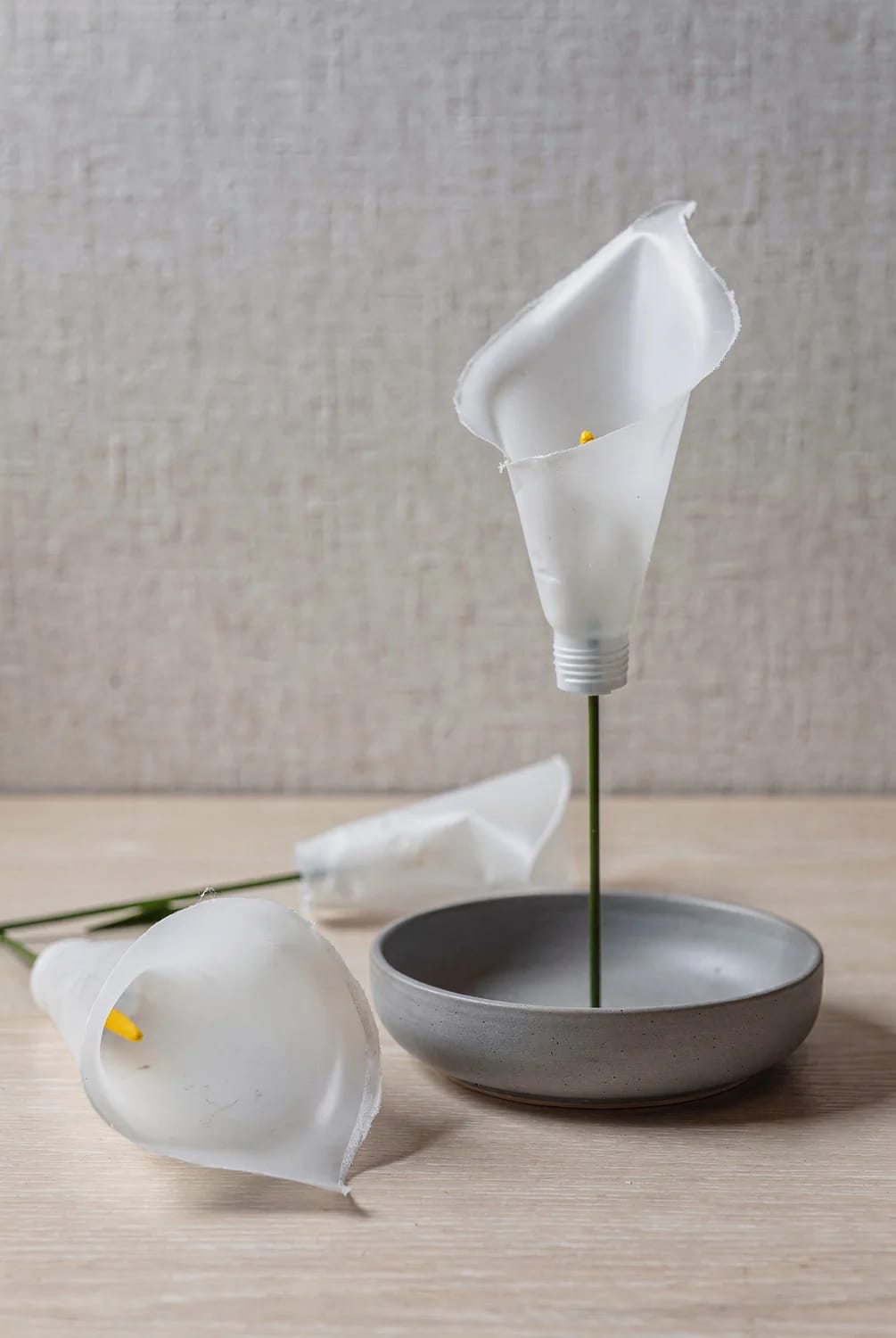
Milk-jug calla lilies, cut from one curled sheet
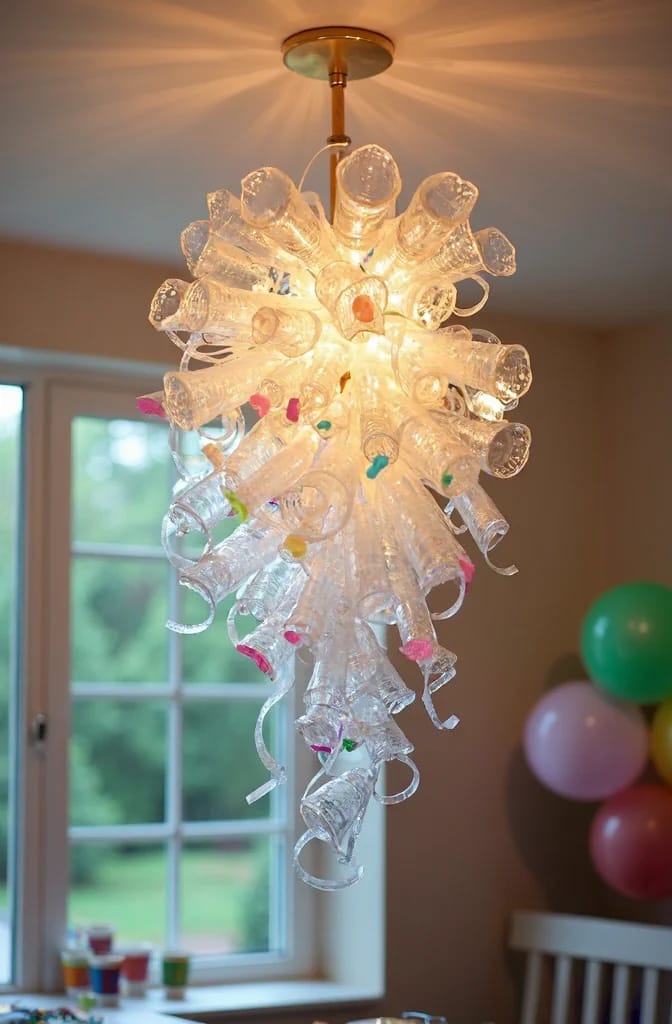
A 2-liter PET bottle turns glassy at around 176°F, and it does most of the shaping itself. Cut the top off, cut down the bottle's own molded grooves, flip the piece so those grooves face the table, then pass a heat gun over it. The ribs soften, thicken, and crumple upward into a curl you could not have cut by hand. A five-groove bottle gives you a five-petal flower, so the bottle picks the petal count before you do.
Granted, PET gives you a narrow window. Its glass transition sits near 176°F and its melting point is closer to 482°F, and everything between those two numbers is where the material goes from soft to stringy to ruined. Hold the gun three or four inches off the plastic, keep it moving, and stop the moment the petals hold a curve. A hair dryer will not get you there; the one in your bathroom tops out well below the working range, and you will spend twenty minutes wondering why nothing is happening.
Work outdoors or at an open garage door. Heated PET smells like a sweet version of a burnt photocopier, and that odor is the least of it. Wear thin gloves, because the plastic stays hot far longer than it looks, and keep a flat metal tray to drop pieces onto. A dual-temperature heat gun is the one tool worth buying for this, typically $25 to $40, and the spreader nozzles that come with a kit make an even pass across a wide petal much easier. Wagner HT1000 heat gun kit with three nozzle attachments
Spiral-cut bottle trumpets that unwind as they hang
Cut one continuous strip from a 500 ml bottle, starting at the base and running up toward the neck without ever lifting the scissors, and you get a long ribbon of plastic that curls into a trumpet bloom as it hangs. The strip holds its own twist, and that twist is what gives these flowers a throat instead of a flat face, which is the difference between a petal and a shard of glass.
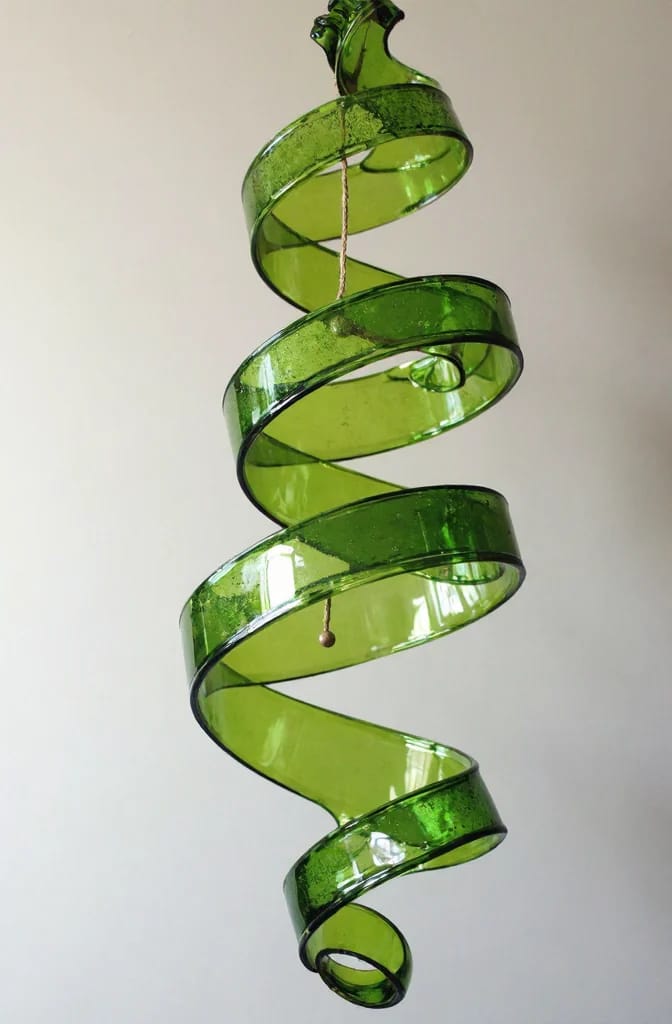
Stop the cut before the shoulder. Run into the neck and the spiral loses its spring, hangs limp, and looks like a peel. Stop where the bottle starts to narrow and the ribbon keeps a natural coil that reads as a long-throated bloom from below. A ceiling’s worth of spiral cutting leaves dozens of bottle bases behind, and the planter projects that use up the leftovers are worth a look before any of it reaches the bin.
Bottle-cap centers and neck strips for the middle of the flower
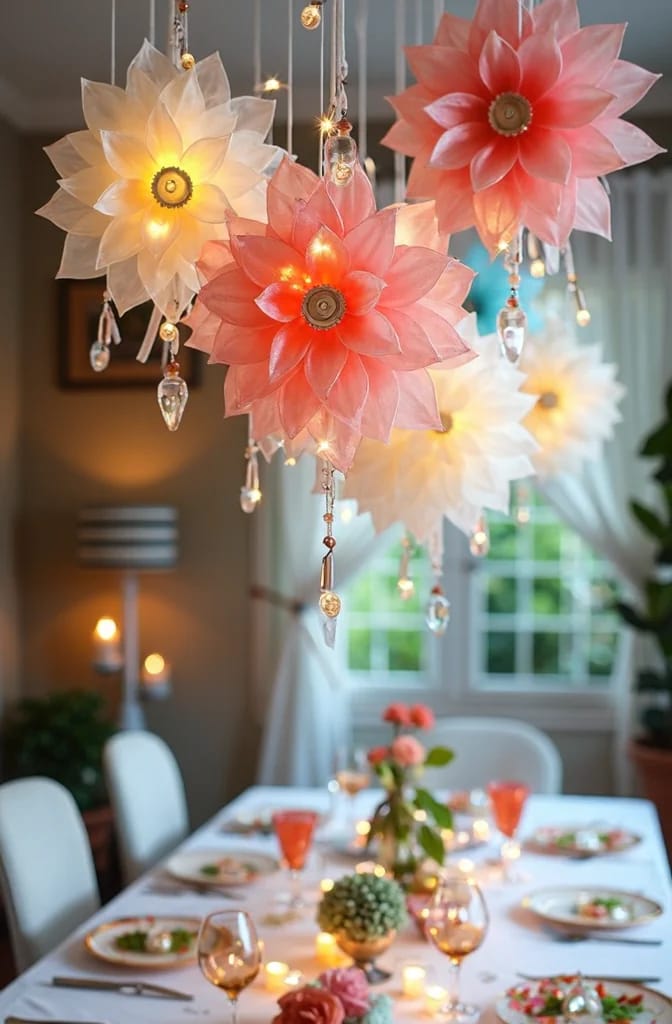
The center is what stops a plastic flower from reading as a plastic flower. A heat-formed petal ring with an open hole in the middle looks unfinished from underneath, and a party ceiling guarantees that everyone sees it from underneath.
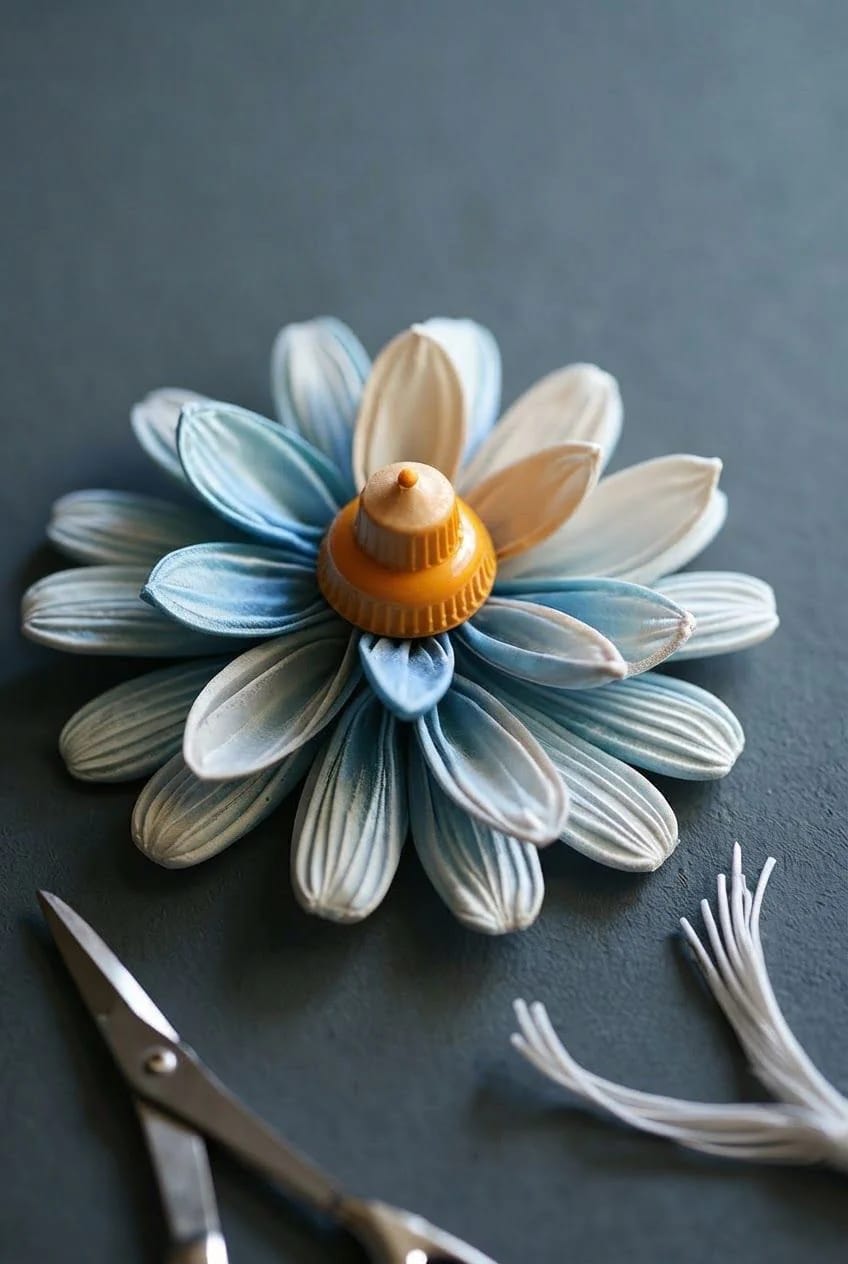
Two cheap answers. Glue three or four bottle caps into a short stack and thread it onto the strand so it sits like a stamen. Or cut the bottle’s neck into strips about an eighth of an inch wide, fan them out, and hit them with the heat gun for ten seconds; they curl into a starburst that fills the throat. Both are worth doing, and the cap stack is faster if you are making thirty flowers. Scraps suit this job better than anything you would buy for it, which is roughly the point of turning the offcuts into art projects of their own rather than sweeping them up.
 12 Surprising Crafts With Old Pill Bottles Why the small amber bottles slip through recycling sorting and are worth keeping, and what they turn into.
Making Plastic Read as Glass
Alcohol ink instead of spray paint, so the light still gets through
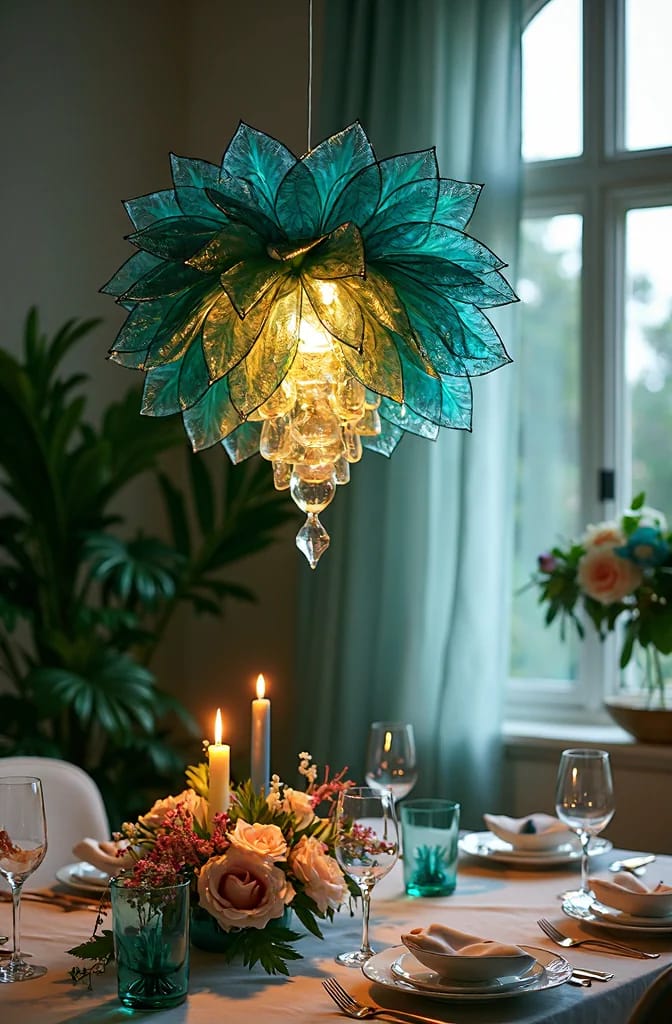
Alcohol ink is the right colorant for PET and spray paint is the wrong one. Paint sits on top of the plastic as an opaque film, and the moment it goes on, the material stops being translucent and starts being a painted bottle. Ink sinks in and stains rather than coats, so the surface keeps passing light. (The spray-painted chandeliers are usually photographed from across the room, which tells you most of what you need to know.)
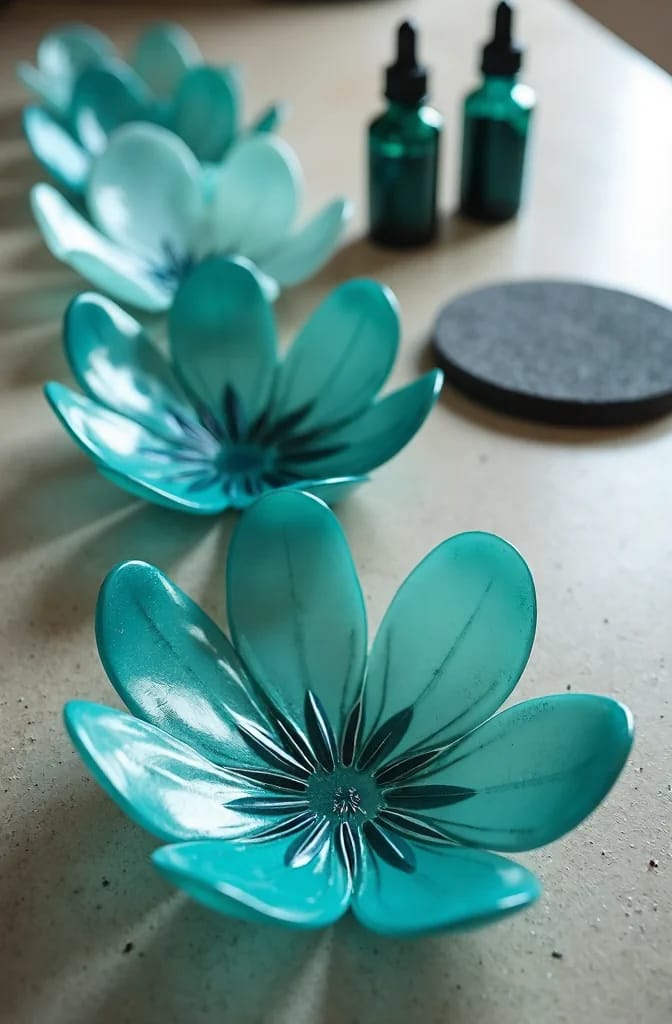
Dab it on with a felt pad over nitrile gloves, in a ventilated room, because alcohol ink is mostly solvent. Two drops per petal goes further than it looks like it will. Build the color in layers and let each one flash off for a minute rather than going dark in a single pass; a 24-color set covers a full party’s worth of petals and costs less than one can of good spray paint. SigWong metallic alcohol ink set, 24 colors in 10 ml squeeze bottles
Rim-dipped varnish that darkens the petal edges
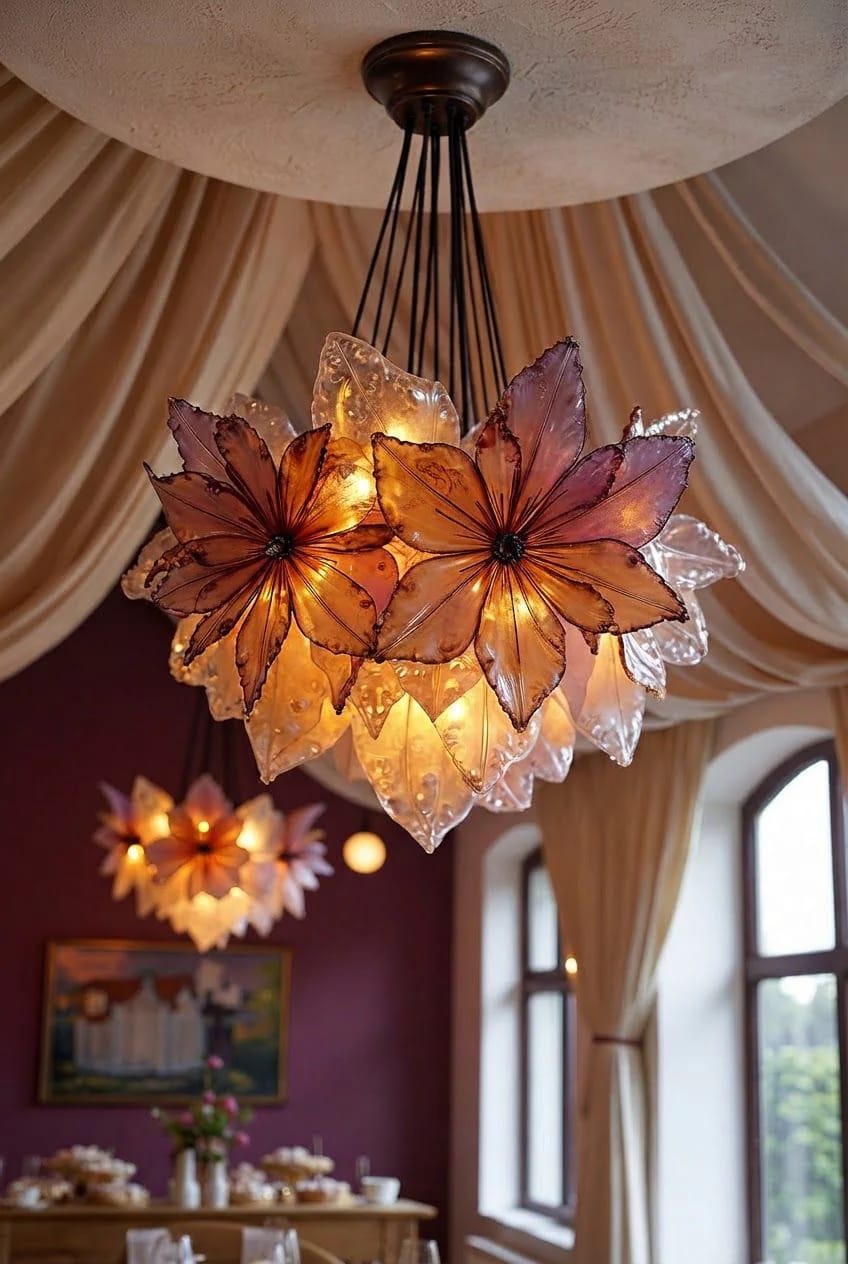
Blown glass is never one flat color. It darkens where the wall of the vessel thins at the rim and lightens across the belly, and that gradient is most of why the real thing costs what it costs. You can fake it in about a minute per petal by dipping the outer edge into tinted translucent varnish and letting it drain.
Use a water-based varnish made for glass and plastic, not a polyurethane, which yellows on PET inside a season. Hold the petal face down, dip only the outer quarter inch, and hang it nose-down so the excess runs toward the tip instead of pooling in the throat. Drain lines are the effect, not a defect, so a slower-drying varnish is the wrong answer if you want them crisp. For the rest of the finish work on this kind of piece, the broader set of upcycled craft techniques is a useful next stop.
Frosted bottle flowers for a sea-glass chandelier
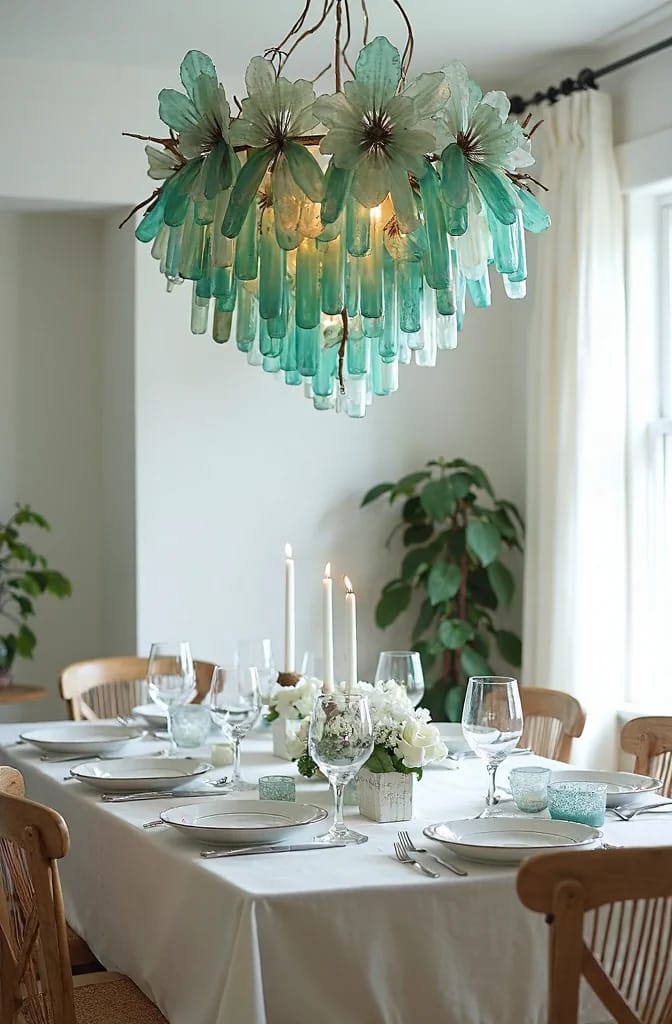
A matte surface scatters light instead of passing it in a straight line, and scattered light is what makes a guest stop and ask what the chandelier is made of. Sea glass is the reference point: real beach glass is frosted by decades of tumbling, and the softness is the whole appeal.
Granted, frosting also eats color. Go one shade darker in the tint than you think you want, because a matte surface reads about half a step lighter under a party light than it does in daylight on your kitchen table.
Two routes in. Wet 400-grit paper worked over the outside of the petal gives you the most control and the most convincing result, because the scratches follow the plastic's own curvature. A matte clearcoat is faster, and on thin PET it can craze along a fold within a few weeks, so save it for petals with no sharp bends.
UV-reactive pigment for a blacklight bottle flower chandelier
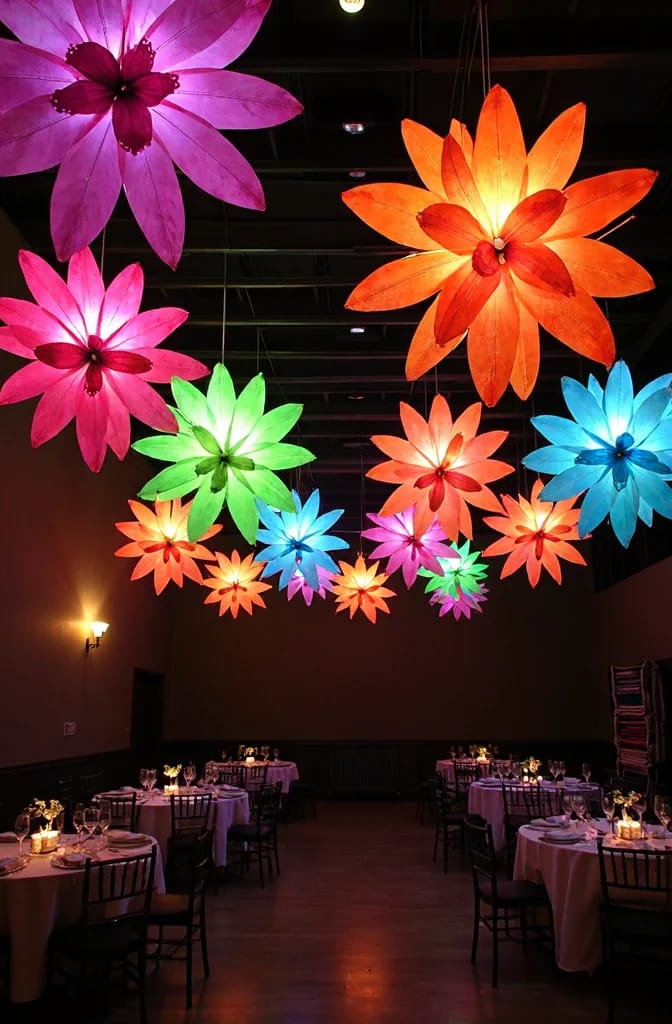
For a party that runs past dark, fluorescent pigment turns a white ceiling into the best thing in the room. Fluorescent colorants absorb ultraviolet light and re-emit it in the visible range, so under a blacklight the flowers glow hard while the tables, the floor, and the guests stay dim. It is the closest a plastic bottle gets to looking lit from inside.
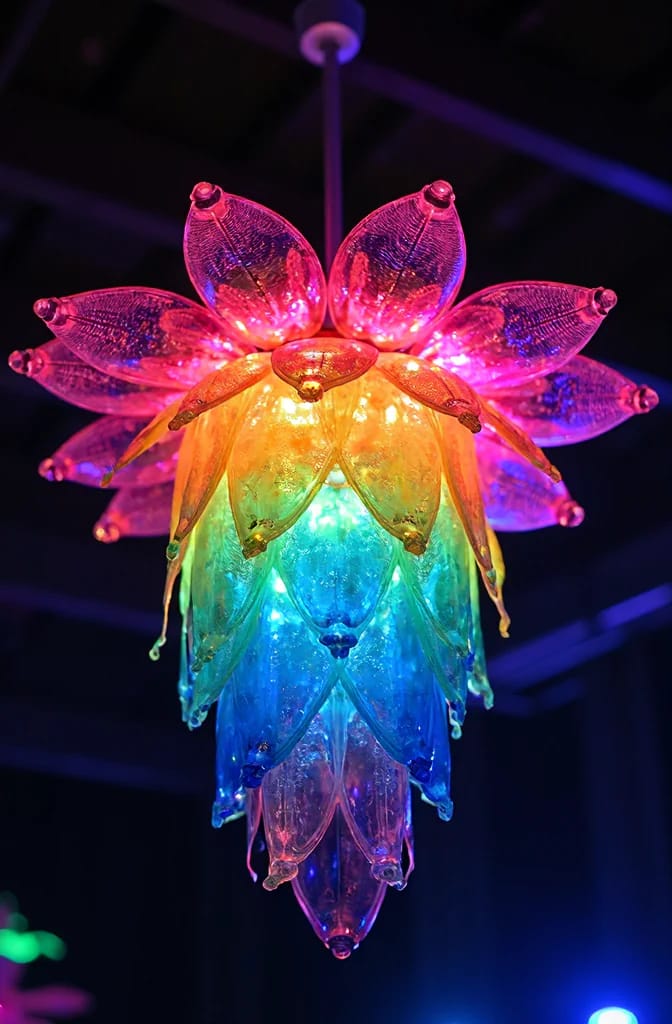
Two ways in, and the ink route is the better one. Fluorescent alcohol ink applies exactly like the standard tint and stays inside the plastic, which keeps the petals translucent between the glow. A UV-reactive clearcoat sprayed lightly over finished petals works too, though it sits on the surface and adds a sheen that undoes some of the matte finish.
Do not mix fluorescent and standard ink on the same flower. Under UV the fluorescent one takes everything and the other goes grey, and you will not notice until the lights go down.
The Rig That Keeps the Illusion Up There
This is the part that decides whether the installation survives the night, and it is also the part that decides whether it reads as glass. A chandelier hanging crooked looks like a craft project no matter how good the petals are, because everything that makes plastic pass for glass depends on the light hitting it from a predictable angle. These three ideas are ordered by how much they change the result.
A hula-hoop armature with a swivel, so the whole thing turns
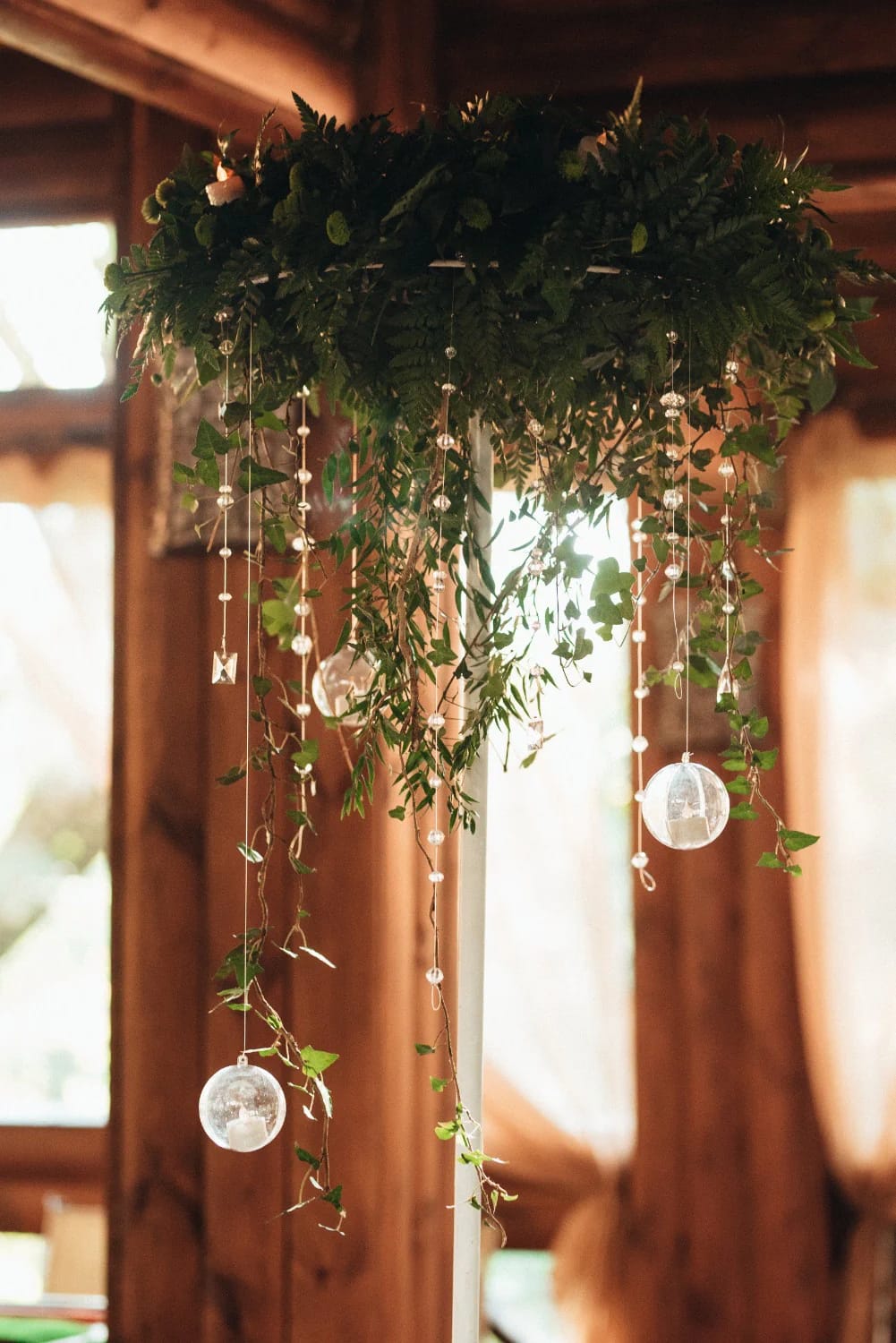
A hula hoop is the cheapest rigid ring you can buy, and a 30-inch hoop is already the right proportion for a three-foot chandelier. The plastic ones are light and hold a circle better than expected once they are carrying an even load.
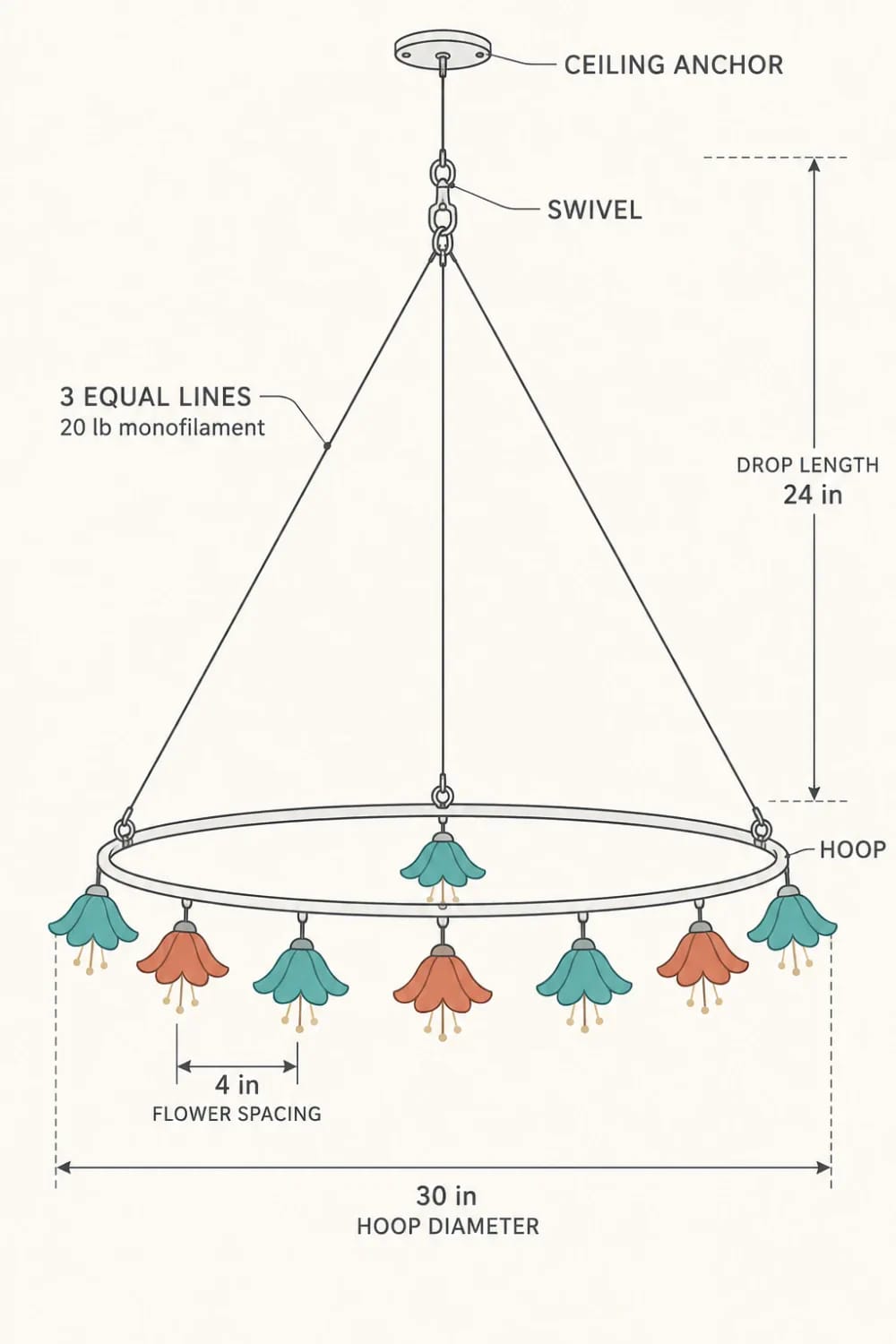
Hang it from three points, not one. Three strands of monofilament running from the rim up to a single clip above make the ring sit level; a single strand lets it hang like a picture frame and it will never be flat again. A tilted ring reads as a craft project. A level one reads as glass, because the petals all catch the same light at the same angle. Twenty-pound clear monofilament holds far more than this rig will ever weigh and disappears against a dark ceiling. Berkley Trilene XL monofilament in 20 lb test, clear
Then put a swivel snap between the harness and the ceiling anchor. A slow rotation is most of the effect here, and a swivel buys you one for about a dollar. Without it the chandelier hangs dead still, and dead still is the one thing a chandelier should never be. The same rigging question comes up on a much smaller scale in wall-mounted pieces that have to carry lights without a ceiling, and the answers there transfer.
Tiered embroidery hoops for a cascading bottle chandelier
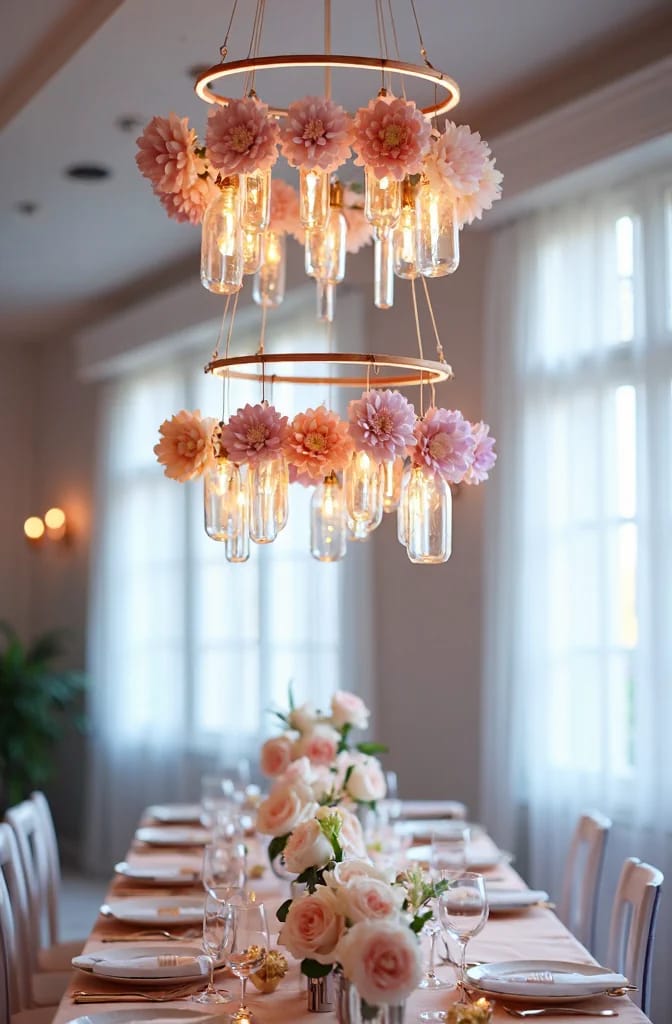
Three embroidery hoops in descending sizes, hung one below the other on a single drop, give you a cascade for roughly the price of a coffee. Fourteen, ten and six inches is a shape that works: the eye reads it as a single object rather than three rings.
Tier spacing matters more than the diameters do. Six to eight inches between rings keeps the layers reading as separate, and anything tighter collapses into one mass. Tie each hoop to the one above at three points to keep it level, and hang the flowers from the lower hoop's inner edge so they overlap the tier below rather than hiding behind it.
Bamboo hoops are fine and cheap. The thin metal ones sold for craft use flex under a load and will not stay round once thirty flowers are hanging off them.
Three hanging depths, so the chandelier has volume from the door
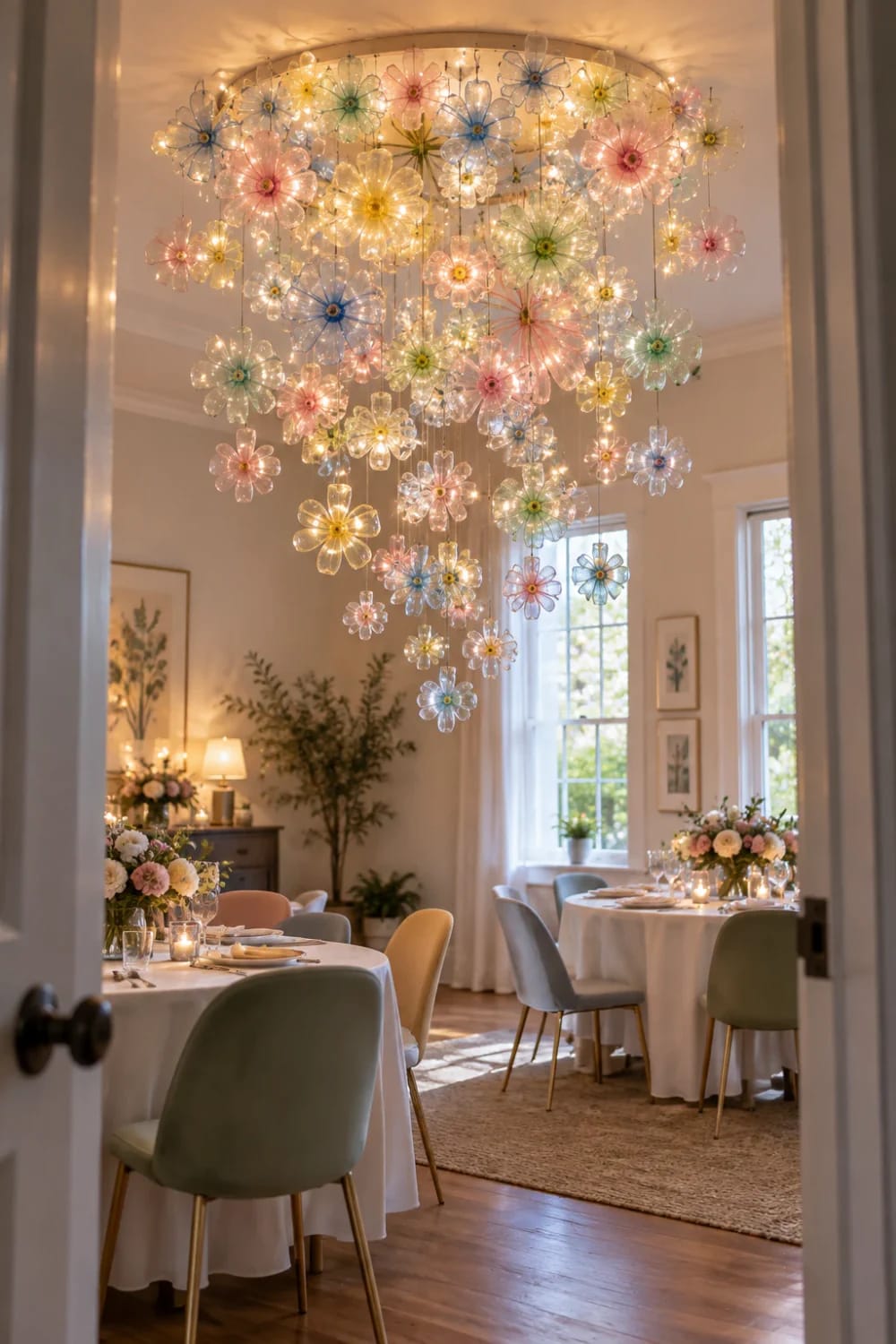
A chandelier where every flower hangs at the same height is a disc, and a disc disappears the moment you look at it from anywhere but straight on. A party is entirely made of people looking at things from the wrong angle.
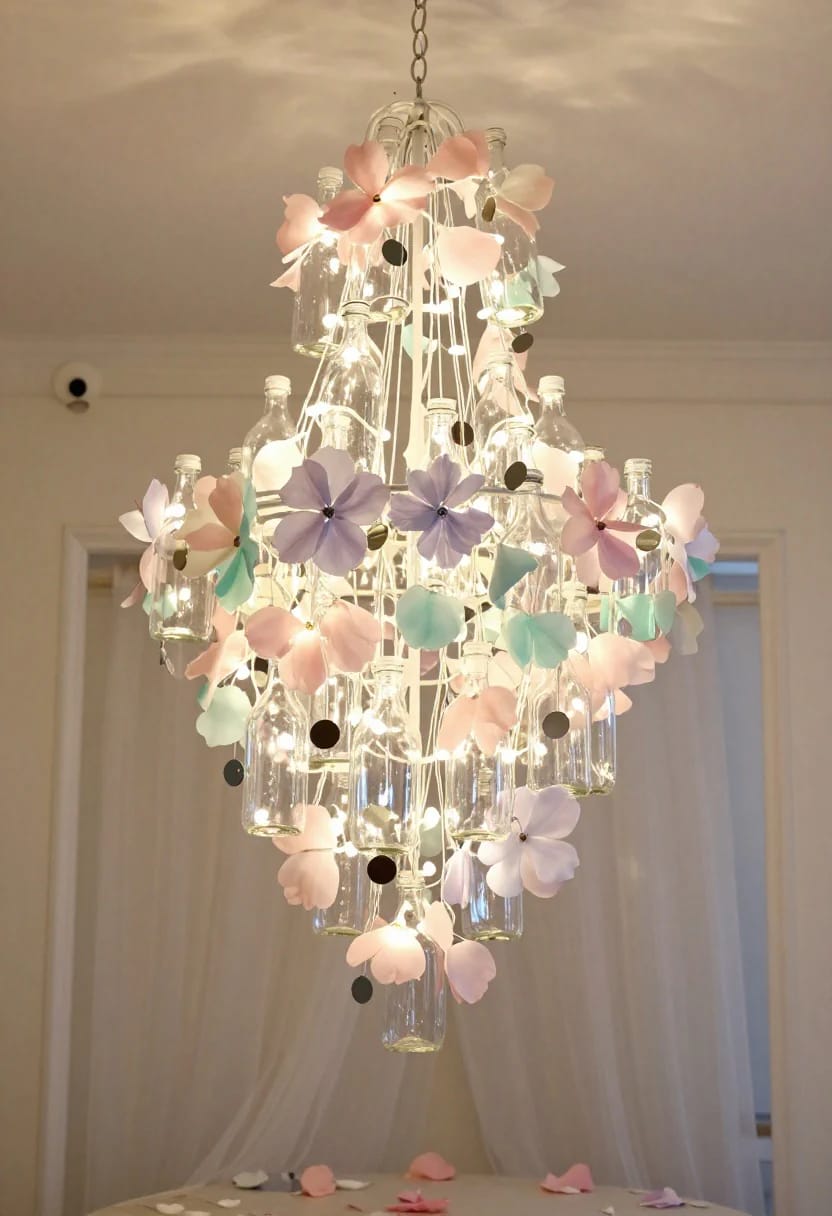
This only pays off if you commit to a real spread. Three or four inches between depths does nothing. Go for a twelve-inch spread between the top layer and the bottom, and hang the lowest tier lower than your first instinct says is safe, then check the clearance: eight feet over a dance floor, and higher if anyone tall is walking under it.
The reason it works is sightline. From the door you see the underside of the top layer and the topside of the bottom one at the same time, which is the same trick a real glass chandelier uses when its arms turn at different angles.
 Upcycled Tin Can Christmas Lanterns for the Porch: 7 Ideas That Hold Up Outdoors What actually survives wind, freeze-thaw and a whole season when a light has to hang outside.
Scaling the Glass Look Across the Whole Party Ceiling
A ceiling-wide canopy of stranded bottle flowers
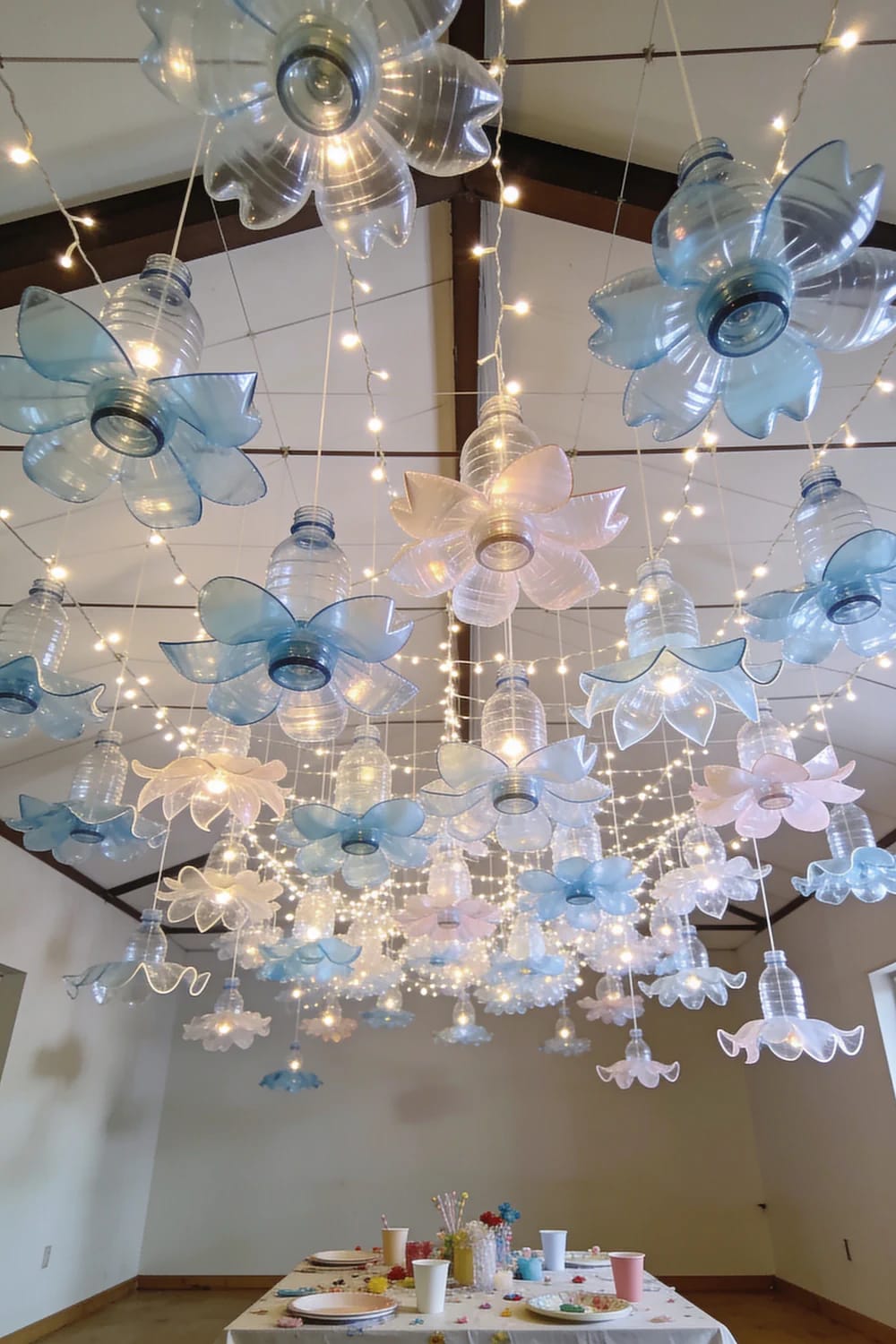
One chandelier is a centerpiece. The same flowers, stranded across the whole ceiling, are the party, and they are also where the glass illusion works hardest: a ceiling covered in translucent blooms lit from below reads as one continuous vitrine rather than thirty separate craft objects. This is the version that gets photographed from below with a phone held straight up.
A workable density is a strand every 12 to 15 inches, with five to eight flowers on each strand at mixed depths. On a 10 by 12 foot ceiling that lands somewhere in the twenties for the strand count, which sounds like a lot until you remember each one takes about four minutes to string. Budget the ceiling first and let the flower count follow; it is much easier to make forty more flowers than to un-hang a finished ceiling. If the budget is the binding constraint, the wedding-decor collections built entirely from recycled material, like these recycled-material wedding decor ideas, are where to steal the cheap tricks from.
Fire rules apply to canopies in a way they do not apply to a single hanging piece, and a venue's fire marshal will want decoration specs in advance. That is usually the point at which a project like this stalls, so ask early rather than the week of.
Clip-on color and UV wash for evening parties
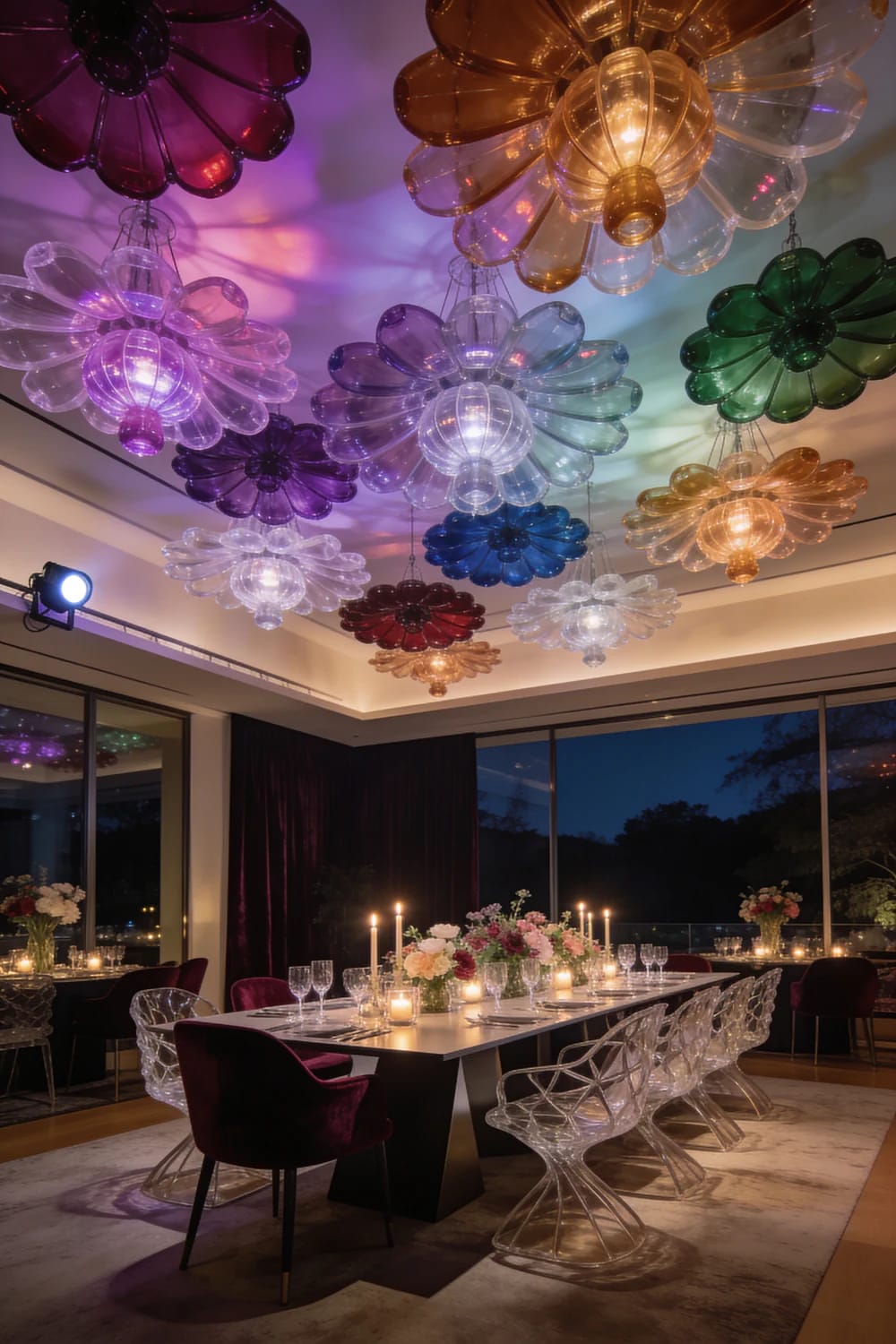
Light the chandelier from below, not from inside it. A clip-on LED puck aimed up at the flowers from a table or a floor stand throws petal shapes onto the ceiling and makes the whole installation read at twice its actual size. It is also the single biggest lever on whether the plastic reads as glass at all.
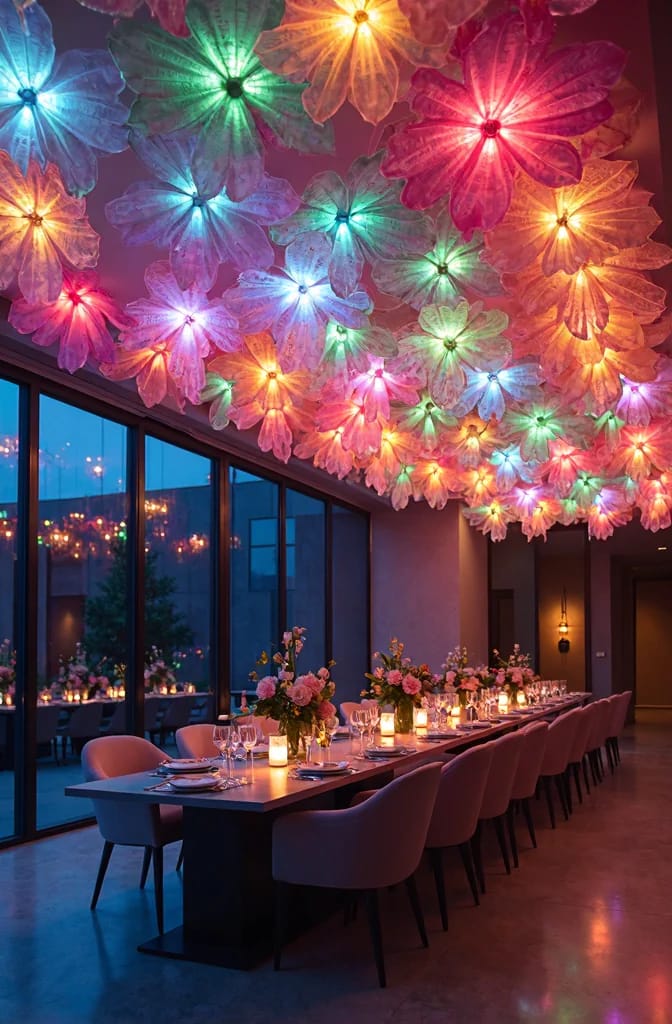
Two fixtures do the job for most rooms. One warm white at about 45 degrees off the composition gives the plastic something to pass light through, and one saturated color aimed straight up supplies the drama. The plastic will pick up whatever you point at it, which is the argument for tinting the petals lightly and letting the light do the rest.
Anything that runs hot is out. Clip-on incandescent work lights, candles, and halogen are all wrong next to thin PET, and a chandelier is exactly the wrong place to find out how wrong. Cool-running LEDs also cost less to leave on all night. If the party is going outdoors, the outdoor decoration projects that deal with wind and weather are worth reading before you commit to a ceiling rig.
Build the rig first. Then make the flowers.
The order matters because the rig is the boring part and the flowers are the satisfying part, and a weekend spent making two hundred petals before anyone has worked out how the thing hangs is how these projects end up in a garage. Hang the empty hoop, check it turns, check the venue's rules, and only then start cutting. The plastic is not going anywhere.
What you end up with will not fool anyone standing directly under it. It will fool everyone across the room, and at a party that is the whole audience. Bags of bottles were going to the bin either way.
Related Posts
- 12 Creative Wine and Glass Bottle Upcycles That Cut, Hang, and Glow
- Recycled Glass Jar Christmas Votives That Actually Glow on a Cozy Table
- Creative Old Glass Jar Upcycles: Lanterns, Terrariums & Decor
- 10 DIY Beaded Lampshade and Lamp Ideas for a Warm, Jeweled Glow
- Upcycled Tin Can Christmas Lanterns for the Porch: 7 Ideas That Hold Up Outdoors
- 15 Recycled Bottle Garden Planter Ideas to Brighten Your Space