
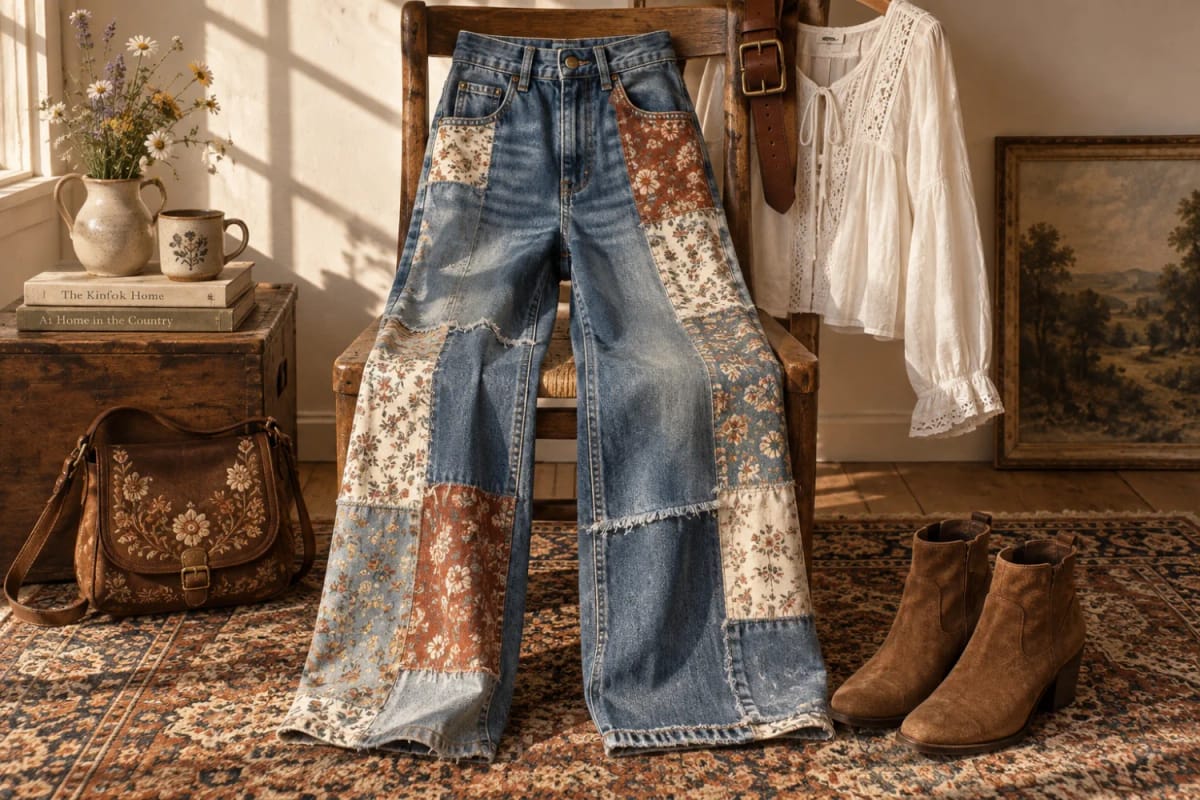
Floral cotton weighs about a third of what denim does. That one fact decides nearly everything about a pair of wide leg patchwork jeans with floral cotton panels: where the panels can sit, how wide they can run, what has to go behind them, and whether the pair is still wearable a year from now. Seven builds follow, from a full outseam godet to a floral facing nobody sees until you turn the cuff, with the weights, stitch settings and sourcing that keep the cotton from failing first.
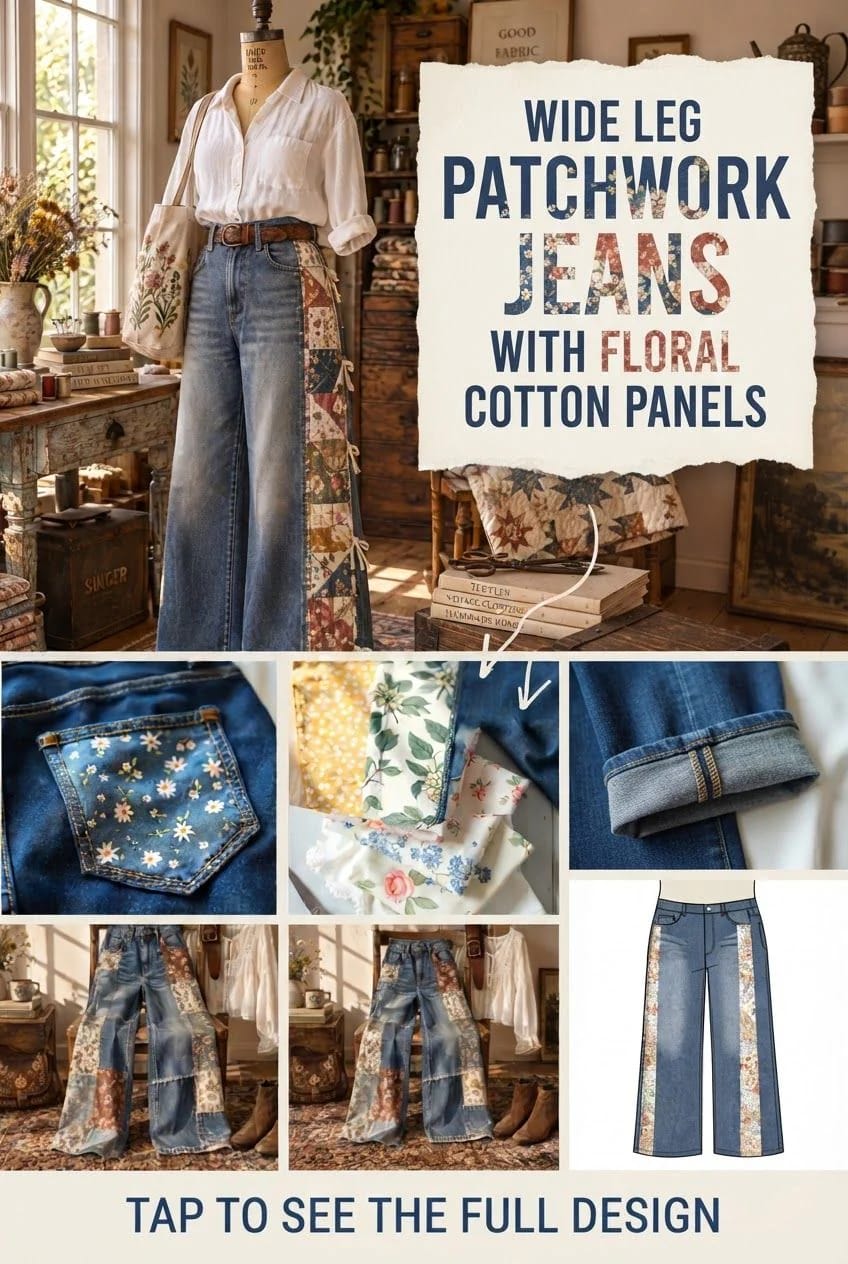
The wide leg comes from the outseam, and the floral panel is what fills it
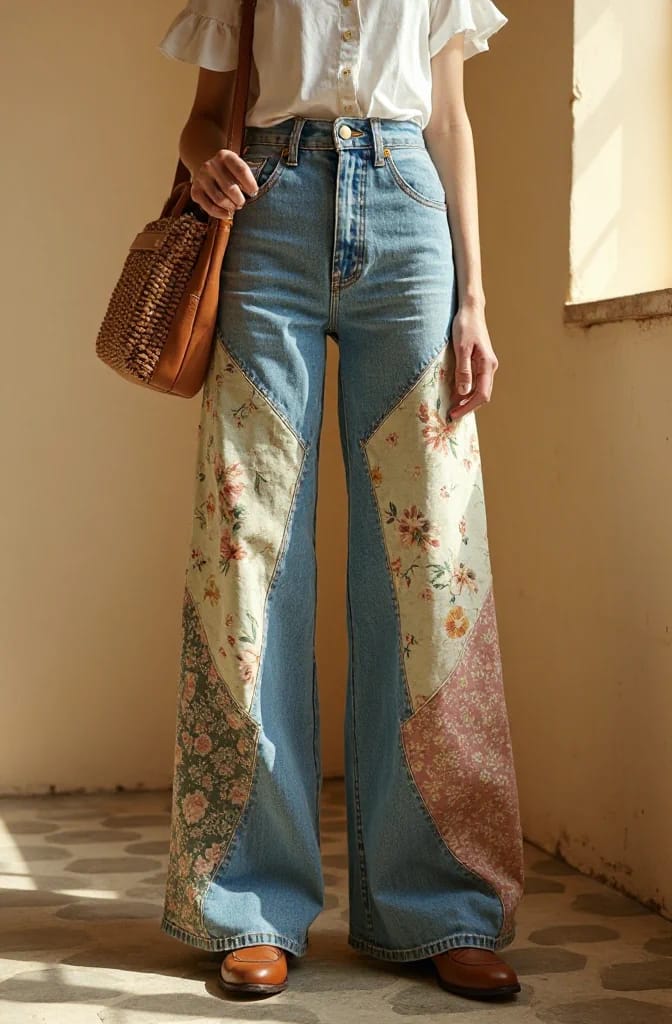
Open the outseam, never the inseam. The inseam runs straight into the crotch junction, which is where every pair of jeans dies first, and a light cotton triangle feeding into that point will split inside a season of real wear. The outseam is a low stress line from hip to hem, and on most pairs it is a felled seam you can unpick in ten minutes with a seam ripper and a good light.
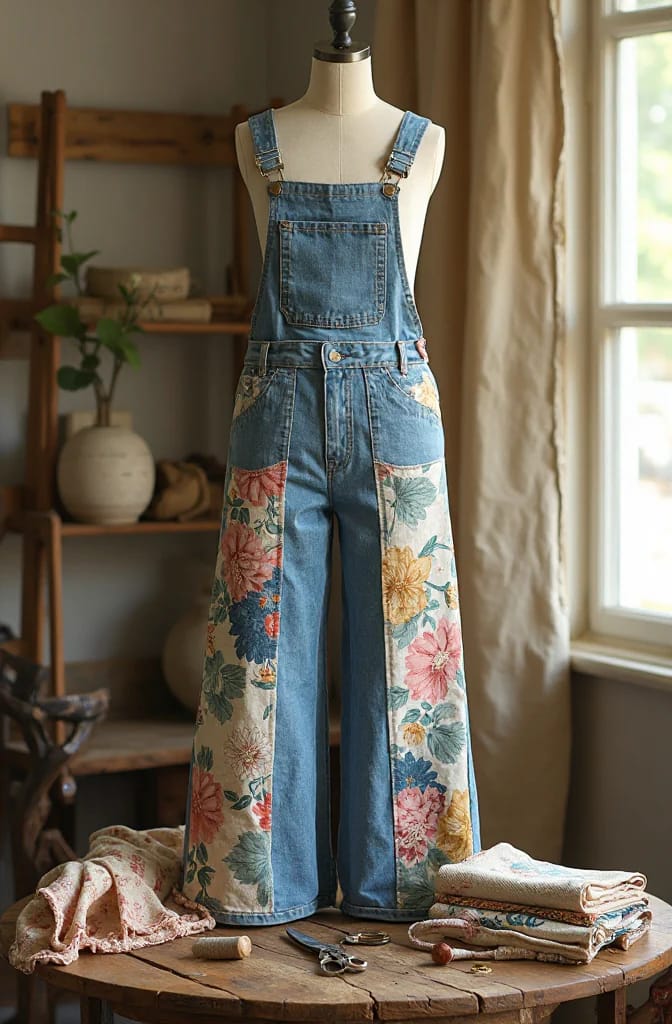
The width is arithmetic. A godet nine inches across at the hem, set into both outseams, adds eighteen inches of hem circumference, which takes a straight seventeen inch leg opening to roughly twenty six. Scraps of contrast denim work here too, and if you are going that route it is worth sorting the pieces by how far the indigo has already faded before you cut a single triangle.
Start the godet above the knee, not at it
Three to four inches above the kneecap is the line. Start exactly at the knee and the leg breaks into a 1970s bell, with a hard kink where the flare begins; start at the hip and you need a yard and a half of floral per leg and the thing hangs like a skirt with a seam up the middle. The higher you go, the more the panel becomes the garment, which is a choice rather than an error, but it is worth making on purpose.
Every floral panel wants a second layer behind it
Floral cotton face, cut with the print running lengthwise down the leg.
Fusible woven interfacing, fused to the wrong side of the floral before any seam is sewn.
A backing layer of light denim, chambray or old shirting, cut to the same shape and treated as one with the face.
Topstitching a quarter inch from each seam, through all layers, so the load sits on the stitching and not on the cotton alone.
Sew all of it with a jeans needle. A universal 80/12 will snap the first time it hits the point where the felled outseam crosses the waistband, and it usually breaks toward your face. Stitch length goes up to 3.0 or 3.5mm, because a short stitch in heavy cotton perforates the fabric like a stamp sheet.
Size 100/16 is the one that gets through a folded felled seam plus interfacing without deflecting; buy the five needle card and treat them as consumable.
SCHMETZ Jean & Denim sewing machine needles, size 100/16, 5-needle card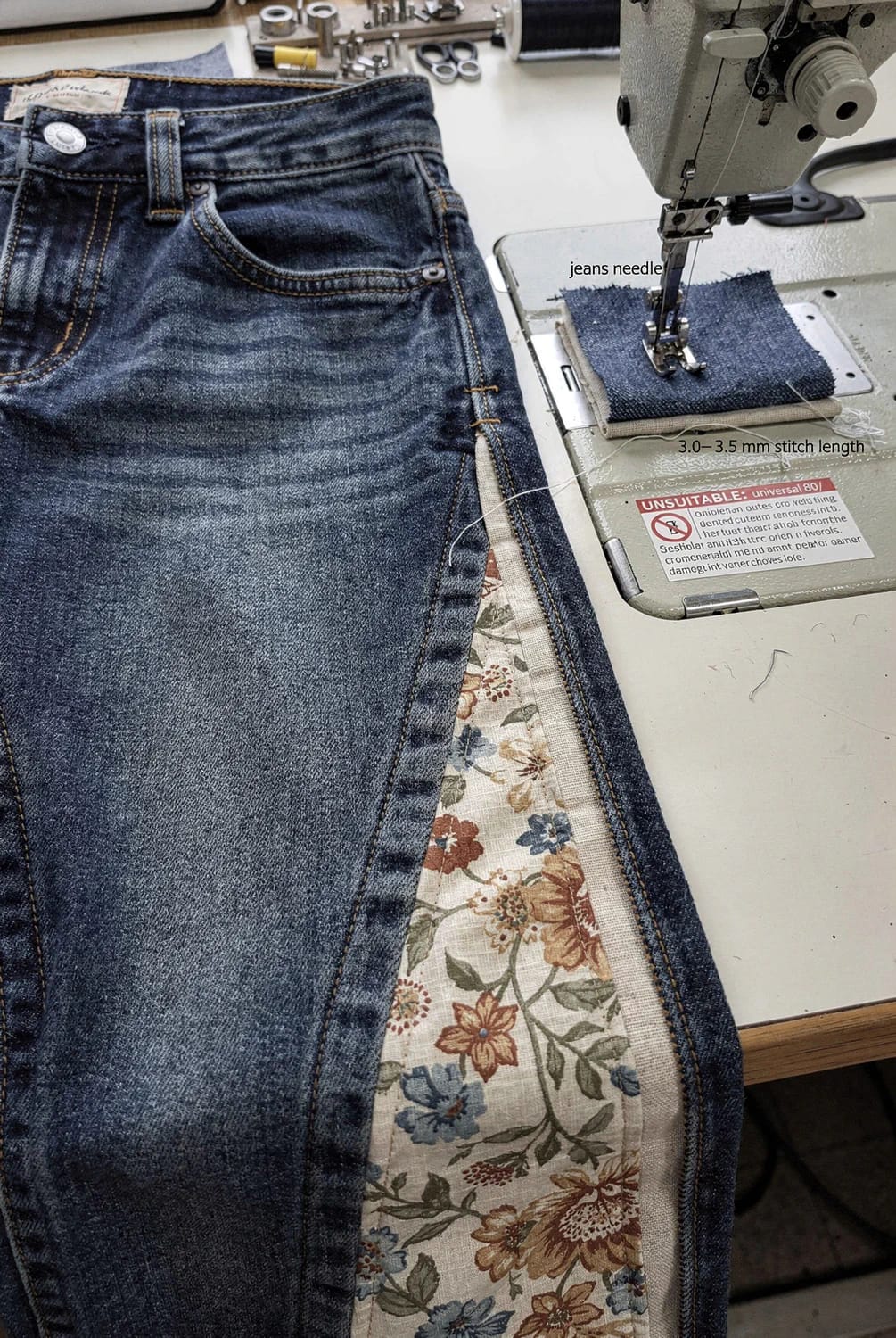
Denim to the knee, floral below: the colorblock pair that reads as designed
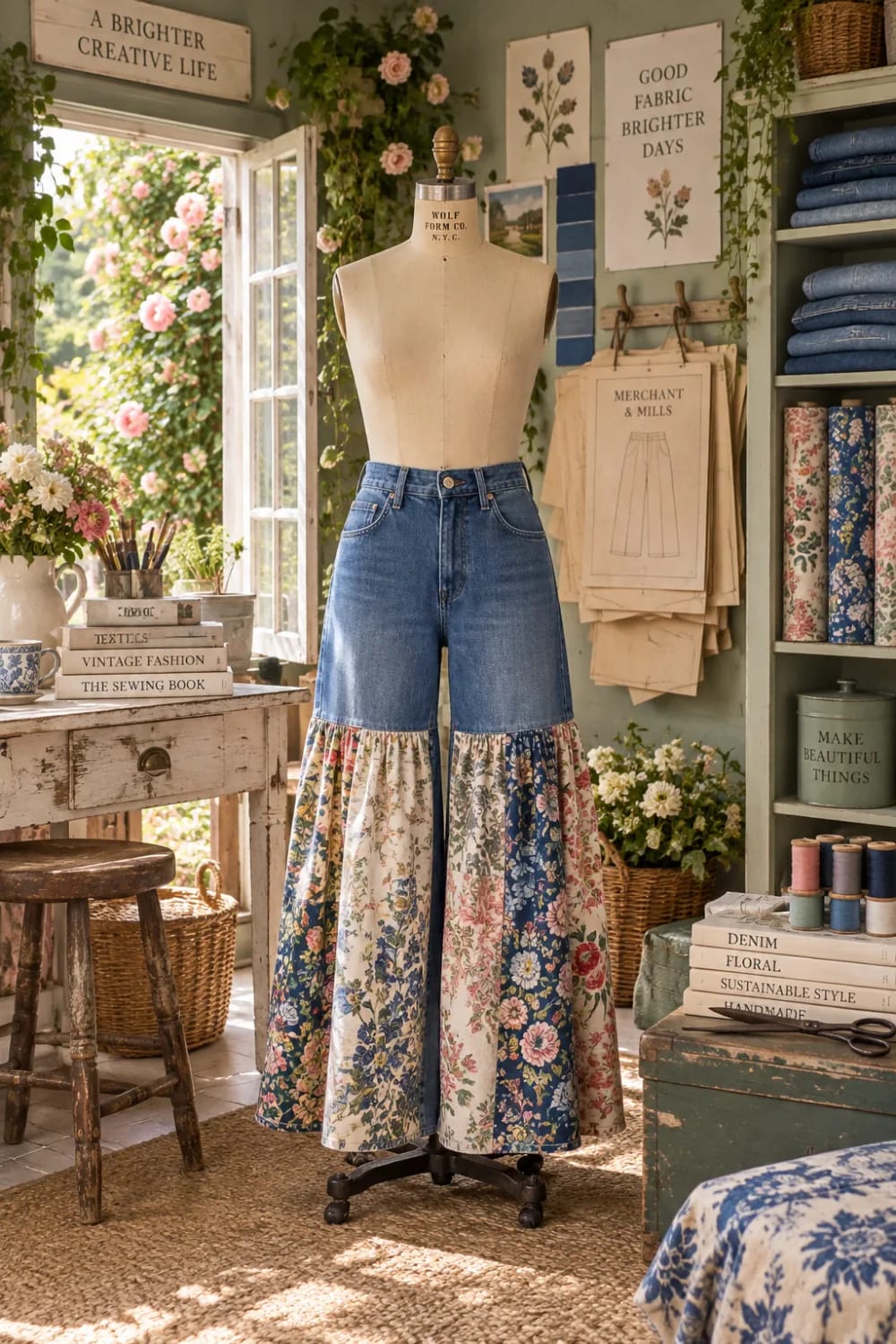
Cut the leg straight across and rebuild the bottom half in floral. This is the version that survives a first attempt, because there is no triangle geometry to get wrong and no point to bury in a seam: two straight seams, two hems, done in an afternoon.
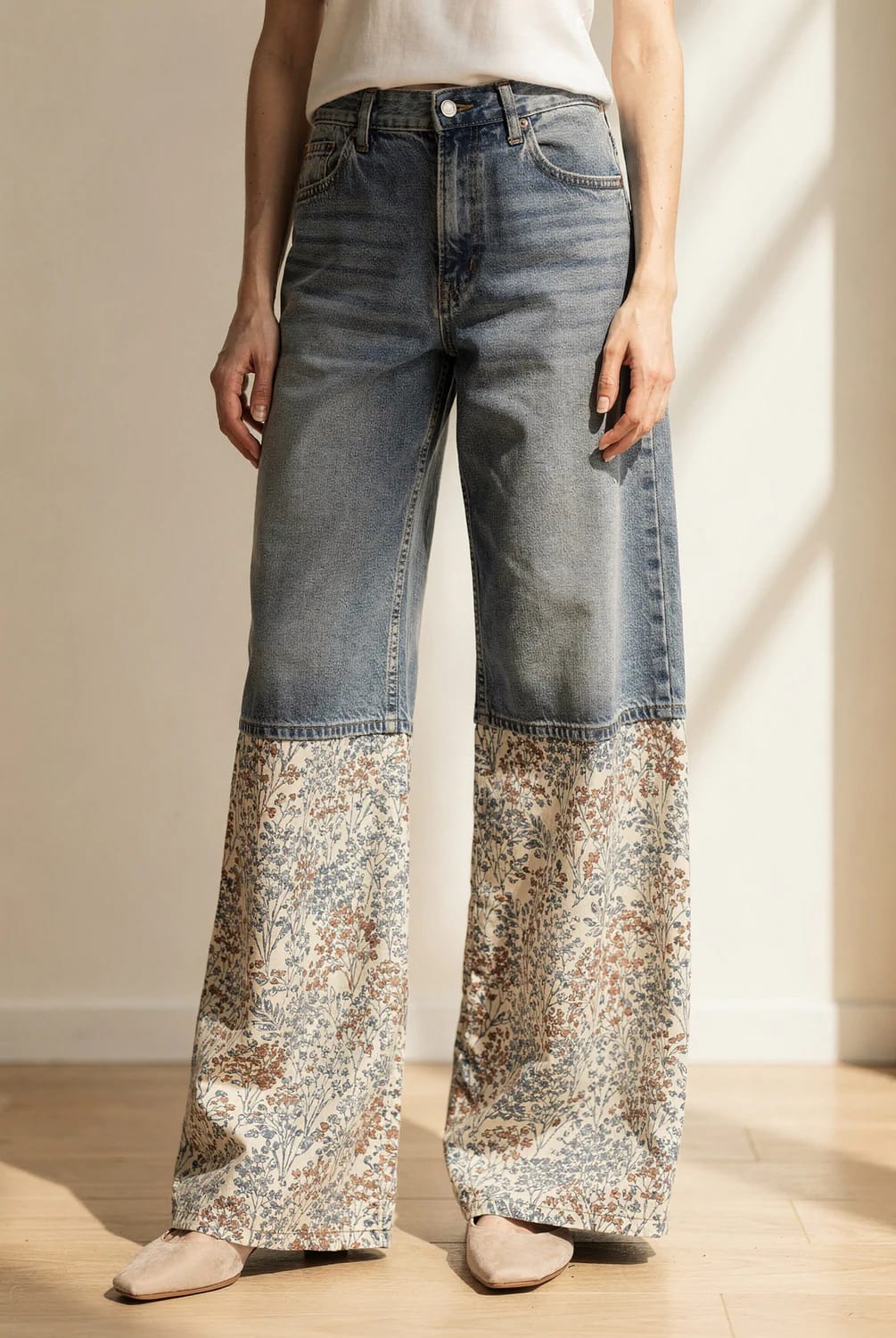
Put the joining seam below the kneecap, not on it
Roughly three inches below the kneecap, measured sitting down rather than standing up. A seam that lands on the knee folds sharply every time you take a step, and cotton against a fold line abrades far faster than denim does; you will see the print go chalky along that crease within a few months. Below the bend, the same seam barely moves.
The floral section should be cut wider than the denim it meets, then eased or lightly pleated into the joining seam, which is what stops the lower leg reading as a tube stuck onto a pair of jeans. On a 32 inch inseam cut at 20 inches, you need about 13.5 inches of floral per leg once you allow an inch and a half for the hem. Make that hem deep. A doubled inch of cotton at the bottom edge gives the leg enough weight to swing instead of flutter.
 How to Make a Braided Denim Rag Rug From Old Jeans Two full lower legs of intact denim is exactly the input this project wants.
Vintage cotton sheets outlast quilting cotton in a leg panel
Quilting cotton runs about 4 to 4.5 ounces per square yard. Twelve ounce denim is close to 400 gsm, near enough three times the weight, and that mismatch is the whole engineering problem of this garment. A fat quarter is engineered to sit flat inside a quilt sandwich, not to take a thigh rubbing against a car seat.
A thrifted percale bedsheet is a better panel fabric on almost every axis. The weave is tighter, the fabric has already been through several hundred hot washes so the shrinkage is finished, and a flat twin sheet at roughly 66 by 96 inches yields more usable fabric than four yards off a bolt for the price of a coffee. Look on the linens shelf rather than the craft aisle, and while you are there, the same trip usually turns up cotton shirts and dresses that are past wearing but perfectly good as panel stock.
Where the polyester blend actually helps
Most floral sheets from the 1970s and 80s are 50/50 polyester cotton, and sewing purists will tell you to put them back. Ignore that here. A poly blend resists abrasion better than pure cotton at the same weight, holds a printed colour through repeated washing, and does not go soft and papery at the knee the way an all-cotton sheet eventually will. The one thing it will not do is take a natural dye later, so if overdyeing is part of the plan, buy all-cotton and accept the shorter life.
| Panel fabric | Rough weight | Holds up where | Fails where |
|---|---|---|---|
| Quilting cotton | 4 to 4.5 oz/sq yd | Cuffs, pocket faces, yokes | Outseam godets below the knee |
| Vintage percale sheet | Similar weight, tighter weave | Full leg panels, backed | Anywhere unbacked and unlined |
| Cotton lawn or Liberty type | Roughly 2.5 to 3 oz | Cuff facings, small inserts | Any seam that takes load |
| Cotton shirting or chambray | 5 to 5 oz | Backing layer under a print | As the visible print, no florals |
Back the print regardless of which you pick. Fusible woven interfacing is the cheap insurance here: a yard of Pellon SF101 Shape-Flex cotton fusible interfacing covers both godets with fabric left over, and it stabilises the cut edge so the panel does not stretch into a curve while you sew it to a straight denim seam.
Not the panel you worried about. The failures land at the crotch junction, the inner thigh where the legs rub, and the seat, and in every case it is because a light cotton was allowed to run into one of those zones. Keep florals out of all three, no exceptions, no matter how good the print looks on the cutting table. If a panel has to cross the inner thigh, cut it from denim and save the floral for the outer half of the leg.
Two florals and one solid is the limit on a patchwork pair
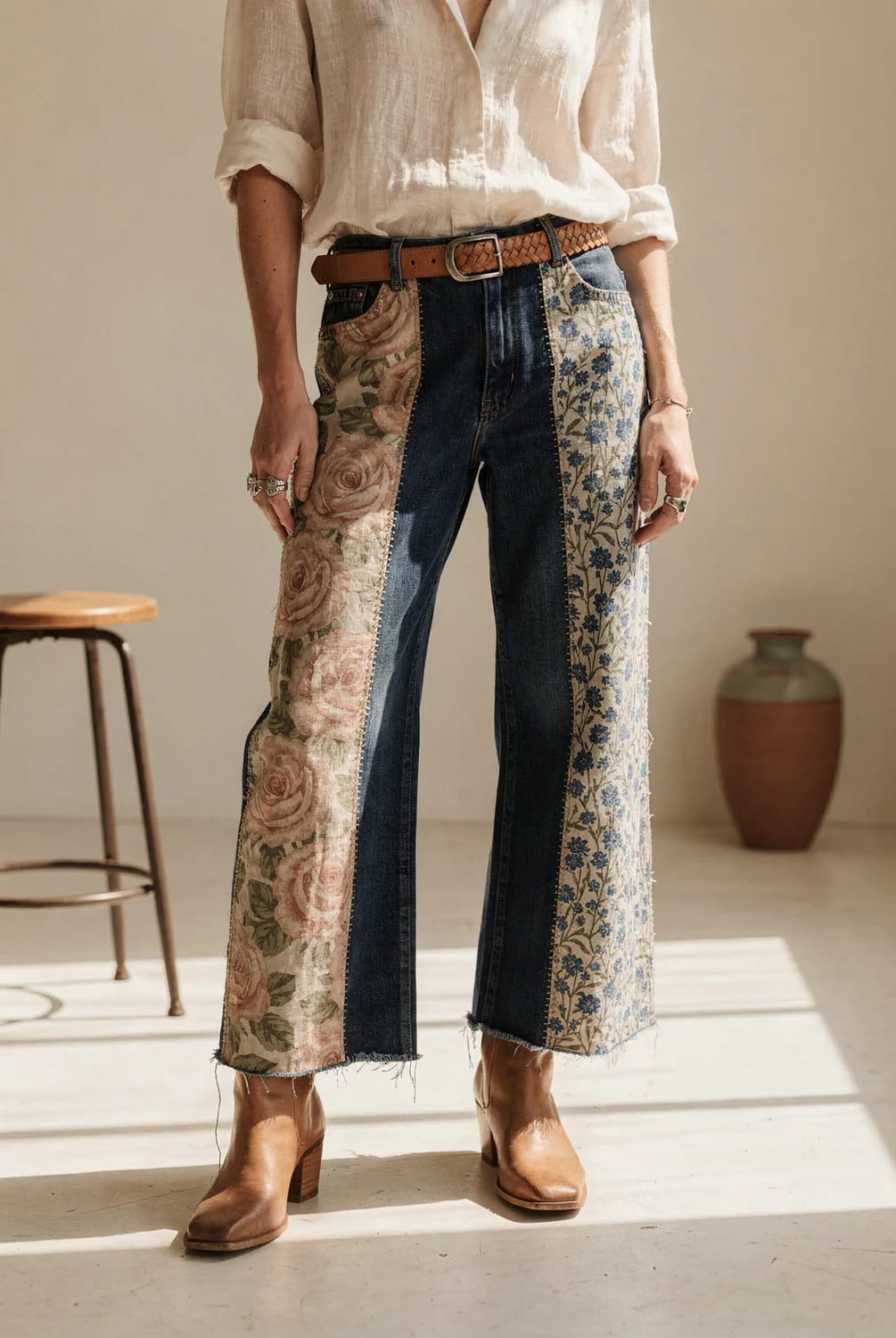
Three prints is where these jeans start looking like a fabric sample book. Two florals plus one plain cotton gives you enough contrast to read as deliberate and enough repetition to read as a pair rather than a pile.
Scale the print to the panel, not to the bolt
A ditsy print with a repeat under an inch reads as texture from six feet away, which is the distance at which anyone actually sees your jeans. A cabbage rose with a five inch repeat needs a panel at least ten inches wide or you get half a flower and a lot of background. Pair one of each, then let the solid do the work of separating them, and pull that solid from a colour already inside the print instead of matching it to the denim.
Light grounds are the risk. Indigo crocks onto pale cotton in the first few washes, and the cream background of a print will pick up a blue cast along every seam. Wash the finished pair cold, inside out, alone, for the first three cycles; a dye trapping sheet like Shout Color Catcher in-wash dye trapping sheets reduces the transfer, though it gets overwhelmed by genuinely raw denim rather than stopping it. What will not help is the vinegar trick, which does nothing to fix cotton dye after the fact, a myth Denimhunters has taken apart in detail.
Run an orphan quilt block down the outseam
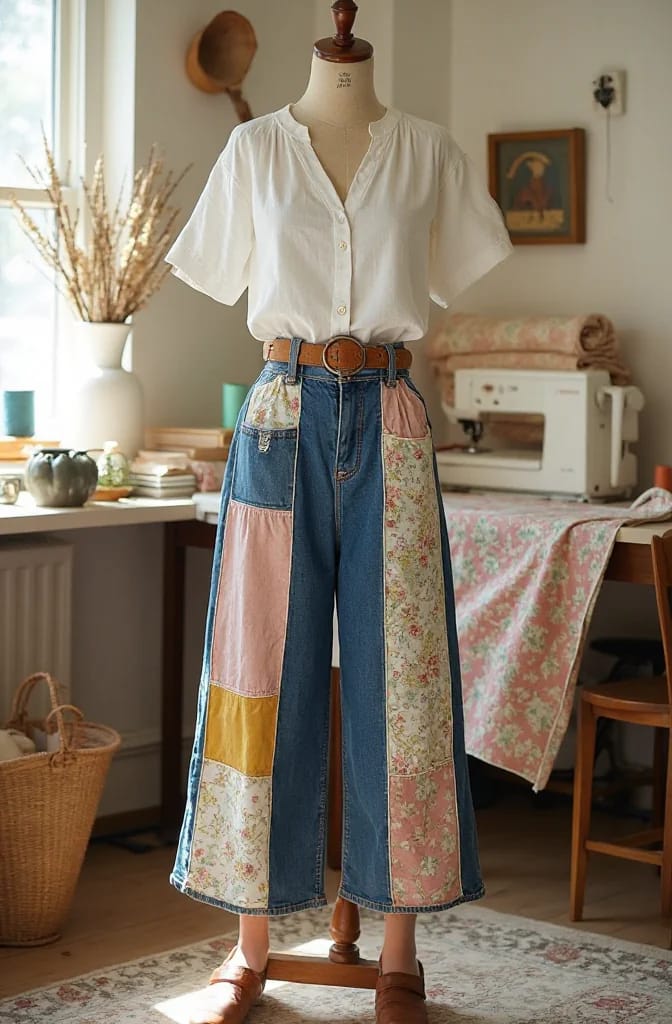
Estate sales and thrift stores are full of unfinished quilt blocks that nobody will ever turn into a quilt, and they run one to three dollars each. Five nine inch log cabin blocks joined end to end give you a pieced strip long enough to run the full outseam of an adult leg, already patchworked, already floral, and carrying a century of somebody else's fabric choices.
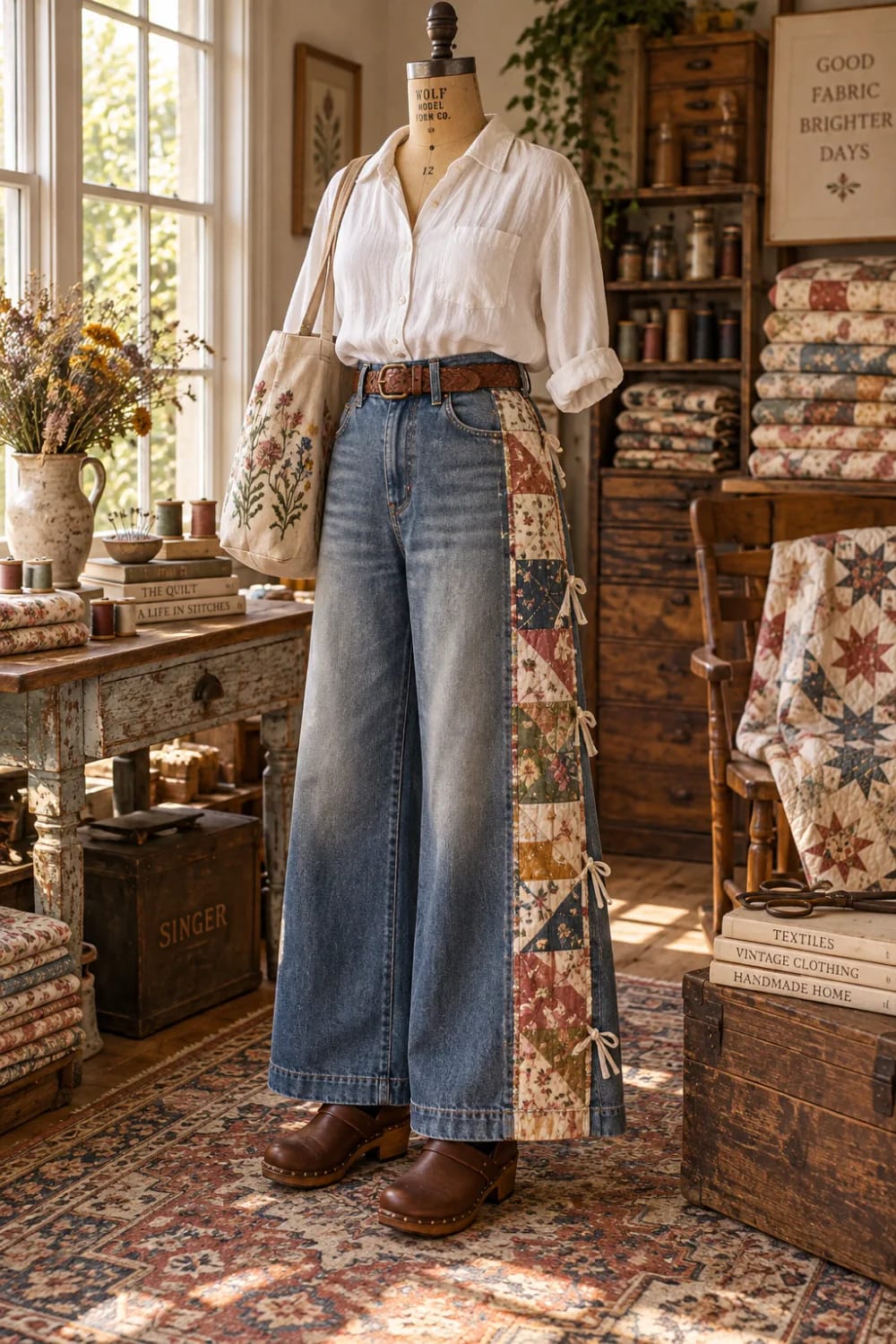
Piece the strip first, then cut it to the leg
Join the blocks, press every seam open rather than to one side (pressed-to-the-side seams stack up into a ridge that your machine will fight at the intersections), fuse interfacing across the whole strip, and only then cut it to the shape of the opened seam. You will lose points off some blocks in that cut. Let them go; a strip that fits the leg beats a strip with intact corners and a pucker every nine inches.
One position I will defend: cut up orphan blocks and damaged tops, never an intact hand-pieced quilt top. Somebody finished that, and a finished top is worth more as itself. Whatever ends up too small for a leg panel is still useful, since the offcuts land at exactly the size that small denim and patchwork decor projects want.
Floral on the yoke and back pockets only, when you still have to go to work
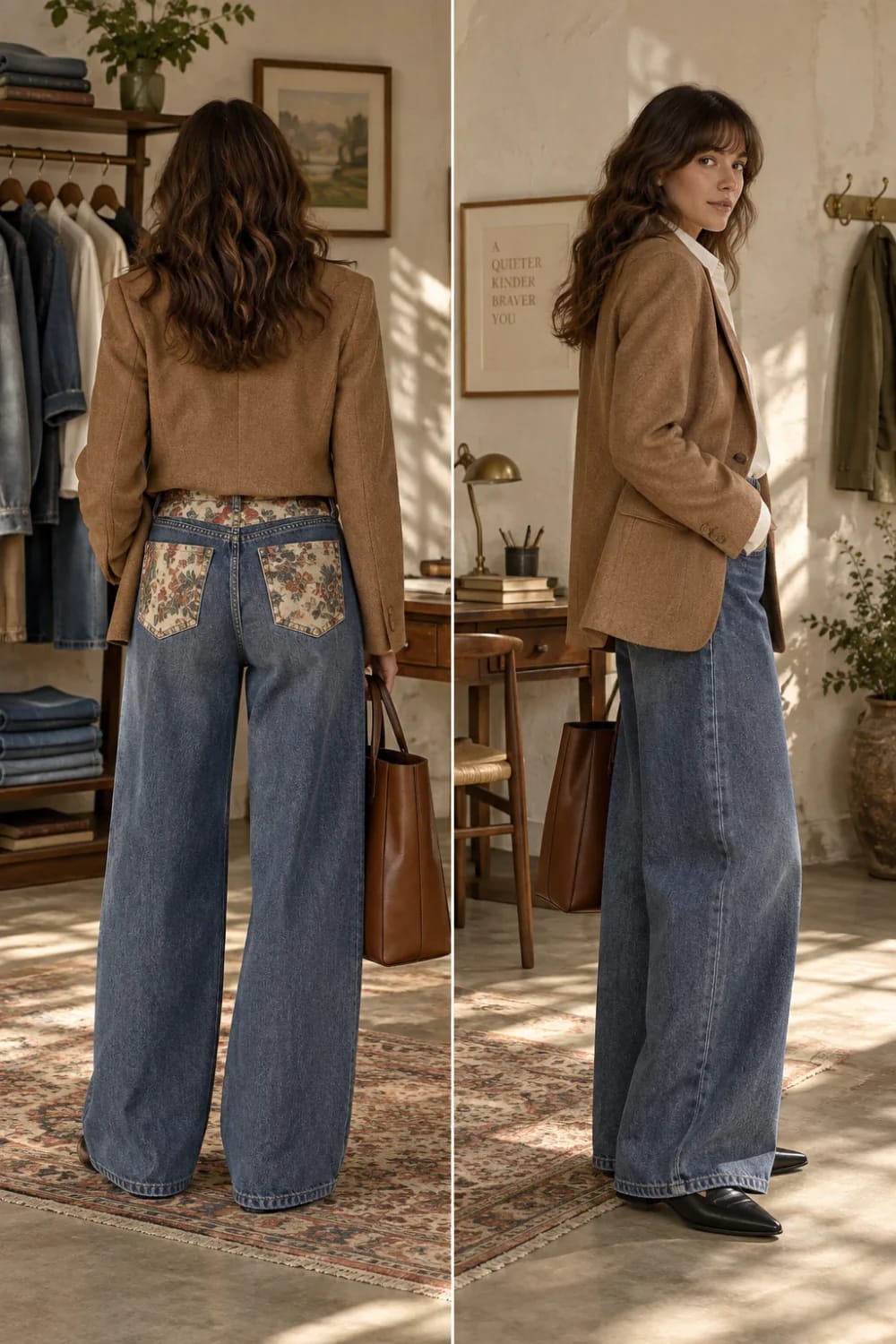
The restrained version of this whole idea puts the print on the back yoke and the two pocket faces and nowhere else. From the front the jeans are plain. From behind they are clearly patchwork, and they pass in a lot of rooms where a full floral leg does not.
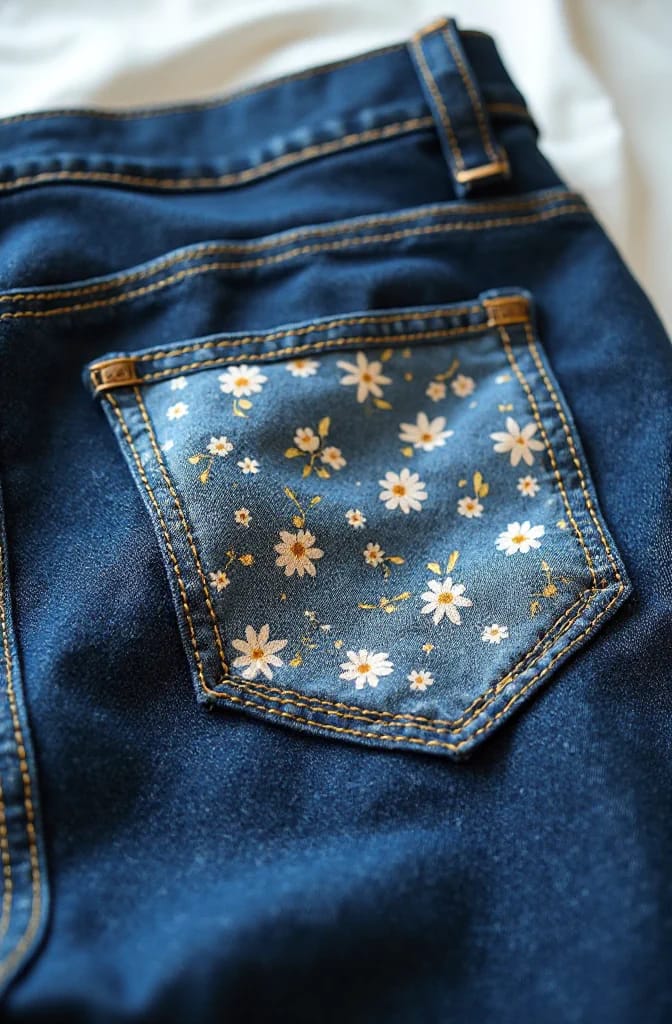
Match the topstitching before you match the print
Unpick the original pocket, use it flat as your pattern, add a quarter inch all round, and sew the new face down on the exact original stitch lines so the shadow of the old holes disappears under thread. Thread choice matters more than print choice here: a regular 50wt sew-all thread sinks into denim and the whole thing reads as unfinished. Heavy gold jeans thread is what makes a home-sewn pocket look like a pocket, and a spool of Gütermann jeans thread in gold, 100 yards does several pairs. Top thread heavy, bobbin thread normal, tension eased slightly, stitch length 3.5mm.
If you want more than thread on the yoke, the same logic that governs panels governs decoration, which is to say it belongs on the lines the garment already has. That is also the argument behind stitching motifs along a pocket edge or a felled seam rather than floating them in the middle of a leg.
 57 Innovative Upcycled Jeans Ideas: Transform Your Old Denim into Chic Fashion and Home Decor A wider run of projects for the jeans that are too far gone to rebuild.
Face the cuff in floral so it only shows when you turn it
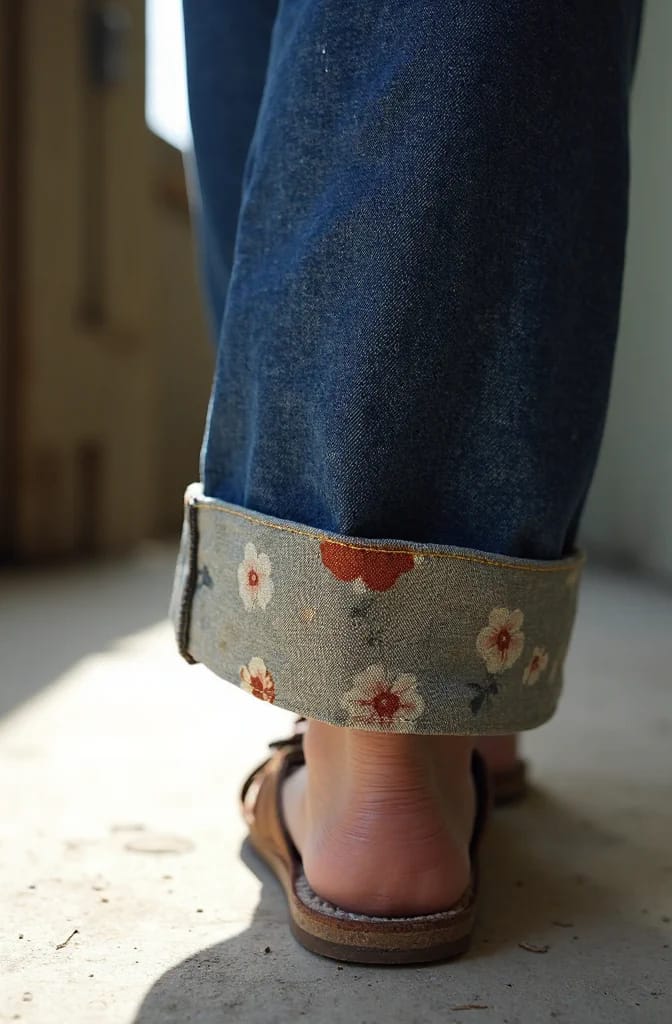
This is the cheapest idea here and the one most likely to get worn. A strip of floral four inches deep and about twenty two inches long, seamed to the raw hem edge and turned up, costs you a scrap and gives a band of print that appears when the cuff goes up and vanishes when it comes down. Hem facings also add weight exactly where a wide leg needs it, which is the reason tailors have been putting them in trousers for a century.
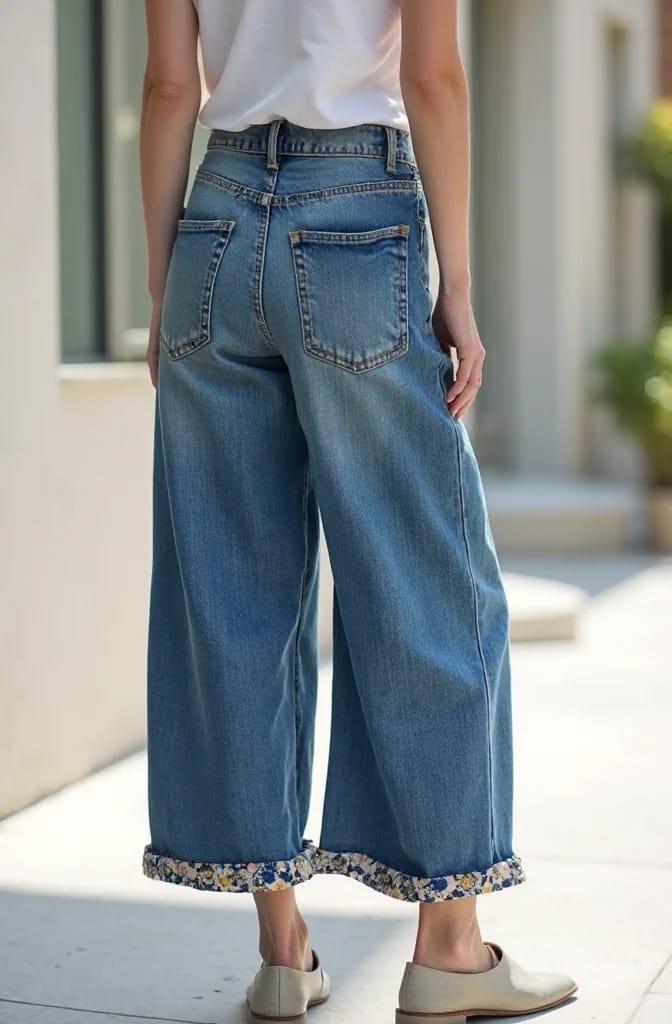
It works best when the rest of what you are wearing stays plain, since the whole effect depends on the print being a surprise rather than a theme.
Sequence matters more than skill on these builds. Do the cuff facing or a pocket face first, on the pair you care least about, because those two jobs teach you how your machine behaves through denim plus cotton plus interfacing before you have committed to cutting an outseam open from hip to hem.
I could not find any reliable figure for how long a backed percale panel lasts in a leg seam, and I would not trust one if I did, since it depends entirely on whether you cycle, sit on concrete, or own a dog. Plan on replacing one panel a year. Finish the panel seams so they can be unpicked cleanly rather than serging everything into a solid edge, and the replacement is an hour instead of an afternoon.
Keep a quarter yard of every print you use, folded and labelled with the pair it went into. Prints from a thrifted sheet are unrepeatable, and the moment you need the match is the moment the knee goes.
Related Posts
- Multi Wash Patchwork Jeans From Old Denim Scraps: The Decisions That Make the Pair
- Butterfly Embroidery Jeans: Ideas Worth Stitching Onto Denim You Already Own
- How to Make Stunning Angel Wings from Old Jeans for Your Home
- 11 Upcycled Jeans Decor Ideas for the Pile You Can’t Toss
- How to Make a Decorative Hot Air Balloon Planter from Old Jeans
- 13 DIY Denim Christmas Stockings From Old Jeans