
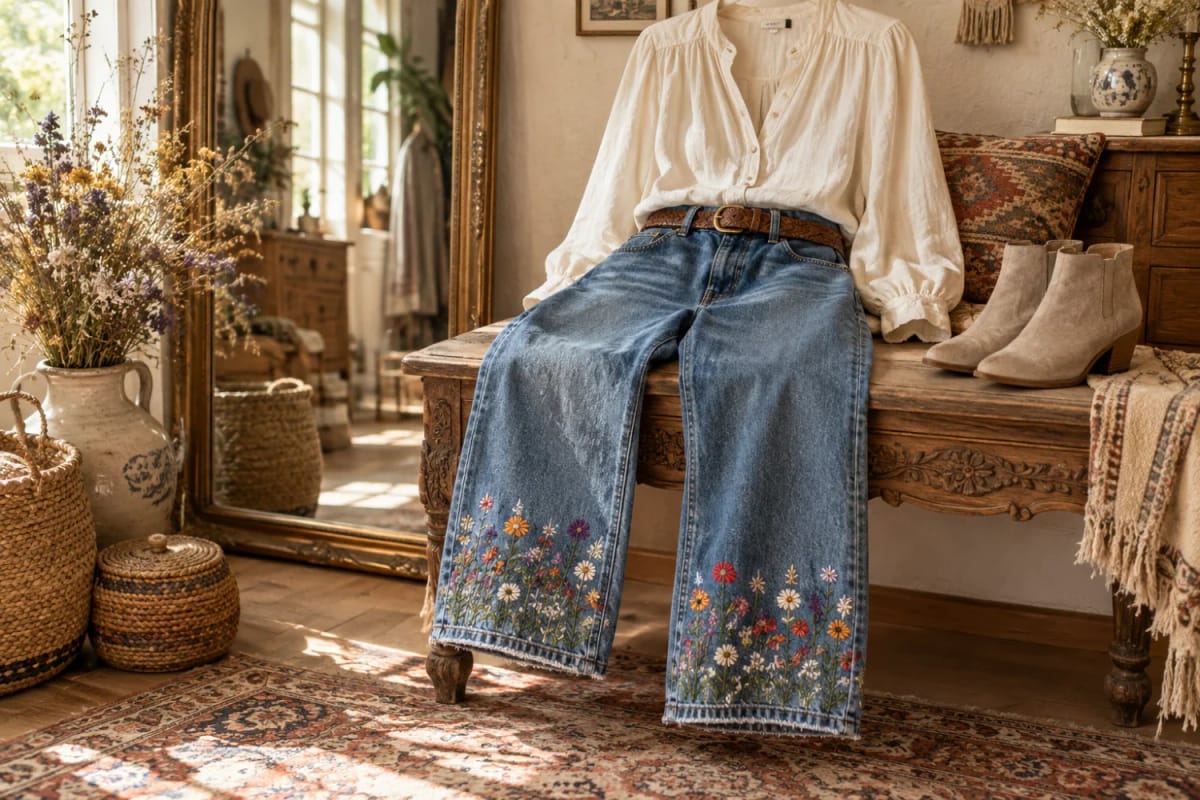
Most floral hem embroidery fails on the first hot wash, and the thread is almost never the reason. It fails because the flowers were stitched straight through the folded hem, which welds the turn-up shut, puckers the ankle into a slow ripple, and guarantees the jeans can never be let down again. Work on a single layer of leg, an inch or two above that fold, and the same design outlasts the denim around it. The eleven treatments below are sorted by that logic rather than by difficulty: where the flowers sit, what they look like, how they are stitched, and what to do when the hem is already wrecked.
Where the flowers sit on the jeans
Placement decides more here than motif does. A flower marooned on the flat of the shin reads as a sticker somebody sewed down. The same flower riding a hem, an outseam or the fold of a cuff reads as part of the garment, because the eye already expects a line there.
1. A single embroidered flower sprig at the outer ankle
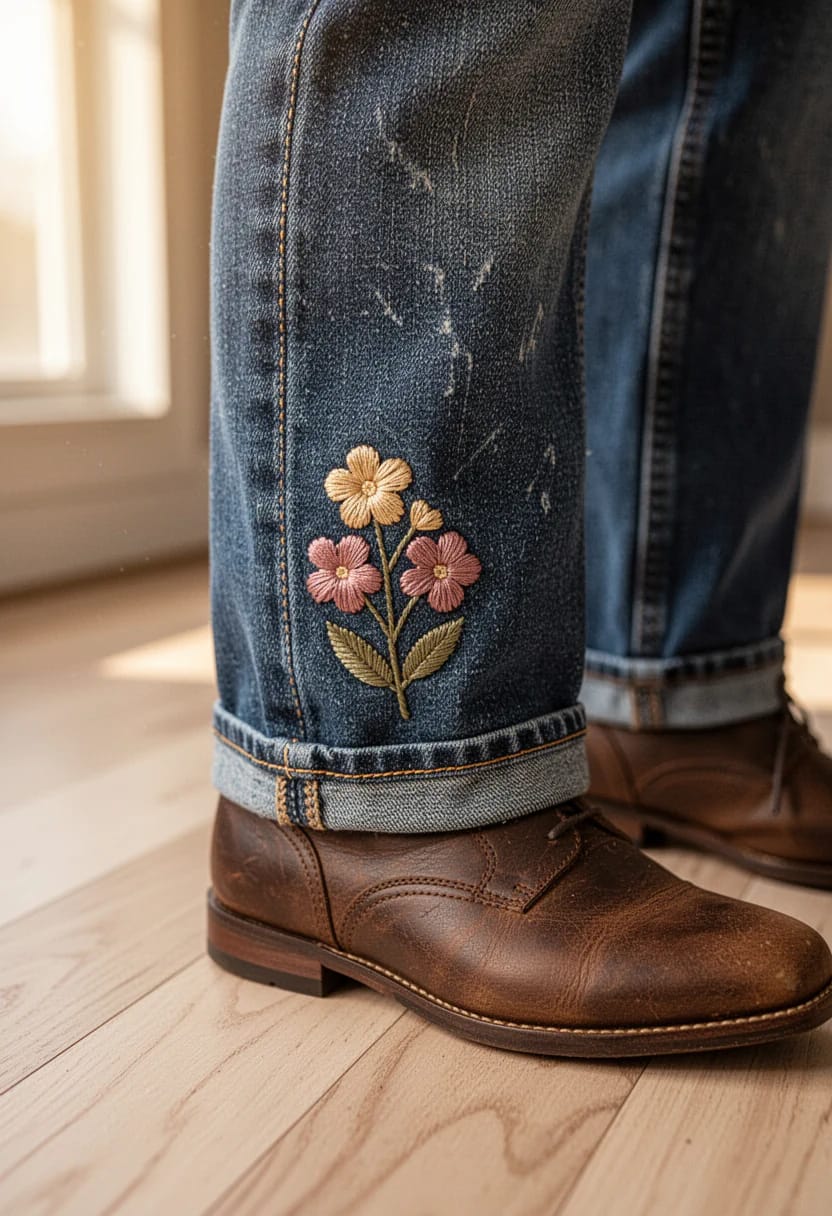
One sprig, one leg, roughly two inches above the hem on the outer ankle. This is the cheapest possible test of whether you actually want floral denim: a single skein of DMC six-strand floss runs about a dollar and covers three square inches of stitching with thread to spare, and the whole thing is an evening's work in front of something on television. Three small blooms, a stem, two leaves. Stop there.
Match both ankles and it stops being a sprig and starts being a factory print, which is the opposite of the point. Keep it on the outer face too, not the inner, where every step rubs it against the other leg and the raised stitches wear pale within a season.
2. Florals hidden inside the turned cuff
Stitch the flowers on the inside face of the leg, in the band that only shows when the cuff is rolled. From the outside the jeans are plain. Roll a deep double cuff and a line of coral and mustard blooms appears along the fold, which is the single most satisfying version of this idea and almost nobody does it.
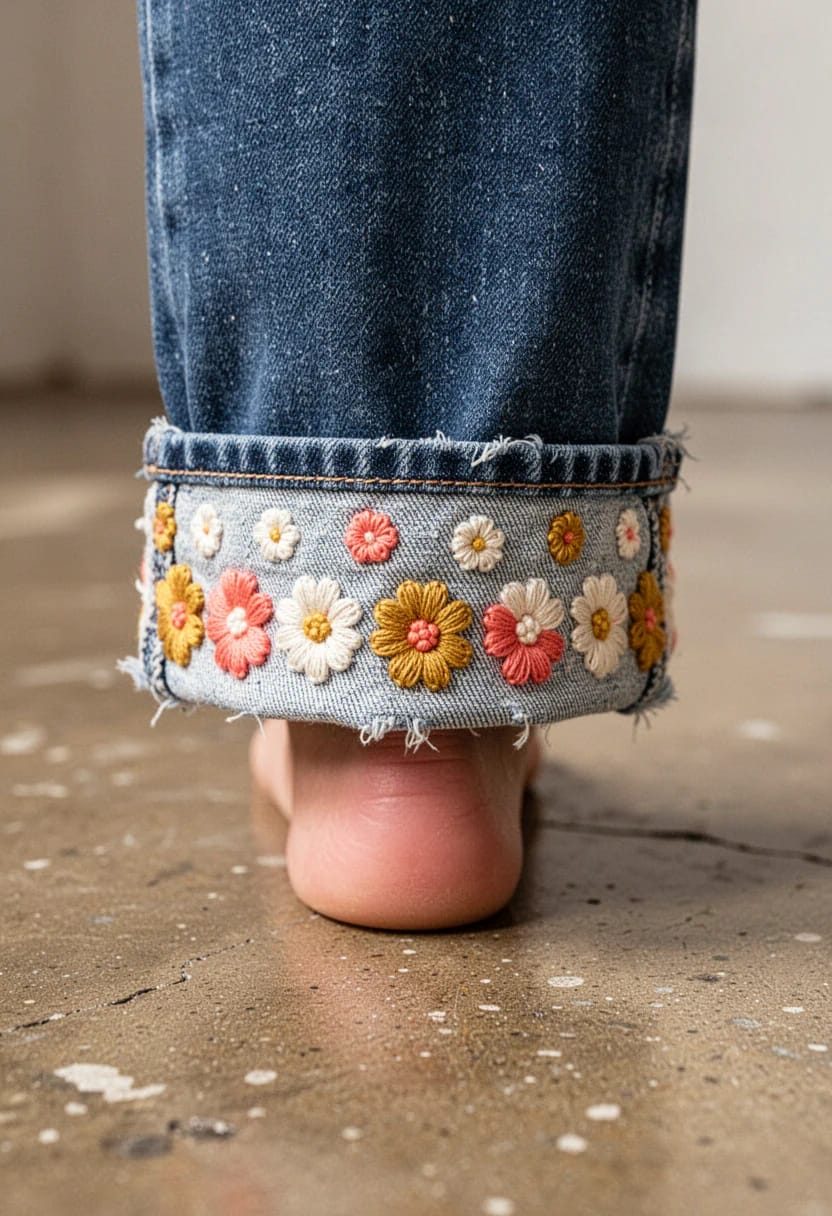
Measure before you stitch: fold the cuff the way you will actually wear it, mark the top and bottom of the exposed band with tailor's chalk, unroll, and work inside those marks. The exposed band on a double-rolled straight leg usually lands between two and three inches deep. Stitch outside it and the flowers get swallowed by the roll.
Separate the layers: slide a folded magazine or a thin cutting mat down inside the leg so the needle can never catch the back of the trouser.
Topper, not backing: a printable water-soluble sheet stuck to the face carries the design. Denim is stable enough on its own that it needs nothing behind it, unlike jersey or linen.
Hoop position: a 4-inch hoop slips inside the leg opening on straight and wide cuts. On a slim ankle it will not fit, so stitch in hand with loose tension and accept the slower pace.
Strand count: three of the six strands for stems and outlines, all six for petals you want standing off the twill.
3. A continuous embroidered border above the hem
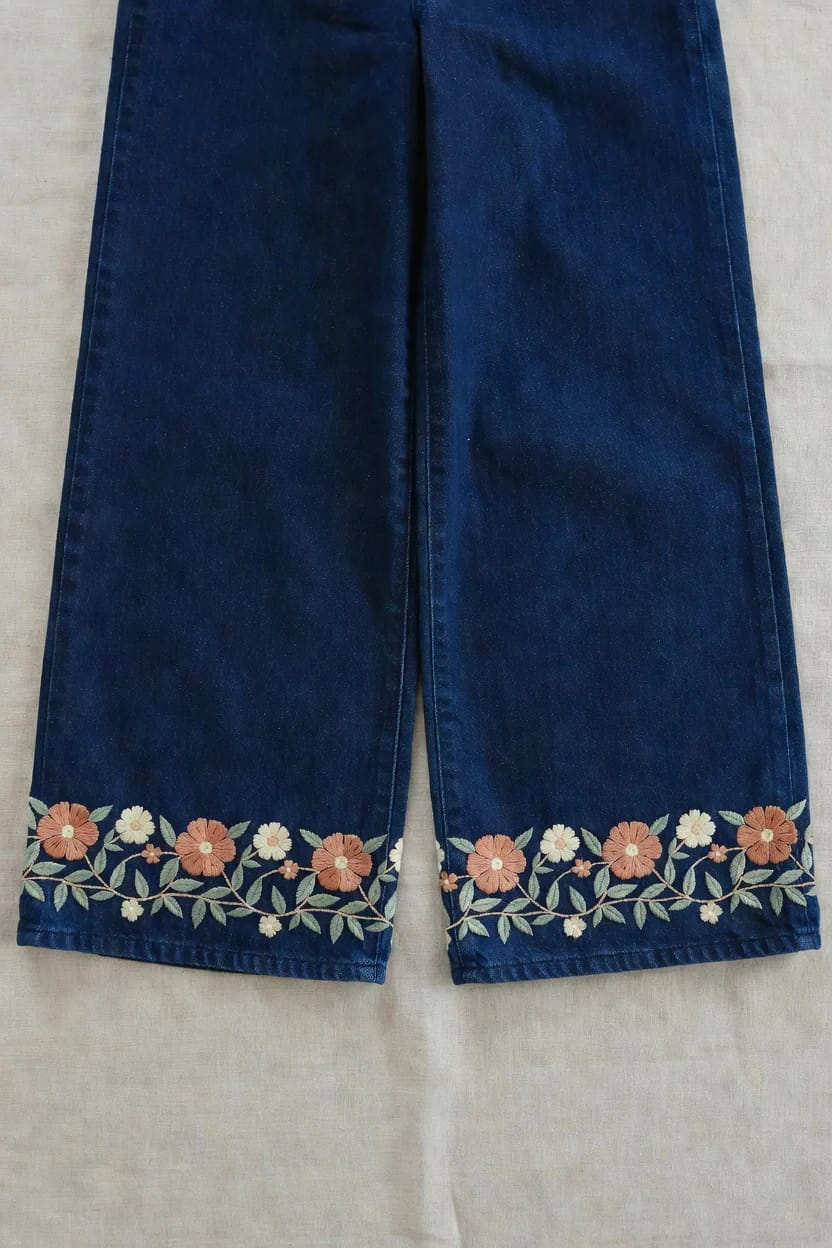
A border band that runs the whole way around both legs is the version most people picture when they search for this, and on a slim ankle it is the one I would talk you out of. A closed band cuts the leg line at its narrowest point and makes the ankle read shorter. On a wide leg or a barrel cut, where there is fabric to spare, the same band is the single most effective thing you can do to a plain pair.
Depth is the whole decision. Two to two and a half inches above the hem on a straight leg gives a repeat enough room for a bloom, a bud and a leaf pair without crowding, and it sits above the shoe so the stitching never scuffs. Design one unit, chalk it around the leg, and check that the repeat meets itself at the outseam rather than somewhere arbitrary on the front of the shin, which looks like a measuring error even when it is not.
Hooping a narrow tube is the awkward part. A small wooden hoop with a proper brass tension screw holds denim without the constant re-tightening a cheap spring hoop demands, and 4 inches is the largest that will pass through most leg openings.
Small enough to fit inside a straight-leg opening, and the beechwood ring grips heavy twill without the fabric creeping as you stitch.
Edmunds German beechwood embroidery hoop, 4-inch4. One vine climbing from hem to knee
Run a single stem-stitched vine up the outseam of one leg, starting at the hem and thinning out below the knee. It reads as deliberate in a way a scatter of separate flowers never does, because the felled seam gives the line a reason to be there, and it uses perhaps a third of the thread a border band eats.
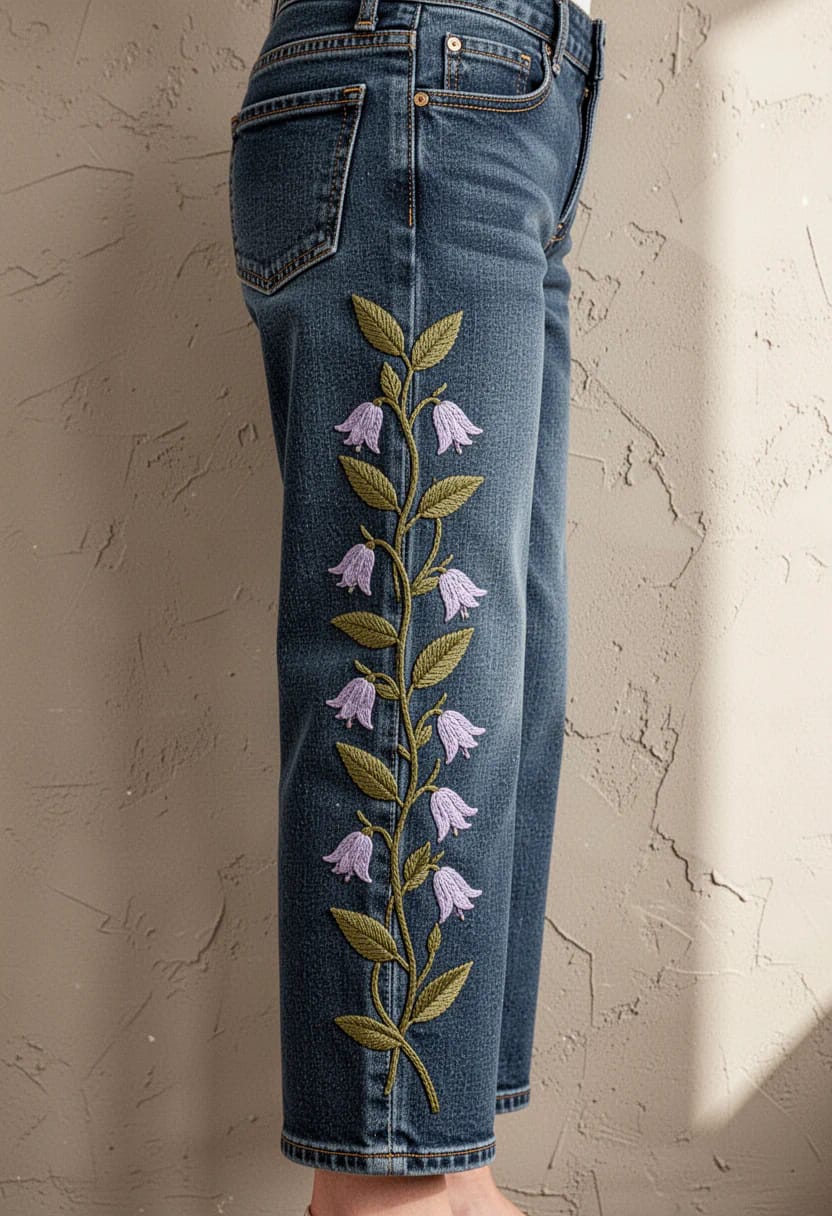
Let it get sparser as it rises. Leaves every few inches near the ankle, then just a bud or two toward the knee, then nothing. A vine of even density all the way up is a stripe, and you already own striped trousers. Keeping a garment in rotation like this is the least glamorous and most effective thing in the whole sustainable fashion conversation, and it costs about four dollars in floss.
 Butterfly Embroidery Jeans: Ideas Worth Stitching Onto Denim You Already Own Eleven butterfly placements that follow the same seam-and-hem logic, for when a wing suits the pair better than a bloom.
Motif and color: what reads from across a room
5. Indigo-on-indigo florals in three shades of blue
Skip the contrast. Nearly every tutorial tells you to reach for scarlet and mustard so the flowers pop against the blue, and the result is a pair of jeans that fight with most of what is already in the wardrobe. Stitch the same design in three blues instead, one a shade darker than the denim, one a shade lighter, one closer to grey, and the border becomes texture rather than decoration.
Tonal work lives or dies on stitch direction, because you have given up colour as your only separation tool. Satin stitch each petal at a different angle from the one beside it and the light does the rest, which is the same trick the Kalocsa embroiderers use when they work a rose in a single family of reds. A box of twelve navy skeins is cheaper than picking blues one at a time and gives you enough depth variation to work with.
Twelve skeins of one navy, which sounds dull until you separate the strands and realise how much shade variation sits inside a single dye lot.
DMC 6-strand cotton embroidery floss, navy blue, 12-pack6. A Kalocsa-style folk rose border on the hem
Borrow the density. Kalocsa embroidery, from the town of that name in southern Hungary, packs layered roses, forget-me-nots, paprika-shaped buds and curling leaves so tightly that almost no ground fabric shows inside the band, and it has been doing that on white linen for well over a century. Transplanted onto the hem of dark denim, the effect is startling, mostly because we are used to seeing floral embroidery used sparsely.
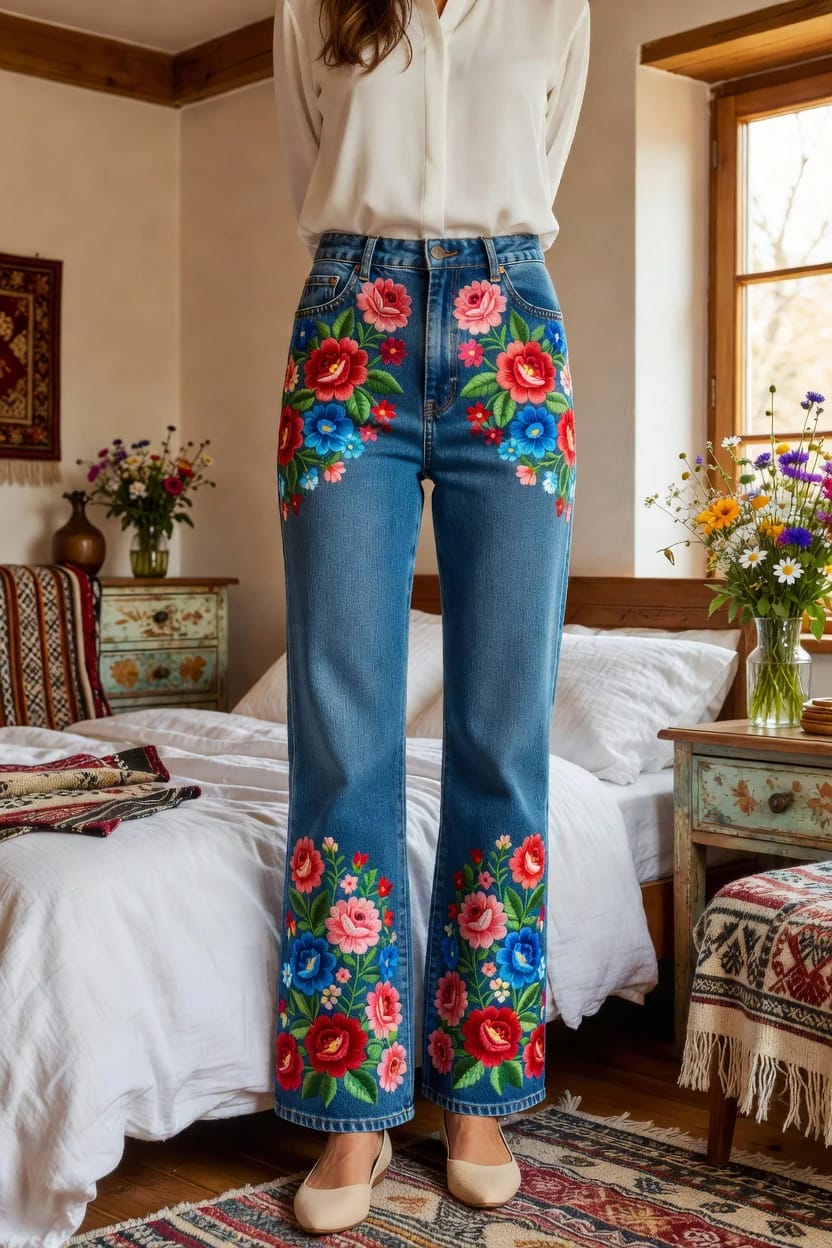
Two honest caveats. The style uses something like twenty-seven colours in its modern form, so a faithful band is a real thread investment and a lot of hours. And it is a living regional tradition rather than a free-floating aesthetic, so call it what it is when someone asks. A five-colour version keeping the characteristic layered petals and the flat directional satin stitch gets you most of the visual argument for a fraction of the work, and sits comfortably alongside the rest of the upcycled fashion ideas worth actually finishing.
| Jean cut | Border depth | Motif scale | How far around |
|---|---|---|---|
| Skinny or slim ankle | 1 to 1.5 in | Single sprigs, nothing wider than a quarter | Outer ankle only |
| Straight leg | 2 to 2.5 in | Three-flower repeat | All the way around |
| Wide leg or barrel | 3 to 4 in | Full roses with leaf pairs | All the way around, both legs |
| Cropped or raw hem | 1 in above the fray | Small buds only | Front half of the leg |
7. Single-line contour botanicals when you are low on floss
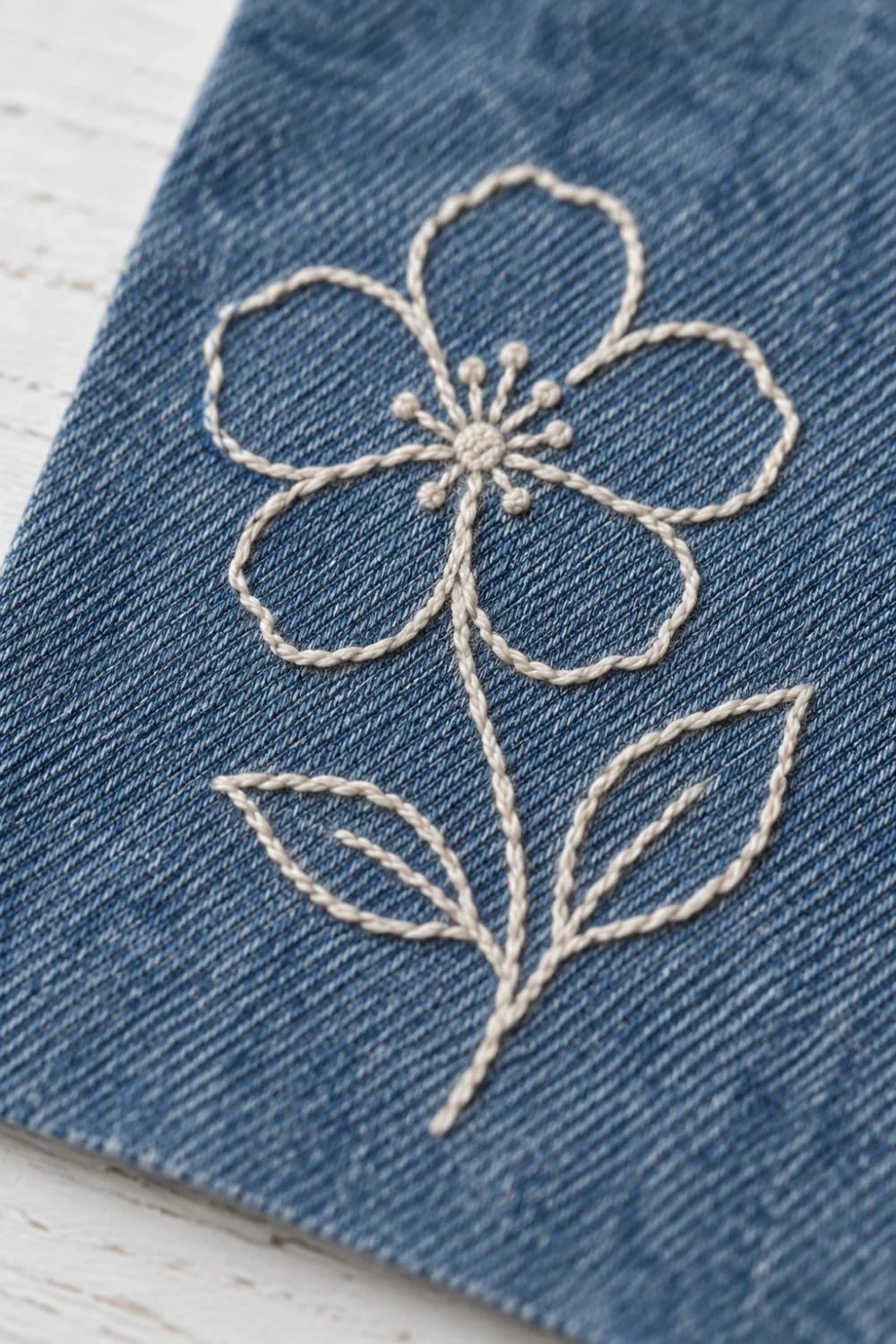
Draw the flower as one continuous outline and fill nothing: back stitch or a fine stem stitch, one colour, no shading, the bare denim left showing inside the petals so the twill diagonal runs straight through the bloom. A whole hem in contour work uses roughly a quarter of the thread a filled border does, and it forgives a shaky hand in a way satin stitch never will. Off-white on mid-blue is the pairing that looks most intentional; black on black denim is the one that looks most expensive.
Stitches that give denim texture, not just color
8. A chain-stitch daisy chain riding the gold topstitch line
Put a row of detached chain daisies directly above the gold machine topstitching at the hem and let the existing line do the alignment work for you. Six chain loops around a French knot centre, spaced about three quarters of an inch, running parallel to a line the factory already sewed dead straight.
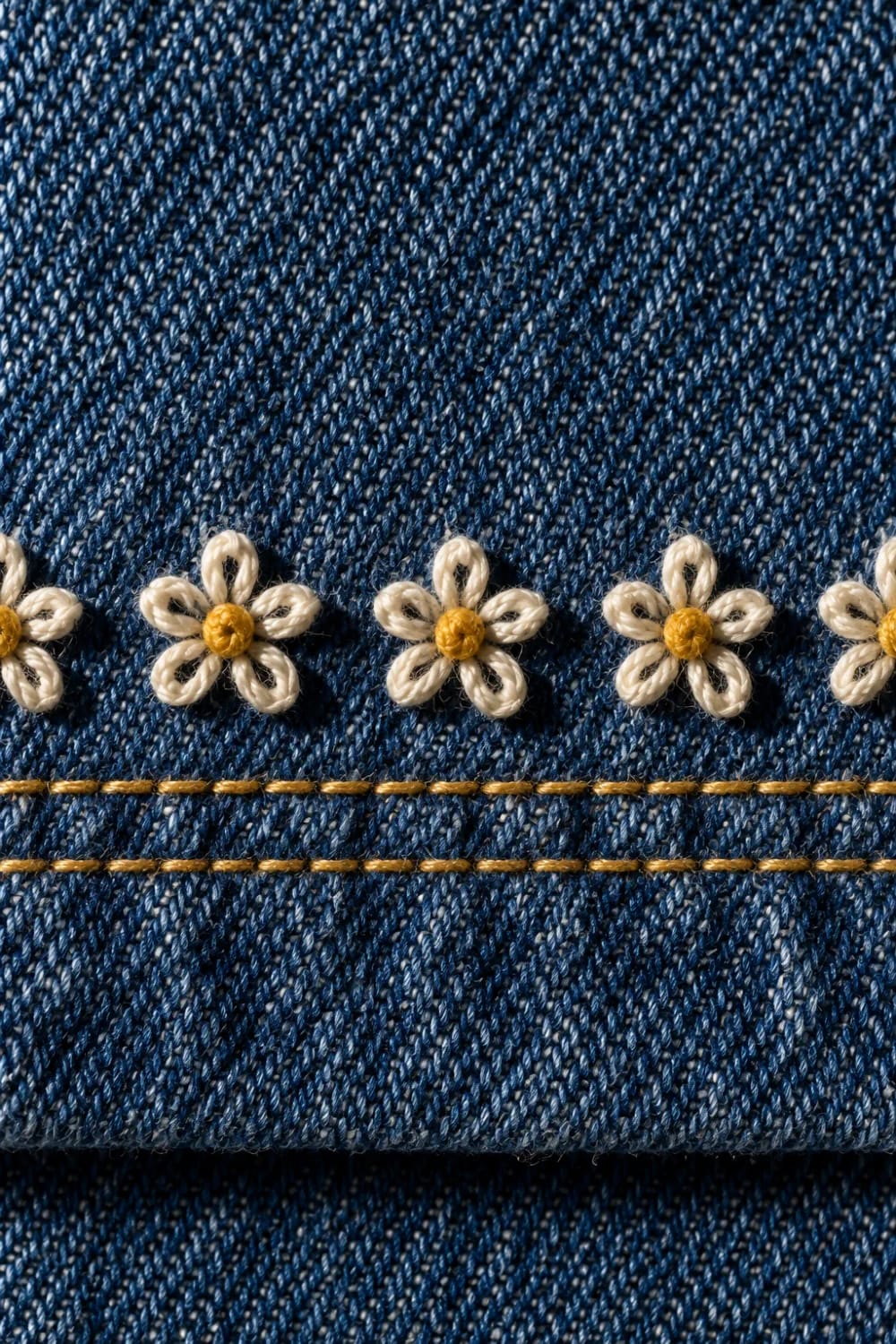
The reason this one keeps looking right is that you are not asking anyone to believe the flowers arrived by accident. They are obviously following a seam, so the eye reads intent. Cream or ecru floss against the existing gold gives you two warm tones against indigo, which is a narrower and better palette than most people choose when left to themselves. This same borrow-the-existing-line trick works across plenty of other garments waiting in the mending pile.
Stitching through both layers of the leg, which sews the trouser shut and is only discovered when you try to put them on. Hooping over the felled outseam, where four layers of twill meet and the ring distorts everything around it, so reposition and work up to the seam from each side instead. And washing hot: cotton floss and denim shrink at different rates, so the border cups and the ankle ripples. Cold water, inside out, and let them dry flat.
9. Bullion roses clustered on the outseam above the hem
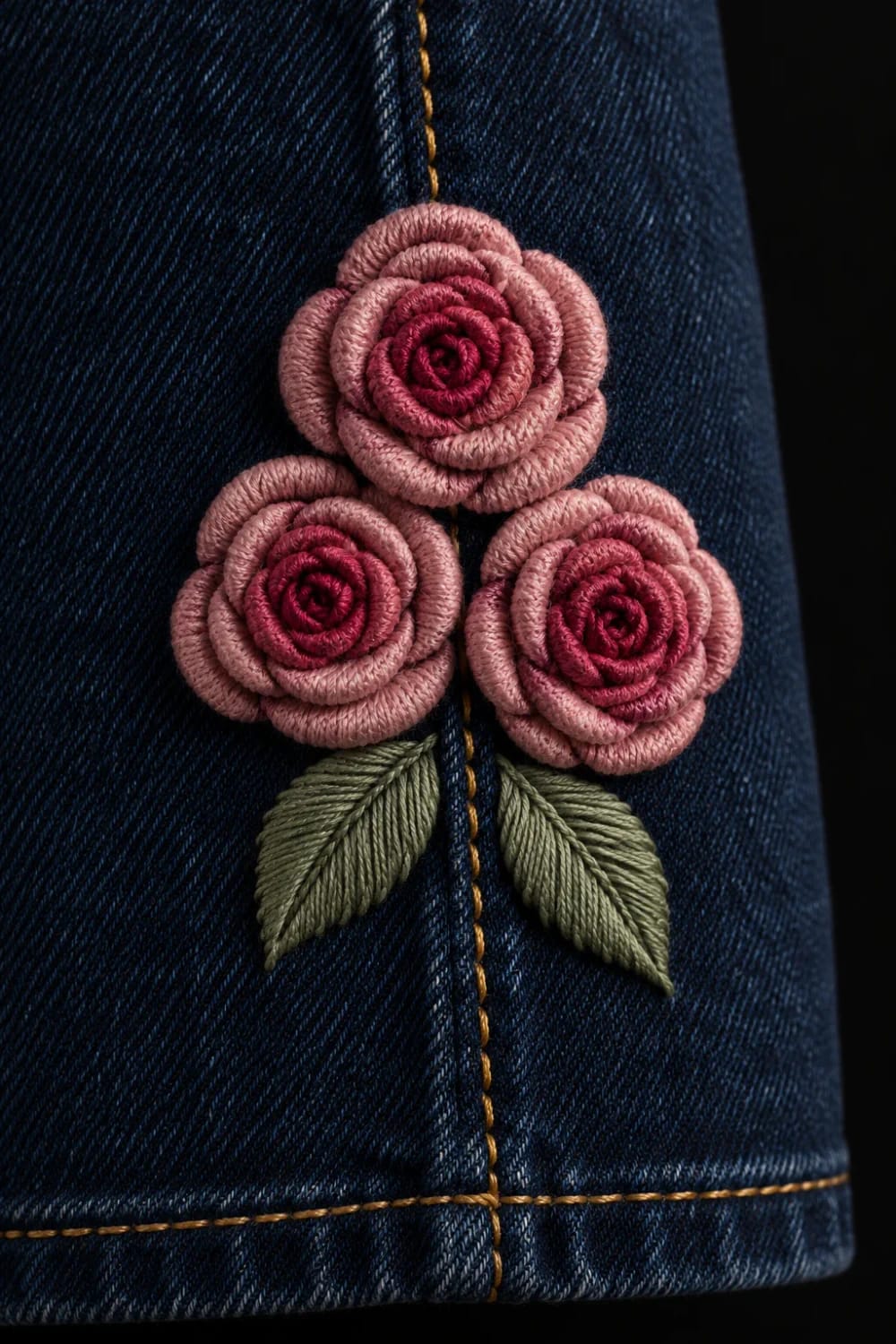
Bullion knots are the one stitch here that changes the surface rather than the colour of it. Each rose is a set of long wrapped coils spiralling out from a centre, standing clearly proud of the denim, and a cluster of three at the outseam above the hem catches raking light in a way no flat stitch manages. Dusty pink shading to deep rose, two matte sage leaves underneath, and nothing else on the leg.
You need the right needle or you will hate this. Bullions are wrapped along the shaft and then pulled through, so a milliner needle, which is the same diameter from eye to point, is close to mandatory; a standard embroidery needle with its wider eye snags every time. An assorted pack of John James milliners costs about the same as two skeins of floss and lasts years.
Straight-shafted so wrapped knots slide off cleanly, and the assorted sizes cover both fine stems and six-strand petals.
John James milliners and straw needles, assorted sizes 5/10Hems that are already damaged are the ones worth stitching
The pairs worth stitching are rarely the good ones. A hem that has gone thin, frayed, or carries the pale ghost line of an old alteration is already asking for something to be done to it, and embroidery over damage reads as repair rather than decoration. Hems and knees are where jeans fail first, long before the seat or the pockets give out, and when a pair finally loses that argument for good, there is a long list of things to cut the legs into.
Worth embroidering over
- The pale crease left behind when a hem was let down
- Thin but unbroken denim at the back of the hem, where heels drag
- A deliberately frayed raw edge that has started to climb
- Small holes, under about a centimetre, backed with a scrap patch first. Anything larger wants a proper patch and a different article.
Leave it
- Denim split right along the hem fold. Stitching there loads the weakest line in the garment.
- Stretch denim whose elastane has gone slack and rippled: the embroidery will sit flat and the fabric around it will not.
- Anything you are only mending because you feel guilty about it. Guilt makes poor garments.
10. A flower border that hides a let-down hem crease
Let the hem down first, then stitch along the crease. Most jeans carry half an inch to an inch of hem allowance, and letting it out gains you that length plus a permanent pale line where the old fold sat, bleached by years of washing. No amount of pressing removes it. A border worked along that exact line turns the flaw into the reason the design is placed where it is.
Work the band so the crease runs through the middle of it rather than along its edge, which reads as accidental. A repeat of buds and leaves with the stems crossing the line at irregular intervals hides it best; a straight chain-stitched stem laid directly on top of the crease just draws a second line beside the first one you were trying to lose.
This is the fussiest transfer job on the list, because the border has to follow a line that is already on the fabric rather than one you drew. Printable stick-and-stitch sheets solve it: print the repeat, cut it into segments, stick each segment down against the crease, stitch, then rinse the whole thing away. Twelve sheets run somewhere around fifteen dollars and cover several pairs.
Print any repeat straight onto the sheet, stick it down where the crease actually sits, and rinse it out afterward with no chalk line to remove.
Sulky Stick ‘n Stitch printable wash-away stabilizer sheets, 12-pack How to Make a Braided Denim Rag Rug From Old Jeans The one denim project that uses the whole pile rather than one good pair, for the jeans that lost the argument.
11. Blossom heads on a blanket-stitched raw hem
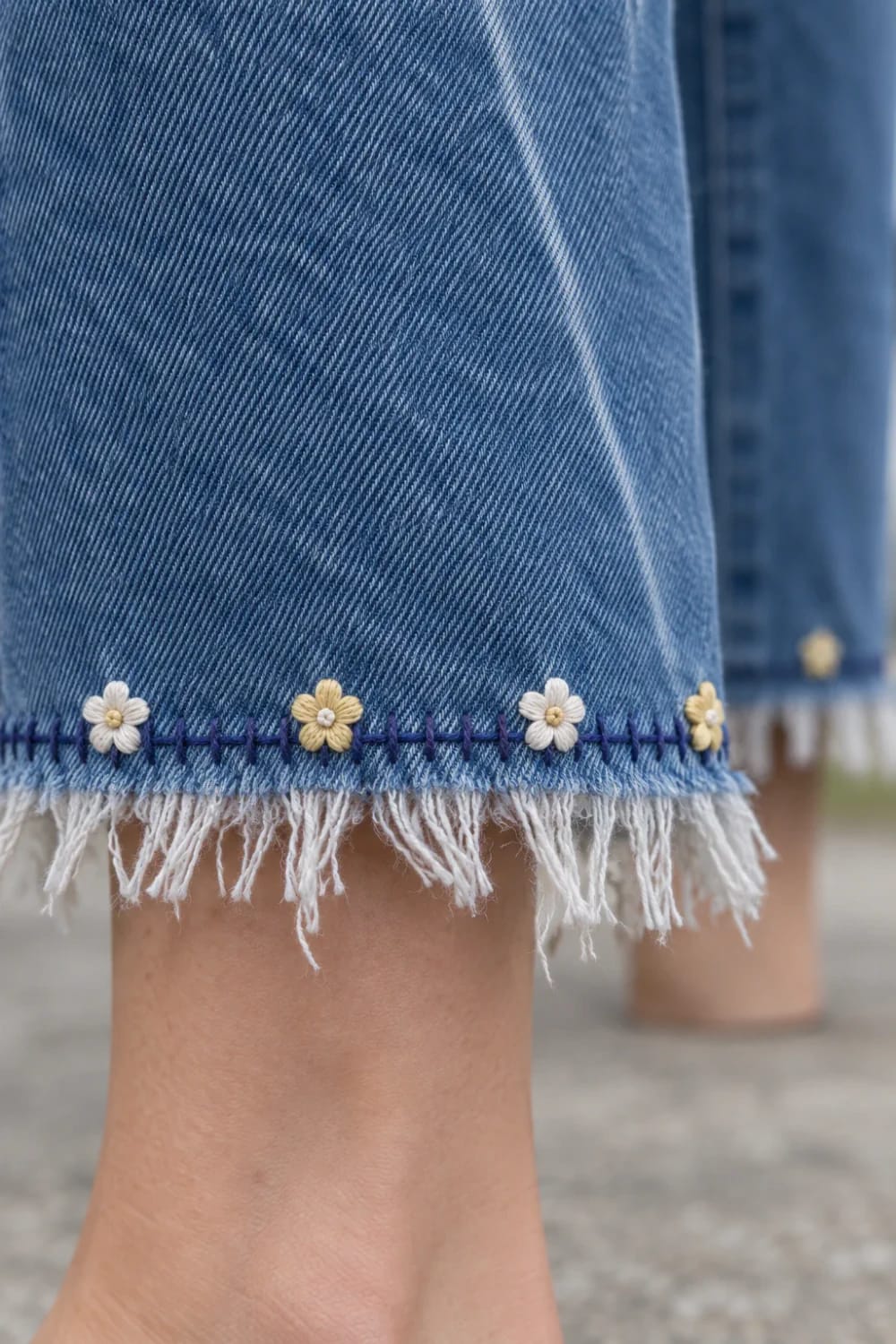
Lock a climbing fray with blanket stitch about a quarter inch above the cut edge, then drop a flat blossom head directly onto the stitched line at four or five uneven points. The blanket stitch is doing structural work, stopping the fraying where you want it stopped; the flowers are doing the work of making that repair look chosen. Uneven spacing is the entire trick, because four flowers at equal intervals is a trim and four at irregular intervals is a design.
Where the fray has already eaten through to a hole, back it from the inside with a scrap of printed cotton so the print shows faintly through the thinned indigo, then run small rows of running stitch across the repair and let two embroidered leaves cross the patch edge into sound denim. That join is what stops a patch reading as a patch.
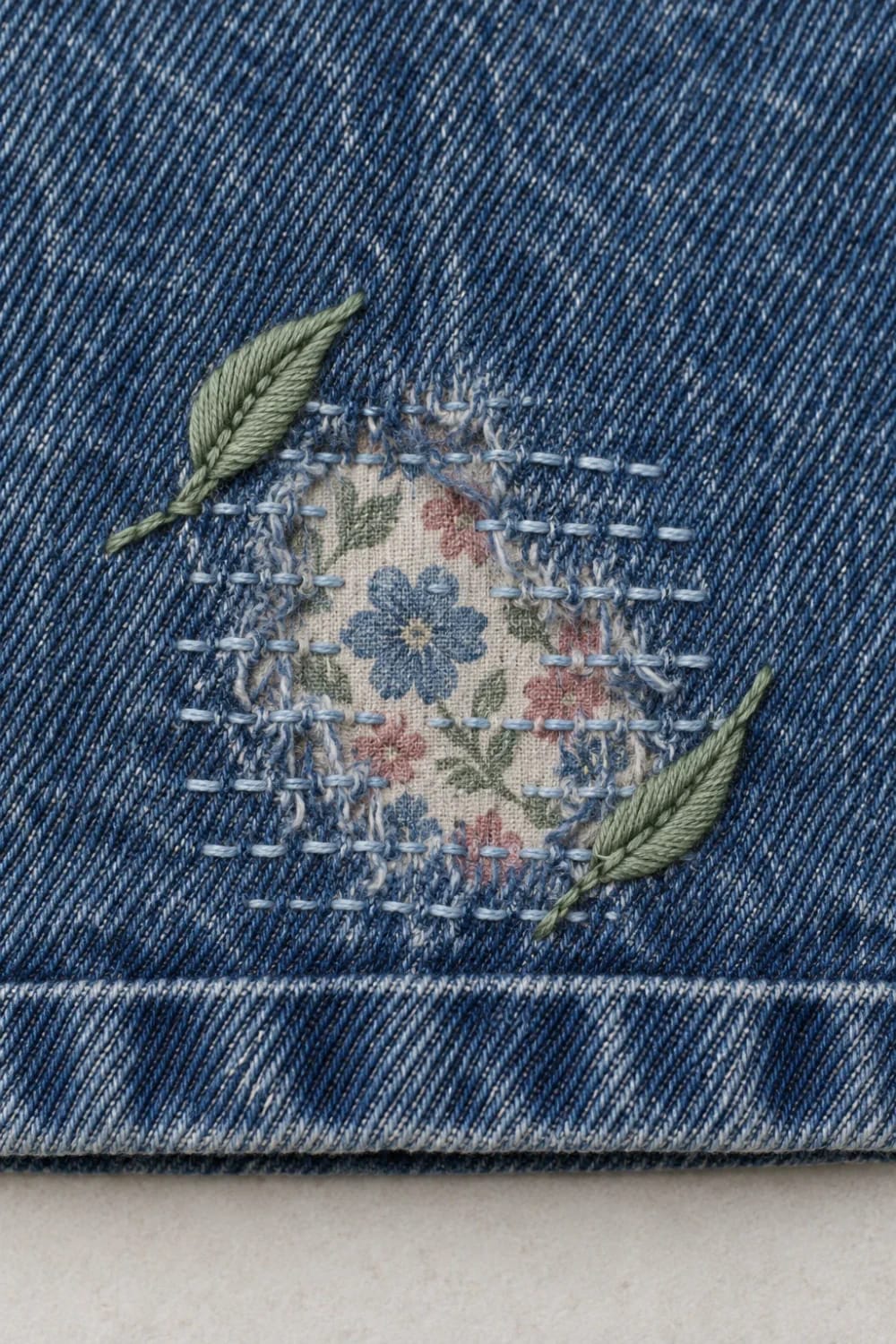
Both versions want a plain finish elsewhere on the leg. A frayed hem plus a border band plus a climbing vine is three ideas fighting over the same six inches of trouser, and I would rather see three flowers stitched well than fourteen stitched fast. Whichever you pick, keep the blanket stitch tight enough that the fraying stops where the stitching is, about a quarter inch up, and no further.
Related Posts
- Butterfly Embroidery Jeans: Ideas Worth Stitching Onto Denim You Already Own
- 11 Upcycled Jeans Decor Ideas for the Pile You Can’t Toss
- 13 DIY Denim Christmas Stockings From Old Jeans
- 12 Denim Christmas Tree Skirt Ideas to Make From Upcycled Jeans
- 57 Innovative Upcycled Jeans Ideas: Transform Your Old Denim into Chic Fashion and Home Decor
- 15 Unique Upcycled Jeans Winter Tablescape Ideas