
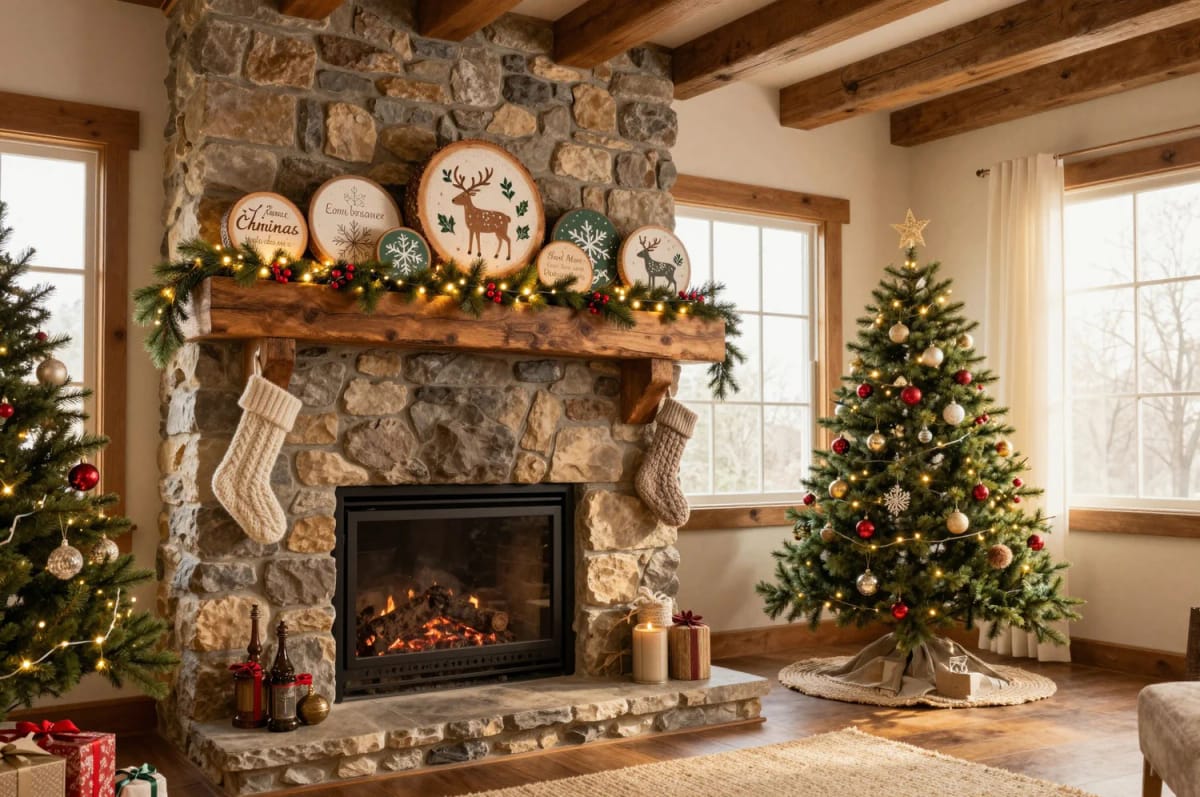
Log rounds are the cheapest rustic Christmas material there is and the easiest one to overload a mantel with. Most mantel shelves run five to eight inches deep, a cross-cut round is three to four inches across before you add a candle or a sprig of anything, and two dozen of them turned face-out is a woodpile with tinsel on it. What follows is twelve ways to use rounds on a mantel where depth is the binding constraint, including the finish decision that determines whether they read as decor or as firewood someone forgot to carry in.

Standing log rounds in three heights beat a row of flat discs
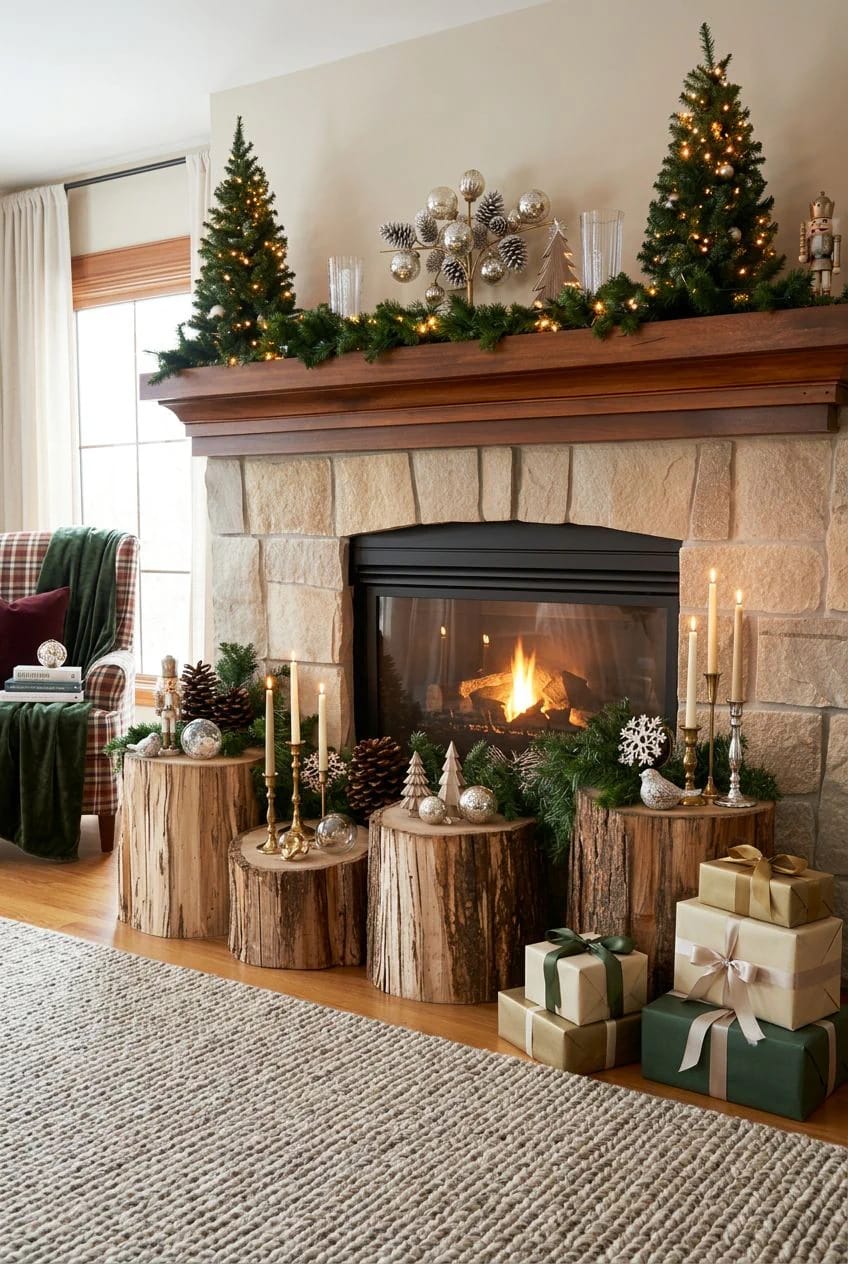
Granted, this only works if your rounds differ in height by more than an inch, but standing them on end is what buys back the shelf. A round laid face-out has to lean on something, and it eats the full depth of the mantel doing it. Stood on its cut face, the same round occupies its own diameter and nothing else, and what you see from the sofa is the bark ring rather than a flat blond circle.
Cut three at roughly four, six and nine inches tall from the same log so the bark and the grain match, then group them at one end of the mantel instead of centering them. Diameter is the number that actually matters: on a six-inch shelf, a five-inch round leaves an inch of breathing room, and anything past six inches overhangs the front edge where the eye lands first. The same arithmetic that governs what a coffee can will and will not do on a mantel applies here, because both objects are cylinders competing for the same eight inches.
Three is the working number. Two reads as a mistake, four starts to look like a display of firewood samples.
Drill birch rounds for tealights and keep the flame above the wood

Drill shallow, not deep. A standard tealight measures a shade over 1 9/16 inches across, which is why a 1 1/2 inch Forstner bit fights you and a 1 5/8 inch bit drops the cup in clean with room for a glass insert. Depth of about three quarters of an inch is the number to hit: the wick then sits proud of the cut face, and the flame is burning in open air instead of in a wooden cup.

Use the glass insert even though almost no tutorial online bothers with one. The stamped aluminium cup a tealight comes in is thin enough to conduct real heat into end grain, and end grain is the thirstiest, most absorbent surface on the round. Birch is the species everyone reaches for because the chalky white bark holds a hard edge against the flame colour, but any tight-grained hardwood takes the bit without tearing out.
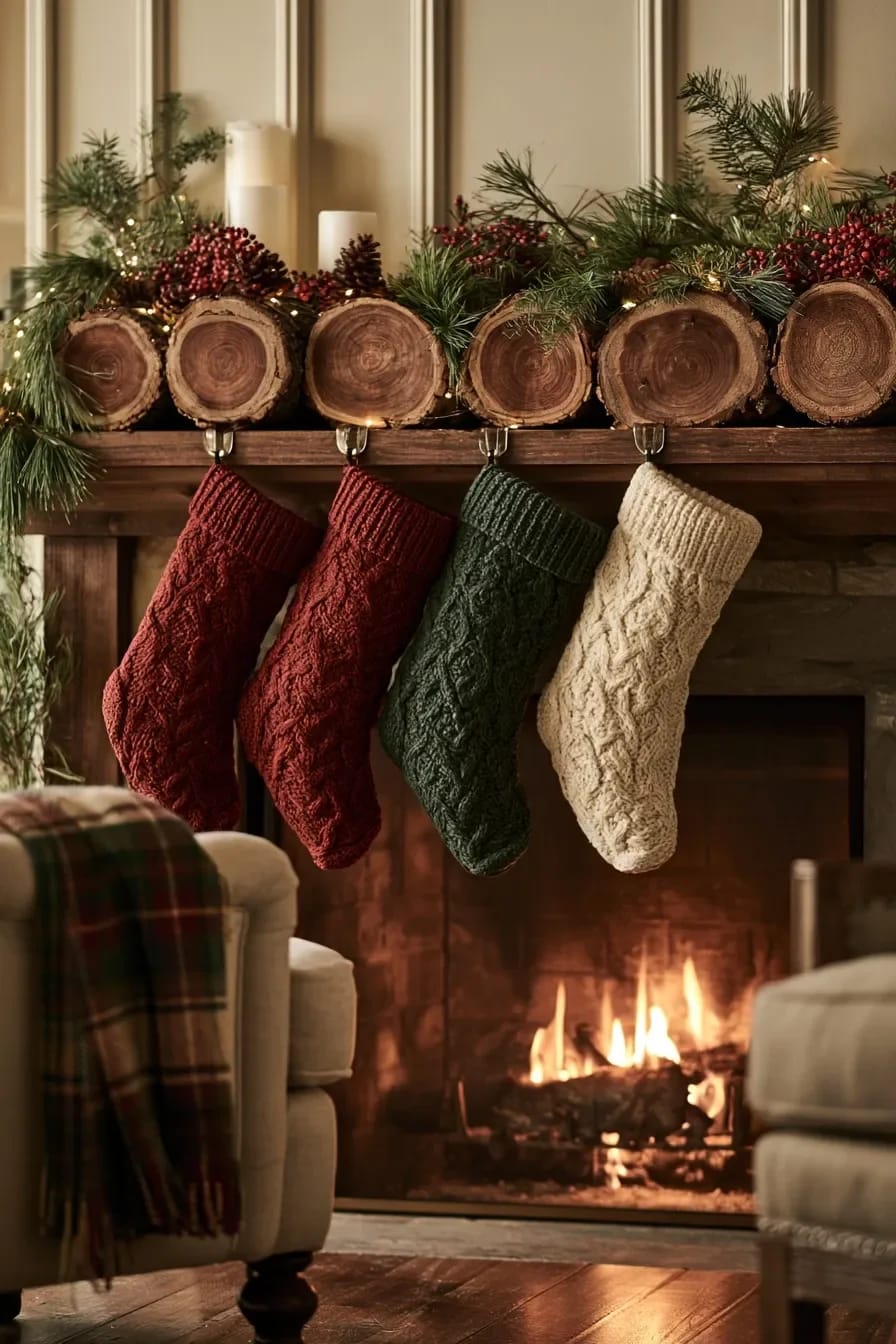
Weighted log rounds hold stockings without a single hole in the mantel

Screw a hook into the side of a fat round, sit it on the mantel, and the round is the anchor. The weight has to be real, though. An eight-inch round cut three inches thick works out to roughly four pounds in dry oak, which is about what a loaded stocking weighs by Christmas Eve; a six-inch round two inches thick is under a pound and a half and will slide off the shelf the moment a child tugs it. Cut thick, or cut wide, and check it by hanging something heavier than the stocking before you trust it.
 Rustic Pallet Christmas Decor for Renters Who Can’t Drill the Walls The same no-fixings thinking applied to bigger pieces, for anyone whose deposit is on the line.
A jute-strung wood slice garland belongs on the front edge, not draped
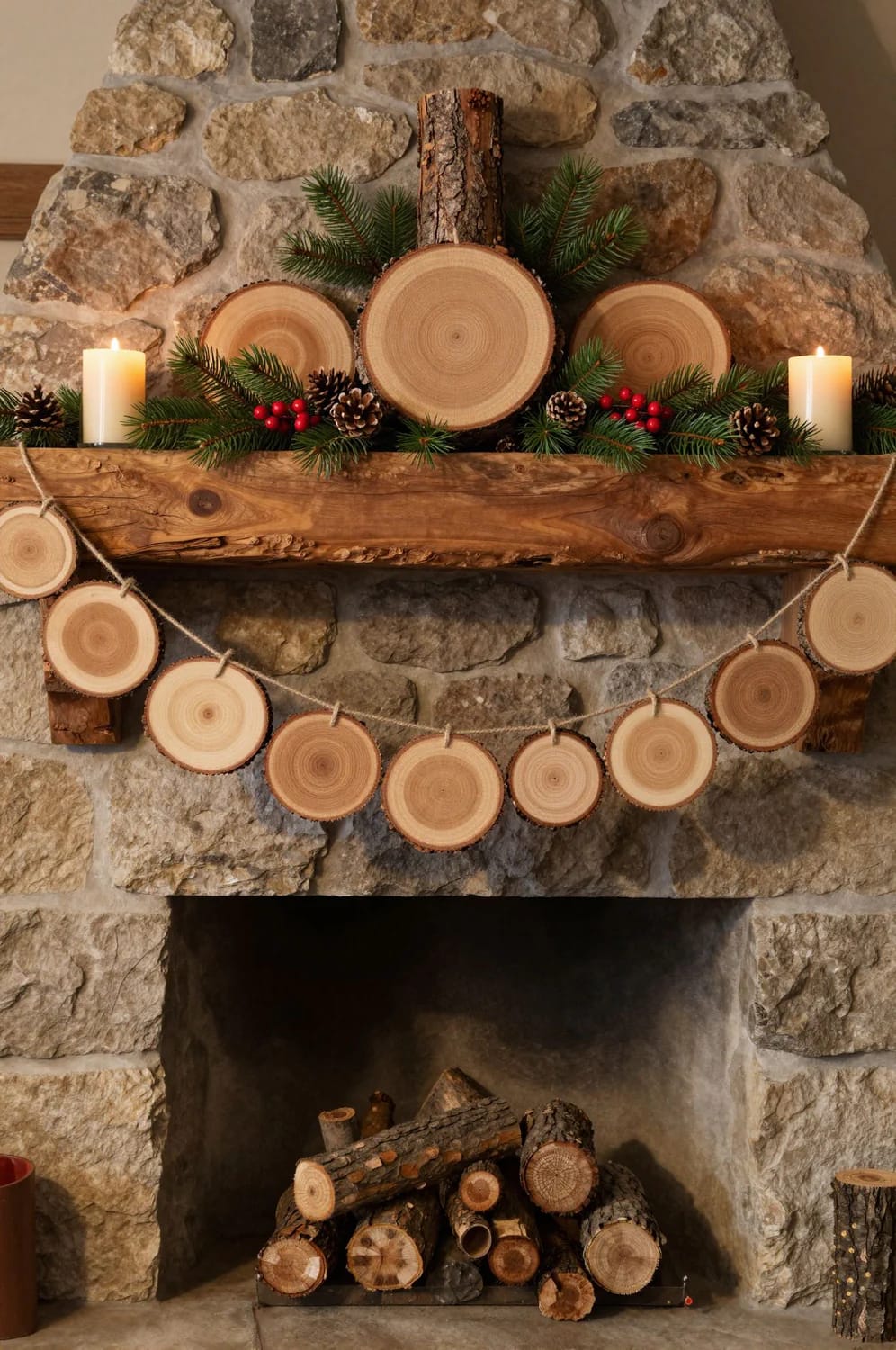
Run it flat along the front lip of the shelf and you use zero depth. Drape it in swags and you have added a second layer in front of everything already standing there, which on a narrow mantel is how the whole arrangement stops reading. Slices around three inches across, drilled with a 1/8 inch bit half an inch in from the bark edge, threaded on three-ply jute so the twine shows.
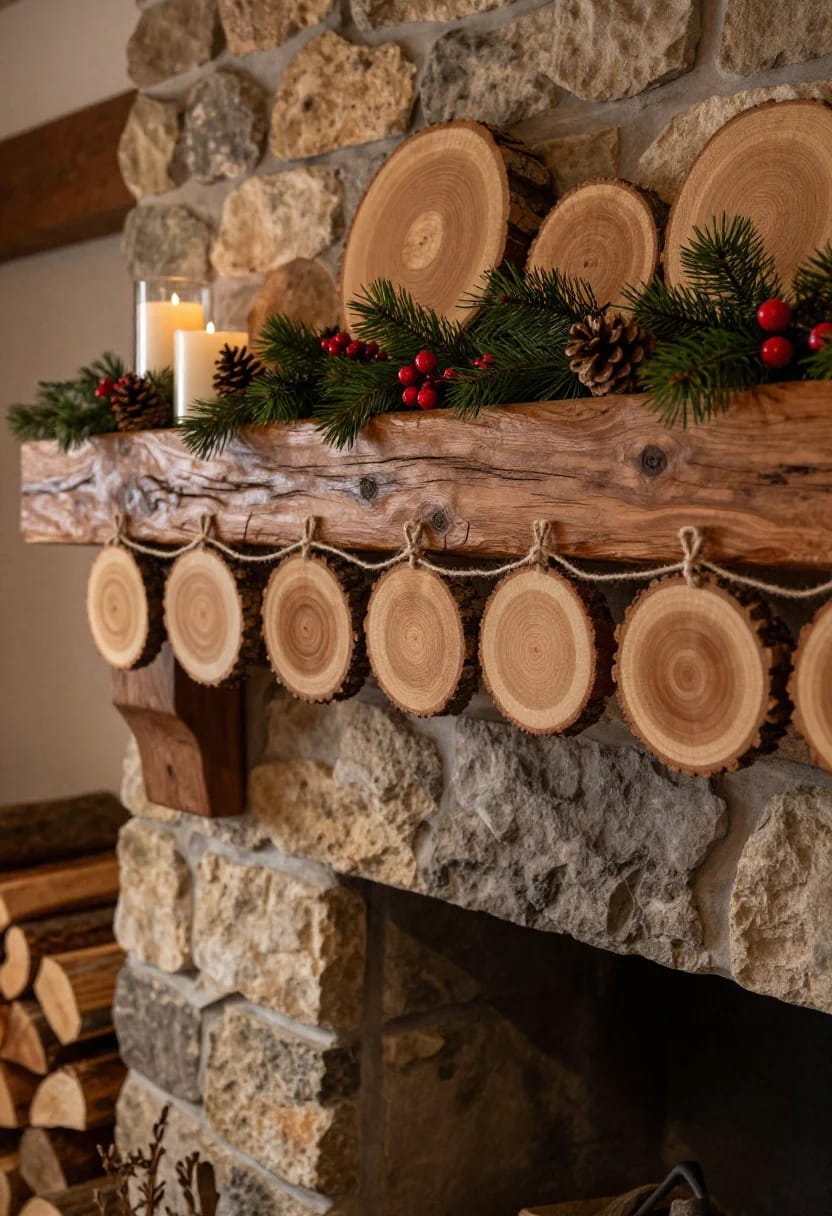
Space them so adjacent slices just touch rather than overlap. Overlapped, the garland turns into a solid tan band and the individual grain patterns vanish, which is the only thing making it more interesting than a length of rope. If you already have a eucalyptus and pine base garland running the length of the shelf, the slice strand goes below it on the front edge, not woven through it.
Backlight the rounds so the bark edge glows, not the cut face
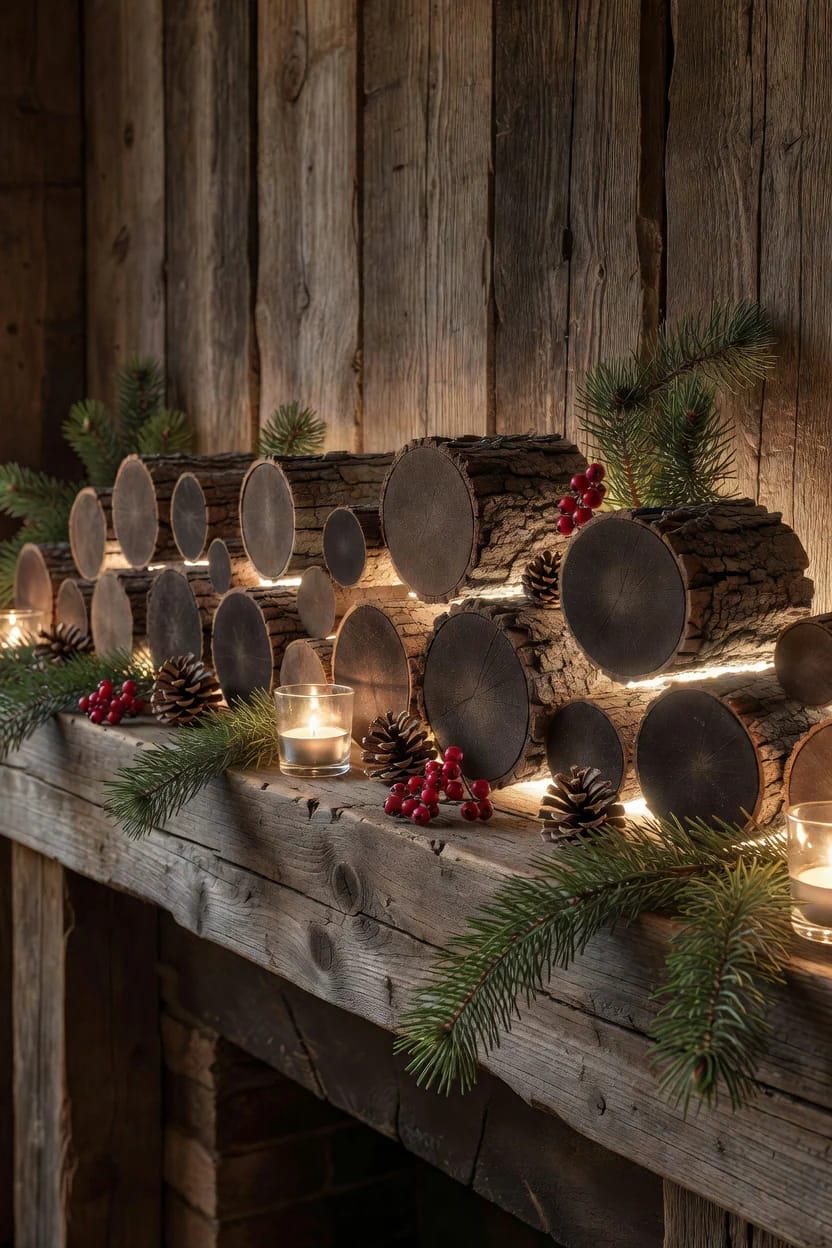
A wire micro-light strand tucked behind the rounds, against the wall, throws light forward past the bark and leaves a rim of it lit. Lights laid in front do the opposite: they flatten the cut faces into pale blank discs and the bulbs themselves become the thing you look at. Use 2700K warm white if you want the sapwood to stay cream, or 2200K amber if the surround is dark brick and you want the whole shelf warmer.
One wood-burned word per round, never a whole scene
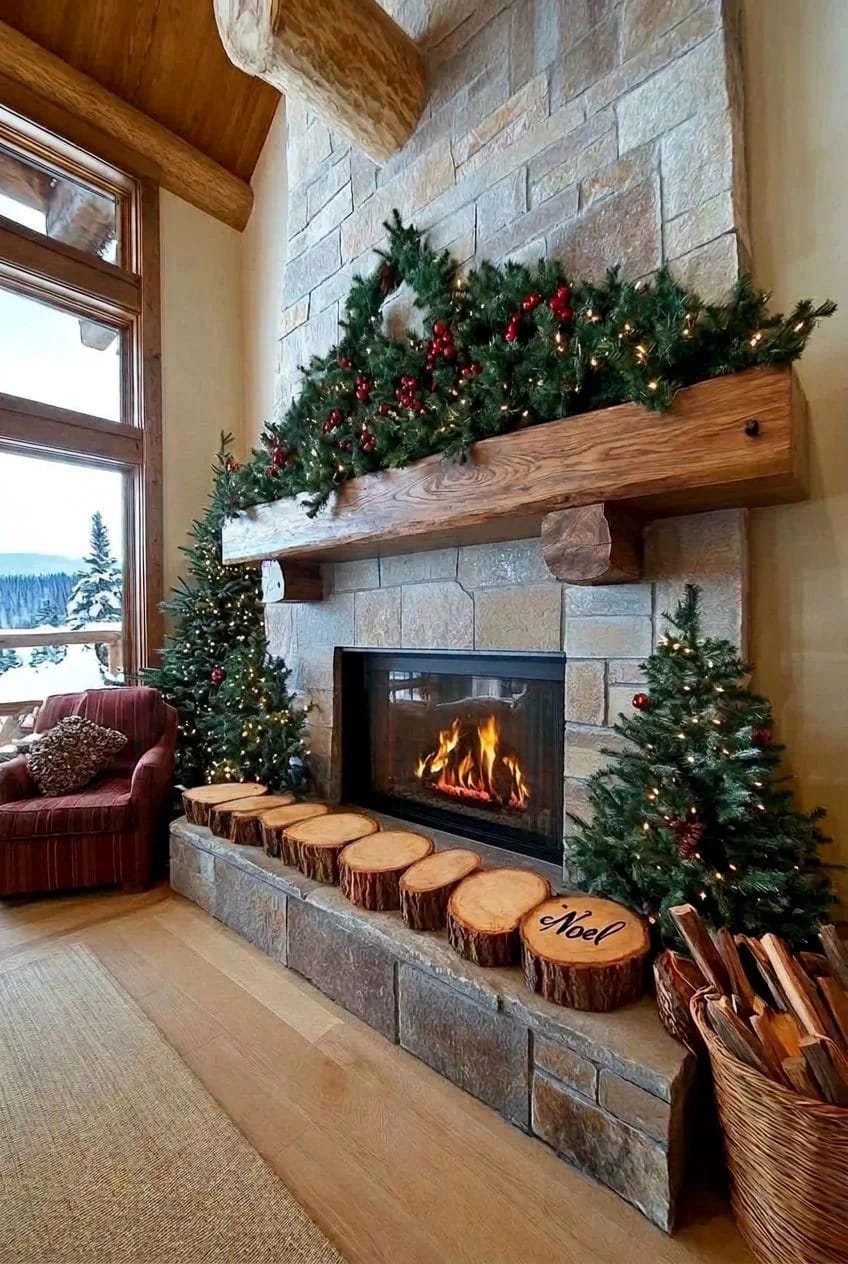
Restraint is what separates this from a craft-fair table. A four-inch face gives you room for one word or one year in plain capitals, and a burned line at that scale holds its edge; a burned snowflake at that scale turns to mush because the tip wanders across soft early wood and skates on the dense late wood. Pencil the letters first, burn slowly, and accept that the second round will be better than the first.
 Wood Slice Christmas Ornaments With Wood Burned Designs That Don’t Look Like a Kit Which designs survive being burned into three inches of soft grain, and which collapse.
Thin slices in a starburst read better above the mantel than another wreath

Quarter-inch slices are the specification here, because a starburst of two-inch-thick rounds becomes a structural problem hanging over the heads of everyone on the sofa. Glue them to a plywood disc in three overlapping rings and hang the disc from a single picture hook rated well above its weight. It fills the wall space a wreath would occupy while echoing the material already on the shelf, which a fir wreath does not.
Use log rounds as risers so the greenery sits at three heights
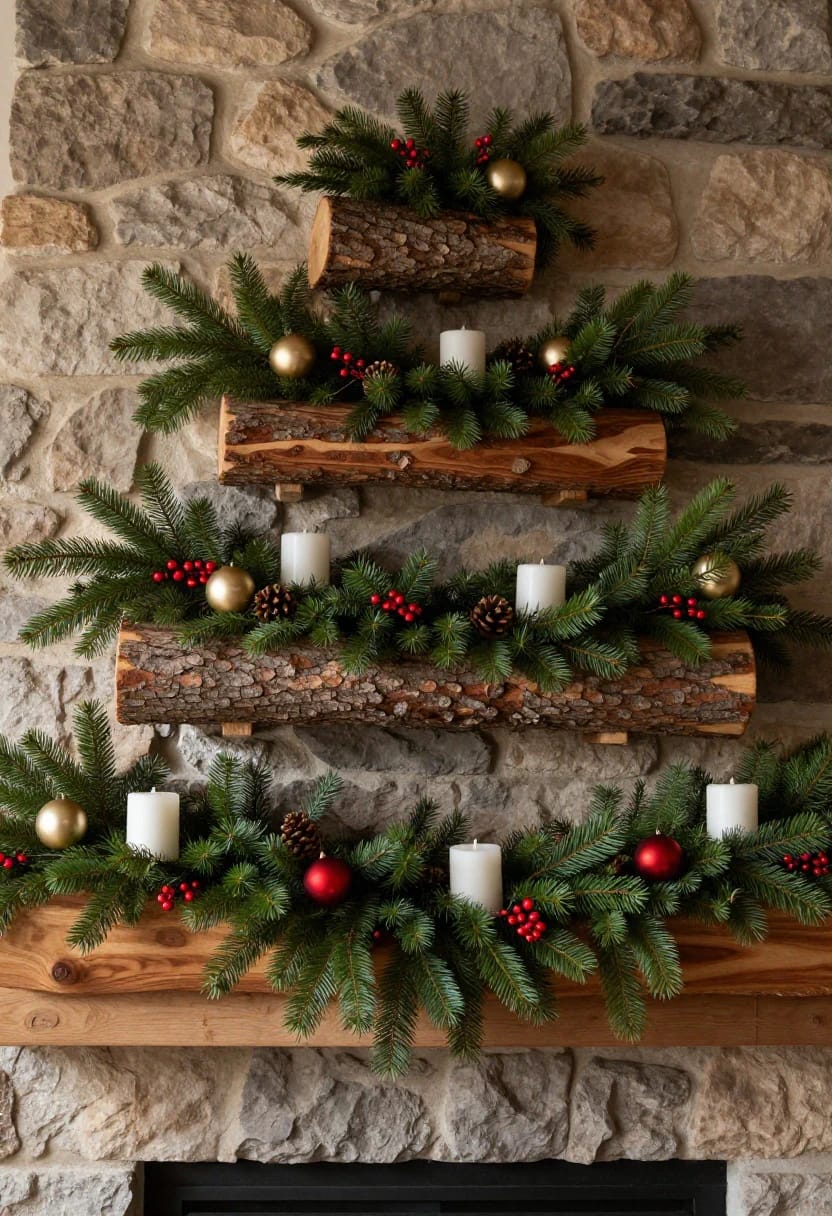
Height is the only variable that makes a shallow shelf look arranged rather than lined up. A two-inch round under one candle and a four-inch round under another puts three heights into a group of three objects without moving anything forward, and the risers themselves read as part of the material story instead of as plinths. Hide the join by letting the greenery break across the base of each riser.
That said, the risers change the geometry of the fire below, and this is the point where the arrangement stops being purely decorative. Under the IRC, combustible material is not permitted within six inches of a fireplace opening, and anything within twelve inches of it may project only 1/8 inch for each inch of distance from the opening, which is why the standard mantel shelf sits twelve inches above the firebox in the first place. Stacking upward from the shelf is fine; letting anything hang down toward the opening is where people get into trouble. The greenery-led approaches to the same fireplace run into this constraint too, and the answer is the same in both cases.
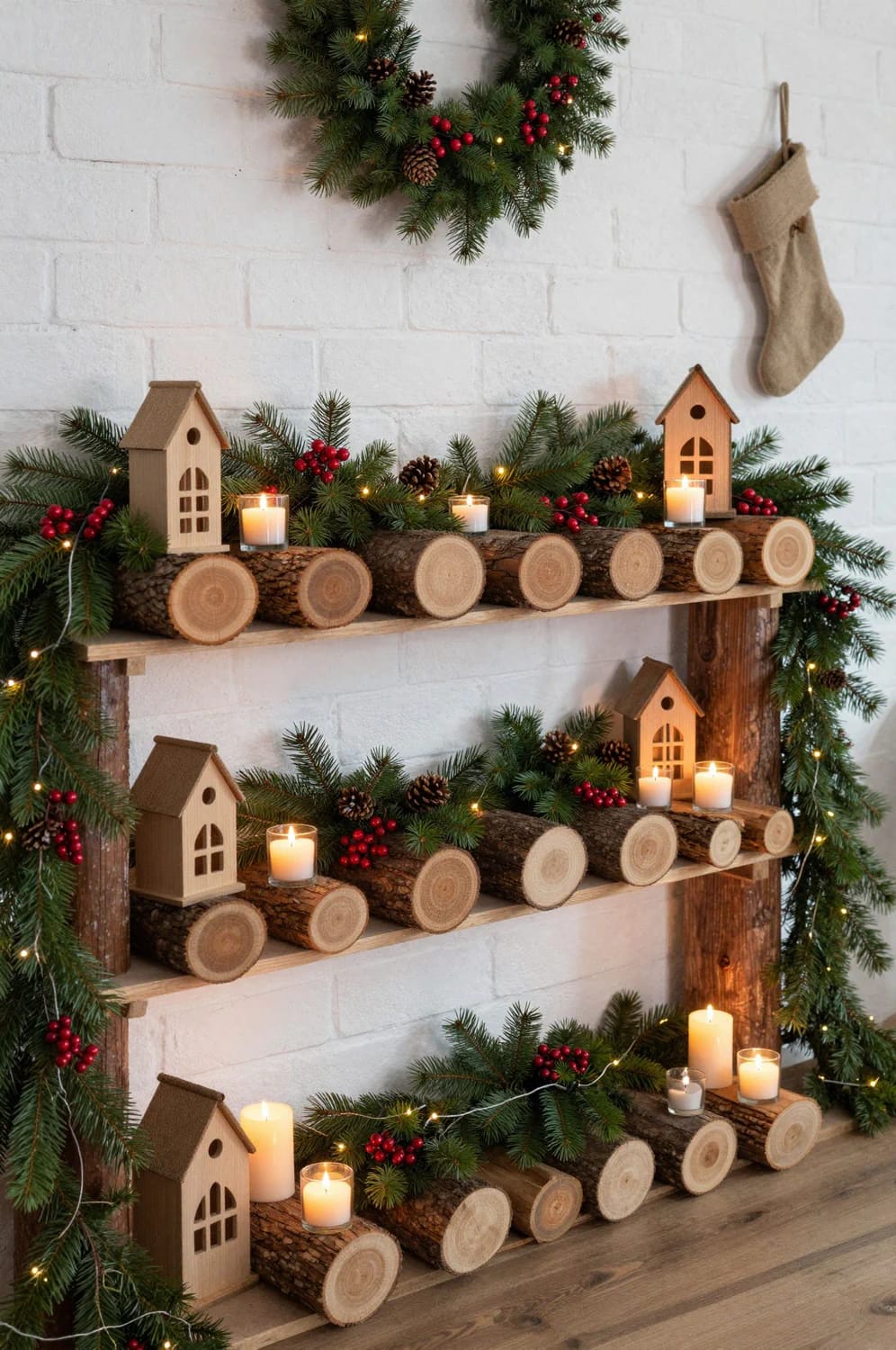
Dried greenery plus an open flame on a raised riser is a worse combination than either alone, because the riser lifts the wick up into the tinder rather than keeping it below the greenery line. If you are burning real candles on a working fireplace, keep the flame at least a hand’s width clear of any pine, and swap to battery tealights for the rounds sitting closest to the firebox. Fresh pine holds moisture for a couple of weeks indoors; by the third week it is kindling.
A slice-stacked tree at one end fixes an off-center mantel

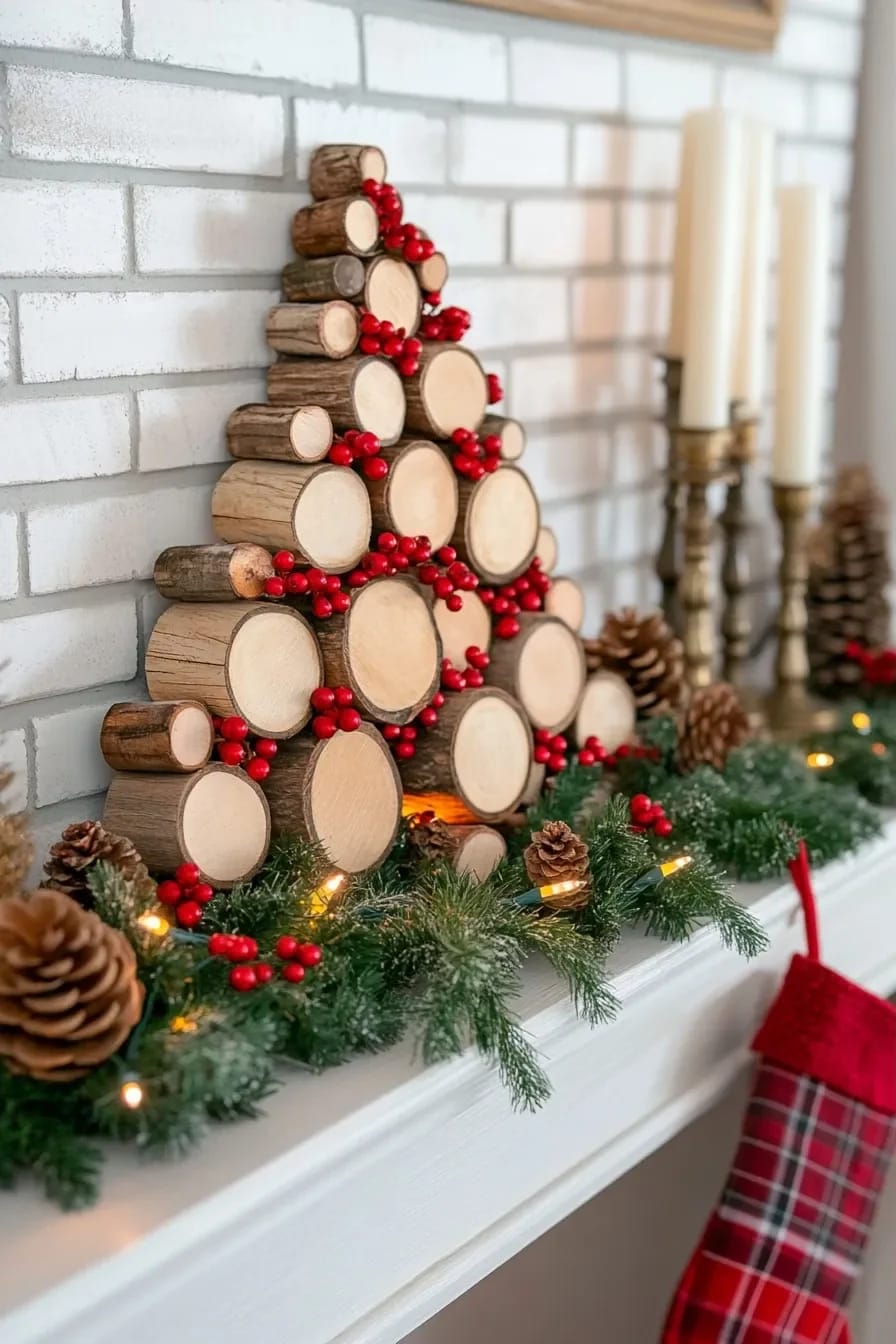

Five slices in descending diameter, threaded onto a dowel with a spacer between each, gives you a fourteen-inch tree that occupies four inches of depth and reads as deliberate mass at whichever end the room needs weight. Most mantels are unbalanced by something structural, a corner, a doorway, a television, and a single tall object at the light end fixes it faster than redistributing everything. The same logic drives the driftwood tree builds that work in cabins, where the material is grey rather than tan.
Leave the bark on your log rounds and sand only the cut face
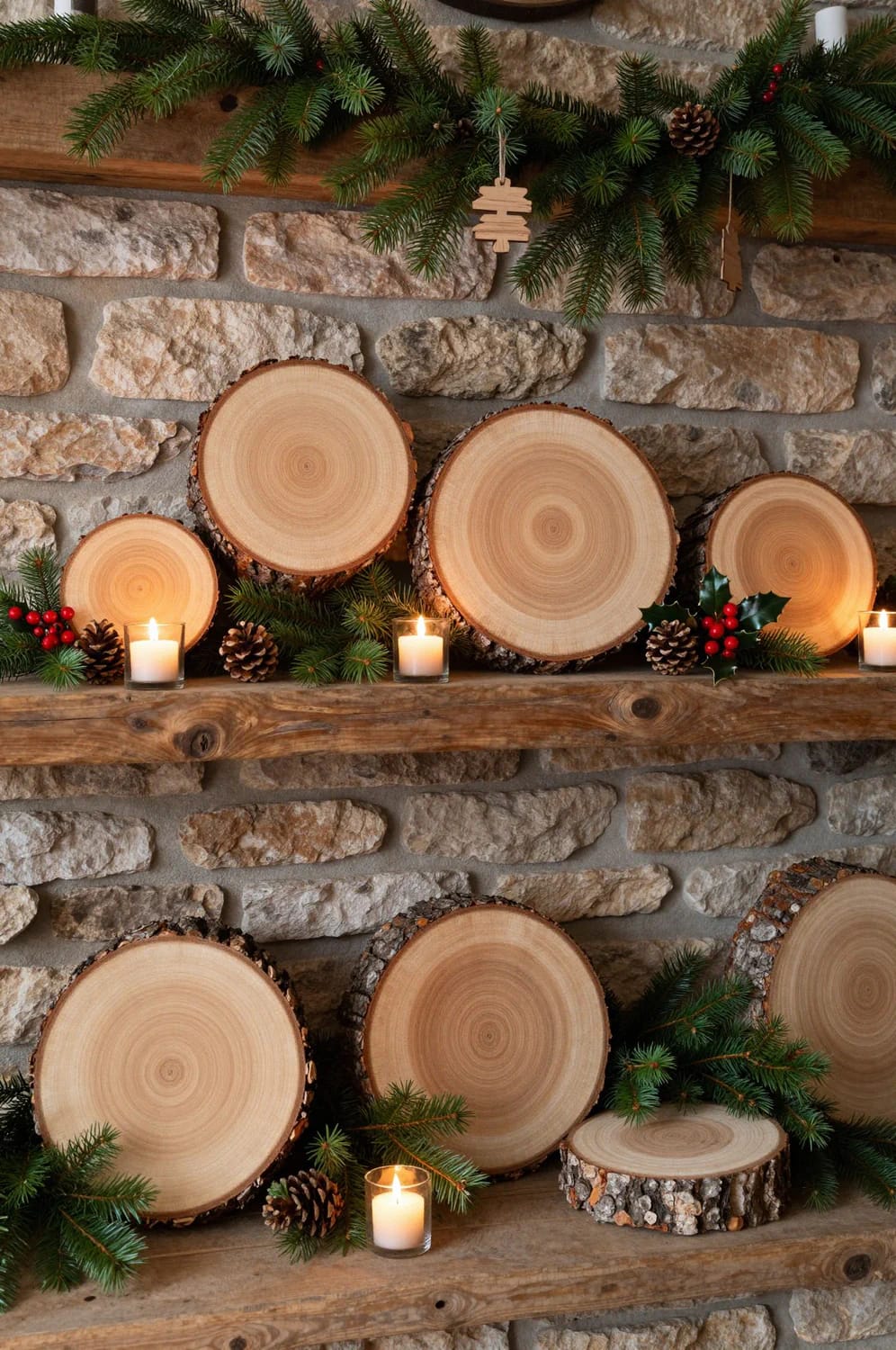
The bark is the whole reason a log round looks different from a wooden coaster, and stripping it converts the piece into a beige disc that could have come from any craft aisle. Sand the cut face to 180 grit so the growth rings and the ray flecks come up, and leave the perimeter exactly as the saw found it, loose fibres included.
I would skip varnish entirely. Gloss polyurethane on end grain gives you a plasticky sheen that fights every other texture on a rustic mantel, and it soaks in unevenly because end grain drinks finish at a different rate than the face. A rag of Danish oil or a matte water-based sealer keeps the surface matte and stops the rounds from powdering onto the shelf. Bark retention is mostly decided at the saw, not the finish: rounds cut from a dormant winter tree hold their bark, and rounds cut in spring when the sap is running shed it in sheets by February, which is why the free wood from a summer foraging trip through the garden behaves so differently from firewood bought seasoned.
Do this
- Sand the cut face only, to 180 grit, and stop there.
- Use a matte oil or water-based sealer so the surface stays flat under candlelight.
- Cut rounds from a winter-felled log if you have the choice, because dormant-season bark stays put. Seasoned firewood from last year’s pile is already past this problem.
Avoid
- Gloss polyurethane. Every one of these looks wet at ten feet.
- Slicing green rounds in December and expecting them to survive a heated room. Radial checks open within days.
Match the round's bark to the surround, not to the wood tone you like
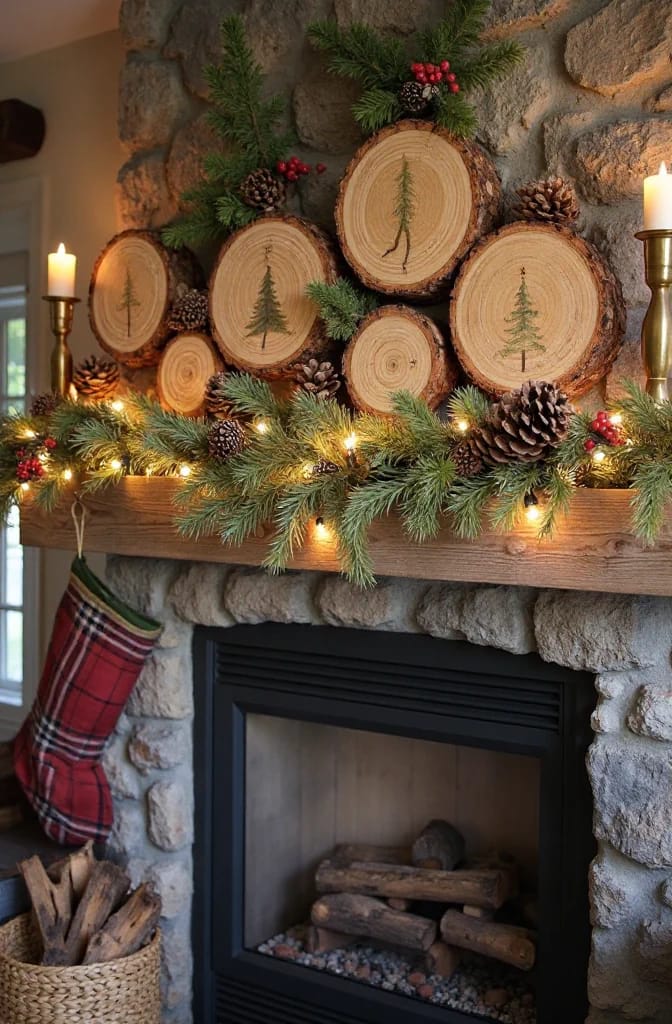
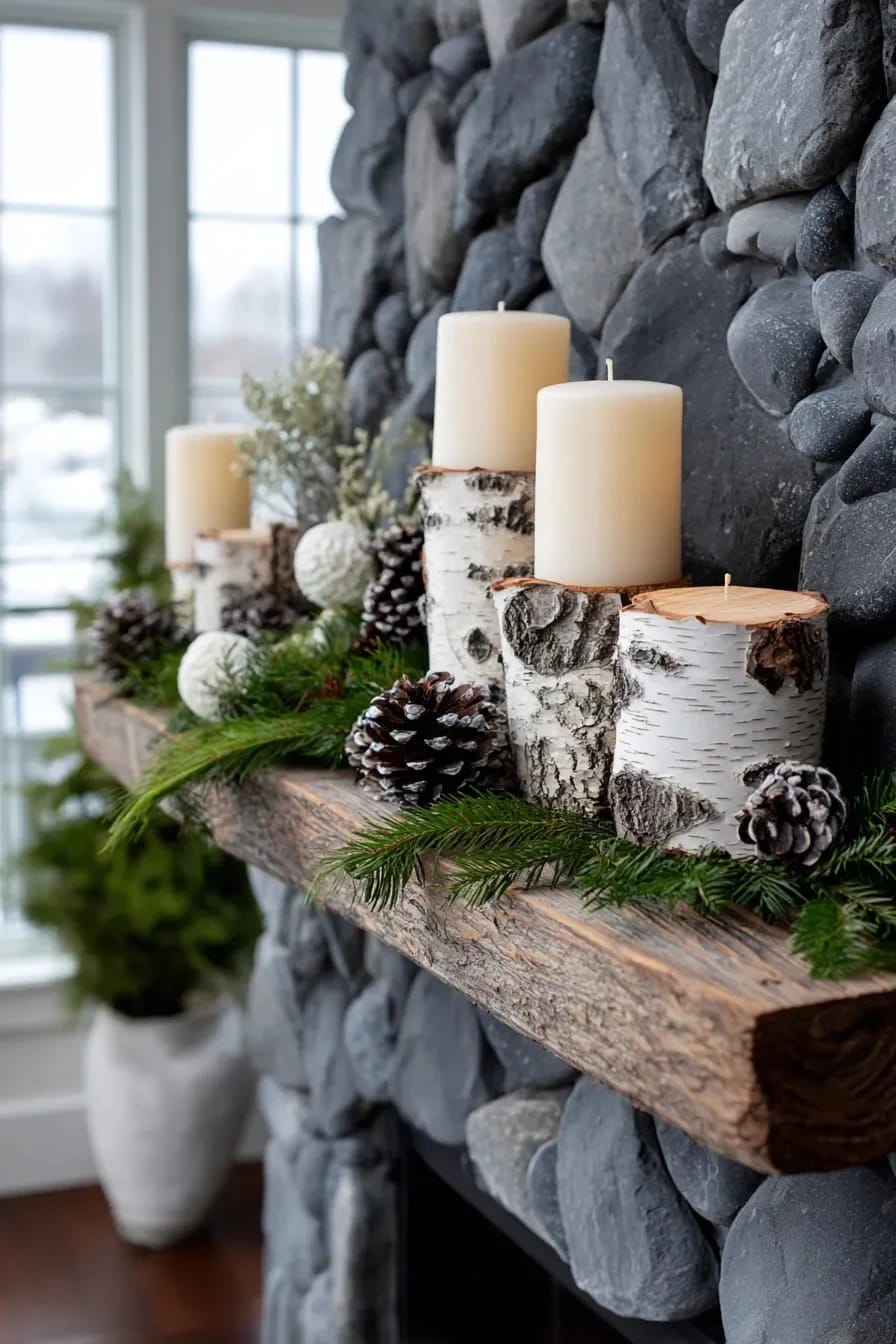
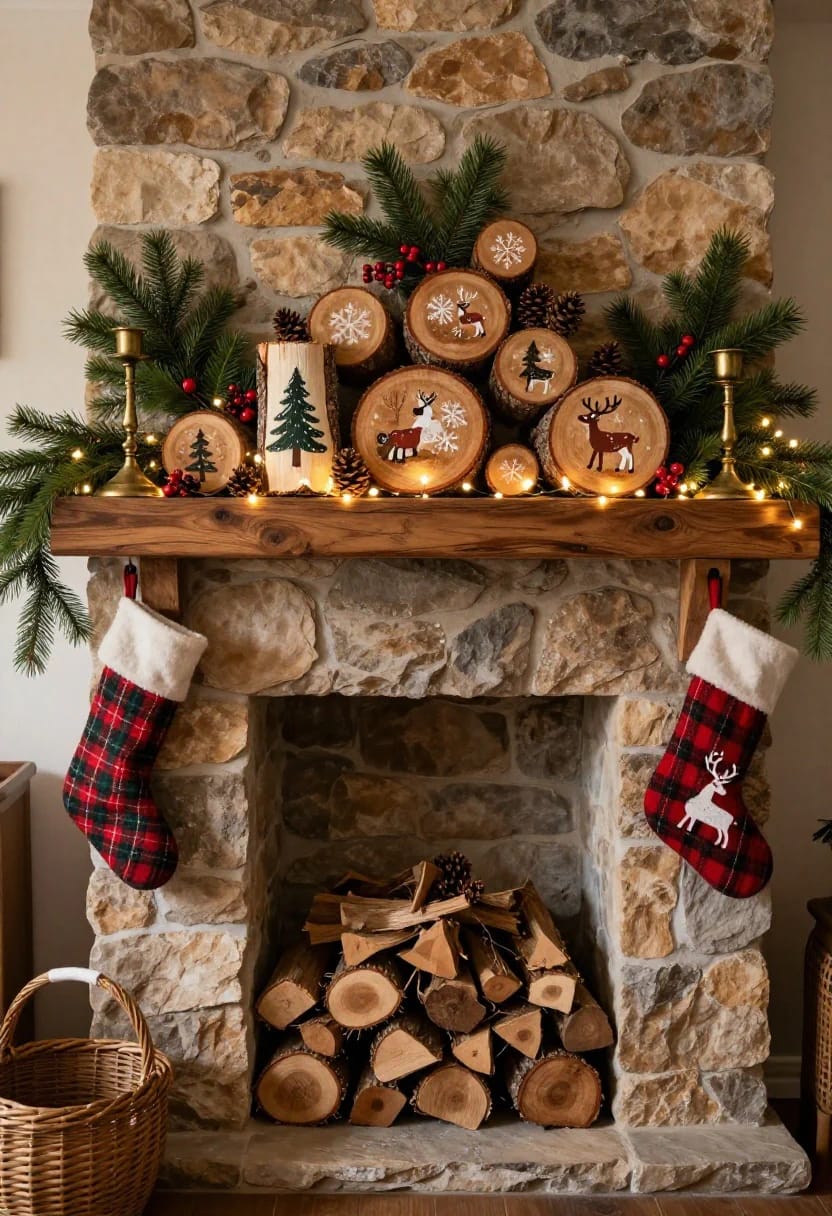
Contrast is the deciding factor, and the wood species you find prettiest in isolation is irrelevant to it. Pale birch against dark fieldstone is legible from the far side of the room; the same birch against a whitewashed brick surround disappears into it and you have spent a weekend on decor nobody can see. Sugar maple, which reads almost white on the cut face, has exactly this problem in a pale limestone room.
| Species | Bark | Cut face | Disappears against |
|---|---|---|---|
| White birch | Chalky white, dark horizontal dashes | Pale cream | Whitewashed brick, white painted surrounds |
| Red oak | Grey-brown, deeply fissured | Pink-tan, open pores | Dark brown stone, walnut mantels |
| Eastern red cedar | Shredding red-brown strips | Purple-red heart, cream sapwood | Red brick |
| Sugar maple | Grey, plated | Near white, tight grain | Pale limestone, light plaster |
A log round reindeer needs one round, not three

The three-round snowman logic does not transfer to deer, because a deer is a head and antlers rather than a body. One round, two drilled holes, two forked twigs from the garden, and two dark beads set low and wide is the entire build; add a felt scarf and a pom-pom nose and you have made the same thing that arrives flat-packed from a garden centre. The cork reindeer that avoid the googly-eye problem get there by the same subtraction.
Cut the rounds in November, not the week you decorate
Drying is the constraint nobody mentions and the one that decides whether any of this survives to January. Air-drying wood runs roughly a year per inch of thickness, so a two-inch round cut fresh in December is still soaking when it goes onto a shelf above a working fire, and it will open a radial check straight through the growth rings within a week or two. Kiln-dried craft slices sidestep it, and so does the seasoned firewood already stacked by the hearth, which is the free option most people walk past.
Pricing on pre-cut slices is the part I could not pin down usefully: the same nominal four-inch birch slice runs across a wide range depending on thickness, seller and whether the bark is intact, so get a quote rather than budgeting from any figure. A local tree service will often hand over offcuts for nothing, which makes thickness and species your only real decisions.
One last check before you commit to a species. Set two candidate rounds on the shelf at night with only the string lights on, stand back at the far side of the room, and see whether the bark edge still separates from the surround. If both vanish into grey, the matrix above is telling you something, and it is cheaper to learn it with two rounds than with twenty.
Related Posts
- Rustic Driftwood Christmas Tree Ideas for Cabins
- Rustic Pallet Christmas Decor for Renters Who Can’t Drill the Walls
- 29 Unique Rustic Christmas Decorations You Must See
- 27 Rustic Christmas Decoration Ideas For Your Farmhouse
- 23 Burlap Christmas Decor Ideas for a Unique Rustic Holiday
- 25 Green Christmas Fireplace Decor Ideas for a Fresh and Festive Mantel